Postdoctoral Researcher
$67K - $81K/yr
Postdoctoral Researcher Grade: 18 Salary: $67,552 - $81,257 The Research Foundation for Mental Hygiene is seeking a qualified candidate to fill a full-time Postdoctoral Researcher position. The ...
$67K - $81K/yr
Postdoctoral Researcher Grade: 18 Salary: $67,552 - $81,257 The Research Foundation for Mental Hygiene is seeking a qualified candidate to fill a full-time Postdoctoral Researcher position. The ...
$67K - $81K/yr
Postdoctoral Researcher Grade: 18 Salary: $67,552 - $81,257 The Research Foundation for Mental Hygiene is seeking a qualified candidate to fill a full-time Postdoctoral Researcher position. The ...
Boone, NC · On-site
Posting Details Request to Recruit Position Title Postdoctoral Researcher Location Boone, NC Faculty Rank No Provide Rank N/A Position Number 089591 Department Computer Science - 250600 Position ...
Boone, NC · On-site
Posting Details Request to Recruit Position Title Postdoctoral Researcher Location Boone, NC Faculty Rank No Provide Rank N/A Position Number 089591 Department Computer Science - 250600 Position ...
Request to Recruit Position Title Postdoctoral Researcher Location Boone, NC Faculty Rank No Provide Rank N/A Position Number 089591 Department Computer Science - 250600 Position Summary Information ...
Request to Recruit Position Title Postdoctoral Researcher Location Boone, NC Faculty Rank No Provide Rank N/A Position Number 089591 Department Computer Science - 250600 Position Summary Information ...
Role Description The Postdoctoral Researcher will engage in full-time, on-site research activities at Nova Southeastern University College of Dental Medicine in Fort Lauderdale, FL. Daily ...
Role Description The Postdoctoral Researcher will engage in full-time, on-site research activities at Nova Southeastern University College of Dental Medicine in Fort Lauderdale, FL. Daily ...
Request to Recruit Position Title Postdoctoral Researcher Location Boone, NC Faculty Rank No Provide Rank N/A Position Number 089591 Department Computer Science - 250600 Position Summary Information ...
Request to Recruit Position Title Postdoctoral Researcher Location Boone, NC Faculty Rank No Provide Rank N/A Position Number 089591 Department Computer Science - 250600 Position Summary Information ...
$66K - $75K/yr
Postdoctoral Researcher Grade: 18 Salary: $66,227-$75,827 The Research Foundation for Mental Hygiene is seeking a qualified candidate to fill a full-time Postdoctoral Researcher position. The Anacker ...
$66K - $75K/yr
Postdoctoral Researcher Grade: 18 Salary: $66,227-$75,827 The Research Foundation for Mental Hygiene is seeking a qualified candidate to fill a full-time Postdoctoral Researcher position. The Anacker ...
Lubbock, TX · On-site
Postdoctoral Research Associate -- Aquatic Toxicology, Texas Tech University The Crago Lab at Texas Tech University is hiring a Postdoctoral Research Associate to lead aquatic toxicology work on ...
New
Lubbock, TX · On-site
Postdoctoral Research Associate -- Aquatic Toxicology, Texas Tech University The Crago Lab at Texas Tech University is hiring a Postdoctoral Research Associate to lead aquatic toxicology work on ...
New
Manhattan, NY · On-site
$67K - $81K/yr
Postdoctoral Researcher Grade: 18 Salary: $67,552 - $81,257 The Research Foundation for Mental Hygiene is seeking a qualified candidate to fill a full-time Postdoctoral Researcher position. The ...
Manhattan, NY · On-site
$67K - $81K/yr
Postdoctoral Researcher Grade: 18 Salary: $67,552 - $81,257 The Research Foundation for Mental Hygiene is seeking a qualified candidate to fill a full-time Postdoctoral Researcher position. The ...
Manhattan, NY · On-site
$67K - $81K/yr
Postdoctoral ResearcherGrade: 18Salary: $67,552 - $81,257The Research Foundation for Mental Hygiene is seeking a qualified candidate to fill a full-time Postdoctoral Researcher position. The ...
Quick apply
Manhattan, NY · On-site
$67K - $81K/yr
Postdoctoral ResearcherGrade: 18Salary: $67,552 - $81,257The Research Foundation for Mental Hygiene is seeking a qualified candidate to fill a full-time Postdoctoral Researcher position. The ...
Moscow, ID · On-site
$58K/yr
The postdoctoral researcher will conduct cutting-edge research in areas such as cyber-physical systems security, protection of critical infrastructure, and adversarial machine learning. The position ...
Moscow, ID · On-site
$58K/yr
The postdoctoral researcher will conduct cutting-edge research in areas such as cyber-physical systems security, protection of critical infrastructure, and adversarial machine learning. The position ...
Moscow, ID · On-site
$58K/yr
The postdoctoral researcher will conduct cutting-edge research in areas such as cyber-physical systems security, protection of critical infrastructure, and adversarial machine learning. The position ...
Moscow, ID · On-site
$58K/yr
The postdoctoral researcher will conduct cutting-edge research in areas such as cyber-physical systems security, protection of critical infrastructure, and adversarial machine learning. The position ...
Manhattan, NY · On-site
$67K - $81K/yr
Postdoctoral Researcher Grade: 18 Salary: $67,552 - $81,257 The Research Foundation for Mental Hygiene is seeking a qualified candidate to fill a full-time Postdoctoral Researcher position. The ...
Manhattan, NY · On-site
$67K - $81K/yr
Postdoctoral Researcher Grade: 18 Salary: $67,552 - $81,257 The Research Foundation for Mental Hygiene is seeking a qualified candidate to fill a full-time Postdoctoral Researcher position. The ...
Philadelphia, PA · On-site
Postdoctoral Fellow Position at the interface of Cognitive & Motor Neuroscience The Cognitive-Motor Learning Laboratory at Jefferson Moss Rehabilitation Research Institute located in Elkins Park, PA ...
Philadelphia, PA · On-site
Postdoctoral Fellow Position at the interface of Cognitive & Motor Neuroscience The Cognitive-Motor Learning Laboratory at Jefferson Moss Rehabilitation Research Institute located in Elkins Park, PA ...
Manhattan, NY · On-site
$66K - $75K/yr
Postdoctoral Researcher Grade: 18 Salary: $66,227-$75,827 The Research Foundation for Mental Hygiene is seeking a qualified candidate to fill a full-time Postdoctoral Researcher position. The Anacker ...
Manhattan, NY · On-site
$66K - $75K/yr
Postdoctoral Researcher Grade: 18 Salary: $66,227-$75,827 The Research Foundation for Mental Hygiene is seeking a qualified candidate to fill a full-time Postdoctoral Researcher position. The Anacker ...
Manhattan, NY · On-site
$66.23 - $75.83/hr
Postdoctoral Researcher Grade: 18 Salary: $66,227-$75,827 The Research Foundation for Mental Hygiene is seeking a qualified candidate to fill a full-time Postdoctoral Researcher position. The Anacker ...
Manhattan, NY · On-site
$66.23 - $75.83/hr
Postdoctoral Researcher Grade: 18 Salary: $66,227-$75,827 The Research Foundation for Mental Hygiene is seeking a qualified candidate to fill a full-time Postdoctoral Researcher position. The Anacker ...
$52 - $70/hr
We invite applications for a Postdoctoral Researcher to join a dynamic, interdisciplinary research team. The successful candidate will contribute to a collaborative project investigating the ...
$52 - $70/hr
We invite applications for a Postdoctoral Researcher to join a dynamic, interdisciplinary research team. The successful candidate will contribute to a collaborative project investigating the ...
Philadelphia, PA · On-site
A background in chemosensory research is not required. This application portal is for all postdoctoral applications. One funding opportunity for postdoctoral fellows in all areas of chemosensory ...
Philadelphia, PA · On-site
A background in chemosensory research is not required. This application portal is for all postdoctoral applications. One funding opportunity for postdoctoral fellows in all areas of chemosensory ...
Milwaukee, WI · On-site
The postdoctoral fellow will create and follow an individualized development plan (IDP), conduct research studies, attend required courses/seminars, write grants, publish manuscripts, present oral ...
Milwaukee, WI · On-site
The postdoctoral fellow will create and follow an individualized development plan (IDP), conduct research studies, attend required courses/seminars, write grants, publish manuscripts, present oral ...
$50 - $70/hr
The Bellan Laboratory ( at Vanderbilt University seeks an outstanding postdoctoral researcher to work on an NIH-funded vascular tissue engineering project that focuses on establishing a 3D in vitro ...
$50 - $70/hr
The Bellan Laboratory ( at Vanderbilt University seeks an outstanding postdoctoral researcher to work on an NIH-funded vascular tissue engineering project that focuses on establishing a 3D in vitro ...
Newark, DE · On-site
$52 - $70/hr
We invite applications for a Postdoctoral Researcher to join a dynamic, interdisciplinary research team. The successful candidate will contribute to a collaborative project investigating the ...
Newark, DE · On-site
$52 - $70/hr
We invite applications for a Postdoctoral Researcher to join a dynamic, interdisciplinary research team. The successful candidate will contribute to a collaborative project investigating the ...
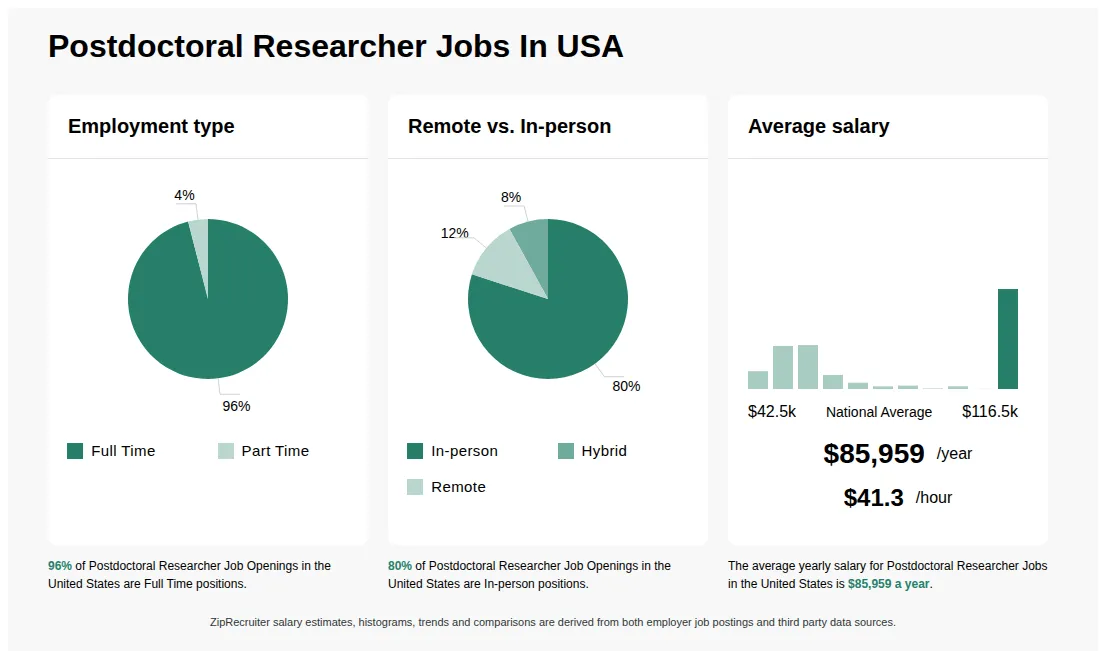
$42.5K - $49.2K
7% of jobs
$55.5K is the 25th percentile. Wages below this are outliers.
$49.2K - $56K
19% of jobs
$56K - $62.7K
19% of jobs
The median wage is $68.7K / yr.
$62.7K - $69.4K
5% of jobs
$69.4K - $76.1K
2% of jobs
$76.1K - $82.9K
1% of jobs
$82.9K - $89.6K
1% of jobs
$89.6K - $96.3K
0% of jobs
$96.3K - $103K
1% of jobs
$103K - $109.8K
0% of jobs
$112.7K is the 75th percentile. Wages above this are outliers.
$109.8K - $116.5K
44% of jobs
$42.5K
$86K
$116.5K
| Aspect | Postdoctoral Researcher | Research Scientist |
|---|---|---|
| Required Credentials | Ph.D. in relevant field | Master's or Ph.D., often with more industry experience |
| Work Environment | Academic labs, universities, research institutions | Industry labs, corporate R&D, private companies |
| Employer & Industry Usage | Primarily academia and research institutions | Primarily industry and corporate sectors |
| Common Search & Comparison Intent | Understanding academic research roles | Exploring industry research careers |
The main difference between a Postdoctoral Researcher and a Research Scientist lies in their work environment and career stage. Postdoctoral Researchers typically work in academic or research institutions focusing on specialized research after earning their Ph.D., often aiming for academic careers. Research Scientists are usually employed in industry settings, applying research to product development or innovation, often with more industry experience. Both roles require advanced degrees, but their career paths and work environments differ significantly.
Cities with the most Postdoctoral Researcher job openings:
The top employers for Postdoctoral Researcher jobs are:
States with the most job openings for Postdoctoral Researcher jobs include:
The top searched job categories for Postdoctoral Researcher jobs are:
For Postdoctoral Researcher jobs, the most frequently searched job titles are:

$67K - $81K/yr
Full-time
Retirement
Re-posted 9 days ago
Job Title: Postdoctoral Researcher
Grade: 18
Salary: $67,552 - $81,257
The Research Foundation for Mental Hygiene is seeking a qualified candidate to fill a full-time Postdoctoral Researcher position. The Department of Psychiatry at Columbia University Irving Medical Center (CUIMC) and the New York State Psychiatric Institute, New York, NY is seeking a full-time postdoctoral researcher in the field of Translational Neuroscience.
The postdoctoral scientist will work in the laboratory of Dr. Milenna van Dijk investigating how genetic susceptibility and early-life experiences shape risk for and resilience to depression by integrating basic neuroscience, human neuroimaging, statistical genetics, and large-scale population datasets.
The successful candidate will join an NIH-funded research program focused on hippocampal mechanisms underlying depression following early-life adversity. The postdoc will perform analyses of large human neuroimaging and genomic datasets, including cross-species translation and integration of mouse and human post-mortem gene expression signatures with human neuroimaging and genetics in large cohort studies.
This position offers the opportunity to work at the interface of neuroscience, genetics, epidemiology, and computational biology while contributing to research aimed at identifying biological pathways that can inform prevention strategies for youth at risk for depression. The postdoctoral scientist will be encouraged to develop independent research questions, lead publications, and collaborate with an interdisciplinary network of neuroscientists, geneticists, and clinicians.
Duties and Responsibilities:
Minimum Qualifications:
Preferred Qualifications:
Work Location: 1051 Riverside Drive, New York, NY 10032
To Apply: Submit an application through our website at https://rfmh.applicantpro.com/jobs/. Please note only applications submitted through our website will be considered.
The Mission of the Research Foundation for Mental Hygiene, Inc. (RFMH) is to promote the mental health of all New Yorkers, with a focus on providing hope and supporting recovery for adults with serious mental illness and children with serious emotional disturbances. Applicants with lived mental health experience are encouraged to apply. RFMH is deeply committed to supporting underserved individuals, organizations, and communities. To this end, RFMH is focused on implementing activities and initiatives to reduce disparities in access, quality, and treatment outcomes for underserved populations. A critical component of these efforts is ensuring that RFMH is a diverse and inclusive workplace where all employees' unique attributes and skills are valued and utilized to support the mission of the Agency. RFMH is an equal opportunity/affirmative action employer.
The Research Foundation is a private not-for-profit corporation and is not an agency or instrumentality of the State of New York. Employees of the Research Foundation are not state employees, do not participate in any state retirement system, and do not receive state fringe benefits. Excellent Benefits Package. Affirmative Action/Equal Opportunity Employer - Disabled/Veteran, 41 CFR 60-741.5(a) and 41 CFR 60-300.5(a) compliant.

Sourced by ZipRecruiter