As a Security Officer Hospital Morgue Enhanced Part Time in Dover, NH , this role is designed to provide reliable, consistent hours at an assigned site with the flexibility for you to earn more by ...
Quick apply
As a Security Officer Hospital Morgue Enhanced Part Time in Dover, NH , this role is designed to provide reliable, consistent hours at an assigned site with the flexibility for you to earn more by ...
Quick apply
As a Security Officer Hospital Morgue Enhanced Part Time in Dover, NH , this role is designed to provide reliable, consistent hours at an assigned site with the flexibility for you to earn more by ...
Dover, NH · On-site
$21/hr
As a Security Officer Hospital Morgue Enhanced Part Time in Dover, NH , this role is designed to provide reliable, consistent hours at an assigned site with the flexibility for you to earn more by ...
Dover, NH · On-site
$21/hr
As a Security Officer Hospital Morgue Enhanced Part Time in Dover, NH , this role is designed to provide reliable, consistent hours at an assigned site with the flexibility for you to earn more by ...
Rockport, TX · On-site
$16.45/hr
As a Security Officer Hospital Morgue Security in Rockport, TX , you will serve and safeguard clients in a range of industries such as Healthcare, and more. As a Patrol Unarmed Officer in a health ...
Rockport, TX · On-site
$16.45/hr
As a Security Officer Hospital Morgue Security in Rockport, TX , you will serve and safeguard clients in a range of industries such as Healthcare, and more. As a Patrol Unarmed Officer in a health ...
Sterling, VA · On-site
$22.71/hr
As a Security Officer Hospital Morgue Security in Sterling, VA , you will serve and safeguard clients in a range of industries such as Healthcare, and more. Join a leading team where flexibility ...
Sterling, VA · On-site
$22.71/hr
As a Security Officer Hospital Morgue Security in Sterling, VA , you will serve and safeguard clients in a range of industries such as Healthcare, and more. Join a leading team where flexibility ...
Sterling, VA · On-site
$22.71/hr
As a Security Officer Hospital Morgue Security in Sterling, VA , you will serve and safeguard clients in a range of industries such as Healthcare, and more. Join a leading team where flexibility ...
Quick apply
Sterling, VA · On-site
$22.71/hr
As a Security Officer Hospital Morgue Security in Sterling, VA , you will serve and safeguard clients in a range of industries such as Healthcare, and more. Join a leading team where flexibility ...
Aventura, FL · On-site
$18.54/hr
As a Security Officer Part Time Morgue Area Security in Aventura, FL , you will serve and safeguard clients in a range of industries such as Healthcare, and more. Join a leading team where ...
Aventura, FL · On-site
$18.54/hr
As a Security Officer Part Time Morgue Area Security in Aventura, FL , you will serve and safeguard clients in a range of industries such as Healthcare, and more. Join a leading team where ...
Delray Beach, FL · On-site
$17.91/hr
As a Security Officer Enhanced Mobile Morgue in Delray Beach, FL , this role is designed to provide reliable, consistent hours at an assigned site with the flexibility for you to earn more by picking ...
Delray Beach, FL · On-site
$17.91/hr
As a Security Officer Enhanced Mobile Morgue in Delray Beach, FL , this role is designed to provide reliable, consistent hours at an assigned site with the flexibility for you to earn more by picking ...
Aventura, FL · On-site
$18.54/hr
As a Security Officer Part Time Morgue Area Security in Aventura, FL , you will serve and safeguard clients in a range of industries such as Healthcare, and more. Join a leading team where ...
Aventura, FL · On-site
$18.54/hr
As a Security Officer Part Time Morgue Area Security in Aventura, FL , you will serve and safeguard clients in a range of industries such as Healthcare, and more. Join a leading team where ...
Westwood, NJ · On-site
$20.09/hr
As a Security Guard Flex Hospital Morgue Security in Union, NJ , you'll expand your skillset, gain exposure to a variety of sites, and position yourself for advancement within the company. This is ...
Westwood, NJ · On-site
$20.09/hr
As a Security Guard Flex Hospital Morgue Security in Union, NJ , you'll expand your skillset, gain exposure to a variety of sites, and position yourself for advancement within the company. This is ...
As a Security Guard Flex Hospital Morgue Security in Union, NJ , you'll expand your skillset, gain exposure to a variety of sites, and position yourself for advancement within the company. This is ...
Quick apply
As a Security Guard Flex Hospital Morgue Security in Union, NJ , you'll expand your skillset, gain exposure to a variety of sites, and position yourself for advancement within the company. This is ...
Corpus Christi, TX · On-site
$16.45/hr
As a Security Officer Enhanced Part Time Unarmed Morgue Patrol in Corpus Christi, TX , this role is designed to provide reliable, consistent hours at an assigned site with the flexibility for you to ...
Corpus Christi, TX · On-site
$16.45/hr
As a Security Officer Enhanced Part Time Unarmed Morgue Patrol in Corpus Christi, TX , this role is designed to provide reliable, consistent hours at an assigned site with the flexibility for you to ...
Corpus Christi, TX · On-site
$16.45/hr
As a Security Officer Enhanced Part Time Unarmed Morgue Patrol in Corpus Christi, TX , this role is designed to provide reliable, consistent hours at an assigned site with the flexibility for you to ...
Quick apply
Corpus Christi, TX · On-site
$16.45/hr
As a Security Officer Enhanced Part Time Unarmed Morgue Patrol in Corpus Christi, TX , this role is designed to provide reliable, consistent hours at an assigned site with the flexibility for you to ...
Aiea, HI · On-site
$19.50 - $24.77/hr
Provides morgue services 24/hours, 7 days/week, 365 days/year -follows all morgue procedures to meet regulatory requirements for the handling of bodies related to morgue duties. Follows operational ...
Aiea, HI · On-site
$19.50 - $24.77/hr
Provides morgue services 24/hours, 7 days/week, 365 days/year -follows all morgue procedures to meet regulatory requirements for the handling of bodies related to morgue duties. Follows operational ...
Aiea, HI · On-site
$83K - $102K/yr
Provides morgue services 24/hours, 7 days/week, 365 days/year -follows all morgue procedures to meet regulatory requirements for the handling of bodies related to morgue duties. * Follows operational ...
Aiea, HI · On-site
$83K - $102K/yr
Provides morgue services 24/hours, 7 days/week, 365 days/year -follows all morgue procedures to meet regulatory requirements for the handling of bodies related to morgue duties. * Follows operational ...
Aiea, HI · On-site
$19.50 - $24.77/hr
Provides morgue services 24/hours, 7 days/week, 365 days/year -follows all morgue procedures to meet regulatory requirements for the handling of bodies related to morgue duties. Follows operational ...
Aiea, HI · On-site
$19.50 - $24.77/hr
Provides morgue services 24/hours, 7 days/week, 365 days/year -follows all morgue procedures to meet regulatory requirements for the handling of bodies related to morgue duties. Follows operational ...
Aiea, HI · On-site
$25 - $31.27/hr
Provides morgue services 24/hours, 7 days/week, 365 days/year -follows all morgue procedures to meet regulatory requirements for the handling of bodies related to morgue duties. Follows operational ...
Aiea, HI · On-site
$25 - $31.27/hr
Provides morgue services 24/hours, 7 days/week, 365 days/year -follows all morgue procedures to meet regulatory requirements for the handling of bodies related to morgue duties. Follows operational ...
Aiea, HI · On-site
$83K - $102K/yr
Provides morgue services 24/hours, 7 days/week, 365 days/year -follows all morgue procedures to meet regulatory requirements for the handling of bodies related to morgue duties. * Follows operational ...
Aiea, HI · On-site
$83K - $102K/yr
Provides morgue services 24/hours, 7 days/week, 365 days/year -follows all morgue procedures to meet regulatory requirements for the handling of bodies related to morgue duties. * Follows operational ...
Aiea, HI · On-site
$19.50 - $24.77/hr
Provides morgue services 24/hours, 7 days/week, 365 days/year -follows all morgue procedures to meet regulatory requirements for the handling of bodies related to morgue duties. Follows operational ...
Aiea, HI · On-site
$19.50 - $24.77/hr
Provides morgue services 24/hours, 7 days/week, 365 days/year -follows all morgue procedures to meet regulatory requirements for the handling of bodies related to morgue duties. Follows operational ...
Aiea, HI · On-site
$83K - $102K/yr
Provides morgue services 24/hours, 7 days/week, 365 days/year -follows all morgue procedures to meet regulatory requirements for the handling of bodies related to morgue duties. * Follows operational ...
Aiea, HI · On-site
$83K - $102K/yr
Provides morgue services 24/hours, 7 days/week, 365 days/year -follows all morgue procedures to meet regulatory requirements for the handling of bodies related to morgue duties. * Follows operational ...
Aiea, HI · On-site
$19.50 - $24.77/hr
Provides morgue services 24/hours, 7 days/week, 365 days/year -follows all morgue procedures to meet regulatory requirements for the handling of bodies related to morgue duties. Follows operational ...
Aiea, HI · On-site
$19.50 - $24.77/hr
Provides morgue services 24/hours, 7 days/week, 365 days/year -follows all morgue procedures to meet regulatory requirements for the handling of bodies related to morgue duties. Follows operational ...
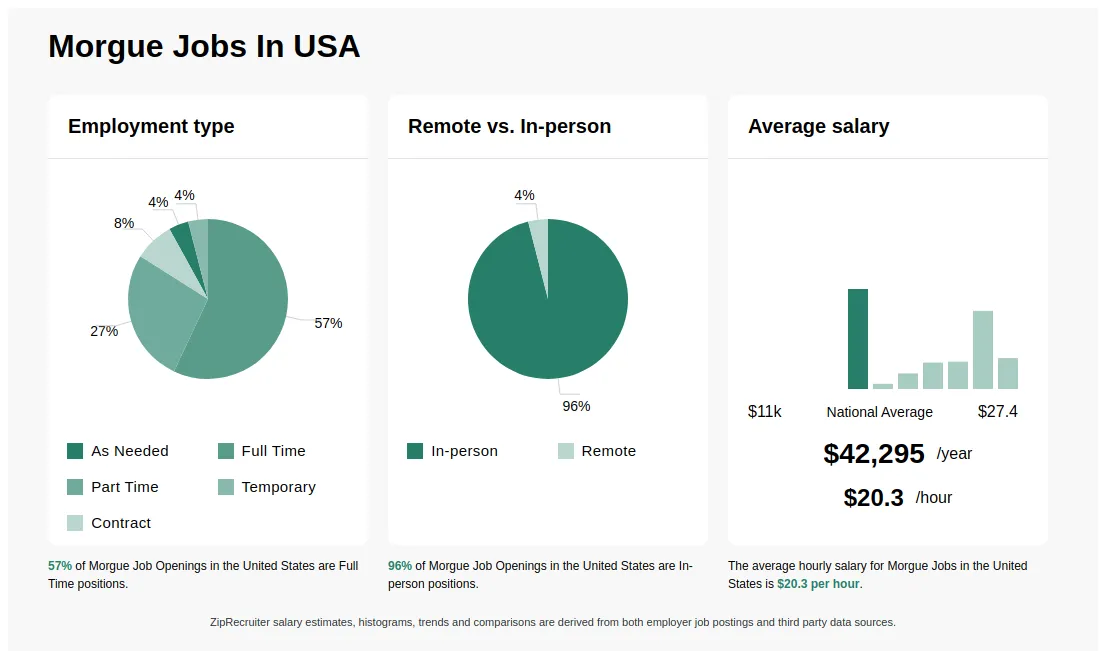
$5.29 - $7.30
0% of jobs
$7.30 - $9.31
0% of jobs
$9.31 - $11.32
0% of jobs
$11.32 - $13.33
0% of jobs
$14.71 is the 25th percentile. Wages below this are outliers.
$13.33 - $15.34
36% of jobs
$15.34 - $17.35
1% of jobs
$17.35 - $19.36
5% of jobs
The median wage is $20.93 / hr.
$19.36 - $21.37
9% of jobs
$21.37 - $23.38
9% of jobs
$24.35 is the 75th percentile. Wages above this are outliers.
$23.38 - $25.39
28% of jobs
$25.39 - $27.40
10% of jobs
$5
$20
$27
There are a variety of positions in a morgue, including attendants, pathologists, and security guards. In a mortuary role, you may assist in the preparation of a body for a funeral service or burial, provide cremation services, or perform an autopsy on a deceased individual. Some details of this job vary by location. For example, morgues at universities may focus on donations for science, while morgues in hospitals take donated organs before proceeding to other tasks. Morgue jobs often involve using surgical instruments for postmortem examinations, and you may work on heavily damaged bodies. The ability to remain professional while exposed to death and extremely upsetting sights is essential to this position.
| Aspect | Morgue | Medical Examiner |
|---|---|---|
| Credentials | None required; often medical or forensic training | Medical degree and forensic pathology certification |
| Work Environment | Facilities where bodies are stored and prepared | Offices, autopsy suites, and crime scenes |
| Employer & Industry | Hospitals, funeral homes, forensic labs | Government agencies, hospitals, forensic institutes |
| Common Search & Comparison | Often compared for roles in death care and forensic work | Legal and forensic investigations of deaths |
The main difference is that a morgue is a facility where bodies are stored and prepared, while a medical examiner is a trained forensic doctor who investigates deaths. Medical examiners perform autopsies and determine causes of death, whereas morgues serve as the location for these processes. Both roles are essential in forensic and death care industries but serve different functions within the process of death investigation.
Cities with the most Morgue job openings:
The most popular types of Morgue jobs are:
States with the most job openings for Morgue jobs include:
The top searched job categories for Morgue jobs are:

Dover, NH
$21/hr
Part-time
Retirement
Posted 10 days ago
5.5
Based on 2,615 frontline employees who took The Breakroom Quiz
Allied Universal®, North America’s leading security and facility services company, offers rewarding careers that provide you a sense of purpose. While working in a dynamic, welcoming, and collaborative workplace, you will be part of a team that contributes to a culture that positively impacts the communities and customers we serve.
Life doesn’t always follow a fixed schedule. That’s why we created the Security Officer – Part Time Enhanced position: a flexible, dependable option for individuals looking to supplement their income, gain hands-on experience, or work toward a full-time career with the industry leader.
As a Security Officer Hospital Morgue Enhanced Part Time in Dover, NH, this role is designed to provide reliable, consistent hours at an assigned site with the flexibility for you to earn more by picking-up additional shifts when it works for you.
Pay Rate: $21.00 / Hour
Job Schedule:
DayTimeSun01:00 PM - 01:00 AMHow This Role Works:
This role is ideal for candidates seeking part-time employment with flexibility, income stability, and opportunities to build-up to a full-time schedule of up to 40 hours per week; always with the option to scale back when needed.
Responsibilities:
Minimum Requirements:
Why Join Us:
Allied Universal® is an Equal Opportunity Employer. All qualified applicants will receive consideration for employment without regard to race/ethnicity, age, color, religion, sex, sexual orientation, gender identity, national origin, genetic information, disability, protected veteran status or relationship/association with a protected veteran, or any other basis or characteristic protected by law. For more information: www.aus.com.
If you have difficulty using the online system and require an alternate method to apply or require an accommodation, please contact our local Human Resources department. To find an office near you, please visit: www.aus.com/offices.
Get the full story on Breakroom

Sourced by ZipRecruiter
Allied Universal® is a leading security and facility services company. We provide proactive security services and cutting-edge smart technology to deliver evolving, tailored solutions that allow our clients to focus on their core business. Our excellence starts with our local leadership and local presence. Operating in more than 90 countries, our global workforce of approximately 800,000 people. Employees help to deliver our promise globally and locally: keeping people safe so our customers and communities can thrive. As we build the world's best services company, we continue to expand our footprint and infrastructure on a global and local level. In North America, we operate our business under the existing Allied Universal brand, and our international business operates under the G4S brand.
Investigation and physical security services, chemical manufacturing and real estate
10,000+ Employees
Santa Ana, CA, US


