1

Japanese Translator Jobs (NOW HIRING)

Japanese/English Translator

Lagrange, GA · On-site

$19.75 - $26/hr

Attend conferences and meetings and act as official translator to mediate discussion. Relay ... Support Japanese and American Executives. QUALIFICATION REQUIREMENTS: To perform this job ...

Translator

Sparks, NV

$22.50 - $29.75/hr

Translator #1052118 ... The Interpreter is proficient in spoken/written Japanese and English. * This person is bilingual or ...

Translator I

De Soto, KS · On-site

$42K - $55K/yr

Bachelor's degree in Japanese, Linguistics, Translation, or a related field * Technical coursework ... or exposure to manufacturing, engineering, or industrial environments Essential Qualifications:

Translator I - Nights

De Soto, KS · On-site

$42K - $55K/yr

Bachelor's degree in Japanese, Linguistics, Translation, or a related field * Technical coursework ... or exposure to manufacturing, engineering, or industrial environments Essential Qualifications:

MUST BE BUSINESS PROFICIENT AND BILINGUAL IN JAPANESE POSITION SUMMARY The Localization Translator will work on translation and localization of Japanese games and anime titles to North America. The ...

next page

Showing results 1-20

Japanese Translator information

See salary details

$12

$25

$40

How much do japanese translator jobs pay per hour?

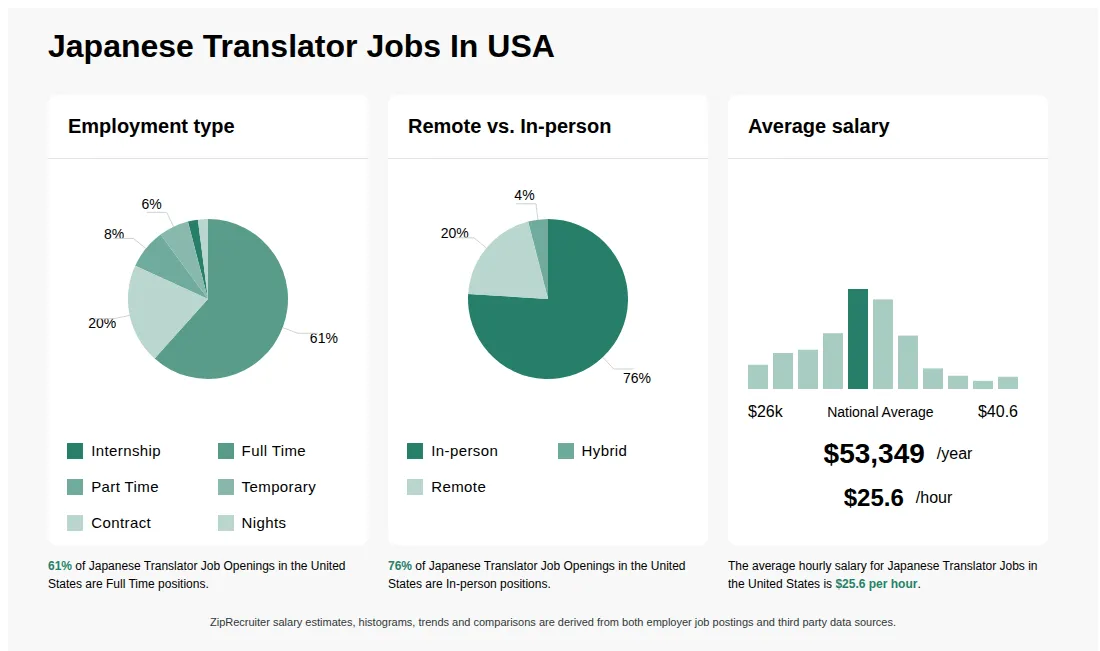
As of Jun 9, 2026, the average hourly pay for japanese translator in the United States is $25.65, according to ZipRecruiter salary data. Most workers in this role earn between $21.15 and $27.88 per hour, depending on experience, location, and employer.

What are Japanese Translators?

Japanese Translators are professionals who convert written or spoken content from Japanese to another language, or vice versa. Their work ensures accurate communication between people or organizations that speak different languages. Japanese Translators may work in various fields, including business, literature, legal, and technical sectors. They must have strong language skills, cultural knowledge, and attention to detail to convey meaning and context accurately. Many also specialize in specific industries to provide more precise translations.

What are some common challenges faced by Japanese Translators when working with technical or specialized content?

Japanese Translators often encounter challenges when translating technical or specialized content, such as legal, medical, or engineering documents. These texts frequently contain industry-specific terminology and complex concepts that may not have direct equivalents in Japanese or English. Overcoming these challenges requires strong research skills, familiarity with both cultures, and sometimes collaboration with subject matter experts to ensure accuracy and clarity. Additionally, maintaining the original tone and intent while adapting the content to suit the target audience can be demanding but is essential for effective communication.

What is the difference between Japanese Translator vs Japanese Interpreter?

AspectJapanese TranslatorJapanese Interpreter
CredentialsLanguage proficiency, translation certifications (e.g., ATA)Language proficiency, interpretation certifications (e.g., ATA, CIOL)
Work EnvironmentOffice, home, or remote; document-based workConferences, meetings, live events
Industry UsagePublishing, legal, technical, businessConferences, diplomatic events, legal proceedings
Search & Comparison IntentWritten translation skills, document accuracyReal-time communication, verbal skills

While both roles require strong language skills and relevant certifications, Japanese Translators focus on written documents, whereas Japanese Interpreters facilitate real-time spoken communication. The choice depends on whether the job involves translating texts or interpreting conversations.

What are the key skills and qualifications needed to thrive as a Japanese Translator, and why are they important?

To thrive as a Japanese Translator, a high level of proficiency in both Japanese and the target language, along with a strong grasp of grammar, vocabulary, and cultural nuances, is essential—often supported by a language or translation degree. Familiarity with computer-assisted translation (CAT) tools, localization software, and certification from recognized translation bodies like the ATA can be important. Exceptional attention to detail, time management, and strong communication skills enable translators to deliver accurate and culturally appropriate translations. These skills ensure that language barriers are effectively bridged, supporting clear and precise communication in global business, legal, or academic contexts.

What Does a Japanese Translator Do?

A Japanese translator's primary responsibilities are to interpret and translate written and spoken language from Japanese to English. In this career, you provide bilingual communication and understanding between two individuals or parties that do not speak the same language. Your duties may include relaying concepts and ideas that differ between the cultures, attending conferences and meetings to mediate discussions, providing support and understanding for clients in prison and at trials, editing and proofreading translated text, or accompanying foreign visitors from Japan. As a Japanese translator, you need to have a firm understanding of cultural differences, including customs and colloquial phrases that may not translate well.

What cities are hiring for Japanese Translator jobs? Cities with the most Japanese Translator job openings:
What are the most commonly searched types of Japanese Translator jobs? The most popular types of Japanese Translator jobs are:
What states have the most Japanese Translator jobs? States with the most job openings for Japanese Translator jobs include:
What are popular job titles related to Japanese Translator jobs? For Japanese Translator jobs, the most frequently searched job titles are:
Infographic showing various Japanese Translator job openings in the United States as of May 2026, with employment types broken down into 75% Full Time, and 25% Contract. Highlights an 100% In-person job distribution, with an average salary of $53,349 per year, or $25.6 per hour.
Japanese - English Interpreter/Translator

Japanese - English Interpreter/Translator

TOYOTETSU NORTH AMERICA

Somerset, KY

$16 - $21.25/hr

Full-time

Posted 7 days ago


Toyotetsu rating

8.2

Company rating: 8.2 out of 10

Based on 6 frontline employees who took The Breakroom Quiz


Job description

Job Purpose:  Interpret spoken and written communications between languages; support Japanese coordinators and local staff in effective communication; assist coordinators with their daily living needs.

Key Responsibilities:

  • Provide consecutive interpretation between languages.
  • Interpret complete statements from one language into another and convey responses back into the original language during consecutive interpretation.
  • Express either approximate or exact translation, depending on the nature of the occasion.
  • Interpret and edit written documentation from one language to another.
  • Support Japanese coordinators, visitors, and supporters assigned from the Japanese parent company and their families.
  • Provide daily living support, including school and medical interpretation assistance, among other needs.
  • Assist in coordinating team member activities (e.g., company picnics, community events, etc).
  • Assist Human Resource management with special projects as needed.
  • Be available to support urgent interpretation needs on an as-needed basis.
  • Any other duties as assigned.

    Required Education/Experience: Bachelor’s degree, or four (4)+ years of related experience and a high school diploma or G.E.D., or an equivalent combination of education and experience.

    Required Skills and Abilities:

    • Must be fluent in both English and Japanese.
    • Proficient in computer operations and system software, including but not limited to Microsoft Outlook, Word, Excel, and PowerPoint.
    • Interpersonal skills (teamwork, customer orientation).
    • Communication (verbal communication, listening, written communication).
    • Performance skills (accuracy with detail, planning, prioritizing, organizing, efficiency).
    • Confidentiality (ability to handle sensitive and confidential information).
    • Personal characteristics (motivation/commitment, flexibility, assertiveness).
    • Cultural competency (ability to work effectively across cultural differences and adapt communication accordingly).