R&AD is currently seeking a Program Manager 3 to serve as the Vehicle Management Systems (VMS) Hardware Manager with oversight over multiple VMS suppliers. This leadership opportunity is in Melbourne ...
R&AD is currently seeking a Program Manager 3 to serve as the Vehicle Management Systems (VMS) Hardware Manager with oversight over multiple VMS suppliers. This leadership opportunity is in Melbourne ...

Hardware Support Technician
Charlotte, NC · On-site
$17/hr
Pay- $17/hr This position supports our hardware management of mobile devices and accessories for our customers. This includes staging, kitting, shipping, storing, cleaning, and restoring mobile ...
Quick apply
Hardware Support Technician
Charlotte, NC · On-site
$17/hr
Pay- $17/hr This position supports our hardware management of mobile devices and accessories for our customers. This includes staging, kitting, shipping, storing, cleaning, and restoring mobile ...

This position works closely with the Administrative Services Manager (ASM) and Hardware Manager to ensure purchasing, inventory, office operations, licensing, and customer needs are handled ...
This position works closely with the Administrative Services Manager (ASM) and Hardware Manager to ensure purchasing, inventory, office operations, licensing, and customer needs are handled ...

Hardware Sales
Dayton, TN · On-site
Ace Hardware Corporation will not receive a copy of any applications submitted for this position ... management. • Possess strong product knowledge and knowledge of store layout and location of ...
Hardware Sales
Dayton, TN · On-site
Ace Hardware Corporation will not receive a copy of any applications submitted for this position ... management. • Possess strong product knowledge and knowledge of store layout and location of ...
$150K - $255K/yr
Hardware Engineering Section Manager - Mechanical Team (Hybrid) Company: BAE Systems Category: Maintenance Job Type: Permanent City: Wayne State: New Jersey Country: United States See what you're ...
$150K - $255K/yr
Hardware Engineering Section Manager - Mechanical Team (Hybrid) Company: BAE Systems Category: Maintenance Job Type: Permanent City: Wayne State: New Jersey Country: United States See what you're ...
Hardware Engineering Section Manager - Mechanical Team (Hybrid)
Wayne, NJ · On-site
$150K - $255K/yr
Hardware Engineering Section Manager - Mechanical Team (Hybrid) Company: BAE Systems Category: Maintenance Job Type: Permanent City: Wayne State: New Jersey Country: United States See what you're ...
Hardware Engineering Section Manager - Mechanical Team (Hybrid)
Wayne, NJ · On-site
$150K - $255K/yr
Hardware Engineering Section Manager - Mechanical Team (Hybrid) Company: BAE Systems Category: Maintenance Job Type: Permanent City: Wayne State: New Jersey Country: United States See what you're ...
Administrative Services Coordinator
Richardson, TX · On-site
$45K - $55K/yr
This position works closely with the Administrative Services Manager (ASM) and Hardware Manager to ensure purchasing, inventory, office operations, licensing, and customer needs are handled ...
Quick apply
Administrative Services Coordinator
Richardson, TX · On-site
$45K - $55K/yr
This position works closely with the Administrative Services Manager (ASM) and Hardware Manager to ensure purchasing, inventory, office operations, licensing, and customer needs are handled ...

Support
Courtdale, PA · On-site
Horizon and Call Logging · Consistently monitor Horizon for incoming repairs. · Escalate issues to Hardware Manager/Supervisor, Quality Assurance/Control staff as applicable. Other · Accountable ...
Support
Courtdale, PA · On-site
Horizon and Call Logging · Consistently monitor Horizon for incoming repairs. · Escalate issues to Hardware Manager/Supervisor, Quality Assurance/Control staff as applicable. Other · Accountable ...
Depot Services & Solutions
Pittston, PA · On-site
Managers: You must review with your team member's the percentages that pertain to their job. Hardware Repair * Replicate and resolve customer issues in the hardware environment (Triage.) * Prioritize ...
Depot Services & Solutions
Pittston, PA · On-site
Managers: You must review with your team member's the percentages that pertain to their job. Hardware Repair * Replicate and resolve customer issues in the hardware environment (Triage.) * Prioritize ...

NVIDIA's LPU team is now looking for a Hardware Engineering Lab Manager! In this role, you will join a highly collaborative team that provides engineering support to our Datacenter products in ...
NVIDIA's LPU team is now looking for a Hardware Engineering Lab Manager! In this role, you will join a highly collaborative team that provides engineering support to our Datacenter products in ...
Manage engineering, procurement, and construction firms, fabricators, suppliers, contract ... Own the hardware schedule, budget, qualification timeline, technical quality, partner deliverables ...
Manage engineering, procurement, and construction firms, fabricators, suppliers, contract ... Own the hardware schedule, budget, qualification timeline, technical quality, partner deliverables ...
NVIDIA's LPU team is now looking for a Hardware Engineering Lab Manager. In this role, you will join a highly collaborative team that provides engineering support to our Datacenter products in ...
NVIDIA's LPU team is now looking for a Hardware Engineering Lab Manager. In this role, you will join a highly collaborative team that provides engineering support to our Datacenter products in ...
NVIDIA's LPU team is now looking for a Hardware Engineering Lab Manager! In this role, you will join a highly collaborative team that provides engineering support to our Datacenter products in ...
NVIDIA's LPU team is now looking for a Hardware Engineering Lab Manager! In this role, you will join a highly collaborative team that provides engineering support to our Datacenter products in ...
Senior HPC Hardware Engineer
Dallas, TX · On-site
$109K - $146K/yr
RESPONSIBILITIES Design, configure, and manage a high-performance compute fleet comprising large ... Lead troubleshooting of hardware components including CPUs, GPUs, DPUs, NVSwitches, NICs, memory ...
Senior HPC Hardware Engineer
Dallas, TX · On-site
$109K - $146K/yr
RESPONSIBILITIES Design, configure, and manage a high-performance compute fleet comprising large ... Lead troubleshooting of hardware components including CPUs, GPUs, DPUs, NVSwitches, NICs, memory ...
$81K - $108K/yr
RESPONSIBILITIES Design, configure, and manage a high-performance compute fleet comprising large ... Lead troubleshooting of hardware components including CPUs, GPUs, DPUs, NVSwitches, NICs, memory ...
$81K - $108K/yr
RESPONSIBILITIES Design, configure, and manage a high-performance compute fleet comprising large ... Lead troubleshooting of hardware components including CPUs, GPUs, DPUs, NVSwitches, NICs, memory ...
$81K - $108K/yr
You will own the full hardware lifecycle for NMC²'s compute fleet -- from bare‑metal ... Design, configure, and manage a high‑performance compute fleet comprising large‑scale GPU ...
$81K - $108K/yr
You will own the full hardware lifecycle for NMC²'s compute fleet -- from bare‑metal ... Design, configure, and manage a high‑performance compute fleet comprising large‑scale GPU ...
Manage engineering, procurement, and construction firms, fabricators, suppliers, contract ... Own the hardware schedule, budget, qualification timeline, technical quality, partner deliverables ...
Quick apply
Manage engineering, procurement, and construction firms, fabricators, suppliers, contract ... Own the hardware schedule, budget, qualification timeline, technical quality, partner deliverables ...
Manage engineering, procurement, and construction firms, fabricators, suppliers, contract ... Own the hardware schedule, budget, qualification timeline, technical quality, partner deliverables ...
Manage engineering, procurement, and construction firms, fabricators, suppliers, contract ... Own the hardware schedule, budget, qualification timeline, technical quality, partner deliverables ...
Manage engineering, procurement, and construction firms, fabricators, suppliers, contract ... Own the hardware schedule, budget, qualification timeline, technical quality, partner deliverables ...
Manage engineering, procurement, and construction firms, fabricators, suppliers, contract ... Own the hardware schedule, budget, qualification timeline, technical quality, partner deliverables ...
Senior HPC Hardware Engineer
Dallas, TX · On-site
$109K - $146K/yr
You will own the full hardware lifecycle for NMC²'s compute fleet -- from bare‑metal ... Design, configure, and manage a high‑performance compute fleet comprising large‑scale GPU ...
Senior HPC Hardware Engineer
Dallas, TX · On-site
$109K - $146K/yr
You will own the full hardware lifecycle for NMC²'s compute fleet -- from bare‑metal ... Design, configure, and manage a high‑performance compute fleet comprising large‑scale GPU ...
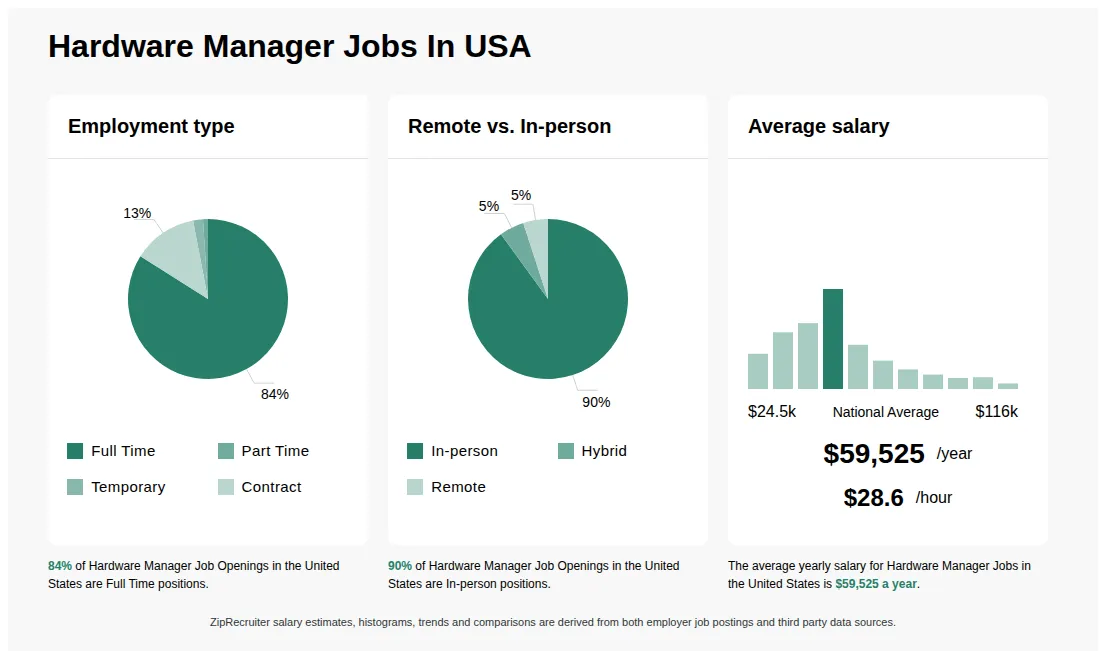
Hardware Manager information
See salary details
$24.5K - $32.8K
9% of jobs
$32.8K - $41.1K
15% of jobs
$41.8K is the 25th percentile. Wages below this are outliers.
$41.1K - $49.5K
17% of jobs
The median wage is $52.3K / yr.
$49.5K - $57.8K
27% of jobs
$62.9K is the 75th percentile. Wages above this are outliers.
$57.8K - $66.1K
12% of jobs
$66.1K - $74.4K
8% of jobs
$74.4K - $82.7K
4% of jobs
$82.7K - $91K
3% of jobs
$91K - $99.4K
2% of jobs
$99.4K - $107.7K
2% of jobs
$107.7K - $116K
1% of jobs
$24.5K
$59.5K
$116K
How much do hardware manager jobs pay per year?
As of Sep 13, 2026, the average yearly pay for hardware manager in the United States is $59,525.00, according to ZipRecruiter salary data. Most workers in this role earn between $42,000.00 and $68,500.00 per year, depending on experience, location, and employer.
What is a hardware manager?
Hardware Managers are professionals responsible for overseeing the design, development, testing, and maintenance of computer hardware systems and components. They manage teams of engineers and technicians, coordinate project timelines, and ensure that hardware products meet technical specifications and quality standards. Hardware Managers also collaborate with other departments such as software engineering, procurement, and manufacturing to deliver products efficiently and within budget.
What are the key skills and qualifications needed to thrive as a hardware manager?
To thrive as a Hardware Manager, you need a solid background in computer engineering or electronics, proven experience in hardware development, and often a relevant degree or certification. Familiarity with CAD tools, hardware testing platforms, and product lifecycle management (PLM) systems is typically required. Strong leadership, project management, and communication skills help in guiding teams and coordinating with cross-functional departments. These skills are crucial for ensuring efficient hardware product development, timely project delivery, and maintaining high quality standards.
What are some common challenges hardware managers face when overseeing cross-functional engineering teams?
Hardware Managers often encounter challenges coordinating between design, manufacturing, and quality assurance teams to ensure project timelines are met and technical specifications are achieved. Balancing resource allocation and managing shifting priorities due to unforeseen design changes or supply chain issues are also frequent hurdles. Effective communication, proactive risk management, and fostering a collaborative team environment are key strategies to address these challenges and ensure successful hardware development.
What is the difference between Hardware Manager vs Hardware Technician?
| Aspect | Hardware Manager | Hardware Technician |
|---|---|---|
| Credentials | Typically requires a bachelor's degree in IT, Computer Science, or related field; certifications like CompTIA A+ or Network+ are common | Often requires a high school diploma or associate degree; certifications like CompTIA A+ are preferred |
| Work Environment | Oversees hardware teams, manages hardware deployment, and plans infrastructure in offices or data centers | Performs hardware repairs, installations, and troubleshooting on-site or in repair centers |
| Employer & Industry Usage | Used by IT departments in various industries, including corporate, healthcare, and education | Commonly employed in technical support, repair shops, and IT service providers |
The Hardware Manager focuses on overseeing hardware operations, managing teams, and strategic planning, while the Hardware Technician handles hands-on hardware installation, troubleshooting, and repairs. Both roles require technical knowledge, but the manager role involves leadership and planning responsibilities.
More about Hardware Manager jobs
What cities are hiring for Hardware Manager jobs?
Cities with the most Hardware Manager job openings:
What are the most commonly searched types of Hardware jobs?
The most popular types of Hardware jobs are:
What states have the most Hardware Manager jobs?
States with the most job openings for Hardware Manager jobs include:
What are popular job titles related to Hardware Manager jobs?
For Hardware Manager jobs, the most frequently searched job titles are:

Program Manager 3 - VMS Hardware Manager
Melbourne, FL
Northrop Grumman
• Space Research Administration • 10K+ employees10,000+ employees
Full-time
Medical, Life, PTO
Posted 17 days ago
Northrop Grumman rating

8.3
Based on 372 frontline employees who took The Breakroom Quiz
Job description
RELOCATION ASSISTANCE: Relocation assistance may be available
CLEARANCE REQUIRED FOR START: Yes
CLEARANCE TYPE: Secret
TRAVEL: Yes, 10% of the TimeDescription
At Northrop Grumman, our employees have incredible opportunities to work on revolutionary systems that impact people's lives around the world today, and for generations to come. Our pioneering and inventive spirit has enabled us to be at the forefront of many technological advancements in our nation's history - from the first flight across the Atlantic Ocean, to stealth bombers, to landing on the moon. We look for people who have bold new ideas, courage and a pioneering spirit to join forces to invent the future, and have fun along the way. Our culture thrives on intellectual curiosity, cognitive diversity and bringing your whole self to work — and we have an insatiable drive to do what others think is impossible. Our employees are not only part of history, they're making history.
Please note that this opportunity is contingent on program funding. Start dates are determined after funding confirmation.
Northrop Grumman’s Aeronautics Systems – Research & Advanced Design (R&AD) transforms breakthrough ideas into mission-ready capabilities through intelligent anticipation. We’re the front-end design engine, defining what comes next. From developing cutting-edge next-generation future aircraft to trailblazing collaborative autonomous platforms, we push the boundaries of technology and forge industry-leading partnerships that set new standards for what’s possible.
Our team owns the full lifecycle of advanced concept creation, from visionary early-stage designs and rapid prototyping to high-impact demonstrations and solving the toughest technical challenges in survivability, autonomy, and battle management. We seek curious, adaptable people who thrive on turning intuition into breakthrough solutions. If you’re driven to invent the future, build what’s next, and shape the landscape of national security, this is where you belong.
R&AD is currently seeking a Program Manager 3 to serve as the Vehicle Management Systems (VMS) Hardware Manager with oversight over multiple VMS suppliers. This leadership opportunity is in Melbourne, Florida.
Due to the nature of the role, an on-site presence is required and cannot be performed remotely. The position will follow our 9/80 schedule and allows employees who work a nine-hour day Monday through Thursday to take every other Friday off.
Primary responsibilities will include but are not limited to:
- Managing suppliers to meet program objectives
- Enforcement of subcontractor execution of a Statement of Work (SOW) and support of contract modifications as necessary
- Maintaining close collaborative relationships with the customer, suppliers, engineering, operations, and all relevant stakeholders
- Ensuring program team, including suppliers, understands and adheres to contract scope, and manages change through control board activities
- Measuring and reporting supplier performance as it relates to program performance
- Delivering presentations to customers, executive management and other program stakeholders
- Participating in the negotiation of contracts, contract changes, specifications, operating budgets, schedule milestones, and key terms and conditions
- Identification, distribution, tracking, and completion of program requirements
- Establishment and management of the program and subordinate baselines
- Development and adherence to budget baselines utilizing Earned Value Management (EVM) or similar cost & schedule control methodologies and tools
- Adherence to all internal processes, policies, and applicable industry standards
- Development and adherence to master plans and schedules
- Resolves issues in accordance with business objectives, strategies, legal requirements, regulations, contract terms, and company policies
Our Leaders at Northrop Grumman live our values daily and encourage our teams to do the same. We do the right thing: upholding the highest ethical standards and facilitating a safe and respectful environment that attracts, retains, and inspires a diverse and engaged team. We do what we promise: holding yourself and others accountable to meet predictable and balanced results. We commit to shared success: operating as OneNG and removing barriers for our teams. Finally, we pioneer: setting a vision that shapes the future and inspires others.
Basic Qualifications:
- Bachelor’s degree and 10 years (or Bachelor of Science in STEM and 9 years) of related experience as defined below, OR a Master’s degree and 8 years (or Master of Science in STEM and 7 years) of related experience as defined below
- Demonstrated experience serving in a formal leadership role such as a Project Lead, Integrated Team Lead, Supplier Management Team Lead, or Cost Account Manager
- Demonstrated experience working with Program Management principles: managing projects, scheduling, budget management, etc.
- Demonstrated experience managing or interfacing with suppliers
- The ability to travel domestically 10% of the time
- Must have an active US Government Secret clearance (with a background investigation within the past 6 years or enrolled into Continuous Evaluation)
- Must have the ability to obtain and maintain Special Access Program (SAP) clearance, within a reasonable amount of time as determined by business needs
Preferred Qualifications:
- Experience with vehicle management systems, guidance and control systems, flight & safety critical software, and/or systems engineering and architecture design
- Experience managing multiple suppliers through contract award, design, and execution phases
- Experience managing program/projects of > $50 Million / year with P&L responsibilities
- Experience leading cross-functional teams of 5 or more individuals to achieve defined project or organizational objectives, including responsibility for task coordination, performance tracking, and issue resolution.
- Experience using program management tools such as Earned Value Management System (EVMS), Integrated Master Plan (IMP), Integrated Master Schedule (IMS), Risk and Opportunity Management
- Experience utilizing Atlassian tool suite (JIRA/Confluence) for management of agile-based development activity
- Experience producing clear, professional written communications (eg. Reports, briefings, status updates) and delivering verbal presentations to stakeholders at multiple organizational levels, including senior leadership and individual contributors
#blue
#AS-FA3
Primary Level Salary Range: $166,700.00 - $250,100.00 The above salary range represents a general guideline; however, Northrop Grumman considers a number of factors when determining base salary offers such as the scope and responsibilities of the position and the candidate's experience, education, skills and current market conditions. Depending on the position, employees may be eligible for overtime, shift differential, and a discretionary bonus in addition to base pay. Annual bonuses are designed to reward individual contributions as well as allow employees to share in company results. Employees in Vice President or Director positions may be eligible for Long Term Incentives. In addition, Northrop Grumman provides a variety of benefits including health insurance coverage, life and disability insurance, savings plan, Company paid holidays and paid time off (PTO) for vacation and/or personal business. The application period for the job is estimated to be 20 days from the job posting date. However, this timeline may be shortened or extended depending on business needs and the availability of qualified candidates. Northrop Grumman is an Equal Opportunity Employer, making decisions without regard to race, color, religion, creed, sex, sexual orientation, gender identity, marital status, national origin, age, veteran status, disability, or any other protected class. For our complete EEO and pay transparency statement, please visit http://www.northropgrumman.com/EEO. U.S. Citizenship is required for all positions with a government clearance and certain other restricted positions.What Northrop Grumman employees say
Pay
Benefits
Hours and flexibility
Workplace
Get the full story on Breakroom

About Northrop Grumman
Sourced by ZipRecruiter
At Northrop Grumman, our employees have incredible opportunities to work on revolutionary systems that impact people's lives around the world today, and for generations to come. Our pioneering and inventive spirit has enabled us to be at the forefront of many technological advancements in our nation's history - from the first flight across the Atlantic Ocean, to stealth bombers, to landing on the moon. We look for people who have bold new ideas, courage and a pioneering spirit to join forces to invent the future, and have fun along the way. Our culture thrives on intellectual curiosity, cognitive diversity and bringing your whole self to work - and we have an insatiable drive to do what others think is impossible.
Industry
Space research administration
Company size
10,000+ Employees
Headquarters location
Falls Church, VA, US
Year founded
1939