1

Vp Information Technology Jobs (NOW HIRING)

Vice President-IT

Lake Zurich, IL · On-site

$261 - $319/hr

The Vice President of Information Technology is a strategic enterprise leader responsible for defining and executing ECHO's technology vision in support of business growth, operational excellence ...

The Vice President of Information Technology is a strategic enterprise leader responsible for defining and executing ECHO's technology vision in support of business growth, operational excellence ...

Vice President-IT

Lake Zurich, IL · On-site

$221 - $270/hr

The Vice President of Information Technology is a strategic enterprise leader responsible for defining and executing ECHO's technology vision in support of business growth, operational excellence ...

Vice President, Information Technology

Westlake, OH · On-site

$145K - $181K/yr

General Summary The Vice President, Information Technology will report to the Chief Financial Officer and is responsible for the development and implementation of an overall Information Systems ...

About this Position Net at Work is seeking a hands-on, business-oriented Vice President of Information Technology to lead the company's internal technology organization. Reporting to the Chief ...

Showing results 21-40

Vp Information Technology information

See salary details

$100K

$182.2K

$262.5K

How much do vp information technology jobs pay per year?

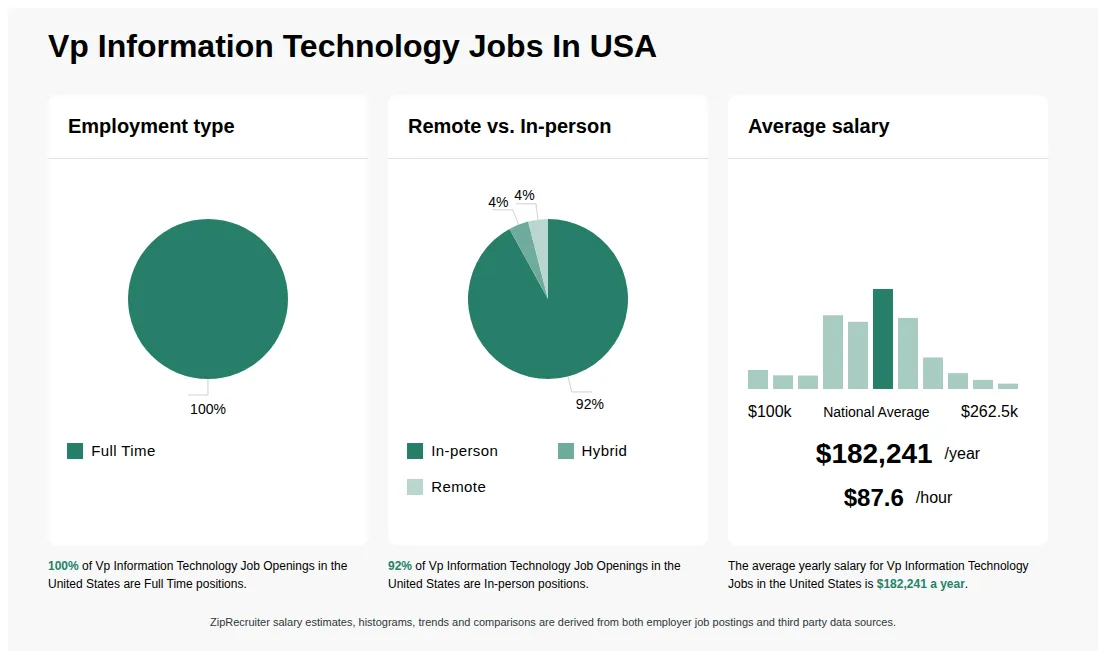
As of Sep 6, 2026, the average yearly pay for vp information technology in the United States is $182,241.00, according to ZipRecruiter salary data. Most workers in this role earn between $157,000.00 and $196,500.00 per year, depending on experience, location, and employer.

What are some common challenges faced by a VP of Information Technology when aligning IT strategy with overall business goals?

A VP of Information Technology often faces the challenge of ensuring that IT initiatives are closely aligned with the company's broader business objectives. This involves balancing long-term strategic technology investments with immediate operational needs, communicating IT’s value to non-technical stakeholders, and adapting to rapidly evolving technologies. Additionally, VPs must manage cross-departmental collaboration to ensure IT solutions effectively support various business units, all while maintaining data security and compliance standards. Overcoming these challenges requires strong leadership, strategic vision, and excellent communication skills.

What are the key skills and qualifications needed to thrive as a VP of Information Technology, and why are they important?

To thrive as a VP of Information Technology, you need extensive experience in IT management, strategic planning, and a relevant degree, often complemented by certifications like PMP, CISSP, or ITIL. Familiarity with enterprise systems, cloud computing platforms, cybersecurity tools, and project management software is typically required. Strong leadership, communication, and problem-solving skills help you guide teams and align technology with business goals. These skills are crucial to drive digital transformation, ensure robust IT operations, and support organizational growth.

What is the difference between Vp Information Technology vs IT Director?

AspectVp Information TechnologyIT Director
ResponsibilitiesOversees entire IT strategy, aligns technology with business goals, manages senior IT teamsManages IT operations, implements policies, supervises IT staff, ensures system stability
Required CredentialsBachelor's or master's in IT, Computer Science, or related field; extensive experience; leadership skillsBachelor's in IT or related field; experience in IT management; technical expertise
Work EnvironmentExecutive-level, strategic planning, interacts with C-suiteOperational, team management, project oversight
Industry UsageCommon in large organizations and corporationsWidely used across industries for IT management roles

The Vp Information Technology typically holds a higher strategic and leadership role, focusing on aligning IT with business objectives, while the IT Director manages daily IT operations and team supervision. Both roles require strong technical backgrounds, but the VP is more involved in executive decision-making.

What does a VP of information technology do?

A VP of Information Technology oversees an organization’s technology strategy, manages IT teams, and ensures the security and efficiency of IT systems. They develop technology policies, align IT initiatives with business goals, and often work with executives to support digital transformation and innovation.
More about Vp Information Technology jobs

What cities are hiring for Vp Information Technology jobs?

Cities with the most Vp Information Technology job openings:

What are the most commonly searched types of Information Technology jobs?

The most popular types of Information Technology jobs are:

What states have the most Vp Information Technology jobs?

States with the most job openings for Vp Information Technology jobs include:

Infographic showing various Vp Information Technology job openings in the United States as of August 2026, with employment types broken down into 1% As Needed, 73% Full Time, 23% Part Time, and 3% Contract. Highlights an 93% Physical, 2% Hybrid, and 5% Remote job distribution, with an average salary of $182,241 per year, or $87.6 per hour.

Vice President, Information Technology

GEON Performance Solutions

Westlake, OH • On-site

$145K - $181K/yr

Full-time

Posted 11 days ago


Job description

General Summary
The Vice President, Information Technology will report to the Chief Financial Officer and is responsible for the development and implementation of an overall Information Systems strategy. The VP, IT provides leadership and direction to the enterprise, aligning the organization’s technology strategy with the company’s growth objectives. The VP, IT is responsible for all company-wide IT activities, including infrastructure and architecture, security, business applications development, digital transformation, networks, and computer and auxiliary operations and support.
Essential Duties and Responsibilities
  • Develop strategies and methodology to accelerate integration and optimization of processes.
  • Provide leadership and guidance to the IT department to achieve safe, reliable and cost-effective operations of IT infrastructure and applications.
  • Define core IT competencies and develop strategies to continue learning and expertise development in the rapidly changing IT / technology industry to maintain a competitive advantage.
  • Create appropriate balance between in-house staffing levels and managed service provider support.
  • Assess the relative impact of emerging technologies on strategic business needs and interpret their implications for the executive team.
  • Participate in overall business technology planning, bringing a current knowledge and future vision of technology and systems as related to the company’s competitive position.
  • Be responsive to strategic business decisions regarding the use of technology and identify opportunities for integration, streamlining, and potential outsourcing.
  • Direct the design, development, and maintenance of systems, programs, and systems software to meet the Company’s needs.
  • Track a broad range of emerging technologies to determine their maturity and applicability to the company.
  • Drive digital transformation strategy with focus on business intelligence and analytics.
  • Build and maintain effective relationships across Geon’s various functions in support of business objectives and goals.
  • Oversee and manage capital projects on schedule and within approved budgets.
  • Administer and control the IT expense and capital budgets effectively.
  • Compile and review performance indicators to determine department productivity, quality of output, and cost of service, and develop methods to continually improve results.
  • Oversee the creation, maintenance and enforcement of written policies and procedures regarding all IT operations throughout the company.
  • Maintain IT general controls and support internal and external audit, including access management, change control, and segregation-of-duties review.
  • Incorporate cybersecurity best practices into IT programs and systems.
  • Maintain disaster recovery and business continuity plans for critical systems, with defined recovery objectives and periodic testing.
  • Partner with Business Intelligence to drive AI policy and strategy
  • Other duties as assigned.

Required Qualifications
  • Bachelor’s degree in Computer Science, Information Technology, or a related field.
  • Advanced degree in Computer Science or Business Management is a plus.
  • Minimum of 15 years of diversified Information Technology experience with at least 5 years leading an IT function of an organization.
  • Experience in a multi-site manufacturing or process-industry environment driving digital transformation with focus on data-driven business intelligence and analytics.