1

Trauma Program Manager Jobs in Texas (NOW HIRING)

... Program Manager, or Trauma Coordinator. Participates in report generation internally and externally as mandated by regulatory agencies. Assist with the preparation of materials and minutes of Trauma ...

... Program Manager, or Trauma Coordinator. Participates in report generation internally and externally as mandated by regulatory agencies. Assist with the preparation of materials and minutes of Trauma ...

Represents the trauma program on various hospital, community, state, and national committees to enhance and foster optimal trauma care management. Additionally, leads programs and initiatives focused ...

... Program Manager. Participates in report generation internally and externally as mandated by regulatory agencies. Assist with the preparation of materials and minutes of Trauma Service meetings.

next page

Showing results 1-20

Trauma Program Manager information

See Texas salary details

$10.2K

$62K

$131.4K

How much do trauma program manager jobs pay per year?

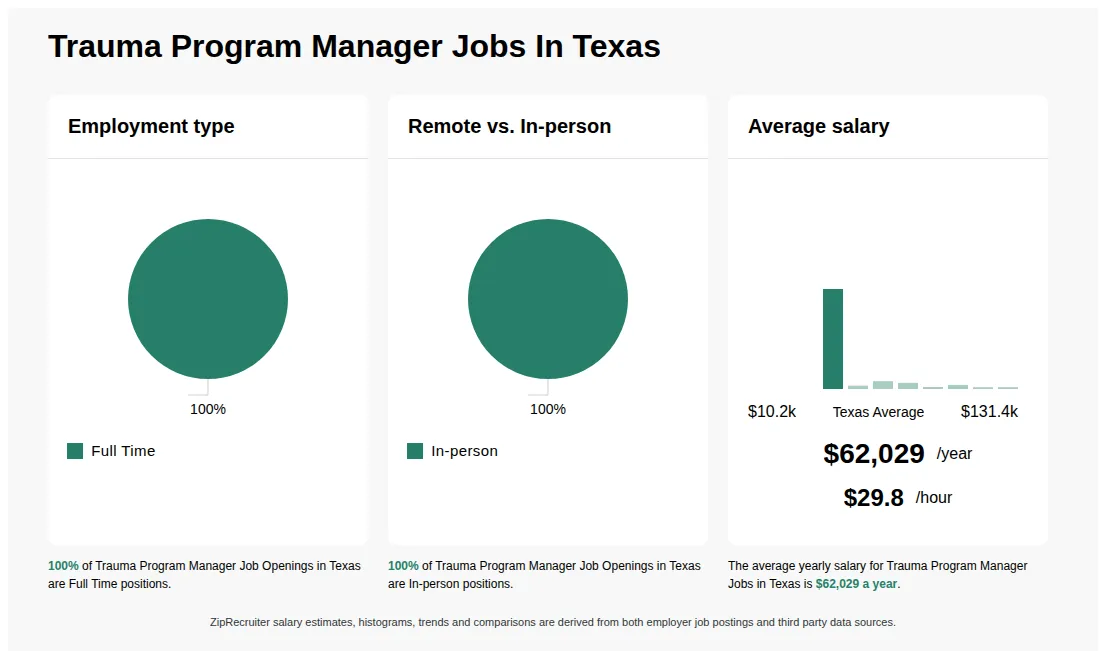
As of Jun 13, 2026, the average yearly pay for trauma program manager in Texas is $62,029.00, according to ZipRecruiter salary data. Most workers in this role earn between $45,700.00 and $55,900.00 per year, depending on experience, location, and employer.

How to heal from past work trauma?

A Trauma Program Manager can address work-related trauma by implementing strategies such as seeking professional counseling, practicing stress management techniques, and establishing healthy boundaries. Developing resilience and utilizing skills like emotional intelligence can also aid in recovery and prevent future burnout.

What jobs pay 2000 a day?

Trauma Program Managers typically do not earn $2,000 a day; such high daily rates are more common in specialized consulting, executive-level roles, or freelance medical experts. High-paying jobs in healthcare or management often involve extensive experience, certifications, and sometimes contract or consulting work that can command daily rates of this level.

What are Trauma Program Managers?

Trauma Program Managers are healthcare professionals, often nurses, responsible for overseeing and coordinating all aspects of a hospital's trauma program. They ensure that trauma care meets regulatory standards and guidelines, manage trauma team operations, and facilitate quality improvement initiatives. Their role also includes staff education, data collection, and reporting to ensure optimal patient outcomes and compliance with accreditation bodies such as the American College of Surgeons. Trauma Program Managers serve as liaisons between hospital administration, medical staff, and external agencies.

How does a Trauma Program Manager typically collaborate with multidisciplinary teams to improve patient outcomes?

A Trauma Program Manager regularly works with physicians, nurses, trauma registrars, and ancillary staff to coordinate care and ensure compliance with trauma center standards. They facilitate multidisciplinary meetings, oversee performance improvement initiatives, and review trauma cases to identify areas for quality enhancement. By fostering open communication and providing education across departments, the Trauma Program Manager helps drive process improvements that directly impact patient outcomes and maintain trauma center accreditation.

What are the key skills and qualifications needed to thrive as a Trauma Program Manager, and why are they important?

To thrive as a Trauma Program Manager, you need expertise in trauma nursing or emergency care, a bachelor’s or master’s degree in nursing, and a valid RN license, often complemented by experience in trauma program coordination. Familiarity with trauma registry databases, performance improvement processes, and certifications like TNCC (Trauma Nursing Core Course) or ATCN (Advanced Trauma Care for Nurses) is typically required. Strong leadership, organizational, and communication skills are crucial for managing multidisciplinary teams and ensuring compliance with trauma system standards. These competencies are vital for maintaining high standards of patient care, facilitating continuous quality improvement, and ensuring the trauma program meets accreditation requirements.

How much do trauma program managers make?

Trauma program managers typically earn a median annual salary of around $80,000 to $100,000, depending on experience, location, and the size of the healthcare facility. They often require certifications such as Certified Trauma Services Manager (CTSM) and have strong leadership and clinical skills. Salaries can vary based on the complexity of trauma programs and organizational budgets.

How much does a trauma program manager make?

The average salary for a trauma program manager in Texas ranges from $70,000 to $100,000 annually, depending on experience, certifications, and the size of the healthcare facility. Salaries may also include benefits such as health insurance and retirement plans, and the role often requires strong leadership and knowledge of trauma protocols and healthcare regulations.

What Does a Trauma Program Manager Do?

A trauma program manager (TPM) develops and oversees all operational nursing issues related to emergency trauma care at a hospital or medical facility. As a TPM, you manage all nurses in the trauma center and report to the trauma program director. Your responsibilities include improving the flow of patients through the center, coordinating care systems for different types of trauma, and contributing to the development and implementation of clinical treatment for all trauma patients. In performing your duties, you work closely with other nurses, physicians, surgeons, and medical staff to ensure this program is working smoothly and to address any issues in care delivery.


What is the difference between Trauma Program Manager vs Trauma Coordinator?

Trauma Program ManagerTrauma Coordinator
Oversees the entire trauma program, manages staff, develops policies, and ensures compliance with regulations.Supports trauma team operations, assists with patient care coordination, and maintains trauma registry data.

Both roles require knowledge of trauma protocols and certifications like TNCC or ATCN. The Trauma Program Manager typically has more administrative responsibilities, while the Trauma Coordinator focuses on clinical support and data management. Employers in hospitals and trauma centers often use both titles, with the Program Manager holding a broader leadership role. Understanding these differences helps in choosing the right career path or job search focus.

What are the most commonly searched types of Trauma Program jobs in Texas? The most popular types of Trauma Program jobs in Texas are:
What are popular job titles related to Trauma Program Manager jobs in Texas? For Trauma Program Manager jobs in Texas, the most frequently searched job titles are:
What job categories do people searching Trauma Program Manager jobs in Texas look for? The top searched job categories for Trauma Program Manager jobs in Texas are:
What cities in Texas are hiring for Trauma Program Manager jobs? Cities in Texas with the most Trauma Program Manager job openings:
Trauma Registrar

Full-time

Posted 22 days ago


Longview Regional Medical Center rating

6.3

Company rating: 6.3 out of 10

Based on 13 frontline employees who took The Breakroom Quiz

750th of 999 rated hospitals


Job description

Job Description Job Summary
The Trauma Registrar is responsible for collecting, entering, and maintaining comprehensive trauma patient data in the trauma registry database. This role ensures the accuracy, completeness, and integrity of trauma data to support quality improvement, performance monitoring, research, and compliance with state and national trauma reporting standards. The Trauma Registrar collaborates closely with trauma program leadership, clinical teams, and regulatory bodies to support trauma program goals and accreditation readiness.
Essential Functions
  • Identifies eligible trauma patients for inclusion in the trauma registry based on established criteria.
  • Enters and maintains detailed trauma data, including demographic, clinical, procedural, and outcome information, in the trauma registry system.
  • Reviews medical records and provider documentation to ensure accuracy, completeness, and consistency of data.
  • Performs regular audits and validation of trauma registry data to ensure data integrity and compliance with internal and external standards.
  • Generates reports for use by trauma program leadership, clinical teams, regulatory agencies, and national databases.
  • Supports the trauma program’s performance improvement initiatives by compiling data for quality assurance and benchmarking.
  • Tracks trauma outcomes such as length of stay, complications, mortality, and readmissions for internal and external reporting.
  • Assists with preparations for trauma center re-verification, including documentation review and submission of required data.
  • Collaborates with the Trauma Program Manager/Director, trauma medical staff, and emergency department personnel to facilitate accurate data collection and process improvements.
  • Ensures compliance with trauma data submission guidelines, including those outlined by the American College of Surgeons (ACS), state trauma systems, and other accrediting bodies.
  • Performs other duties as assigned.
  • Maintains regular and reliable attendance.
  • Complies with all policies and standards.
Qualifications
  • 0-2 years of experience in a healthcare setting including patient registration, medical office scheduling, or front desk/admissions required and
  • 0-2 years of experience in customer service required
  • 1-2 years of experience with trauma registry databases (e.g., NTDB, TRACS, or similar systems) and familiarity with ICD coding preferred
Knowledge, Skills and Abilities
  • Strong understanding of medical terminology, anatomy, and physiology.
  • Knowledge of trauma coding guidelines, data abstraction methods, and registry inclusion criteria.
  • Familiarity with national trauma standards, including those from ACS and state trauma systems.
  • Excellent attention to detail and commitment to data accuracy.
  • Proficiency with trauma registry software, electronic health records, and Microsoft Office applications.
  • Strong organizational and time management skills.
  • Ability to maintain confidentiality and adhere to data privacy standards.
  • Effective written and verbal communication skills.
Licenses and Certifications
  • ATSRCB - Certified Trauma Registrar preferred

What Longview Regional Medical Center employees say

Pay

Hours and flexibility

Workplace

Get the full story on Breakroom


Longview Regional Medical Center logo

About Longview Regional Medical Center

Sourced by ZipRecruiter

Longview Regional Medical Center is your community healthcare provider, a 224-bed facility. We believe in the power of people to create great care. We're 185 active physicians strong, and quality-driven, nationally recognized for chest pain and stroke care, and dedicated to great patient service, with multi-specialty clinical expertise. And we work hard every day to be a place of healing, caring and connection for patients and families in the community we call home.

Industry

Health care and social assistance

Company size

501 - 1,000 Employees

Headquarters location

Longview, TX, US

Year founded

1980

Social media