Trauma Registrar RN
College Station, TX · On-site
The Trauma Registrar works closely with the Trauma Program Manager, physicians, nurses, and other hospital staff to support trauma program quality improvement, reporting, research, and continued ...
College Station, TX · On-site
The Trauma Registrar works closely with the Trauma Program Manager, physicians, nurses, and other hospital staff to support trauma program quality improvement, reporting, research, and continued ...
College Station, TX · On-site
The Trauma Registrar works closely with the Trauma Program Manager, physicians, nurses, and other hospital staff to support trauma program quality improvement, reporting, research, and continued ...
College Station, TX · On-site
The Trauma Registrar works closely with the Trauma Program Manager, physicians, nurses, and other hospital staff to support trauma program quality improvement, reporting, research, and continued ...
College Station, TX · On-site
The Trauma Registrar works closely with the Trauma Program Manager, physicians, nurses, and other hospital staff to support trauma program quality improvement, reporting, research, and continued ...
Assists the Trauma Program Manager/Director with orienting and supporting Trauma Registry staff. This includes training, delegation, and reviewing individual and team productivity. * Provides ...
Assists the Trauma Program Manager/Director with orienting and supporting Trauma Registry staff. This includes training, delegation, and reviewing individual and team productivity. * Provides ...
Taylor, TX · On-site
$49K - $60K/yr
Job Summary The Manager of Trauma Programs 1 works with the Medical Director to set up and evaluate the trauma program. They oversee clinical care, education, research, and registry maintenance to ...
Taylor, TX · On-site
$49K - $60K/yr
Job Summary The Manager of Trauma Programs 1 works with the Medical Director to set up and evaluate the trauma program. They oversee clinical care, education, research, and registry maintenance to ...
Houston, TX · On-site
$60 - $80/hr
You'll work closely with the Trauma Registry Supervisor and Trauma Program Manager, ensuring database integrity and quality. To be successful, you will be self-motivated, with meticulous attention to ...
Houston, TX · On-site
$60 - $80/hr
You'll work closely with the Trauma Registry Supervisor and Trauma Program Manager, ensuring database integrity and quality. To be successful, you will be self-motivated, with meticulous attention to ...
Assists the Trauma Program Manager/Director with orienting and supporting Trauma Registry staff. This includes training, delegation, and reviewing individual and team productivity. * Provides ...
Assists the Trauma Program Manager/Director with orienting and supporting Trauma Registry staff. This includes training, delegation, and reviewing individual and team productivity. * Provides ...
College Station, TX · On-site
The Trauma Registrar works closely with the Trauma Program Manager, physicians, nurses, and other hospital staff to support trauma program quality improvement, reporting, research, and continued ...
College Station, TX · On-site
The Trauma Registrar works closely with the Trauma Program Manager, physicians, nurses, and other hospital staff to support trauma program quality improvement, reporting, research, and continued ...
The Trauma Program Manager partners with clinical and operational leaders to ensure trauma services meet state designation, American College of Surgeons (ACS), and organizational standards while ...
The Trauma Program Manager partners with clinical and operational leaders to ensure trauma services meet state designation, American College of Surgeons (ACS), and organizational standards while ...
... TMD), Trauma Program Manager (TPM) or Trauma Program Director (TPD), sub-specialists, nursing and medical teams, and ancillary services to coordinate all aspects of the Trauma Department ...
... TMD), Trauma Program Manager (TPM) or Trauma Program Director (TPD), sub-specialists, nursing and medical teams, and ancillary services to coordinate all aspects of the Trauma Department ...
Schertz, TX · On-site
... TMD), Trauma Program Manager (TPM) or Trauma Program Director (TPD), sub-specialists, nursing and medical teams, and ancillary services to coordinate all aspects of the Trauma Department ...
Schertz, TX · On-site
... TMD), Trauma Program Manager (TPM) or Trauma Program Director (TPD), sub-specialists, nursing and medical teams, and ancillary services to coordinate all aspects of the Trauma Department ...
San Antonio, TX · On-site
... TMD), Trauma Program Manager (TPM) or Trauma Program Director (TPD), sub-specialists, nursing and medical teams, and ancillary services to coordinate all aspects of the Trauma Department ...
San Antonio, TX · On-site
... TMD), Trauma Program Manager (TPM) or Trauma Program Director (TPD), sub-specialists, nursing and medical teams, and ancillary services to coordinate all aspects of the Trauma Department ...
San Antonio, TX · On-site
... TMD), Trauma Program Manager (TPM) or Trauma Program Director (TPD), sub-specialists, nursing and medical teams, and ancillary services to coordinate all aspects of the Trauma Department ...
San Antonio, TX · On-site
... TMD), Trauma Program Manager (TPM) or Trauma Program Director (TPD), sub-specialists, nursing and medical teams, and ancillary services to coordinate all aspects of the Trauma Department ...
Cibolo, TX · On-site
... TMD), Trauma Program Manager (TPM) or Trauma Program Director (TPD), sub-specialists, nursing and medical teams, and ancillary services to coordinate all aspects of the Trauma Department ...
Cibolo, TX · On-site
... TMD), Trauma Program Manager (TPM) or Trauma Program Director (TPD), sub-specialists, nursing and medical teams, and ancillary services to coordinate all aspects of the Trauma Department ...
... TMD), Trauma Program Manager (TPM) or Trauma Program Director (TPD), sub-specialists, nursing and medical teams, and ancillary services to coordinate all aspects of the Trauma Department ...
... TMD), Trauma Program Manager (TPM) or Trauma Program Director (TPD), sub-specialists, nursing and medical teams, and ancillary services to coordinate all aspects of the Trauma Department ...
San Antonio, TX · On-site
... TMD), Trauma Program Manager (TPM) or Trauma Program Director (TPD), sub-specialists, nursing and medical teams, and ancillary services to coordinate all aspects of the Trauma Department ...
San Antonio, TX · On-site
... TMD), Trauma Program Manager (TPM) or Trauma Program Director (TPD), sub-specialists, nursing and medical teams, and ancillary services to coordinate all aspects of the Trauma Department ...
San Antonio, TX · On-site
... TMD), Trauma Program Manager (TPM) or Trauma Program Director (TPD), sub-specialists, nursing and medical teams, and ancillary services to coordinate all aspects of the Trauma Department ...
San Antonio, TX · On-site
... TMD), Trauma Program Manager (TPM) or Trauma Program Director (TPD), sub-specialists, nursing and medical teams, and ancillary services to coordinate all aspects of the Trauma Department ...
San Antonio, TX · On-site
... TMD), Trauma Program Manager (TPM) or Trauma Program Director (TPD), sub-specialists, nursing and medical teams, and ancillary services to coordinate all aspects of the Trauma Department ...
San Antonio, TX · On-site
... TMD), Trauma Program Manager (TPM) or Trauma Program Director (TPD), sub-specialists, nursing and medical teams, and ancillary services to coordinate all aspects of the Trauma Department ...
Schertz, TX · On-site
... TMD), Trauma Program Manager (TPM) or Trauma Program Director (TPD), sub-specialists, nursing and medical teams, and ancillary services to coordinate all aspects of the Trauma Department ...
Schertz, TX · On-site
... TMD), Trauma Program Manager (TPM) or Trauma Program Director (TPD), sub-specialists, nursing and medical teams, and ancillary services to coordinate all aspects of the Trauma Department ...
San Antonio, TX · On-site
The Trauma Performance Improvement (PI) Coordinator works in collaboration with the Trauma Medical Director (TMD), Trauma Program Manager (TPM) or Trauma Program Director (TPD), sub-specialists ...
New
San Antonio, TX · On-site
The Trauma Performance Improvement (PI) Coordinator works in collaboration with the Trauma Medical Director (TMD), Trauma Program Manager (TPM) or Trauma Program Director (TPD), sub-specialists ...
New
Responsible for Trauma Registry Data base management and promptly communicates data base related issues to the Trauma Program leadership. * Analyses trauma registry data for epidemiological and ...
Responsible for Trauma Registry Data base management and promptly communicates data base related issues to the Trauma Program leadership. * Analyses trauma registry data for epidemiological and ...
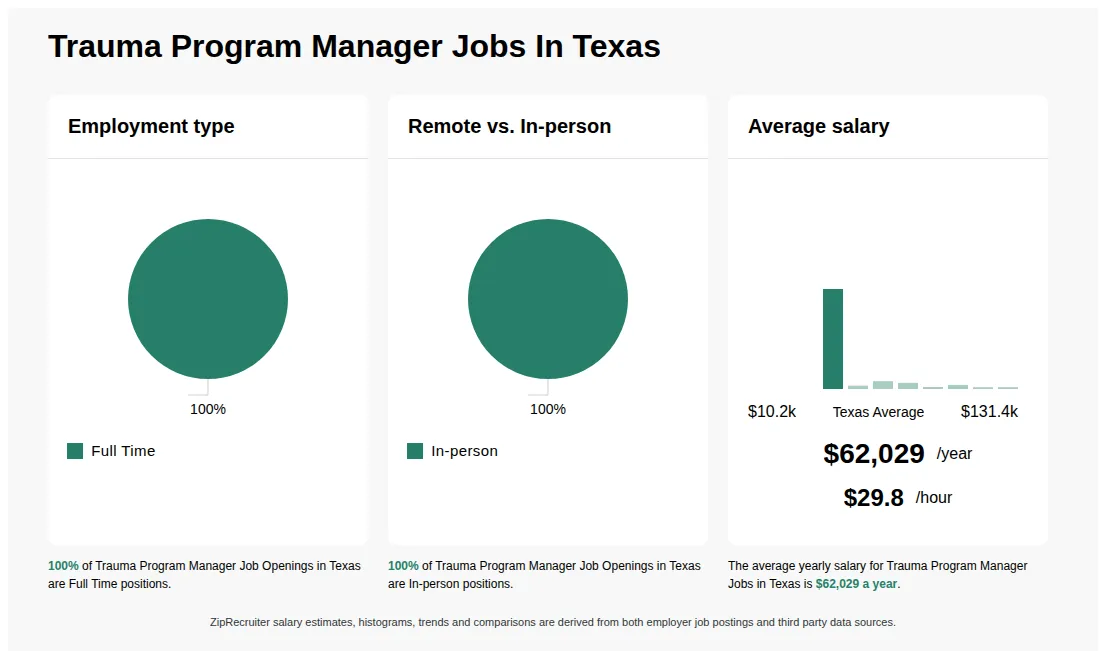
$10.2K - $21.3K
0% of jobs
$21.3K - $32.3K
0% of jobs
$32.3K - $43.3K
0% of jobs
$46.7K is the 25th percentile. Wages below this are outliers.
$43.3K - $54.3K
81% of jobs
$54.3K - $65.3K
2% of jobs
$65.3K - $76.3K
6% of jobs
$76.3K - $87.3K
4% of jobs
$87.3K - $98.3K
1% of jobs
$98.3K - $109.3K
3% of jobs
$109.3K - $120.4K
1% of jobs
$120.4K - $131.4K
1% of jobs
$10.2K
$62K
$131.4K
A trauma program manager (TPM) develops and oversees all operational nursing issues related to emergency trauma care at a hospital or medical facility. As a TPM, you manage all nurses in the trauma center and report to the trauma program director. Your responsibilities include improving the flow of patients through the center, coordinating care systems for different types of trauma, and contributing to the development and implementation of clinical treatment for all trauma patients. In performing your duties, you work closely with other nurses, physicians, surgeons, and medical staff to ensure this program is working smoothly and to address any issues in care delivery.
| Trauma Program Manager | Trauma Coordinator |
|---|---|
| Oversees the entire trauma program, manages staff, develops policies, and ensures compliance with regulations. | Supports trauma team operations, assists with patient care coordination, and maintains trauma registry data. |
Both roles require knowledge of trauma protocols and certifications like TNCC or ATCN. The Trauma Program Manager typically has more administrative responsibilities, while the Trauma Coordinator focuses on clinical support and data management. Employers in hospitals and trauma centers often use both titles, with the Program Manager holding a broader leadership role. Understanding these differences helps in choosing the right career path or job search focus.
The most popular types of Trauma Program jobs in Texas are:
For Trauma Program Manager jobs in Texas, the most frequently searched job titles are:
The top searched job categories for Trauma Program Manager jobs in Texas are:
Cities in Texas with the most Trauma Program Manager job openings:

Full-time
Medical, Retirement, PTO
Re-posted 8 days ago
7.4
Based on 775 frontline employees who took The Breakroom Quiz
263rd of 898 rated healthcare providers
Here at Baylor Scott & White Health we promote the well-being of all individuals, families, and communities. Baylor Scott and White is the largest not-for-profit healthcare system in Texas that empowers you to live well.
Our Core Values are:
Our benefits are designed to help you live well no matter where you are on your journey. For full details on coverage and eligibility, visit the Baylor Scott & White Benefits Hub to explore our offerings, which may include:
Note: Benefits may vary based upon position type and/or level.
Job SummaryAs a Trauma Registrar RN, you will support the Trauma Program by maintaining a complete, accurate, and high-quality trauma registry. You will identify and abstract trauma cases from the medical record, enter and validate required data, and ensure information is maintained according to established trauma registry standards and regulatory requirements.
This role requires strong clinical knowledge, attention to detail, organization, and the ability to accurately interpret medical records. The Trauma Registrar works closely with the Trauma Program Manager, physicians, nurses, and other hospital staff to support trauma program quality improvement, reporting, research, and continued trauma designation.
Essential Functions of the RoleWe believe that all people should feel welcomed, valued and supported.
Qualifications
Get the full story on Breakroom

Sourced by ZipRecruiter
Outpatient health care and health care and social assistance
10,000+ Employees
Dallas, TX, US