RN Trauma PI Coordinator
Schertz, TX · On-site
... TMD), Trauma Program Manager (TPM) or Trauma Program Director (TPD), sub-specialists, nursing and medical teams, and ancillary services to coordinate all aspects of the Trauma Department ...
Schertz, TX · On-site
... TMD), Trauma Program Manager (TPM) or Trauma Program Director (TPD), sub-specialists, nursing and medical teams, and ancillary services to coordinate all aspects of the Trauma Department ...
Schertz, TX · On-site
... TMD), Trauma Program Manager (TPM) or Trauma Program Director (TPD), sub-specialists, nursing and medical teams, and ancillary services to coordinate all aspects of the Trauma Department ...
San Antonio, TX · On-site
The Trauma Performance Improvement (PI) Coordinator works in collaboration with the Trauma Medical Director (TMD), Trauma Program Manager (TPM) or Trauma Program Director (TPD), sub-specialists ...
San Antonio, TX · On-site
The Trauma Performance Improvement (PI) Coordinator works in collaboration with the Trauma Medical Director (TMD), Trauma Program Manager (TPM) or Trauma Program Director (TPD), sub-specialists ...
Cibolo, TX · On-site
... TMD), Trauma Program Manager (TPM) or Trauma Program Director (TPD), sub-specialists, nursing and medical teams, and ancillary services to coordinate all aspects of the Trauma Department ...
Cibolo, TX · On-site
... TMD), Trauma Program Manager (TPM) or Trauma Program Director (TPD), sub-specialists, nursing and medical teams, and ancillary services to coordinate all aspects of the Trauma Department ...
San Antonio, TX · On-site
The Trauma Performance Improvement (PI) Coordinator works in collaboration with the Trauma Medical Director (TMD), Trauma Program Manager (TPM) or Trauma Program Director (TPD), sub-specialists ...
San Antonio, TX · On-site
The Trauma Performance Improvement (PI) Coordinator works in collaboration with the Trauma Medical Director (TMD), Trauma Program Manager (TPM) or Trauma Program Director (TPD), sub-specialists ...
Responsible for Trauma Registry Data base management and promptly communicates data base related issues to the Trauma Program leadership. * Analyses trauma registry data for epidemiological and ...
Responsible for Trauma Registry Data base management and promptly communicates data base related issues to the Trauma Program leadership. * Analyses trauma registry data for epidemiological and ...
The Trauma Program Manager partners with clinical and operational leaders to ensure trauma services meet state designation, American College of Surgeons (ACS), and organizational standards while ...
The Trauma Program Manager partners with clinical and operational leaders to ensure trauma services meet state designation, American College of Surgeons (ACS), and organizational standards while ...
Responsible for Trauma Registry Data base management and promptly communicates data base related issues to the Trauma Program leadership. Analyses trauma registry data for epidemiological and ...
Responsible for Trauma Registry Data base management and promptly communicates data base related issues to the Trauma Program leadership. Analyses trauma registry data for epidemiological and ...
Responsible for Trauma Registry Data base management and promptly communicates data base related issues to the Trauma Program leadership. * Analyses trauma registry data for epidemiological and ...
Responsible for Trauma Registry Data base management and promptly communicates data base related issues to the Trauma Program leadership. * Analyses trauma registry data for epidemiological and ...
You'll manage the Trauma Performance Enhancement Program. You'll oversee trauma care services to ensure excellent attention and recovery for patients. Also, you'll organize performance enhancement ...
You'll manage the Trauma Performance Enhancement Program. You'll oversee trauma care services to ensure excellent attention and recovery for patients. Also, you'll organize performance enhancement ...
You'll manage the Trauma Performance Enhancement Program. You'll oversee trauma care services to ensure excellent attention and recovery for patients. Also, you'll organize performance enhancement ...
You'll manage the Trauma Performance Enhancement Program. You'll oversee trauma care services to ensure excellent attention and recovery for patients. Also, you'll organize performance enhancement ...
You'll manage the Trauma Performance Enhancement Program. You'll oversee trauma care services to ensure excellent attention and recovery for patients. Also, you'll organize performance enhancement ...
You'll manage the Trauma Performance Enhancement Program. You'll oversee trauma care services to ensure excellent attention and recovery for patients. Also, you'll organize performance enhancement ...
The ideal candidate is comfortable independently managing a busy emergency general surgery service, operating across the full breadth of acute care surgery, and leading continued trauma program ...
The ideal candidate is comfortable independently managing a busy emergency general surgery service, operating across the full breadth of acute care surgery, and leading continued trauma program ...
Responsible for Trauma Registry Data base management and promptly communicates data base related ... Communicates trends that may impact Trauma Program performance, injury prevention initiatives, or ...
Responsible for Trauma Registry Data base management and promptly communicates data base related ... Communicates trends that may impact Trauma Program performance, injury prevention initiatives, or ...
Responsible for Trauma Registry Data base management and promptly communicates data base related issues to the Trauma Program leadership. * Analyses trauma registry data for epidemiological and ...
Responsible for Trauma Registry Data base management and promptly communicates data base related issues to the Trauma Program leadership. * Analyses trauma registry data for epidemiological and ...
Responsible for Trauma Registry Data base management and promptly communicates data base related issues to the Trauma Program leadership. Analyses trauma registry data for epidemiological and ...
Responsible for Trauma Registry Data base management and promptly communicates data base related issues to the Trauma Program leadership. Analyses trauma registry data for epidemiological and ...
Responsible for Trauma Registry Data base management and promptly communicates data base related ... Communicates trends that may impact Trauma Program performance, injury prevention initiatives, or ...
Responsible for Trauma Registry Data base management and promptly communicates data base related ... Communicates trends that may impact Trauma Program performance, injury prevention initiatives, or ...
Responsible for Trauma Registry Data base management and promptly communicates data base related ... Communicates trends that may impact Trauma Program performance, injury prevention initiatives, or ...
Responsible for Trauma Registry Data base management and promptly communicates data base related ... Communicates trends that may impact Trauma Program performance, injury prevention initiatives, or ...
Responsible for Trauma Registry Data base management and promptly communicates data base related issues to the Trauma Program leadership. * Analyses trauma registry data for epidemiological and ...
Responsible for Trauma Registry Data base management and promptly communicates data base related issues to the Trauma Program leadership. * Analyses trauma registry data for epidemiological and ...
Responsible for Trauma Registry Data base management and promptly communicates data base related issues to the Trauma Program leadership. * Analyses trauma registry data for epidemiological and ...
Responsible for Trauma Registry Data base management and promptly communicates data base related issues to the Trauma Program leadership. * Analyses trauma registry data for epidemiological and ...
Houston, TX · On-site
$21.96 - $31.01/hr
You'll work closely with the Trauma Registry Supervisor and Trauma Program Manager, ensuring database integrity and quality. To be successful, you will be self-motivated, with meticulous attention to ...
Houston, TX · On-site
$21.96 - $31.01/hr
You'll work closely with the Trauma Registry Supervisor and Trauma Program Manager, ensuring database integrity and quality. To be successful, you will be self-motivated, with meticulous attention to ...
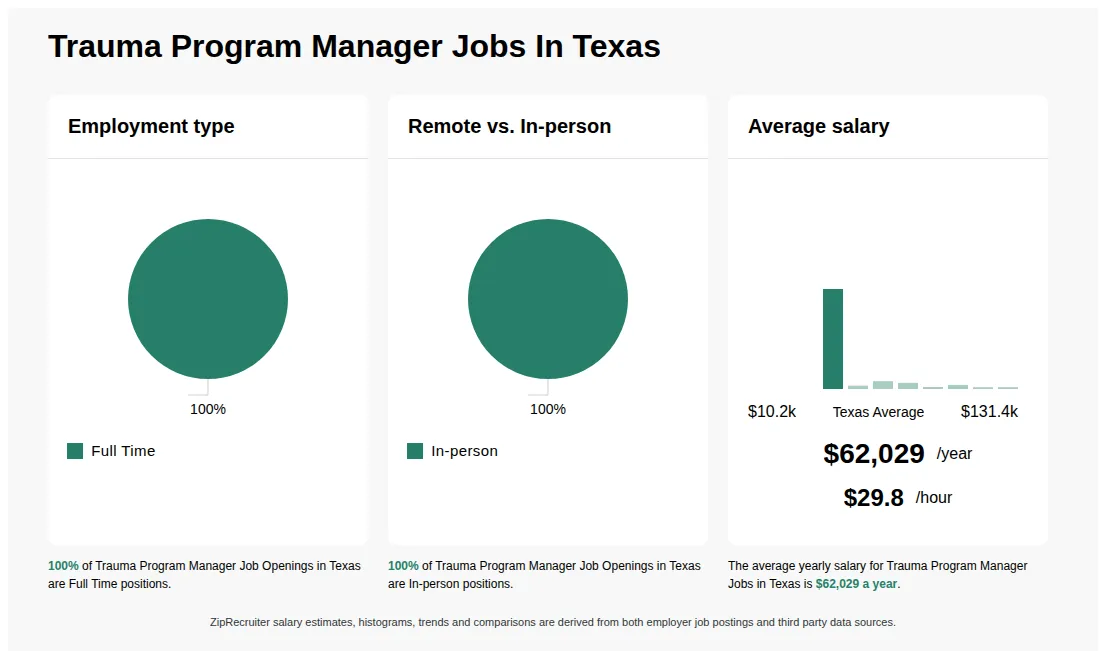
$10.2K - $21.3K
0% of jobs
$21.3K - $32.3K
0% of jobs
$32.3K - $43.3K
0% of jobs
$46.7K is the 25th percentile. Wages below this are outliers.
$43.3K - $54.3K
81% of jobs
$54.3K - $65.3K
2% of jobs
$65.3K - $76.3K
6% of jobs
$76.3K - $87.3K
4% of jobs
$87.3K - $98.3K
1% of jobs
$98.3K - $109.3K
3% of jobs
$109.3K - $120.4K
1% of jobs
$120.4K - $131.4K
1% of jobs
$10.2K
$62K
$131.4K
A trauma program manager (TPM) develops and oversees all operational nursing issues related to emergency trauma care at a hospital or medical facility. As a TPM, you manage all nurses in the trauma center and report to the trauma program director. Your responsibilities include improving the flow of patients through the center, coordinating care systems for different types of trauma, and contributing to the development and implementation of clinical treatment for all trauma patients. In performing your duties, you work closely with other nurses, physicians, surgeons, and medical staff to ensure this program is working smoothly and to address any issues in care delivery.
| Trauma Program Manager | Trauma Coordinator |
|---|---|
| Oversees the entire trauma program, manages staff, develops policies, and ensures compliance with regulations. | Supports trauma team operations, assists with patient care coordination, and maintains trauma registry data. |
Both roles require knowledge of trauma protocols and certifications like TNCC or ATCN. The Trauma Program Manager typically has more administrative responsibilities, while the Trauma Coordinator focuses on clinical support and data management. Employers in hospitals and trauma centers often use both titles, with the Program Manager holding a broader leadership role. Understanding these differences helps in choosing the right career path or job search focus.
The most popular types of Trauma Program jobs in Texas are:
For Trauma Program Manager jobs in Texas, the most frequently searched job titles are:
The top searched job categories for Trauma Program Manager jobs in Texas are:
Cities in Texas with the most Trauma Program Manager job openings:

Schertz, TX • On-site
Other
Medical, Dental, Vision, Life, Retirement, PTO
Re-posted 22 days ago
Coordinate all aspects of the Trauma Department's Performance Improvement and Patient Safety (PIPS) Program in collaboration with medical and nursing teams.
Conduct performance reviews of the continuum of care, identify quality issues, and implement action plans to improve patient outcomes and safety.
Enter PI information into the Trauma Registry and/or Trauma PI database, track and report quality issues, and prepare cases for PI and peer review meetings.
6.9
Based on 17 frontline employees who took The Breakroom Quiz
Do you have the career opportunities as a(an) RN Trauma PI Coordinator you want with your current employer? We have an exciting opportunity for you to join Methodist Healthcare which is part of the nation's leading provider of healthcare services, HCA Healthcare.
Job Summary and QualificationsThe Trauma Performance Improvement (PI) Coordinator works in collaboration with the Trauma Medical Director (TMD), Trauma Program Manager (TPM) or Trauma Program Director (TPD), sub-specialists, nursing and medical teams, and ancillary services to coordinate all aspects of the Trauma Department’s Performance Improvement and Patient Safety (PIPS) Program. The Trauma PI Coordinator conducts performance reviews of the continuum of care from the prehospital setting to hospital discharge and determines compliance with patient care practice management guidelines, policies, procedures, and established standards of care. The Trauma PI Coordinator possesses in-depth knowledge of chart abstraction and the trauma registry, including reporting, data analysis, trend identification and benchmarking of outcomes based upon the Texas Department of State Health Services (DSHS), as well as regional standards and recommendations for quality and maintenance for trauma center designation/re-designation. The Trauma PI Coordinator will assume 24-hour responsibility for the coordination of nursing care of trauma patients throughout the hospital. Must ensure that the trauma services for MHS are in constant compliance with TJC and state regulations appropriate for the level of trauma designation maintained in the various facilities.
Your role will include:
Methodist Healthcare, offers a total rewards package that supports the health, life, career and retirement of our colleagues. The available plans and programs include:
Learn more about Employee Benefits
Note: Eligibility for benefits may vary by location.
HCA Healthcare (Corporate), based in Nashville, Tennessee, supports a variety of corporate roles from business operations to administrative positions. Like our colleagues in any HCA Healthcare hospital, our corporate campus employees enjoy unparalleled resources and opportunities to reach their potential as healthcare leaders and innovators. From market rate compensation to continuing education and career advancement opportunities, every person has a solid foundation for success. Nashville is also home to our Executive Development Program, where exceptional employees are groomed to take on CNO- and COO-level roles in our hospitals. This selective program focuses on ethics, leadership and the financial and clinical knowledge required of professionals at this level of the industry.
HCA Healthcare has been recognized as one of the World’s Most Ethical Companies® by the Ethisphere Institute more than ten times. In recent years, HCA Healthcare spent an estimated $3.7 billion in cost for the delivery of charitable care, uninsured discounts, and other uncompensated expenses.
If you are looking for an opportunity that provides satisfaction and personal growth, we encourage you to apply for our RN Trauma PI Coordinator opening. We promptly review all applications. Highly qualified candidates will be contacted for interviews. Unlock the possibilities and apply today!
We are an equal opportunity employer. We do not discriminate on the basis of race, religion, color, national origin, gender, sexual orientation, age, marital status, veteran status, or disability status.
Get the full story on Breakroom

Sourced by ZipRecruiter
Hospitals
10,000+ Employees
Memphis, TN, US
1918