Trainmaster
Saint Paul, MN · On-site
The Trainmaster will deliver efficient movement of traffic within the road territory and yard-terminal by developing, coordinating and ensuring the daily yard-terminal/road operating plan is ...
Saint Paul, MN · On-site
The Trainmaster will deliver efficient movement of traffic within the road territory and yard-terminal by developing, coordinating and ensuring the daily yard-terminal/road operating plan is ...
Saint Paul, MN · On-site
The Trainmaster will deliver efficient movement of traffic within the road territory and yard-terminal by developing, coordinating and ensuring the daily yard-terminal/road operating plan is ...
De Queen, AR · On-site
The Trainmaster will deliver efficient movement of traffic within the road territory and yard-terminal by developing, coordinating and ensuring the daily yard-terminal/road operating plan is ...
De Queen, AR · On-site
The Trainmaster will deliver efficient movement of traffic within the road territory and yard-terminal by developing, coordinating and ensuring the daily yard-terminal/road operating plan is ...
Washington, DC · On-site
$114K - $119K/yr
The Trainmaster ensures safe and efficient train operations and management of train and engine service employees for Washington, DC. Essential Functions * Oversight of the operation in connection ...
Washington, DC · On-site
$114K - $119K/yr
The Trainmaster ensures safe and efficient train operations and management of train and engine service employees for Washington, DC. Essential Functions * Oversight of the operation in connection ...
Washington, DC · On-site
$114K - $119K/yr
The Trainmaster ensures safe and efficient train operations and management of train and engine service employees for Washington, DC. Essential Functions * Oversight of the operation in connection ...
Washington, DC · On-site
$114K - $119K/yr
The Trainmaster ensures safe and efficient train operations and management of train and engine service employees for Washington, DC. Essential Functions * Oversight of the operation in connection ...
Kansas City, MO · On-site
The Trainmaster will deliver efficient movement of traffic within the road territory and yard-terminal by developing, coordinating and ensuring the daily yard-terminal/road operating plan is ...
Kansas City, MO · On-site
The Trainmaster will deliver efficient movement of traffic within the road territory and yard-terminal by developing, coordinating and ensuring the daily yard-terminal/road operating plan is ...
Washington, DC · On-site
$114K - $119K/yr
The Trainmaster ensures safe and efficient train operations and management of train and engine service employees for Washington, DC. Essential Functions * Oversight of the operation in connection ...
Washington, DC · On-site
$114K - $119K/yr
The Trainmaster ensures safe and efficient train operations and management of train and engine service employees for Washington, DC. Essential Functions * Oversight of the operation in connection ...
Washington, DC · On-site
$114K - $119K/yr
The Trainmaster ensures safe and efficient train operations and management of train and engine service employees for Washington, DC. Essential Functions * Oversight of the operation in connection ...
Washington, DC · On-site
$114K - $119K/yr
The Trainmaster ensures safe and efficient train operations and management of train and engine service employees for Washington, DC. Essential Functions * Oversight of the operation in connection ...
Bensenville, IL · On-site
The Trainmaster will deliver efficient movement of traffic within the road territory and yard-terminal by developing, coordinating and ensuring the daily yard-terminal/road operating plan is ...
Bensenville, IL · On-site
The Trainmaster will deliver efficient movement of traffic within the road territory and yard-terminal by developing, coordinating and ensuring the daily yard-terminal/road operating plan is ...
Plaquemine, LA · On-site
$75K - $85K/yr
Trainmaster - Systemwide Job Location: Plaquemine, LA Facility-Plaquemine-70764 Office Location: Onsite Employment Type: Salary Job Type: Full Time Start a Watco Career and Discover the Difference ...
Plaquemine, LA · On-site
$75K - $85K/yr
Trainmaster - Systemwide Job Location: Plaquemine, LA Facility-Plaquemine-70764 Office Location: Onsite Employment Type: Salary Job Type: Full Time Start a Watco Career and Discover the Difference ...
Night Trainmaster Cherryvale, KS Supervises and coordinates activities of train crew engaged in switching railroad cars within rail yard, industrial plant, or similar locations. Facilitate loading ...
Night Trainmaster Cherryvale, KS Supervises and coordinates activities of train crew engaged in switching railroad cars within rail yard, industrial plant, or similar locations. Facilitate loading ...
Kalamazoo, MI · On-site
Trainmaster - Kalamazoo, MI Job Location: Kalamazoo, MI Depot-49048 Office Location: Onsite Employment Type: Salary Job Type: Full Time Start a Watco Career and Discover the Difference Keep the world ...
Kalamazoo, MI · On-site
Trainmaster - Kalamazoo, MI Job Location: Kalamazoo, MI Depot-49048 Office Location: Onsite Employment Type: Salary Job Type: Full Time Start a Watco Career and Discover the Difference Keep the world ...
The Trainmaster position is an experienced, full-time, exempt salaried supervisory role of Wheeling & Lake Erie Railway (W&LE). This position is responsible for the safe and efficient movement of ...
The Trainmaster position is an experienced, full-time, exempt salaried supervisory role of Wheeling & Lake Erie Railway (W&LE). This position is responsible for the safe and efficient movement of ...
Toledo, OH · On-site
Trainmaster - Toledo, OH Job Location: Toledo-OH-43608-Toledo-43608 Office Location: Onsite Employment Type: Salary Job Type: Full Time Start a Watco Career and Discover the Difference Keep the world ...
Toledo, OH · On-site
Trainmaster - Toledo, OH Job Location: Toledo-OH-43608-Toledo-43608 Office Location: Onsite Employment Type: Salary Job Type: Full Time Start a Watco Career and Discover the Difference Keep the world ...
Toledo, OH · On-site
Trainmaster - Toledo, OH Job Location: Toledo-OH-43608-Toledo-43608 Office Location: Onsite Employment Type: Salary Job Type: Full Time Start a Watco Career and Discover the Difference Keep the world ...
Toledo, OH · On-site
Trainmaster - Toledo, OH Job Location: Toledo-OH-43608-Toledo-43608 Office Location: Onsite Employment Type: Salary Job Type: Full Time Start a Watco Career and Discover the Difference Keep the world ...
Kalamazoo, MI · On-site
Trainmaster - Kalamazoo, MI Job Location: Kalamazoo, MI Depot-49048 Office Location: Onsite Employment Type: Salary Job Type: Full Time Start a Watco Career and Discover the Difference Keep the world ...
Kalamazoo, MI · On-site
Trainmaster - Kalamazoo, MI Job Location: Kalamazoo, MI Depot-49048 Office Location: Onsite Employment Type: Salary Job Type: Full Time Start a Watco Career and Discover the Difference Keep the world ...
The Trainmaster position is an experienced, full-time, exempt salaried supervisory role of Wheeling & Lake Erie Railway (W&LE). This position is responsible for the safe and efficient movement of ...
The Trainmaster position is an experienced, full-time, exempt salaried supervisory role of Wheeling & Lake Erie Railway (W&LE). This position is responsible for the safe and efficient movement of ...
Leesville, LA · On-site
The Trainmaster will deliver efficient movement of traffic within the road territory and yard-terminal by developing, coordinating and ensuring the daily yard-terminal/road operating plan is ...
Leesville, LA · On-site
The Trainmaster will deliver efficient movement of traffic within the road territory and yard-terminal by developing, coordinating and ensuring the daily yard-terminal/road operating plan is ...
Night Trainmaster - SKOL Cherryvale, KS Job Location: Cherryvale, KS Depot1-66757 Office Location: Onsite Employment Type: Salary Job Type: Full Time Start a Watco Career and Discover the Difference ...
Night Trainmaster - SKOL Cherryvale, KS Job Location: Cherryvale, KS Depot1-66757 Office Location: Onsite Employment Type: Salary Job Type: Full Time Start a Watco Career and Discover the Difference ...
Gates, NY · On-site
Supervisor, Transportation Department The person in this position directly supervises up to ten employees in the Transportation Department and carries out supervisory responsibilities in accordance ...
Gates, NY · On-site
Supervisor, Transportation Department The person in this position directly supervises up to ten employees in the Transportation Department and carries out supervisory responsibilities in accordance ...
Duluth, MN · On-site
... to the Trainmaster and Assistant Superintendent for crossing accidents and incidents or site of an injury to support employee reaction, work with police and manage the site until the track and ...
Duluth, MN · On-site
... to the Trainmaster and Assistant Superintendent for crossing accidents and incidents or site of an injury to support employee reaction, work with police and manage the site until the track and ...
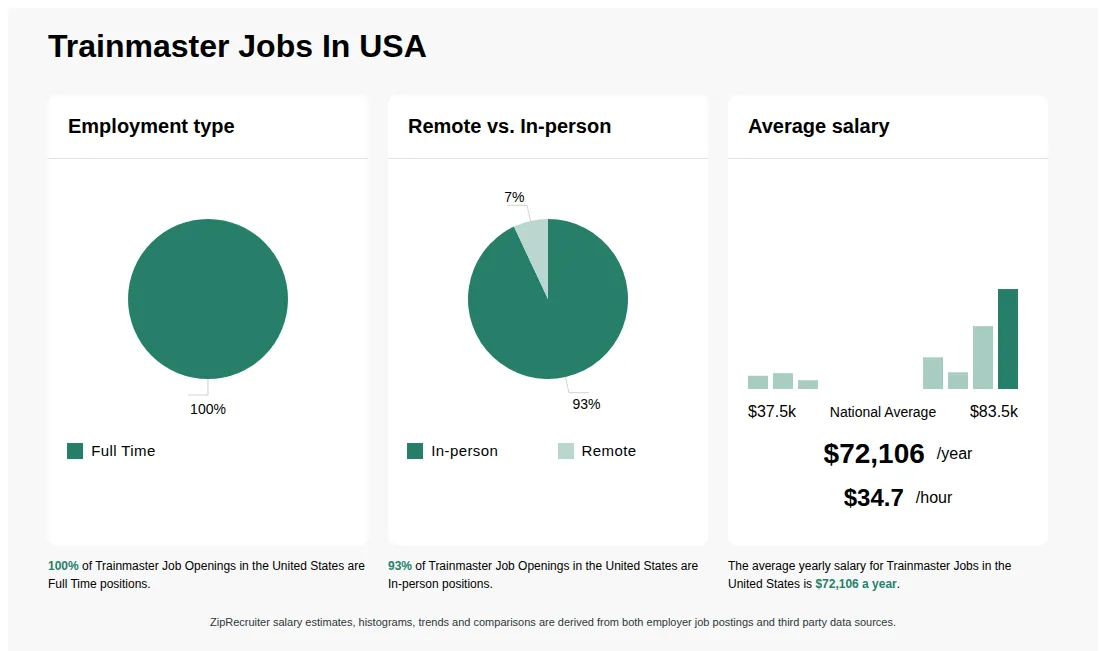
$37.5K - $41.7K
5% of jobs
$41.7K - $45.9K
6% of jobs
$45.9K - $50K
3% of jobs
$50K - $54.2K
0% of jobs
$54.2K - $58.4K
0% of jobs
$58.4K - $62.6K
0% of jobs
$62.6K - $66.8K
0% of jobs
$70.3K is the 25th percentile. Wages below this are outliers.
$66.8K - $71K
12% of jobs
$71K - $75.1K
6% of jobs
The median wage is $77.9K / yr.
$75.1K - $79.3K
26% of jobs
$81K is the 75th percentile. Wages above this are outliers.
$79.3K - $83.5K
41% of jobs
$37.5K
$72.1K
$83.5K
A Trainmaster is a railroad professional responsible for overseeing train operations, crew management, and ensuring safety and efficiency on the rail network. They coordinate train movements, enforce company policies, and respond to operational challenges. Trainmasters work closely with engineers, conductors, and dispatchers to maintain schedules and compliance with regulations. The role requires strong leadership, problem-solving skills, and knowledge of railroad procedures.
A Trainmaster's daily responsibilities include overseeing train operations within assigned territories, ensuring compliance with safety regulations, and coordinating with conductors, engineers, and yard personnel to maintain efficient schedules. They handle incident investigations, manage crew assignments, and monitor real-time train movements to respond to emergencies or delays. Trainmasters often conduct safety briefings and inspections, report operational issues to management, and work closely with both field staff and office teams. This role requires a balance of administrative duties and on-site supervision to maintain the smooth flow of rail operations.
To thrive as a Trainmaster, you need in-depth railroad operations experience, knowledge of federal safety regulations, and completion of relevant industry training or certifications. Familiarity with dispatching systems, track inspection protocols, incident reporting software, and operating rules manuals is essential. Strong leadership, problem-solving abilities, and effective communication are valuable soft skills for coordinating crews and resolving operational challenges. These competencies are crucial for ensuring safe, efficient train movements and managing complex rail logistics.
The most popular types of Trainmaster jobs are:
The top employers for Trainmaster jobs are:
States with the most job openings for Trainmaster jobs include:
The top searched job categories for Trainmaster jobs are:
For Trainmaster jobs, the most frequently searched job titles are:
Other
Medical, Vision, Retirement
This job post has expired 1 day ago. Applications are no longer accepted.
Join CPKC, North America's first transnational railroad connecting U.S. Canada and Mexico, where your career drives progress and safety is paramount. We connect communities, fuel economic growth, and provide meaningful work in a culture that values diversity, accountability, and pride. With opportunities for training, development, and advancement, you're not just building a career-you're part of something bigger. Together, we move goods, connect people, and create lasting change. Your future starts here.
PURPOSE OF THE POSITION:
The Trainmaster will deliver efficient movement of traffic within the road territory and yard-terminal by developing, coordinating and ensuring the daily yard-terminal/road operating plan is completed in a safe and cost-effective manner. The successful candidate will lead by example to build a strong safety culture along with providing coaching on operational standards.
POSITION ACCOUNTABILITIES:
POSITION REQUIREMENTS:
WHAT CPKC HAS TO OFFER:
PRE-EMPLOYMENT REQUIREMENTS:
Medical and Drug Testing
This is a safety critical position and a successful pre-employment medical assessment including physical, vision, hearing, and a negative company or regulated drug test is required. Post hire qualification drug testing may also be required.
Background Investigation
BECOMING A RAILROADER:
As an employee with a North American presence, the possibility does exist that the location of your position may be changed based on organizational requirements.
Management Conductor Program
Becoming a qualified conductor or locomotive engineer is the single best way for a management employee to learn the business at CPKC. You may be required to obtain a certification or to maintain your current certification/qualification as a conductor or locomotive engineer.
CULTURE OF INCLUSION:
For our U.S. applicants, CPKC is an equal opportunity/affirmative action employer, inclusive of protected veterans and individuals with disabilities. For Canadian applicants CPKC is an employment equity employer committed to the principles of employment equity and inclusion. We encourage all qualified candidates to apply including: women, Black, Indigenous, People of Color (BIPOC), members of the LGBTQ+ community and people with disabilities. Accommodations for the job application process can be provide, as appropriate, upon request. All applicant information will be managed in accordance with the federal Personal Information Protection and Electronic Documents Act (PIPEDA).
#LI-ONSITE
#LI-PP1