Title: Telecommunications Administrator Location: Oklahoma City, OK Duration: Full Time Salary: $Market Requirements Telecom/Networking: Reads and interprets design drawings, blueprints, and ...
Title: Telecommunications Administrator Location: Oklahoma City, OK Duration: Full Time Salary: $Market Requirements Telecom/Networking: Reads and interprets design drawings, blueprints, and ...

Telecommunications Technician
North Charleston, SC · On-site
$50K - $66K/yr
Description This position is responsible for providing comprehensive telecommunications, Audio/Video (A/V), cellular systems, and networking support for in-house County assets. The role involves ...
Telecommunications Technician
North Charleston, SC · On-site
$50K - $66K/yr
Description This position is responsible for providing comprehensive telecommunications, Audio/Video (A/V), cellular systems, and networking support for in-house County assets. The role involves ...

Telecommunications Technician
Troy, AL · On-site
Posting Details Position Information Posting Number SF2462P Position Title Telecommunications Technician Position Type Classified Staff/Hourly Department Telecommunications - Troy Division Finance ...
Telecommunications Technician
Troy, AL · On-site
Posting Details Position Information Posting Number SF2462P Position Title Telecommunications Technician Position Type Classified Staff/Hourly Department Telecommunications - Troy Division Finance ...

*This is a contingent opportunity The Telecommunication Specialist reviews and assesses the telecommunications infrastructure that supports the installation protection programs; customer's missions ...
*This is a contingent opportunity The Telecommunication Specialist reviews and assesses the telecommunications infrastructure that supports the installation protection programs; customer's missions ...

The Telecommunications Administrator is responsible for the administration, configuration, and maintenance of all telecommunications systems supporting Howard University Hospital. This position ...
The Telecommunications Administrator is responsible for the administration, configuration, and maintenance of all telecommunications systems supporting Howard University Hospital. This position ...
The customer is seeking a Telecommunications Specialist II to implement Senior Telecommunications Specialist guidance for designing, developing and testing telecommunications software solutions ...
The customer is seeking a Telecommunications Specialist II to implement Senior Telecommunications Specialist guidance for designing, developing and testing telecommunications software solutions ...

Telecommunications Design Engineer
Alexandria, VA · On-site
$190K - $225K/yr
Telecommunications Design Engineer Type: Direct Hire Compensation: $190,000 - $225,000 Work Model: Onsite Telecommunications Design Engineer (Senior) Location: Bolling AFB, Washington, DC Clearance:
Telecommunications Design Engineer
Alexandria, VA · On-site
$190K - $225K/yr
Telecommunications Design Engineer Type: Direct Hire Compensation: $190,000 - $225,000 Work Model: Onsite Telecommunications Design Engineer (Senior) Location: Bolling AFB, Washington, DC Clearance:
*This is a contingent opportunity The Telecommunication Specialist reviews and assesses the telecommunications infrastructure that supports the installation protection programs; customer's missions ...
Quick apply
*This is a contingent opportunity The Telecommunication Specialist reviews and assesses the telecommunications infrastructure that supports the installation protection programs; customer's missions ...

Telecommunications Technician Location: Oklahoma City, OK Eligibility: Candidate must possess an active Secret clearance TELECOMMUNICATIONS TECHNICIAN Make meaningful contributions that fuel critical ...
Telecommunications Technician Location: Oklahoma City, OK Eligibility: Candidate must possess an active Secret clearance TELECOMMUNICATIONS TECHNICIAN Make meaningful contributions that fuel critical ...

Telecommunications Specialist 2
Harrisburg, PA · Hybrid
$67K - $102K/yr
As a Telecommunications Specialist 2, you will perform the following duties: Project Leadership: Coordinate telecommunications design, installation, repair, and replacement work across statewide ...
Telecommunications Specialist 2
Harrisburg, PA · Hybrid
$67K - $102K/yr
As a Telecommunications Specialist 2, you will perform the following duties: Project Leadership: Coordinate telecommunications design, installation, repair, and replacement work across statewide ...

Supv- Telecommunications
Bangor, ME · On-site
$20.27 - $30.90/hr
The Telecommunications Supervisor at Northern Light Eastern Maine Medical Center provides leadership, coordination, and oversight of switchboard operations supporting NL-EMMC and affiliated Northern ...
New
Supv- Telecommunications
Bangor, ME · On-site
$20.27 - $30.90/hr
The Telecommunications Supervisor at Northern Light Eastern Maine Medical Center provides leadership, coordination, and oversight of switchboard operations supporting NL-EMMC and affiliated Northern ...
New
General Characteristics Under direct supervision, monitors, operates, installs and maintains telecommunications systems and equipment in addition to troubleshooting any type of hardware or software ...
Quick apply
General Characteristics Under direct supervision, monitors, operates, installs and maintains telecommunications systems and equipment in addition to troubleshooting any type of hardware or software ...

We are seeking an experienced Telecommunications Mechanic to support the installation, termination, testing, and maintenance of copper and fiber optic cabling in a secure environment. The successful ...
We are seeking an experienced Telecommunications Mechanic to support the installation, termination, testing, and maintenance of copper and fiber optic cabling in a secure environment. The successful ...
Telecommunications Technician
North Charleston, SC · On-site
$50K - $66K/yr
Telecommunications & Cellular Devices: Install and maintain all desk phones, including associated applications. Provide comprehensive support for all County cellular devices, such as smartphones and ...
Telecommunications Technician
North Charleston, SC · On-site
$50K - $66K/yr
Telecommunications & Cellular Devices: Install and maintain all desk phones, including associated applications. Provide comprehensive support for all County cellular devices, such as smartphones and ...

Works with Network engineers to advise on telecommunication impact to network infrastructure. Has an understanding of network design and methods. Prepares equipment specifications and floor plans for ...
Works with Network engineers to advise on telecommunication impact to network infrastructure. Has an understanding of network design and methods. Prepares equipment specifications and floor plans for ...
General Characteristics Under direct supervision, monitors, operates, installs and maintains telecommunications systems and equipment in addition to troubleshooting any type of hardware or software ...
General Characteristics Under direct supervision, monitors, operates, installs and maintains telecommunications systems and equipment in addition to troubleshooting any type of hardware or software ...
ROOT//SOURCE is seeking a Telecommunications Technician to analyze complex local and wide area network systems, including planning, designing, evaluating, and configuring operating systems and ...
ROOT//SOURCE is seeking a Telecommunications Technician to analyze complex local and wide area network systems, including planning, designing, evaluating, and configuring operating systems and ...

Telecommunications Specialist
Tucson, AZ · On-site
$61K/yr
Configuring and maintaining telecommunication networks and applications. * Assisting with designs, development, monitoring, coordination, and completion of technical evaluations on voice ...
Telecommunications Specialist
Tucson, AZ · On-site
$61K/yr
Configuring and maintaining telecommunication networks and applications. * Assisting with designs, development, monitoring, coordination, and completion of technical evaluations on voice ...

Telecommunications Technician
Norfolk, VA · On-site
$20 - $27/hr
Telecommunications Technician Greater Norfolk, VA Area (Chesapeake, Suffolk, or Portsmouth, VA) Onsite Compensation: $20 - $27/hr (DOE) 12-Month Contract (possibility to extend) ABOUT THE ROLE ...
Telecommunications Technician
Norfolk, VA · On-site
$20 - $27/hr
Telecommunications Technician Greater Norfolk, VA Area (Chesapeake, Suffolk, or Portsmouth, VA) Onsite Compensation: $20 - $27/hr (DOE) 12-Month Contract (possibility to extend) ABOUT THE ROLE ...
Telecommunications Mechanic
Chantilly, VA · On-site
$39.03/hr
We are seeking an experienced Telecommunications Mechanic to support the installation, termination, testing, and maintenance of copper and fiber optic cabling in a secure environment. The successful ...
Telecommunications Mechanic
Chantilly, VA · On-site
$39.03/hr
We are seeking an experienced Telecommunications Mechanic to support the installation, termination, testing, and maintenance of copper and fiber optic cabling in a secure environment. The successful ...
Telecommunications information
See salary details
$15.63 - $18.07
5% of jobs
$18.07 - $20.52
12% of jobs
$21.93 is the 25th percentile. Wages below this are outliers.
$20.52 - $22.97
14% of jobs
$22.97 - $25.42
12% of jobs
The median wage is $26.84 / hr.
$25.42 - $27.86
13% of jobs
$27.86 - $30.31
13% of jobs
$32.30 is the 75th percentile. Wages above this are outliers.
$30.31 - $32.76
9% of jobs
$32.76 - $35.21
6% of jobs
$35.21 - $37.65
5% of jobs
$37.65 - $40.10
4% of jobs
$40.10 - $42.55
7% of jobs
$15
$28
$42
How much do telecommunications jobs pay per hour?
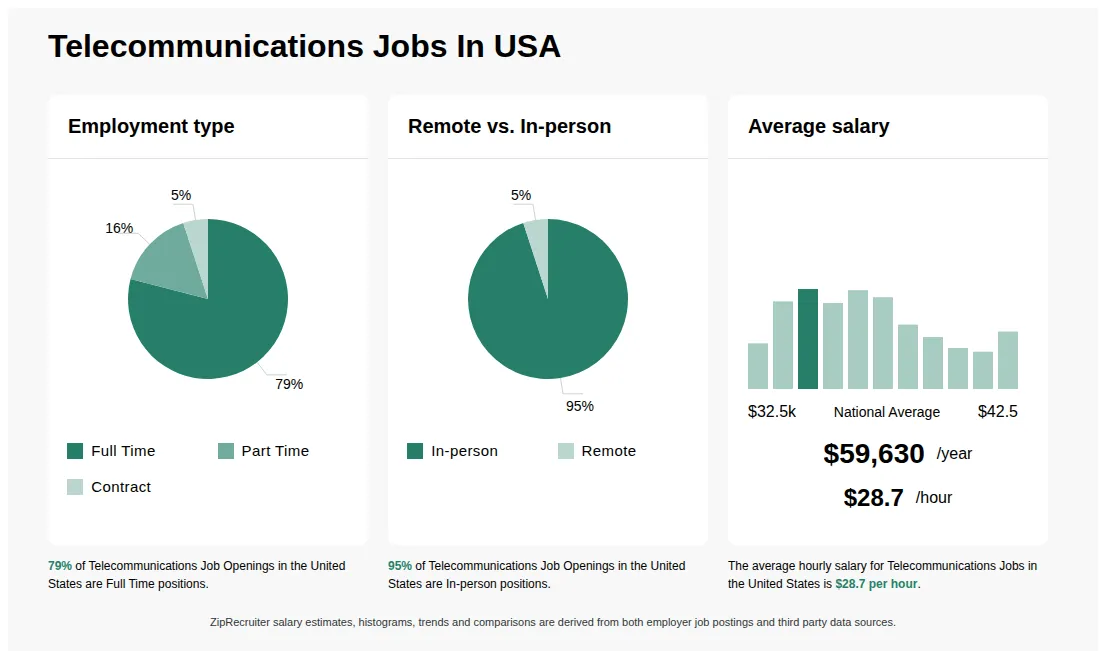
As of Jul 15, 2026, the average hourly pay for telecommunications in the United States is $28.67, according to ZipRecruiter salary data. Most workers in this role earn between $22.12 and $33.65 per hour, depending on experience, location, and employer.
Is telecommunications a good career path?
Telecommunications is a stable career that involves installing, maintaining, and repairing communication systems such as networks, internet, and phone services. It often requires technical skills, certifications, and knowledge of networking tools, with job opportunities in various industries including technology, utilities, and service providers.
What Are Telecommunications Jobs?
Telecommunications jobs involve developing, installing, and using technology to send messages over long distances, such as through cable, satellite, radio, mobile phones, video, and the internet. There are a wide variety of jobs within this industry, such as with networks that provide communication transmission signals and the manufacturers of the equipment that produces the signals. In broadcast and online media, you can work in sales, administration, or customer service working over the phone, and in technical jobs to work as a mechanic or technician repairing equipment and developing new technology. You can also work in a corporate setting or at radio and television stations.
What do you do in a telecommunications job?
A telecommunications job involves installing, maintaining, and repairing communication systems such as phone lines, internet networks, and wireless devices. It requires technical skills, knowledge of networking equipment, and often certifications like Cisco or CompTIA. Workers may troubleshoot issues, upgrade systems, and ensure reliable communication services for clients or organizations.
What is the difference between Telecommunications vs Network Technician?
| Aspect | Telecommunications | Network Technician |
|---|---|---|
| Required Certifications | FCC licenses, Cisco certifications | CompTIA Network+, Cisco CCNA |
| Work Environment | Telecom companies, field sites, offices | Data centers, offices, client sites |
| Industry Usage | Telecom service providers, infrastructure | IT companies, network support |
| Job Focus | Installing, maintaining telecom systems | Configuring, troubleshooting networks |
Telecommunications professionals focus on installing and maintaining telecom infrastructure, while Network Technicians primarily troubleshoot and support computer networks. Both roles require certifications like Cisco or CompTIA and often work in similar environments, but their technical focus differs, with telecommunications centered on voice and data transmission systems and network technicians on data network support.
What jobs can you get with telecommunications?
Telecommunications offers a range of jobs including network engineers, telecommunications technicians, systems analysts, and installation specialists. These roles typically require knowledge of networking, communication systems, and sometimes certifications like Cisco or CompTIA. Opportunities exist in industries such as IT, broadcasting, and service providers, often involving troubleshooting, system design, and maintenance tasks.
What are some common challenges faced by professionals in the telecommunications industry and how can new hires prepare for them?
Professionals in telecommunications often deal with rapid technological advancements and the need to adapt quickly to new systems and protocols. Meeting customer expectations for reliable service while managing network upgrades or troubleshooting outages can be demanding. New hires can prepare by staying updated on industry trends, developing strong problem-solving skills, and being open to ongoing learning and collaboration with cross-functional teams such as engineers and customer support. Familiarity with regulatory standards and best practices in network security is also valuable.
What are telecommunications jobs?
Telecommunications jobs involve the installation, maintenance, and repair of systems that transmit data, voice, and video across distances. Professionals in this field work with technologies such as phone lines, fiber optics, satellites, and wireless networks. Roles can range from network engineers and technicians to sales and customer support specialists, all focused on ensuring reliable communication services. The sector is essential for connecting people and businesses globally and is rapidly evolving with advancements like 5G and fiber-optic technology.
Who are the big 4 in telecom?
In the telecommunications industry, the 'Big 4' typically refers to the four largest wireless carriers: Verizon, AT&T, T-Mobile, and Sprint (now part of T-Mobile). These companies dominate the market in terms of coverage, customer base, and infrastructure, and they often seek telecommunications professionals skilled in network operations, customer service, and technical support.
What are the key skills and qualifications needed to thrive in Telecommunications, and why are they important?
To thrive in Telecommunications, you need a solid understanding of networking, signal processing, and communications technology, often backed by a degree in electrical engineering or a related field. Familiarity with industry-standard tools and certifications such as Cisco (CCNA/CCNP), fiber optics systems, and network management platforms is essential. Strong problem-solving, teamwork, and effective communication skills are vital for troubleshooting and collaborating across departments. These skills ensure reliable network performance, rapid issue resolution, and successful adaptation to evolving technologies in the telecom sector.
More about Telecommunications jobs
- How to Get a Telecommunications Job
- Is Telecommunications a Good Career?
- What Are Telecommunications Services?
- The 10 Top Types Of Telecommunications Jobs
- The 10 Best Types of Telecommunications in 2026
- The 25 Highest Paying Telecommunications Jobs in 2026
- Telecommunications Jobs - What Are They and How to Get One
What cities are hiring for Telecommunications jobs? Cities with the most Telecommunications job openings:
What are the most commonly searched types of Telecommunications jobs? The most popular types of Telecommunications jobs are:
What states have the most Telecommunications jobs? States with the most job openings for Telecommunications jobs include:
What job categories do people searching Telecommunications jobs look for? The top searched job categories for Telecommunications jobs are:

Full-time
Re-posted 17 hours ago
Job description
Title: Telecommunications Administrator
Location: Oklahoma City, OK
Duration: Full Time
Salary: $Market
Requirements
Telecom/Networking:
Reads and interprets design drawings, blueprints, and installation guides.
Installs and secures cables, mounts hardware as described in drawings and notes.
Place, cut, prepare, terminate and secure copper coaxial and optical fiber to their respective connectors, affix splitters based on designs.
Terminate, test, and troubleshoot cables and antennas.
Establishes network and telecommunications specifications by conferring with users; analyzing workflow, access, information, and security requirements; network administration, including interface configuration and management strategies.
Establishes network and telecommunication system by evaluating network and telecommunication performance issues including availability, utilization, throughput, and latency; planning and executing the selection, installation, configuration, and testing of equipment; defining network and telecommunications policies and procedures; establishing data and voice connectivity.
Participates in Design of Telecommunications systems.
Maintains network and telecommunications performance by monitoring and analysis, and performance tuning; troubleshooting network and telecommunications problems; escalating problems to vendor.
Secures network and telecommunications systems by developing access, monitoring, control, and evaluation; maintaining documentation.
Prepares users by designing and conducting training programs; providing references and support.
Upgrades network by conferring with vendors; developing, testing, evaluating, and installing enhancements.
Meets financial requirements by submitting information for budgets; monitoring expenses.
Updates job knowledge by participating in educational opportunities; reading professional publications; maintaining personal networks; participating in professional organizations.
Protects organization's value by keeping information confidential.
Accomplishes organization goals by accepting ownership for accomplishing new and different requests; exploring opportunities to add value to job accomplishments.
Documentation:
Documents specific duties, activities, problems solved and issues resolved
Assists in the documentation of the network, applications and resources on the network in conjunction with the public service staff.
Performs training.
Miscellaneous:
Attends meetings and serves on committees, as requested
Coordinate with the Trainer to set up and take down Cyberschool equipment, as well as any other equipment needed for meetings
Coordinates with upper management to setup new offices as needed.
Regular attendance as required
Performs additional duties and assignments as requested
Some Travel Required
Qualifications
Education/Certification:
High School graduate required.
Bachelor Degree Required
CCNA Collaboration/Voice preferred or comparable experience
Experience Required:
2-4 years of network/telecom administration.
Knowledge of:
Layer 2/3 Protocols
LAN/WAN - TCP/IP, MPLS, BGP, VPN
SOLiD DAS equipment
Cisco Call Manager, Cisco Unity, Cisco Contact Center (PCCE)
Cisco CUBE, Call Manager Express, Unity Express
VOIP, SIP, PRI, MGCP, H.323
Network Performance Tuning - SNMP, NetFlow, IP SLA
Network Administration and Implementation
Cisco IOS
Emerging technology trends
Skills and Abilities:
Evaluate critical systems, prioritize workflow and determine solutions
Excellent written and verbal communication skills
Interpret and apply laws, regulations and policies
Provide technical assistance for computer problems
Read and understand technical manuals
Work for extended time at keyboard/terminal
Maintain effective working relationships with supervisor and coworkers
Work flexible hours, including weekends and evenings
Benefits
Note: If interested please send your updated resume to sagar.chand@two95intl.com and include your Salary requirement along with your contact details with a suitable time when we can reach you. If you know of anyone in your sphere of contacts, who would be a perfect match for this job then, we would appreciate if you can forward this posting to them with a copy to us.
We look forward to hearing from you at the earliest!
Location: Oklahoma City, OK
Duration: Full Time
Salary: $Market
Requirements
Telecom/Networking:
Reads and interprets design drawings, blueprints, and installation guides.
Installs and secures cables, mounts hardware as described in drawings and notes.
Place, cut, prepare, terminate and secure copper coaxial and optical fiber to their respective connectors, affix splitters based on designs.
Terminate, test, and troubleshoot cables and antennas.
Establishes network and telecommunications specifications by conferring with users; analyzing workflow, access, information, and security requirements; network administration, including interface configuration and management strategies.
Establishes network and telecommunication system by evaluating network and telecommunication performance issues including availability, utilization, throughput, and latency; planning and executing the selection, installation, configuration, and testing of equipment; defining network and telecommunications policies and procedures; establishing data and voice connectivity.
Participates in Design of Telecommunications systems.
Maintains network and telecommunications performance by monitoring and analysis, and performance tuning; troubleshooting network and telecommunications problems; escalating problems to vendor.
Secures network and telecommunications systems by developing access, monitoring, control, and evaluation; maintaining documentation.
Prepares users by designing and conducting training programs; providing references and support.
Upgrades network by conferring with vendors; developing, testing, evaluating, and installing enhancements.
Meets financial requirements by submitting information for budgets; monitoring expenses.
Updates job knowledge by participating in educational opportunities; reading professional publications; maintaining personal networks; participating in professional organizations.
Protects organization's value by keeping information confidential.
Accomplishes organization goals by accepting ownership for accomplishing new and different requests; exploring opportunities to add value to job accomplishments.
Documentation:
Documents specific duties, activities, problems solved and issues resolved
Assists in the documentation of the network, applications and resources on the network in conjunction with the public service staff.
Performs training.
Miscellaneous:
Attends meetings and serves on committees, as requested
Coordinate with the Trainer to set up and take down Cyberschool equipment, as well as any other equipment needed for meetings
Coordinates with upper management to setup new offices as needed.
Regular attendance as required
Performs additional duties and assignments as requested
Some Travel Required
Qualifications
Education/Certification:
High School graduate required.
Bachelor Degree Required
CCNA Collaboration/Voice preferred or comparable experience
Experience Required:
2-4 years of network/telecom administration.
Knowledge of:
Layer 2/3 Protocols
LAN/WAN - TCP/IP, MPLS, BGP, VPN
SOLiD DAS equipment
Cisco Call Manager, Cisco Unity, Cisco Contact Center (PCCE)
Cisco CUBE, Call Manager Express, Unity Express
VOIP, SIP, PRI, MGCP, H.323
Network Performance Tuning - SNMP, NetFlow, IP SLA
Network Administration and Implementation
Cisco IOS
Emerging technology trends
Skills and Abilities:
Evaluate critical systems, prioritize workflow and determine solutions
Excellent written and verbal communication skills
Interpret and apply laws, regulations and policies
Provide technical assistance for computer problems
Read and understand technical manuals
Work for extended time at keyboard/terminal
Maintain effective working relationships with supervisor and coworkers
Work flexible hours, including weekends and evenings
Benefits
Note: If interested please send your updated resume to sagar.chand@two95intl.com and include your Salary requirement along with your contact details with a suitable time when we can reach you. If you know of anyone in your sphere of contacts, who would be a perfect match for this job then, we would appreciate if you can forward this posting to them with a copy to us.
We look forward to hearing from you at the earliest!

About TWO95 International
Sourced by ZipRecruiter
At TWO95 International, we believe it is imperative that a hiring company is assured of procuring the right candidate to fill a job requirement. We have an extensive local and International network, and a fully digitalized sourcing approach that allows us to find a candidate best suited for the job. Furthermore, we strive to secure well matched opportunities that align with the personal and career aspirations of our candidates.
Industry
Recruiting and staffing services
Company size
11 - 50 Employees
Headquarters location
Cherry Hill, NJ, US
Year founded
2009