1

Telecommunications Jobs (NOW HIRING)

Telecommunications Analyst

Oklahoma City, OK ยท On-site

$72.25K - $97.75K/yr

Telecommunications, Telecommunication Systems, Video Systems Certifications: None Experience: 9 + years of related experience US Citizenship Required: No Telecommunications Analyst Transform ...

Be Seen First

... telecommunications cabinets/closets, modular furniture to BISCI standard. 4.2.9 Support ongoing submarine/barge moves to include the installation, removal, and reinstallation of copper and fiber ...

Implements telecommunication programs and special projects. Coordinates the preparation of and reviews telecommunications statements of work (SOW). Prepares budget, technical reports, staff studies ...

$93.45K/yr

The primary purpose of this position is to serve as a PACAF command level manager/monitor for telecommunication systems plans, policies, procedures, and requirements and implementation program ...

Job Title Plans and develops methods, procedures, policies, and techniques governing command-wide decisions on telecommunication systems. Serves as technical advisor for the command. Implements ...

New

next page

Showing results 1-20

Telecommunications information

See salary details

$15

$28

$42

How much do telecommunications jobs pay per hour?

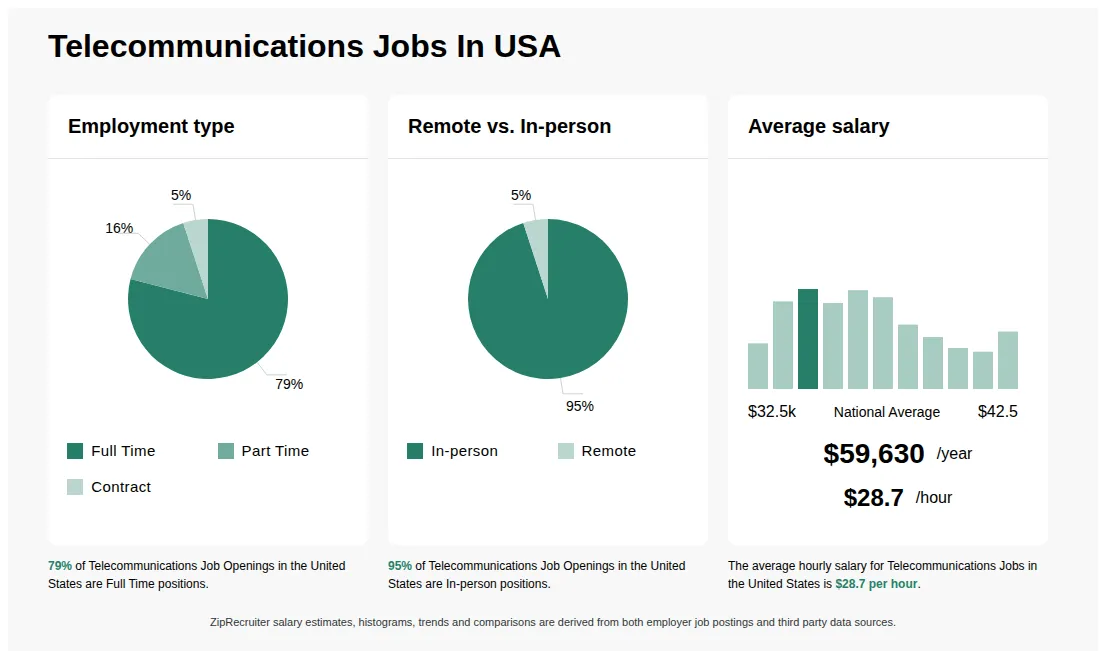
As of Jun 4, 2026, the average hourly pay for telecommunications in the United States is $28.67, according to ZipRecruiter salary data. Most workers in this role earn between $22.12 and $33.65 per hour, depending on experience, location, and employer.

What Are Telecommunications Jobs?

Telecommunications jobs involve developing, installing, and using technology to send messages over long distances, such as through cable, satellite, radio, mobile phones, video, and the internet. There are a wide variety of jobs within this industry, such as with networks that provide communication transmission signals and the manufacturers of the equipment that produces the signals. In broadcast and online media, you can work in sales, administration, or customer service working over the phone, and in technical jobs to work as a mechanic or technician repairing equipment and developing new technology. You can also work in a corporate setting or at radio and television stations.

What are the key skills and qualifications needed to thrive in Telecommunications, and why are they important?

To thrive in Telecommunications, you need a solid understanding of networking, signal processing, and communications technology, often backed by a degree in electrical engineering or a related field. Familiarity with industry-standard tools and certifications such as Cisco (CCNA/CCNP), fiber optics systems, and network management platforms is essential. Strong problem-solving, teamwork, and effective communication skills are vital for troubleshooting and collaborating across departments. These skills ensure reliable network performance, rapid issue resolution, and successful adaptation to evolving technologies in the telecom sector.

What are some common challenges faced by professionals in the telecommunications industry and how can new hires prepare for them?

Professionals in telecommunications often deal with rapid technological advancements and the need to adapt quickly to new systems and protocols. Meeting customer expectations for reliable service while managing network upgrades or troubleshooting outages can be demanding. New hires can prepare by staying updated on industry trends, developing strong problem-solving skills, and being open to ongoing learning and collaboration with cross-functional teams such as engineers and customer support. Familiarity with regulatory standards and best practices in network security is also valuable.

What is the difference between Telecommunications vs Network Technician?

AspectTelecommunicationsNetwork Technician
Required CertificationsFCC licenses, Cisco certificationsCompTIA Network+, Cisco CCNA
Work EnvironmentTelecom companies, field sites, officesData centers, offices, client sites
Industry UsageTelecom service providers, infrastructureIT companies, network support
Job FocusInstalling, maintaining telecom systemsConfiguring, troubleshooting networks

Telecommunications professionals focus on installing and maintaining telecom infrastructure, while Network Technicians primarily troubleshoot and support computer networks. Both roles require certifications like Cisco or CompTIA and often work in similar environments, but their technical focus differs, with telecommunications centered on voice and data transmission systems and network technicians on data network support.

What cities are hiring for Telecommunications jobs? Cities with the most Telecommunications job openings:
What are the most commonly searched types of Telecommunications jobs? The most popular types of Telecommunications jobs are:
What states have the most Telecommunications jobs? States with the most job openings for Telecommunications jobs include:
Infographic showing various Telecommunications job openings in the United States as of May 2026, with employment types broken down into 50% Full Time, and 50% Part Time. Highlights an 50% In-person, and 50% Remote job distribution, with an average salary of $59,630 per year, or $28.7 per hour.

Telecommunications Technician

Motley Communications LLC

Gretna, VA โ€ข On-site

$19 - $28/hr

Full-time

Posted yesterday


Job description

Benefits/Perks
  • Competitive Compensation
  • Great Work Environment
  • Career Advancement Opportunities
Job Summary
We are seeking a Telecommunications Technician to join our team! As a Telecommunications Technician, you will be installing new telecommunications systems, repairing existing telecommunications systems, and upgrading outdated equipment and systems. You will also be troubleshooting systems that are having trouble, running diagnostic tests, ordering replacement components, and ensuring every system you touch is working properly. The ideal candidate has experience with telecommunications equipment, excellent communication skills, and enjoys problem-solving complex issues. This position involves installing cable infrastructure for Commercial customers and is a labor position using ladders and man lifts. Scissor and Boom lift certifications are a plus. Position entails travel through Virginia and North Carolina with further distances a possibility. Most travel is during work week and home most weekends.

Responsibilitiesย 
  • Install new telecommunications cabling (CAT-6/Fiber Optics) for customers
  • Troubleshoot existing infrastructure that isnโ€™t working, run diagnostic tests, and fix any problems that arise
  • Upgrade outdated equipment
  • Walk the customer through any new or updated equipment to ensure everyone knows how to use it properly
  • Maintain a clean and safe working environment by always wearing proper PPE and following safety procedures
Qualifications
  • Excellent customer service skills
  • Previous experience with telecommunications equipment desired
  • Strong analytical and troubleshooting skills
  • Must be comfortable working on your feet, in tight spaces, and a variety of weather conditions