1

Tech Support Jobs in Seattle, WA (NOW HIRING)

The IT Support Specialist provides onsite technical support for end users, workstations, manufacturing systems, and local IT infrastructure within a fast-paced manufacturing environment. This role is ...

IT Support Specialist

Everett, WA · On-site

$36 - $43.25/hr

Contribute to internal knowledge base and standard operating procedures Project & Cross-Functional Support * Assist with IT projects (ERP, infrastructure upgrades, cloud migration) * Work ...

IT Support Technician

Seattle, WA · On-site

$24.50 - $33.50/hr

Keylent Inc is seeking an IT Support Technician for American Seafoods. The role involves providing front line support, managing Active Directory, and assisting users with technical issues across ...

IT Support Associate III

Redmond, WA · On-site

$46.98 - $51.52/hr

Serves as the senior technical resource within the IT Support function, responsible for designing, implementing, and maintaining complex network, server, and virtualization environments that support ...

CALL CENTER TECH SUPPORT

Langley, WA · On-site

$41K - $51K/yr

Join our dynamic team at Whidbey Telecom as a Call Center Tech Support Specialist in Langley, WA. We seek dedicated, customer-oriented individuals to provide exceptional technical support for our ...

IT Support Associate III

Redmond, WA · On-site

$46.98 - $51.52/hr

Serves as the senior technical resource within the IT Support function, responsible for designing, implementing, and maintaining complex network, server, and virtualization environments that support ...

Information Technology Professional (IT/CTN/IS) Category / Component: Enlisted Both Overview ... What to Expect High tempo, mission critical work supporting around the clock operations and watch ...

Information Technology Professional (IT/CTN/IS) Category / Component: Enlisted Both Overview ... What to Expect High tempo, mission critical work supporting around the clock operations and watch ...

Information Technology Professional (IT/CTN/IS) Category / Component: Enlisted Both Overview ... What to Expect High tempo, mission critical work supporting around the clock operations and watch ...

Information Technology Professional (IT/CTN/IS) Category / Component: Enlisted Both Overview ... What to Expect High tempo, mission critical work supporting around the clock operations and watch ...

Information Technology Professional (IT/CTN/IS) Category / Component: Enlisted Both Overview ... What to Expect High tempo, mission critical work supporting around the clock operations and watch ...

Information Technology Professional (IT/CTN/IS) Category / Component: Enlisted Both Overview ... What to Expect High tempo, mission critical work supporting around the clock operations and watch ...

Information Technology Professional (IT/CTN/IS) Category / Component: Enlisted Both Overview ... What to Expect High tempo, mission critical work supporting around the clock operations and watch ...

Information Technology Professional (IT/CTN/IS) Category / Component: Enlisted Both Overview ... What to Expect High tempo, mission critical work supporting around the clock operations and watch ...

Information Technology Professional (IT/CTN/IS) Category / Component: Enlisted Both Overview ... What to Expect High tempo, mission critical work supporting around the clock operations and watch ...

Information Technology Professional (IT/CTN/IS) Category / Component: Enlisted Both Overview ... What to Expect High tempo, mission critical work supporting around the clock operations and watch ...

Showing results 21-40

Tech Support information

See Seattle, WA salary details

$30.7K

$49.5K

$75.1K

How much do tech support jobs pay per year?

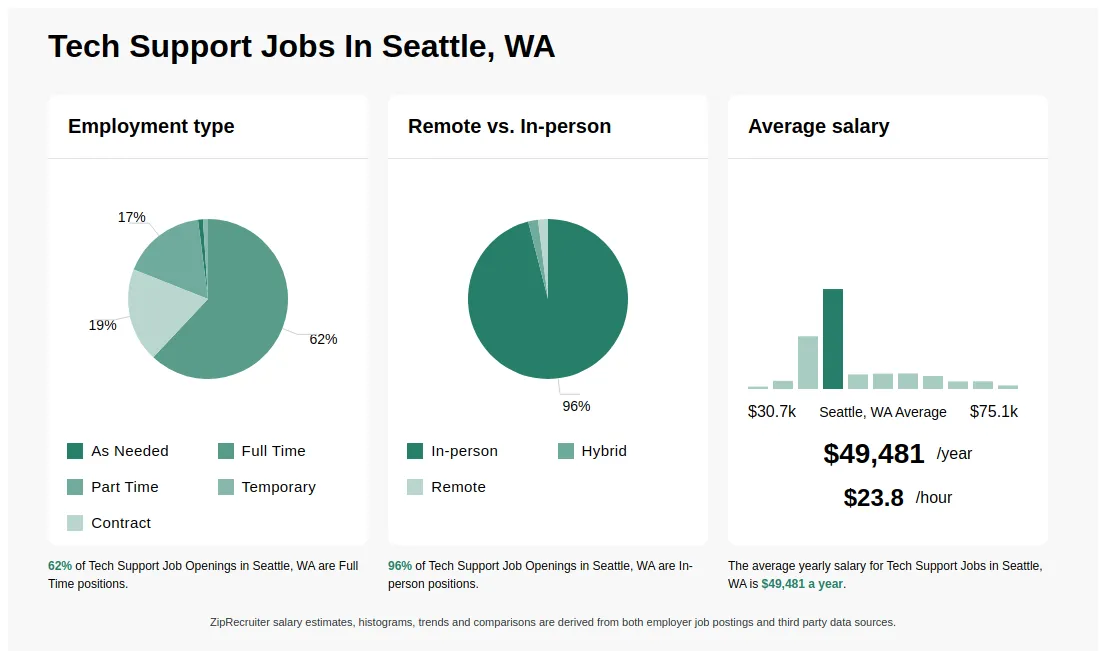
As of Sep 15, 2026, the average yearly pay for tech support in Seattle, WA is $49,482.00, according to ZipRecruiter salary data. Most workers in this role earn between $42,700.00 and $53,500.00 per year, depending on experience, location, and employer.

What is a tech support specialist?

Tech support specialists are professionals who assist users in resolving technical issues with hardware, software, or network systems. They provide guidance by troubleshooting problems, answering questions, and offering solutions via phone, email, chat, or in person. Their goal is to ensure that technology functions smoothly for individuals or organizations by addressing technical challenges promptly and efficiently.

What are the qualifications to get a job in tech support?

The qualifications for jobs in technical or tech support vary but typically include a high school diploma and experience with repairing technology and customer service. Some companies may prefer candidates with a bachelor’s degree in computer science or certification in a specific type of software or hardware. Others may provide on-the-job training in their system. Technical or tech support jobs typically involve helping a company with issues that come up in its internal system or assisting individuals with problems. Duties frequently involve using helpdesk software, checking on system operations, explaining technical processes to users, and tracking issues to identify faults with software or hardware.

What are the key skills and qualifications needed to thrive as a tech support specialist, and why are they important?

To thrive as a Tech Support specialist, you need a solid understanding of computer systems, troubleshooting techniques, and common operating systems, typically supported by relevant IT certifications or coursework. Familiarity with ticketing systems, remote desktop software, and diagnostic tools is often required. Exceptional communication skills, patience, and problem-solving abilities help you effectively assist users and resolve technical issues. These skills ensure timely, accurate support and contribute to positive user experiences and organizational efficiency.

What are some common challenges faced by tech support professionals and how can they be managed?

Tech Support professionals often encounter challenges such as troubleshooting complex technical issues under time pressure, communicating effectively with users of varying technical backgrounds, and managing multiple support requests simultaneously. Success in this role typically involves staying organized, maintaining patience, and developing strong problem-solving skills. Collaborating with team members and documenting solutions can help resolve issues more efficiently and improve the overall customer experience.

What is the difference between Tech Support vs Help Desk Technician?

AspectTech SupportHelp Desk Technician
Required CredentialsHigh school diploma or equivalent; certifications like CompTIA A+ often preferredHigh school diploma or equivalent; certifications like CompTIA A+ are common
Work EnvironmentOn-site or remote; troubleshooting hardware/software issues for end-usersOn-site or remote; providing technical assistance and support to users
Employer & Industry UsageIT companies, tech support firms, corporate IT departmentsIT service providers, corporate IT, government agencies

Both roles involve assisting users with technical issues, often requiring similar certifications and working in comparable environments. The main difference lies in scope: Tech Support may handle more complex technical problems, while Help Desk Technicians focus on user support and issue resolution.

What is entry level tech support?

Entry level tech support refers to the initial position in technical support roles, typically requiring minimal prior experience. It involves assisting users with basic hardware, software, and network issues, often using troubleshooting tools and customer service skills. These roles usually require a high school diploma or equivalent and may offer on-the-job training or certifications like CompTIA A+.

What is the job of a tech support?

A tech support professional assists users with troubleshooting hardware and software issues, providing technical guidance and solutions. They often use diagnostic tools, communicate clearly with customers, and may hold certifications like CompTIA A+ to perform their duties effectively.

What skills do I need for tech support?

Tech support professionals need strong communication skills to explain technical issues clearly, along with problem-solving abilities to diagnose and resolve hardware and software problems. Knowledge of operating systems, networking, and common troubleshooting tools is essential, and certifications like CompTIA A+ can enhance credibility and job prospects.

What are the most commonly searched types of Tech Support jobs in Seattle, WA?

The most popular types of Tech Support jobs in Seattle, WA are:

What are popular job titles related to Tech Support jobs in Seattle, WA?

For Tech Support jobs in Seattle, WA, the most frequently searched job titles are:

What job categories do people searching Tech Support jobs in Seattle, WA look for?

The top searched job categories for Tech Support jobs in Seattle, WA are:

What cities near Seattle, WA are hiring for Tech Support jobs?

Cities near Seattle, WA with the most Tech Support job openings:

Infographic showing various Tech Support job openings in Seattle, WA as of September 2026, with employment types broken down into 1% As Needed, 75% Full Time, 20% Part Time, and 4% Contract. Highlights an 87% Physical, 2% Hybrid, and 11% Remote job distribution, with an average salary of $49,482 per year, or $23.8 per hour.

IT Support Specialist

Bothell, WA • On-site

ait
11 - 50 employees

$31.25/hr

Full-time

Re-posted 2 days ago


Job description

Summary:

The IT Support Specialist provides onsite technical support for end users, workstations, manufacturing systems, and local IT infrastructure within a fast-paced manufacturing environment. This role is responsible for day-to-day technical support, hardware and software deployment, user administration, troubleshooting, and coordination with Corporate IT on enterprise initiatives and operational support activities.

The ideal candidate is a hands-on, service-oriented technical professional with strong troubleshooting skills, experience supporting Windows environments, and the ability to work independently while supporting both office and engineering users.

This is an hourly position.  Hourly rate is $31.25hr - 38.46hr

Duties and Responsibilities: 

  • Provide Tier 1 and Tier 2 technical support for Windows workstations, Microsoft environments, manufacturing systems, and end users.
  • Support engineering and manufacturing applications including CATIA, ENOVIA, Verisurf, Mastercam, and related software.
  • Troubleshoot, configure, deploy, and maintain desktops, laptops, printers, peripherals, and user devices.
  • Support user account administration including Active Directory account management, password resets, permissions, and file share access.
  • Assist with desktop imaging, hardware deployments, software installation, upgrades, patching, and lifecycle replacement activities.
  • Troubleshoot basic networking and connectivity issues involving switches, routers, wireless, and local infrastructure.
  • Monitor and maintain the performance, integrity, and security of local IT systems and user environments.
  • Coordinate with vendors and Corporate IT teams to resolve escalated technical issues and support enterprise initiatives.
  • Document support activities, troubleshooting steps, and ticket resolutions accurately and timely.
  • Ensure compliance with company IT policies, cybersecurity standards, and operational procedures.
  • Participate in enterprise IT projects and technology implementations as assigned.
  • Perform other duties as assigned.

Education and Work Experience:

  • High school diploma or GED required; technical school certification or associate degree in a related field preferred.
  • DoD 8570 Level I certification required (Sec+/Network+)
  • Minimum 2 years of experience supporting Windows desktop environments and end users.
  • Experience troubleshooting Windows 10/11, Microsoft Office, desktop hardware, and peripheral devices.
  • Experience with Active Directory, desktop imaging, hardware deployment, and remote support tools.
  • Basic understanding of networking concepts including switches, routers, wireless connectivity, and TCP/IP troubleshooting.
  • Experience supporting manufacturing or engineering environments preferred.
  • Familiarity with CAD/CAM or manufacturing applications preferred.
  • Strong troubleshooting, customer service, and problem-solving skills required.

Work Authorization/Security Clearance Requirements:

  • This position requires a government security clearance. Must be able to obtain a clearance if do not already have it.

Knowledge, Skills, and Abilities:

List of needed knowledge, skills, and abilities to successfully accomplish the duties and responsibilities of the job.

  • Strong troubleshooting and analytical problem-solving skills.
  • Ability to work independently and manage competing priorities in a fast-paced environment.
  • Strong customer service and communication skills with technical and non-technical users.
  • Ability to follow established IT standards, procedures, and cybersecurity requirements.
  • Service-oriented, dependable, and collaborative team mindset.
  • High level of initiative, accountability, and attention to detail.

Work Conditions:

Environment Type:

  • Indoors. Production and Office Environment. Temperature Controlled.

Exposure Types:

  • Small and/or enclosed spaces

Work Hours:

  • On-call for emergent conditions.
  • Standard work schedule, overtime may be necessary for meeting deadlines, required travel, and emergent conditions

Travel Requirements:

  • This position may involve travel up to 15% of the time.


Physical Demands:

The physical demands described here are representative of those that must be met by an employee to successfully perform the essential functions of this job.

  • Medium work that includes moving objects up to 50 pounds.
  • Moving about on foot to accomplish tasks, particularly for long distances or moving from one work site to another.
  • Picking, pinching, typing or otherwise working, primarily with fingers rather than with whole hand or arm as in handling.
  • Prolonged periods sitting at a desk and working on a computer.
  • Prolonged periods working on feet, using tools, and performing repetitive actions that entail frequent bending and stooping.
  • Repeating motions that may include the wrists, hands and/or fingers.