1

Summer Firefighter Jobs (NOW HIRING)

Firefighter

Hutchinson, KS ยท On-site

$18.47 - $21.68/hr

... summer and winter storms, drought and high winds. HFD has 89 uniformed members and 1 civilian ... The firefighter is primarily responsible for performing emergency response services including fire ...

Firefighter

Hutchinson, KS ยท On-site

$18.47 - $21.68/hr

... future firefighters to join our next Recruit Academy during the spring of 2027.HFD is an ... summer and winter storms, drought and high winds.HFD has 89 uniformed members and 1 civilian ...

... summer and winter storms, drought and high winds. HFD has 89 uniformed members and 1 civilian ... The firefighter is primarily responsible for performing emergency response services including fire ...

As a Student Firefighter, you will: โ€ข Work a 56-hour shift schedule โ€ข Attend college classes in ... CTC Summer Fire Academy ** โ€ข Physical Ability Testing: Must obtain and submit one of the ...

Summer/Winter Internship: Reports to: * The Summer/Winter Internship is a temporary training ... Performs assigned firefighting, man overboard and abandon ship duties as assigned on the Station ...

Summer/Winter Internship: Reports to: * The Summer/Winter Internship is a temporary training ... Performs assigned firefighting, man overboard and abandon ship duties as assigned on the Station ...

next page

Showing results 1-20

Summer Firefighter information

See salary details

$28.5K

$59.6K

$100K

How much do summer firefighter jobs pay per year?

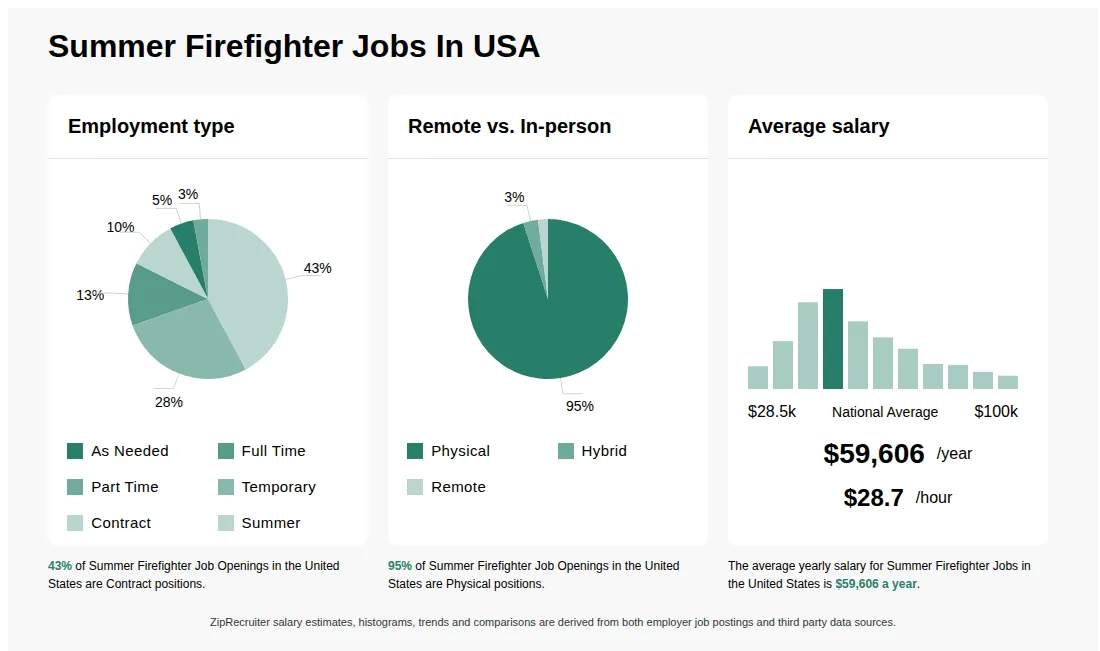
As of Sep 5, 2026, the average yearly pay for summer firefighter in the United States is $59,606.00, according to ZipRecruiter salary data. Most workers in this role earn between $45,500.00 and $69,000.00 per year, depending on experience, location, and employer.

What is a summer firefighter?

Summer Firefighters are seasonal workers who help fight and prevent wildfires during the peak fire season, typically in the summer months. They work for government agencies, such as the U.S. Forest Service or state forestry departments, and are trained to suppress fires, create fire breaks, and protect property and natural resources. In addition to firefighting, they may also assist with fire prevention education, equipment maintenance, and recovery efforts after fires. These positions are physically demanding and often involve working in challenging outdoor conditions for extended periods.

What does a summer firefighter do?

The job duties of a summer firefighter involve fighting fires from June through August. This seasonal firefighting position typically focuses on forest fires and wildfires, which are also known as wildland fires. The Summer months are typically very dry, so wildfire risk is high, and fire departments need extra support. Your responsibilities include working with a team of firefighters to extinguish or control wildfires and working on controlled burns that eliminate flammable landscape from the path of a wildfire. You typically handle your firefighting responsibilities as part of a federal or state firefighting operation. This position is temporary, and employment coincides with wildfire season in the region where you work.

What are the key skills and qualifications needed to thrive as a summer firefighter?

To thrive as a Summer Firefighter, you need physical fitness, basic firefighting knowledge, and completion of fire training programs or certifications such as wildland fire training (e.g., S-130/S-190). Familiarity with firefighting tools, personal protective equipment (PPE), radios, and emergency response protocols is required. Teamwork, quick decision-making, and resilience under pressure are essential soft skills for this role. These skills and qualifications are crucial to ensuring safety, effective response to fire emergencies, and successful collaboration in high-risk outdoor environments.

What are some common challenges faced by summer firefighters, and how can new hires prepare for them?

Summer firefighters often face physically demanding conditions such as high temperatures, long shifts, and rapidly changing fire behavior. New hires should be prepared for extended periods outdoors, strenuous activity, and the need to work closely with a tight-knit team under stressful circumstances. Building strong physical fitness, learning to communicate effectively, and becoming familiar with wildfire safety protocols can help new firefighters adapt successfully to these challenges.

What is the difference between Summer Firefighter vs Wildland Firefighter?

AspectSummer FirefighterWildland Firefighter
CertificationsBasic firefighting training, CPR, First AidBasic firefighting training, S-130/190, First Aid
Work EnvironmentTemporary summer positions, urban and rural areasWildland terrains, forests, national parks
Employer & IndustryFire departments, summer programsForest services, federal agencies

Summer Firefighters typically work during the summer season in various environments, focusing on fire suppression and prevention. Wildland Firefighters specialize in fighting fires in forested and wildland areas, often requiring specific certifications like S-130/190. While both roles involve firefighting skills, Wildland Firefighters usually work in more remote, natural settings and may have longer deployments. Understanding these differences helps candidates choose the right path based on their certifications and preferred work environment.

Can you be a summer firefighter just for the summer?

Summer firefighter positions are often seasonal and typically last for the duration of the fire season, which can be several months. These roles usually require specific training and certifications, and employment is generally limited to the summer months when fire activity is highest. Some agencies may offer extended or year-round positions, but most summer firefighter jobs are temporary and seasonal.

How much do summer firefighters make?

Summer firefighters typically earn between $12 and $20 per hour, depending on experience, location, and agency. They often work full-time during peak fire season and may receive additional benefits or hazard pay for challenging conditions.

What cities are hiring for Summer Firefighter jobs?

Cities with the most Summer Firefighter job openings:

What are the most commonly searched types of Firefighter jobs?

The most popular types of Firefighter jobs are:

What states have the most Summer Firefighter jobs?

States with the most job openings for Summer Firefighter jobs include:

What job categories do people searching Summer Firefighter jobs look for?

The top searched job categories for Summer Firefighter jobs are:

Infographic showing various Summer Firefighter job openings in the United States as of August 2026, with employment types broken down into 100% Full Time. Highlights an 100% In-person job distribution, with an average salary of $59,606 per year, or $28.7 per hour.

2026 Summer Lateral Firefighter Paramedic

Unified Fire Authority

Salt Lake City, UT โ€ข On-site

$70K - $106K/yr

Temporary

This job post hasย expired today.ย Applications are no longer accepted.


Key responsibilities

  • Participate in assessments, interviews, and tests to evaluate qualifications for the firefighter/paramedic role.

  • Complete a 4-week orientation and additional field shifts as part of onboarding.

  • Meet physical and medical standards, including passing a physical agility test and medical screening.


Job description

Lateral Firefighter ParamedicUnified Fire Authority is offering opportunities for Firefighter/Paramedics to join our organization through our lateral process. With compensation potentially starting up to step 10 based on UFA's firefighter pay plan.Applicants must possess a valid driver's license in good standing at the time of employment.2026 Lateral Firefighter Paramedic FAQsLateral Firefighter Paramedic Recruitment Timeline (Summer 2026)DATES AND TIMES MAY BE CHANGED OR ADDED IF NEEDEDRegistrationAugust 7 – September 4EMS and Fire Skills Assessments, Oral Board Interviewand Firefighter Physical Agility Test(Will be required toattend only one of these dates)September 21-25Background InvestigationsOctober-NovemberFinal Job OffersNovember-January 2027New Hire OrientationJanuary 5, 2027Start of 4-week OrientationFebruary 1, 2027STEP 1:Our primary means of contacting you throughout the process will be by email. It is your responsibility to ensure that your email address is correct and any change to your email is updated with the Human Resources Division.STEP 2: ORAL BOARD INTERVIEW/SKILLS ASSESSMENT/PHYSICAL PERFORMANCE TESTApplicants will be notified by email, of the date, time, and location for this portion of the process.ORAL BOARD INTERVIEWThe oral board interview will consist of structured, behaviorally-based interview questions. Your responses will be evaluated by fire officers and other firefighters or firefighter specialists.SKILLS ASSESSMENTApplicants must successfully pass the paramedic skills assessment process conducted by the UFA EMS Division (per NREMT guidelines). Paramedic Skills AssessmentApplicants must successfully pass the firefighter skills assessment process conducted by the UFA Fire Training Division.FIREFIGHTER PHYSICAL AGILITY TESTThe Firefighter Physical Agility Test is based on general firefighting duties. This exam includes lifting, carrying, pulling, and climbing components.The test is designed as an obstacle to closely simulate the endurance a firefighter employee must possess at the scene of a fire. For information on each event related to the test, please click below.View the Firefighter Physical Agility VideoApplicants must pass the Firefighter Physical Agility Test with a cut-off time of at least 13:00 minutes.PLEASE BE ADVISED THAT YOU SHOULD BE IN GOOD PHYSICAL CONDITION TO PARTICIPATE IN THE FIREFIGHTER PHYSICAL AGILITY TEST AND TO PREVENT INJURY OR AGGRAVATION OF ANY EXISTING CONDITION THAT YOU MAY HAVE. ALL APPLICANTS WILL BE REQUIRED TO SIGN A RELEASE OF LIABILITY.STEP 3: REFERENCE, BACKGROUND CHECK, AND PSYCHOLOGICAL EXAMINATIONSTEP 4: NEW-HIRE MEDICAL PHYSICAL AND DRUG SCREENINGApplicants must meet NFPA-1582 standards.STEP 5: 4-WEEK ORIENTATIONOrientation is anticipated to begin February 1, 2027. Applicants will be required to successfully complete a 4-week orientation and 10 shifts of field orientation as an extra crewmember in Operations.Firefighter Pay PlanPer policy, applicants will be placed appropriately on the Firefighter Pay Plan based on years of service and qualifications.Paramedic Lateral Process PolicyFull details for the Paramedic Lateral Process can be found in our Paramedic Lateral Process policy.Paramedic Lateral Process Policy
Job Posted by ApplicantPro