1

Summer Firefighter Jobs (NOW HIRING)

Be Seen First

Water Truck Driver

Anderson, IN · On-site

$30 - $40/hr

Dependable and customer-friendly attitude Great for: * retired CDL drivers, * farmers/ag workers, * firefighters/EMS, * school bus drivers on summer break, * and drivers wanting a break from over-t ...

Urgent

Firefighting operations involves wearing personal protective equipment. The candidate will work ... Ability to withstand exposure to outdoor summer and winter temperatures. * Must have a valid state ...

next page

Showing results 1-20

Summer Firefighter information

See salary details

$28.5K

$59.6K

$100K

How much do summer firefighter jobs pay per year?

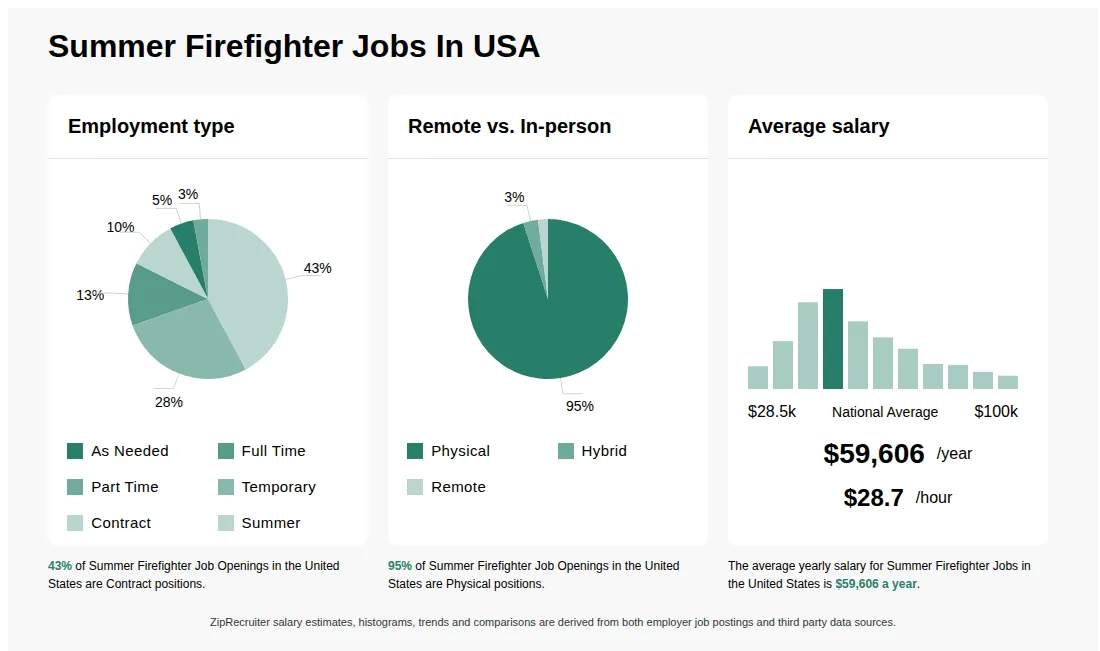
As of Jun 9, 2026, the average yearly pay for summer firefighter in the United States is $59,606.00, according to ZipRecruiter salary data. Most workers in this role earn between $45,500.00 and $69,000.00 per year, depending on experience, location, and employer.

What are some common challenges faced by summer firefighters, and how can new hires prepare for them?

Summer firefighters often face physically demanding conditions such as high temperatures, long shifts, and rapidly changing fire behavior. New hires should be prepared for extended periods outdoors, strenuous activity, and the need to work closely with a tight-knit team under stressful circumstances. Building strong physical fitness, learning to communicate effectively, and becoming familiar with wildfire safety protocols can help new firefighters adapt successfully to these challenges.

What is the difference between Summer Firefighter vs Wildland Firefighter?

AspectSummer FirefighterWildland Firefighter
CertificationsBasic firefighting training, CPR, First AidBasic firefighting training, S-130/190, First Aid
Work EnvironmentTemporary summer positions, urban and rural areasWildland terrains, forests, national parks
Employer & IndustryFire departments, summer programsForest services, federal agencies

Summer Firefighters typically work during the summer season in various environments, focusing on fire suppression and prevention. Wildland Firefighters specialize in fighting fires in forested and wildland areas, often requiring specific certifications like S-130/190. While both roles involve firefighting skills, Wildland Firefighters usually work in more remote, natural settings and may have longer deployments. Understanding these differences helps candidates choose the right path based on their certifications and preferred work environment.

Is 27 too late to become a firefighter?

There is no age limit to becoming a firefighter, and many departments accept applicants in their late 20s or older. Physical fitness, relevant training, and certifications like EMT are important factors in the hiring process. Age should not be a barrier if you meet the requirements and are prepared for the demands of the job.

What Does a Summer Firefighter Do?

The job duties of a summer firefighter involve fighting fires from June through August. This seasonal firefighting position typically focuses on forest fires and wildfires, which are also known as wildland fires. The Summer months are typically very dry, so wildfire risk is high, and fire departments need extra support. Your responsibilities include working with a team of firefighters to extinguish or control wildfires and working on controlled burns that eliminate flammable landscape from the path of a wildfire. You typically handle your firefighting responsibilities as part of a federal or state firefighting operation. This position is temporary, and employment coincides with wildfire season in the region where you work.

What are Summer Firefighters?

Summer Firefighters are seasonal workers who help fight and prevent wildfires during the peak fire season, typically in the summer months. They work for government agencies, such as the U.S. Forest Service or state forestry departments, and are trained to suppress fires, create fire breaks, and protect property and natural resources. In addition to firefighting, they may also assist with fire prevention education, equipment maintenance, and recovery efforts after fires. These positions are physically demanding and often involve working in challenging outdoor conditions for extended periods.

What are the key skills and qualifications needed to thrive as a Summer Firefighter, and why are they important?

To thrive as a Summer Firefighter, you need physical fitness, basic firefighting knowledge, and completion of fire training programs or certifications such as wildland fire training (e.g., S-130/S-190). Familiarity with firefighting tools, personal protective equipment (PPE), radios, and emergency response protocols is required. Teamwork, quick decision-making, and resilience under pressure are essential soft skills for this role. These skills and qualifications are crucial to ensuring safety, effective response to fire emergencies, and successful collaboration in high-risk outdoor environments.
What cities are hiring for Summer Firefighter jobs? Cities with the most Summer Firefighter job openings:
What are the most commonly searched types of Firefighter jobs? The most popular types of Firefighter jobs are:
What states have the most Summer Firefighter jobs? States with the most job openings for Summer Firefighter jobs include:
What job categories do people searching Summer Firefighter jobs look for? The top searched job categories for Summer Firefighter jobs are:
Infographic showing various Summer Firefighter job openings in the United States as of May 2026, with employment types broken down into 88% Full Time, 8% Temporary, and 4% Summer. Highlights an 98% Physical, 1% Hybrid, and 1% Remote job distribution, with an average salary of $59,606 per year, or $28.7 per hour.
Summer/Winter Cadet

Full-time

Posted 28 days ago


Job description

Summer/Winter Internship:  

Reports to:

  • The Summer/Winter Internship is a temporary training position in one of McAllister Towing's ports.  You will report directly to the Officer in Charge of Navigation when on duty.  

Supervises:

  • None

Description of Duties:

As an intern, you will have the opportunity to train, gain valuable experience, and apply classroom knowledge you have learned at your Service Academy. 

Take this opportunity to make the most of your internship while working for McAllister Towing.  Seek professional specialty knowledge, career advice, and sage counsel from as many experienced mariners as possible to enable a pathway of success for your future career in the Maritime Industry.  Maximize your Summer Internship by listening, learning, and participating in all operations, shipboard maintenance, and drills throughout your time onboard.   

Your safety is paramount and our highest priority while working at McAllister Towing.  Pay close attention to all safety procedures and briefs while working on deck, the bridge, or the engine room.  Do not hesitate to ask questions if you are unsure of an operation or safety procedure.  
Duties during your time at McAllister Towing may also include:

  • Lookout

  • Handles lines/wires to and from other vessels or structures during operations at the direction of the Officer in Charge of the Navigation Watch.

  • Tends mooring lines.

  • Performs assigned firefighting, man overboard and abandon ship duties as assigned on the Station Bill.

  • Handles fuel, lube oil and water transfer hoses under the direction of the Person in Charge (PIC).

  • Performs cleaning and maintenance as assigned by the Captain.

  • Accountable for personal hygiene, for maintaining the safe, clean condition of own stateroom, and for participating with other crew to maintain public spaces in like condition.

  • Performs assigned firefighting, man overboard and abandon ship duties as assigned on the Station Bill.

  • Other duties as may be assigned by the Captain.

  • Project a positive company image and maintain professional, amicable relationships with customers, pilots, terminal personnel and the public at all times.

  • Other duties as may be assigned by the Captain.

Minimum Requirements:

  • Current U.S. Coast Guard Merchant Mariner Credential (if Cadet has credentials).

  • Valid Transportation Worker Identification Card (TWIC).

Physical Requirements:

The unpredictable, ever-changing and inherently dangerous nature of tug and towing operations require the Ordinary Seaman to be physically qualified to ensure his/her own safety, as well as that of the vessel and crew. Specific physical requirements include:

  • Adequate vision (i.e., absent any color blindness or impairment that cannot be corrected with prescription lenses).

  • Adequate hearing.

  • Capable of walking and standing on wet surfaces for extended periods of time.

  • Able to handle heavy lines and operate heavy machinery.

  • Ability to climb a 12-foot ladder without assistance.

  • Ability to hoist oneself up and over a 12-inch wide, 6-foot-high barrier.

  • Sufficient strength to:

  • Lift 100 lbs. from deck to waist level.

  • Lift 50 lbs. from deck to shoulder level.

  • Lift 35 lbs. from deck to overhead; and

  • Pull (drag) 120 lbs. at least 20 feet.

Salary: Cadet Day Rate - varies per port

 FLSA Status:

  • Exempt

*This position description does not promise or imply that the functions listed are the only duties to be performed or that the position may not change or be eliminated. Employees are always expected to follow their supervisor's instructions and to perform the tasks requested by their supervisors.

Equal Employment Opportunity Employer:
 
We are an Equal Employment Opportunity ("EEO") Employer.

It has been and will continue to be a fundamental policy of McAllister Towing not to discriminate on the basis of race, color, creed, religion, gender, gender identity, pregnancy, marital status, partnership status, domestic violence victim status, sexual orientation, age, national origin, alienage or citizenship status, veteran or military status, disability, medical condition, genetic information, caregiver status, unemployment status or any other characteristic prohibited by federal, state and/or local laws.

This policy applies to all aspects of employment, including hiring, promotion, demotion, compensation, training, working conditions, transfer, job assignments, benefits, layoff, and termination.