1

Strategic Workforce Planning Jobs (NOW HIRING)

next page

Showing results 1-20

Strategic Workforce Planning information

See salary details

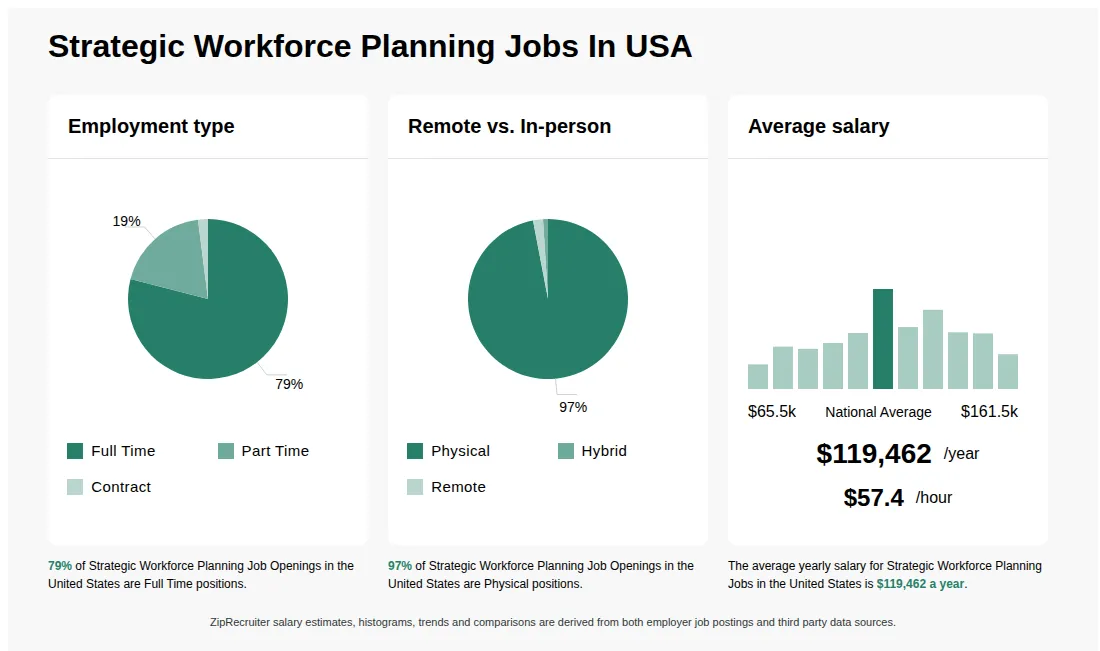
$65.5K

$119.5K

$161.5K

How much do strategic workforce planning jobs pay per year?

As of Jul 11, 2026, the average yearly pay for strategic workforce planning in the United States is $119,462.00, according to ZipRecruiter salary data. Most workers in this role earn between $100,500.00 and $138,500.00 per year, depending on experience, location, and employer.

What is a Strategic Workforce Planning job?

A Strategic Workforce Planning job involves analyzing an organization’s current and future workforce needs to ensure the right talent is in place to achieve business objectives. Professionals in this role assess workforce trends, skills gaps, and succession planning while aligning talent strategies with long-term business goals. They collaborate with HR, finance, and leadership teams to develop data-driven workforce solutions. This role requires a strong understanding of labor market trends, organizational strategy, and workforce analytics.

What does a strategic workforce planner do?

A strategic workforce planner analyzes an organization’s current and future staffing needs to ensure the right talent is in place to meet business goals. They use data, forecasting, and planning tools to develop strategies for talent acquisition, development, and retention, often collaborating with HR and leadership teams. Strong analytical skills and knowledge of workforce trends are essential for this role.

What does a typical week look like for someone working in Strategic Workforce Planning?

A typical week in Strategic Workforce Planning involves a mix of data analysis, forecasting future talent needs, and meeting with department leaders to understand business objectives. You may spend time developing workforce models, reviewing hiring trends, and creating reports to present recommendations to senior management. Collaboration with HR business partners, finance, and operations teams is common, making effective communication and relationship-building important. The work is both analytical and strategic, offering exposure to high-level decision-making and providing a solid pathway for career advancement into broader HR or organizational leadership roles.

Is workforce planning a good career?

Workforce planning is a strategic role focused on analyzing and forecasting an organization’s staffing needs, often requiring skills in data analysis, HR, and business strategy. It offers opportunities for advancement, collaboration with leadership, and the use of tools like HR analytics software, making it a stable and growing career option for those interested in organizational development.

What jobs use strategic planning?

Strategic planning is used in a variety of jobs including executive roles, business analysts, project managers, marketing managers, and human resources professionals. These roles require setting long-term goals, analyzing market trends, and developing plans to achieve organizational objectives, often utilizing tools like SWOT analysis and strategic frameworks.

What are the 7 B's of strategic workforce planning?

The 7 B's of strategic workforce planning are a framework to ensure effective talent management, including Building the workforce, Bridging skills gaps, Benchmarking against industry standards, Balancing supply and demand, Branding the organization to attract talent, Building leadership capacity, and Business alignment to strategic goals. This approach helps HR professionals and workforce planners develop a proactive, comprehensive plan to meet future staffing needs.

What are the key skills and qualifications needed to thrive in the Strategic Workforce Planning position, and why are they important?

To thrive in Strategic Workforce Planning, you need strong analytical abilities, business acumen, and a solid understanding of human resources principles, typically supported by a degree in HR, business, or a related field. Familiarity with workforce analytics platforms, HRIS, and advanced Excel skills—plus certifications like SHRM-SCP or SWP—are often considered a plus. Excellent communication, stakeholder management, and problem-solving skills help you influence decision-making and foster cross-departmental collaboration. These competencies are crucial because the role requires aligning talent strategies with business goals and ensuring the organization can anticipate and respond to workforce needs.

More about Strategic Workforce Planning jobs
What cities are hiring for Strategic Workforce Planning jobs? Cities with the most Strategic Workforce Planning job openings:
What are the most commonly searched types of Strategic Workforce Planning jobs? The most popular types of Strategic Workforce Planning jobs are:
What states have the most Strategic Workforce Planning jobs? States with the most job openings for Strategic Workforce Planning jobs include:
Strategic Workforce Planning Lead

Strategic Workforce Planning Lead

Aurora Innovation

San Francisco, CA

$110K - $137K/yr

Other

Re-posted 2 days ago


Job description

Aurora hires talented people with diverse backgrounds who are ready to help build a transportation ecosystem that will make our roads safer, get crucial goods where they need to go, and make mobility more efficient and accessible for all. We're searching for a Strategic Workforce Planning Lead.

The Strategic Workforce Planning (SWP) Lead will be a key driver in shaping our organizational capabilities and ensuring long-term success. This role is responsible for designing and executing a comprehensive SWP framework to analyze current workforce capabilities and forecast future talent needs based on business strategy and objectives. The ideal candidate is a strategic thinker with deep business acumen, data-driven decision-making, and best-practice SWP methodologies. 

Responsibilities:

Strategic Forecasting & Gap Analysis:

  • Demand Forecasting: Analyzing business goals (e.g., expansion into a new market) to project future staffing requirements.
  • Supply Analysis: Evaluating the current internal workforce to identify existing skills and potential attrition (retirements, turnover).
  • Gap Identification: Pinpointing the discrepancy between future needs and current reality, whether in total headcount or specific technical skills. Including how AI can augment human labor or change the profile of employees required in the future.
  • Partnership: Partner with Executive Leadership, Finance, Talent Acquisition, Compensation, and People Analytics to align workforce strategies with business goals, budget, and headcount projections.

Data Analytics & Reporting:

  • Predictive Modeling: Using historical data and market trends to build models that simulate various business scenarios (e.g., "What happens to our capacity if turnover increases by 10%?").
  • Metric Development: Develop data-driven models and dashboards to track key workforce metrics, trends (internal and external), and the efficacy of SWP initiatives. Translate workforce data into actionable insights for the C-suite.

Financial & Operational Alignment:

  • Budget Integration: Partnering with the Finance department to ensure hiring plans align with the annual operating budget and long-range financial plans.
  • Resource Optimization: Recommending the ideal mix of full-time, part-time, and contingent (contract) workers to maximize efficiency.
  • Location Strategy: Advising on where talent should be located based on cost, skill availability, and business continuity.

Talent Strategy:

  • Identify critical talent gaps, surpluses, and skill adjacencies, developing mitigation strategies (e.g., build, buy, borrow).
  • Skill Mapping: Identifying "perishing" skills that are no longer needed and "emerging" skills (like AI proficiency) that must be prioritized.

Skills:

  • Business Athlete Mindset: You are deeply knowledgeable about the business and industry, comfortable navigating and leading others through ambiguity, pivoting quickly to address new challenges, and solving complex problems without a pre-existing playbook.
  • Systems Thinker: You recognize the connections across the organization, and take a holistic approach to analyzing situations and developing solutions that are sustainable in the longer term and account for system interdependencies.
  • Strategic Acumen: You have an ability to translate long-term business strategy into concrete workforce initiatives.
  • Data-Driven: You use data and insights to proactively diagnose issues, inform your recommendations, influence decisions, and measure the impact of your work.
  • Execution Excellence: You deliver high quality results through leading projects and initiatives with milestones and delivery schedules in partnership with stakeholders, and develop clear action plans with results-oriented goals for measuring success.
  • Resilience and a Growth Mindset: You possess the resilience to thrive in a fast-paced environment and the ability to energize those around you.
  • Consulting & Partnering: You have a strong ability to build trust and credibility with business leaders and other partners as a subject matter expert, and to collaborate effectively across multiple business areas and teams in a fast-paced environment.
  • Innovation: You have a continuous improvement mindset, seeking out and applying best practices and technology solutions in the HR space.
  • Change Management: You are skilled in leading organizational change and ensuring successful adoption of new HR processes.

Qualifications:

  • 10+ years of progressive experience in Human Resources, with a strong focus on Workforce Planning
  • Proven experience partnering directly with C-suite executives within a rapidly scaling organization. 
  • Technology industry experience is strongly preferred.
  • Bachelor's degree in Human Resources (or related field) required. Advanced degree preferred.
  • Proven experience designing and implementing Strategic Workforce Planning frameworks and models.
  • Highly proficient in using Workday and other systems/tools tools to extract, analyze, and present data-driven insights to senior leaders.
  • Exceptional verbal, written, and presentation skills, with the ability to influence and collaborate effectively across all levels of the organization.
  • Strong communication skills (written and verbal) to effectively address all organizational levels.
  • Fluent in English.
  • Ability to travel within the U.S. approximately 10% of the time.
  • This role requires this person to be in the office at least 3 days per week.

The base salary range for this position is $147k - $238k per year.  Aurora's pay ranges are determined by role, level, and location. Within the range, the successful candidate's starting base pay will be determined based on factors including job-related skills, experience, qualifications, relevant education or training, and market conditions. These ranges may be modified in the future. The successful candidate will also be eligible for an annual bonus, equity compensation, and benefits. 

#LI-MS1

#Mid-Senior