2

Remote Telemetry Monitoring Jobs (NOW HIRING)

This is a remote position. Overview : Monitoring & Observability Architect : Role overview: Design ... Service mesh telemetry (Istio/Linkerd). * Experience in regulated environments (e.g., FDA) and ...

$185K - $290K/yr

Multiple Sites - US (Remote/Hybrid eligible) Travel : 50% travel to our data center sites Role ... are continuously monitored, alarmed, and controllable in real time, supporting the safe and ...

Identify security market inflection points (OT/ICS cybersecurity, convergence, secure remote access ... security telemetry/monitoring; familiarity with IT/OT convergence challenges. * Excellent ...

Remote or onsite, we are committed to ensuring you are fully engaged and included in our ... Enhance telemetry, monitoring, and diagnostics to improve platform reliability, availability, and ...

GNC Engineer - Remote

$133K - $200K/yr

GNC Engineer - Remote Belong. Connect. Grow. with KBR! Around here, we define the future. We are a ... monitoring and commanding GNC subsystems * Develop operator displays, telemetry utilization ...

next page

Showing results 1-20

Remote Telemetry Monitoring information

See salary details

$13

$22

$43

How much do remote telemetry monitoring jobs pay per hour?

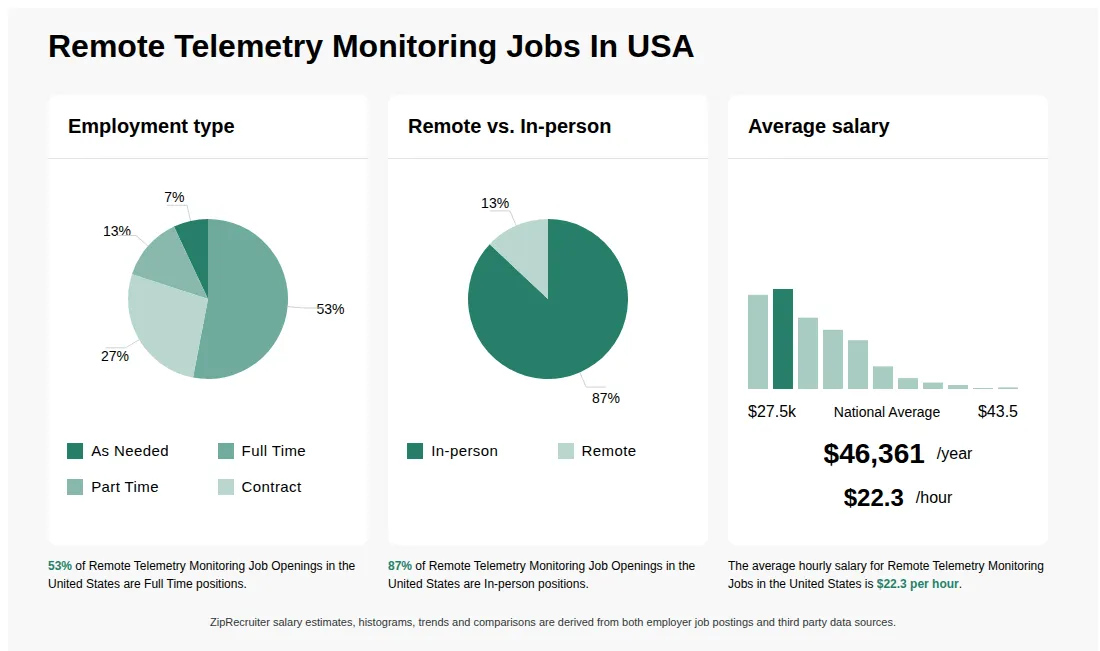
As of Jul 15, 2026, the average hourly pay for remote telemetry monitoring in the United States is $22.29, according to ZipRecruiter salary data. Most workers in this role earn between $17.31 and $24.52 per hour, depending on experience, location, and employer.

What is a Remote Telemetry Monitoring job?

A Remote Telemetry Monitoring job involves overseeing and analyzing data from patients, machines, or systems remotely using telemetry technology. In healthcare, this typically includes monitoring patients’ vital signs and alerting medical staff to critical changes. In other industries, such as energy or telecommunications, it involves tracking equipment performance and detecting faults in real time. The role requires strong analytical skills, attention to detail, and proficiency with monitoring software. It ensures the safety, efficiency, and optimal functioning of the monitored subjects.

What does a typical day look like for someone working in Remote Telemetry Monitoring?

A typical day in Remote Telemetry Monitoring involves continuously observing patient data streams, analyzing vital signs for irregularities, and promptly alerting clinical teams to any significant changes. You’ll spend much of your time using specialized software to monitor multiple patients, documenting findings, and collaborating remotely with on-site nurses and physicians. The role requires high concentration and the ability to prioritize tasks efficiently within a team-based or independent work environment. While it can be fast-paced, this position offers the rewarding challenge of making a direct impact on patient care from a remote location.

Are telemetry techs in high demand?

Telemetry technicians are in steady demand due to the increasing use of remote patient monitoring and healthcare technology. The role often requires technical skills, familiarity with monitoring equipment, and certifications, which can enhance job prospects in healthcare settings and remote work environments.

How to make $1000 a week remotely?

Remote telemetry monitoring professionals can increase earnings by gaining specialized certifications, working multiple shifts, or taking on additional clients. Building experience and efficiency with monitoring tools can also lead to higher pay rates, enabling some to reach or exceed $1000 weekly depending on workload and hours worked.

How can I make $100,000 a year working from home?

Remote telemetry monitoring professionals can earn $100,000 or more annually by gaining specialized certifications, developing strong technical skills, and gaining experience in healthcare or industrial settings. High-paying roles often require advanced knowledge of monitoring systems, data analysis, and remote communication tools, along with the ability to work independently and manage complex cases. Building expertise and seeking positions with healthcare providers or technology companies can increase earning potential in this field.

What are the key skills and qualifications needed to thrive in the Remote Telemetry Monitoring position, and why are they important?

To excel in Remote Telemetry Monitoring, strong analytical abilities, attention to detail, and a background in healthcare or allied health fields are typically required. Familiarity with telemetry software, remote patient monitoring systems, and relevant certifications such as Basic Life Support (BLS) or Certified Telemetry Technician are highly valued. Excellent communication skills, critical thinking, and the ability to work independently make candidates stand out in this position. These skills are essential for accurately interpreting data, promptly identifying abnormalities, and ensuring patient safety in a remote setting.

How can I make 2000 a week working from home?

Remote telemetry monitoring jobs can pay between $20 and $40 per hour, so working full-time (40 hours) could potentially earn around $800 to $1,600 weekly. To reach $2,000, additional shifts, overtime, or higher-paying roles with specialized skills or certifications may be necessary. Developing technical skills and gaining relevant certifications can improve earning potential in this field.
More about Remote Telemetry Monitoring jobs
What cities are hiring for Remote Telemetry Monitoring jobs? Cities with the most Remote Telemetry Monitoring job openings:
What states have the most Remote Telemetry Monitoring jobs? States with the most job openings for Remote Telemetry Monitoring jobs include:
What job categories do people searching Remote Telemetry Monitoring jobs look for? The top searched job categories for Remote Telemetry Monitoring jobs are:
Monitoring and Observability Architect

Monitoring and Observability Architect

Exavalu

Remote

Full-time

Posted 19 days ago


Job description


This is a remote position.
Overview :
Monitoring & Observability Architect :
Role overview: Design, implement, and operate scalable observability platforms to provide metrics, logs, traces, and alerts for cloud-native, distributed systems.
Responsibilities
  • Build and maintain Observability pipelines and dashboards (metrics, logs, traces).
  • Define and track SLOs, SLIs, and SLAs; create actionable alerts.
  • Instrument apps/infrastructure with OpenTelemetry and vendor SDKs.
  • Integrate and operate tools (Splunk, Prometheus/Grafana, ELK/EFK, Datadog, New Relic)
  • Automate deployments with CI/CD and IaC (Terraform/CloudFormation).
  • Collaborate with dev, SRE, and platform teams; produce runbooks and post-incident reports.

Requirements
Required
  • Hands-on with Splunk at least two monitoring tools (Splunk, Prometheus & Grafana, ELK/EFK, Datadog, New Relic).
  • Strong scripting/programming (Python, Go, or Bash).
  • Deep knowledge of Kubernetes, Docker, microservices, and distributed systems.
  • Experience defining SLOs/SLIs/SLAs.
  • Familiar with CI/CD and IaC; experience on AWS.

Preferred
  • OpenTelemetry and distributed tracing experience.
  • Service mesh telemetry (Istio/Linkerd).
  • Experience in regulated environments (e.g., FDA) and telemetry cost/retention optimization.

Soft skills
  • Clear communicator, collaborative, proactive, and good at mentoring.

Benefits
Diversity Inclusion: At Exavalu, we are committed to building a diverse and inclusive workforce. We welcome applications for employment from all qualified candidates, regardless of race, color, gender, national or ethnic origin, age, disability, religion, sexual orientation, gender identity or any other status protected by applicable law. We nurture a culture that embraces all individuals and promotes diverse perspectives, where you can make an impact and grow your career. Exavalu also promotes flexibilitydepending on the needs of employees, customers and the business. It might be part-time work, working outside normal 9-5 business hours or working remotely. We also have a welcome back program to help people get back to the mainstream after a long break due to health or family reasons.