2

Part Time Ceo Jobs (NOW HIRING)

Executive Assistant

Columbus, OH · On-site +1

$22 - $25/hr

Part-Time Executive Assistant to the CEO Do you thrive on keeping things organized, solving problems before they happen, and being the behind-the-scenes force that keeps a creative organization ...

New

NonProfit Fractional Chief Financial Officer (CFO) Part-time | Hybrid Opportunity | Cincinnati, Ohio Reports to: Executive Leadership Manages: Finance & Accounting team (3-4 members) Position ...

Executive Personal Assistant to CEO Location: In-Person (San Diego office) Schedule: Part-Time (10-20 hours per week) Compensation: $25-$30/hr (flexible based on experience) Position Overview: We are ...

next page

Showing results 1-20

Part Time Ceo information

See salary details

$30K

$82.1K

$154.5K

How much do part time ceo jobs pay per year?

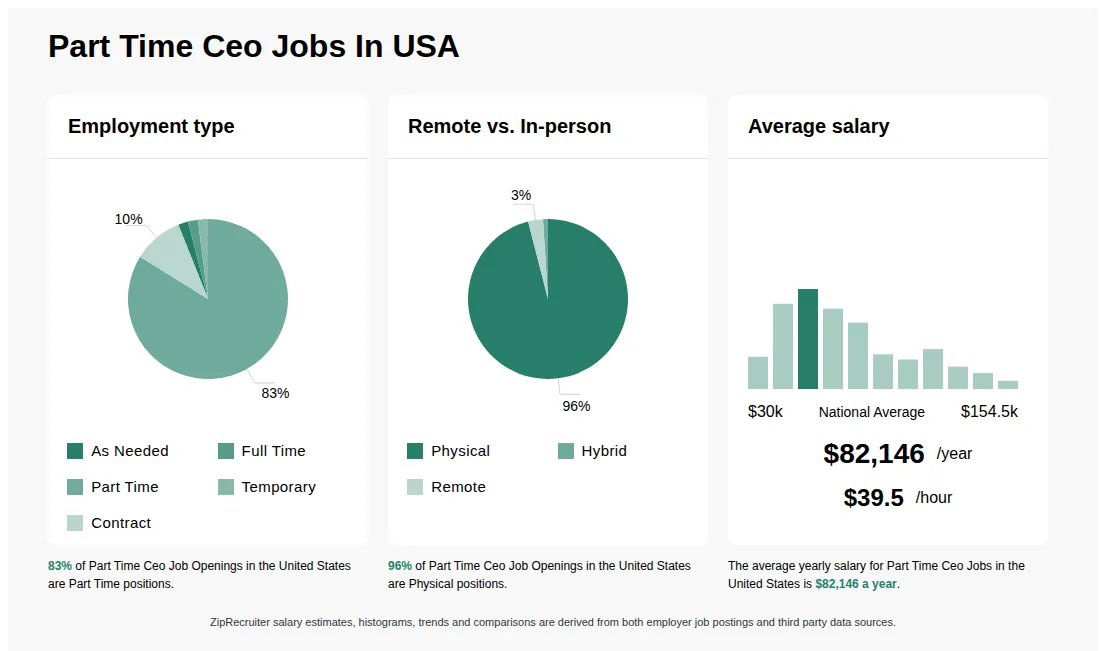
As of Jun 14, 2026, the average yearly pay for part time ceo in the United States is $82,146.00, according to ZipRecruiter salary data. Most workers in this role earn between $54,500.00 and $100,000.00 per year, depending on experience, location, and employer.

What jobs pay 500,000 a year in the US?

High-level executive roles such as CEOs, CFOs, and other C-suite positions often have annual compensation exceeding $500,000, especially in large corporations. Additionally, specialized roles like successful entrepreneurs, certain investment bankers, and top-tier surgeons can also reach or surpass this income level, often requiring extensive experience, advanced skills, and leadership responsibilities.

What jobs make $1,000,000 a year?

High-level executive roles such as CEOs, CFOs, and other C-suite executives often earn $1,000,000 or more annually, especially in large corporations or successful startups. Additionally, entrepreneurs, investment bankers, and certain specialized professionals in finance, technology, or entertainment can reach this income level through bonuses, stock options, or profit sharing. These roles typically require extensive experience, leadership skills, and advanced education or industry expertise.

Can a CEO work part-time?

A CEO role is typically a full-time executive position responsible for overall company strategy and leadership. While rare, some smaller companies or startups may have part-time CEOs or interim leaders, but generally, the role requires full-time commitment due to its high level of responsibility and decision-making demands.

How do part-time CEOs typically balance strategic responsibilities with limited working hours?

Part-time CEOs often focus on high-level strategic decision-making, delegating day-to-day operations to a strong management team. They prioritize clear communication, set measurable goals, and leverage regular check-ins to stay aligned with business objectives. Time management and effective delegation are essential to ensure critical initiatives move forward despite a reduced time commitment. This role is especially common in startups or nonprofits where resources are limited but executive leadership is still needed.

What is a Part Time CEO?

A Part Time CEO is an executive leader who works with an organization on a reduced or flexible schedule, rather than full-time. They are responsible for overseeing the company’s strategy, leadership, and key decisions, but may only dedicate a set number of hours each week or month. Part Time CEOs are often hired by startups, small businesses, or companies in transition that need executive expertise but cannot afford or do not require a full-time CEO. This arrangement allows businesses to access experienced leadership while managing costs. The role may also be referred to as a fractional or interim CEO.

What jobs pay 10,000 a month without a degree?

A part-time CEO role typically requires extensive experience and leadership skills rather than a degree, and it can pay over $10,000 monthly if the individual manages a successful company or startup. Other high-paying jobs without a degree include sales manager, real estate broker, or skilled trades like electrician or plumber, which depend on experience, certifications, and market demand. Success in these roles often involves strong networking, entrepreneurial skills, or specialized training.

What Does a Part-Time CEO Do?

Some companies have leaders who work part-time with responsibilities that are similar to those of a full-time executive. As a part-time CEO, your duties include coordinating projects and priorities and providing strategic leadership for diverse teams throughout the organization, including HR, finance, operations, sales, and administration. You collaborate with members of the corporate management team to ensure the organization meets operational and sales goals, and your duties involve chairing company meetings, negotiating contracts and agreements, approving the annual budget, and ensuring fiscal responsibility and ethical behavior. Some part-time CEO roles are temporary or interim, while others are long-term.

What are the key skills and qualifications needed to thrive as a Part Time CEO, and why are they important?

To thrive as a Part Time CEO, you need strong strategic leadership, financial acumen, and proven executive experience, often supported by an advanced degree such as an MBA. Familiarity with business management software, financial reporting systems, and board governance tools is typically essential. Outstanding communication, decision-making, and time management skills help a part-time CEO effectively lead and inspire teams while balancing limited hours. These skills and qualities ensure the CEO can drive organizational success, make high-impact decisions, and maintain stakeholder confidence despite a reduced time commitment.

What is the difference between Part Time Ceo vs Part Time Executive Director?

AspectPart Time CeoPart Time Executive Director
CredentialsExperience in leadership, business managementNonprofit management experience, leadership skills
Work EnvironmentCorporate, startup, or private companiesNonprofit organizations, charities
Employer & IndustryBusinesses across various industriesNonprofits and charitable organizations
Search & Comparison IntentUnderstanding leadership roles in companiesNonprofit leadership and management

While both roles involve leadership responsibilities, a Part Time Ceo typically oversees business strategy and operations in a corporate setting, whereas a Part Time Executive Director focuses on managing nonprofit activities and mission-driven initiatives. The choice depends on the industry and organizational structure.

What cities are hiring for Part Time Ceo jobs? Cities with the most Part Time Ceo job openings:
What are the most commonly searched types of Ceo jobs? The most popular types of Ceo jobs are:
What states have the most Part Time Ceo jobs? States with the most job openings for Part Time Ceo jobs include:
Infographic showing various Part Time Ceo job openings in the United States as of June 2026, with employment types broken down into 100% Part Time. Highlights an 95% In-person, and 5% Remote job distribution, with an average salary of $82,146 per year, or $39.5 per hour.
Executive Assistant - Part-Time

Executive Assistant - Part-Time

Minority Behavioral Health Group

Akron, OH • On-site

Part-time

Posted 5 days ago


Job description

Job Summary:
The Executive Assistant will coordinate and manage executive scheduling, prepare, and organize important legal and strategic materials and plans, and support board meetings and the preparation of board materials. This role serves as the eyes and ears for the CEO, connecting organizations, projects, and critical business information to the CEO, ensuring meetings and materials are efficient and effective and serves as a trusted partner to deliver against the priorities of the agency.
The dynamic nature of this role requires that the Executive Assistant has exemplary time management skills and the ability to identify and anticipate the CEO’s needs. The role must interact seamlessly and with a professional demeanor across a broad range of individuals including members of the Senior Management Team, Board Members and Community Leaders. To perform this job successfully, the individual is expected to handle highly sensitive and confidential financial, legal, personnel and institutional information while exercising professionalism and discretion.
Essential Functions and Duties:
  • Work directly with the CEO to support all aspects of their daily work routine.
  • Maintain the CEO’s calendar, including scheduling meetings, appointments, speaking engagements, and travel (may include domestic and international) arrangements. Exercise discretion in committing time and evaluating needs.
  • Serve as a liaison between the CEO, MBHG Staff and the Community. This includes receiving and screening the CEO’s phone calls and visitors, answering a variety of questions with tact and diplomacy, taking messages, and directing calls appropriately for resolution.
  • Coordinate work with other MBHG staff as needed; play a key role in the coordination of staff efforts both within and outside the organization.
  • Provide coordination, monitoring, and communication of projects and programs managed by MBHG.
  • Serve as a primary point of contact between the Office of the CEO, various agencies and the community, including helping to coordinate the work of the different groups and providing administrative support for governance meetings.
  • Assist the CEO in the development of presentations and white papers for internal and external audiences.
  • Determine priority of matters of attention for the CEO; redirect matters to staff to handle, or handle matters personally, as appropriate.
  • Keep the CEO advised of time-sensitive and priority issues, ensuring appropriate follow-up.
  • Accompanies the CEO to internal and external meetings as required, keeping detailed notes and files of all documents presented.
  • Coordinates Board of Directors and Senior Management Committee meetings, prepares agenda, communicated action items, and records meeting minutes.
  • Managing accounts payable and handling payments for various vendors.
  • Processing and verifying invoices.
  • Assists with other administrative duties/projects as needed.
Qualifications:
  1. A minimum of an associate’s degree from an accredited university in office administration or a related field; or
  2. A combination of training, education, and experience that is equivalent to the employment standard listed below that provides the required knowledge and abilities.
  3. Reasonably proficient use of Microsoft Office and other design programs, and advance computer skills.
Standard: The tasks performed require training and experience in office work, and skill in applying knowledge of rules, regulations, and instructions to individual cases. Most assignments at this level are determined by the natural flow of work and are performed without specific instructions. Work methods are expected to follow standard practices; unusual or difficult circumstances are attempted for resolve but may be referred to the CEO. There is moderate independent decision-making at this level in interpreting and applying procedures and precedents to specific cases. Errors may be serious and requires determining which activities or cases are routine and which should be separated for special consideration. Originality and independent judgment are required in choosing among several predetermined alternative courses of action based on general instructions or precedents, as well as recognizing situations that will require the consideration of revised policy or procedures.
Skills, Knowledge and Abilities:
  • Knowledge of English grammar, punctuation, spelling and basic math.
  • Moderately advanced clerical office procedures; filing methods; telephone procedures, including operation of multi-line equipment and message taking; business telephone etiquette.
  • Ability to deal tactfully with people displaying strong interpersonal skills; maintain confidentiality of information; write legibly to record information; prepare simple correspondence; understand and follow oral and written instructions; read and understand manuals; verbally communicate information clearly and concisely to others.
  • Ability to operate office equipment such as personal computer, printer, copier, and fax machine; organize and prioritize work; proofread documents and correspondence; file information alphabetically, numerically, and chronologically.
  • Flexible and possesses the ability to work semi-independently and project coordination experience.
  • Ability to work well with all levels of internal management and staff.
  • Maintain confidentiality of all privileged information and handles agency business exercising a high level of discretion.
