Professional Coder
Providence, RI · On-site
Assigns E/M, ICD-10-CM, CPT or chargemaster codes to clinic visits ensuring medical record documentation supports the code. Should physicians have entered in diagnosis, ICD or CPT codes, ensures they ...
Providence, RI · On-site
Assigns E/M, ICD-10-CM, CPT or chargemaster codes to clinic visits ensuring medical record documentation supports the code. Should physicians have entered in diagnosis, ICD or CPT codes, ensures they ...
Providence, RI · On-site
Assigns E/M, ICD-10-CM, CPT or chargemaster codes to clinic visits ensuring medical record documentation supports the code. Should physicians have entered in diagnosis, ICD or CPT codes, ensures they ...
Providence, RI · Remote
Assigns E/M, ICD-10-CM, CPT or chargemaster codes to clinic visits ensuring medical record documentation supports the code. Should physicians have entered in diagnosis, ICD or CPT codes, ensures they ...
Providence, RI · Remote
Assigns E/M, ICD-10-CM, CPT or chargemaster codes to clinic visits ensuring medical record documentation supports the code. Should physicians have entered in diagnosis, ICD or CPT codes, ensures they ...
RI · On-site +1
$23.75 - $31.50/hr
Analyze coding related claim issues, process gaps and denials to trend feedback for providers by ... Education/Experience • Knowledgeable and experienced with Medical Terminology. • Multitask ...
RI · On-site +1
$23.75 - $31.50/hr
Analyze coding related claim issues, process gaps and denials to trend feedback for providers by ... Education/Experience • Knowledgeable and experienced with Medical Terminology. • Multitask ...
Warwick, RI · On-site
$19.79 - $22.91/hr
Apply appropriate coding and billing practices to support proper claim processing and reimbursement ... Hands-on experience in medical billing within a healthcare, clinic, or related revenue cycle ...
Quick apply
Warwick, RI · On-site
$19.79 - $22.91/hr
Apply appropriate coding and billing practices to support proper claim processing and reimbursement ... Hands-on experience in medical billing within a healthcare, clinic, or related revenue cycle ...
Providence, RI · On-site
$24.70 - $28.60/hr
Enter charges for assigned programs in a timely manner while ensuring coding and billing data are ... Prior experience in medical billing within a healthcare environment; behavioral health billing ...
Quick apply
Providence, RI · On-site
$24.70 - $28.60/hr
Enter charges for assigned programs in a timely manner while ensuring coding and billing data are ... Prior experience in medical billing within a healthcare environment; behavioral health billing ...
Providence, RI · On-site
$29 - $32/hr
From fulfilling a single patient's request for their medical records to powering the AI revolution ... Audit coded charts assigned by quality supervisor per the client guidelines * Ability to move from ...
Providence, RI · On-site
$29 - $32/hr
From fulfilling a single patient's request for their medical records to powering the AI revolution ... Audit coded charts assigned by quality supervisor per the client guidelines * Ability to move from ...
Providence, RI · Remote
$24.29 - $40.07/hr
Reviews the medical records to ensure the documentation supports the code assignment. Utilizes 3M 360 Finder for code assignment and appropriate resolutions of claim edits (CCI, NCD, OCE, etc.
Providence, RI · Remote
$24.29 - $40.07/hr
Reviews the medical records to ensure the documentation supports the code assignment. Utilizes 3M 360 Finder for code assignment and appropriate resolutions of claim edits (CCI, NCD, OCE, etc.
Providence, RI · Remote
$67K - $111K/yr
Prepares for and conductseducation sessions which include specialty specific coding and documentation guidelines, examples of relevant medical records, resource materials, etc. Works with Manager to ...
Providence, RI · Remote
$67K - $111K/yr
Prepares for and conductseducation sessions which include specialty specific coding and documentation guidelines, examples of relevant medical records, resource materials, etc. Works with Manager to ...
Providence, RI · On-site
$67K - $111K/yr
Prepares for and conductseducation sessions which include specialty specific coding and documentation guidelines, examples of relevant medical records, resource materials, etc. Works with Manager to ...
Providence, RI · On-site
$67K - $111K/yr
Prepares for and conductseducation sessions which include specialty specific coding and documentation guidelines, examples of relevant medical records, resource materials, etc. Works with Manager to ...
$17.85 - $22.30/hr
Verifying patient's medical record is complete and accurate for medical coding purposes * Triage patient calls and physician messages * Maintain exams rooms with adequate medical supplies and ...
$17.85 - $22.30/hr
Verifying patient's medical record is complete and accurate for medical coding purposes * Triage patient calls and physician messages * Maintain exams rooms with adequate medical supplies and ...
Warwick, RI · On-site
$17.85 - $22.30/hr
Verifying patient's medical record is complete and accurate for medical coding purposes * Triage patient calls and physician messages * Maintain exams rooms with adequate medical supplies and ...
Warwick, RI · On-site
$17.85 - $22.30/hr
Verifying patient's medical record is complete and accurate for medical coding purposes * Triage patient calls and physician messages * Maintain exams rooms with adequate medical supplies and ...
Warwick, RI · On-site
$17.25 - $22.25/hr
Verifying patient's medical record is complete and accurate for medical coding purposes * Triage patient calls and physician messages * Maintain exams rooms with adequate medical supplies and ...
Warwick, RI · On-site
$17.25 - $22.25/hr
Verifying patient's medical record is complete and accurate for medical coding purposes * Triage patient calls and physician messages * Maintain exams rooms with adequate medical supplies and ...
Wakefield, RI · On-site
$17.85 - $22.30/hr
Verifying patient's medical record is complete and accurate for medical coding purposes * Triage patient calls and physician messages * Maintain exams rooms with adequate medical supplies and ...
Wakefield, RI · On-site
$17.85 - $22.30/hr
Verifying patient's medical record is complete and accurate for medical coding purposes * Triage patient calls and physician messages * Maintain exams rooms with adequate medical supplies and ...
Warwick, RI · On-site
$17.25 - $22.25/hr
Verifying patient's medical record is complete and accurate for medical coding purposes * Triage patient calls and physician messages * Maintain exams rooms with adequate medical supplies and ...
Warwick, RI · On-site
$17.25 - $22.25/hr
Verifying patient's medical record is complete and accurate for medical coding purposes * Triage patient calls and physician messages * Maintain exams rooms with adequate medical supplies and ...
Wakefield, RI · On-site
$17.85 - $22.30/hr
Verifying patient's medical record is complete and accurate for medical coding purposes * Triage patient calls and physician messages * Maintain exams rooms with adequate medical supplies and ...
Wakefield, RI · On-site
$17.85 - $22.30/hr
Verifying patient's medical record is complete and accurate for medical coding purposes * Triage patient calls and physician messages * Maintain exams rooms with adequate medical supplies and ...
Wakefield, RI · On-site
$17.85 - $22.30/hr
Verifying patient's medical record is complete and accurate for medical coding purposes * Triage patient calls and physician messages * Maintain exams rooms with adequate medical supplies and ...
Wakefield, RI · On-site
$17.85 - $22.30/hr
Verifying patient's medical record is complete and accurate for medical coding purposes * Triage patient calls and physician messages * Maintain exams rooms with adequate medical supplies and ...
Wakefield, RI · On-site
$17.85 - $22.30/hr
Verifying patient's medical record is complete and accurate for medical coding purposes * Triage patient calls and physician messages * Maintain exams rooms with adequate medical supplies and ...
Wakefield, RI · On-site
$17.85 - $22.30/hr
Verifying patient's medical record is complete and accurate for medical coding purposes * Triage patient calls and physician messages * Maintain exams rooms with adequate medical supplies and ...
Providence, RI · Remote
$40/hr
... coding careers. * Conceptual Teaching & Problem-Solving: Skilled at teaching systematic word analysis, medical term construction, and clinical vocabulary application. Guides students through breaking ...
Providence, RI · Remote
$40/hr
... coding careers. * Conceptual Teaching & Problem-Solving: Skilled at teaching systematic word analysis, medical term construction, and clinical vocabulary application. Guides students through breaking ...
Students learn coding fundamentals by designing games, animations, interactive stories, and creative digital projects in a fun, project-based learning environment. This posting is intended to ...
Quick apply
Students learn coding fundamentals by designing games, animations, interactive stories, and creative digital projects in a fun, project-based learning environment. This posting is intended to ...
Providence, RI · Remote
$40/hr
Ability to explain patient intake procedures, phlebotomy techniques, medical coding basics, and infection control protocols while preparing medical assistant graduates for national CMA certification.
Providence, RI · Remote
$40/hr
Ability to explain patient intake procedures, phlebotomy techniques, medical coding basics, and infection control protocols while preparing medical assistant graduates for national CMA certification.
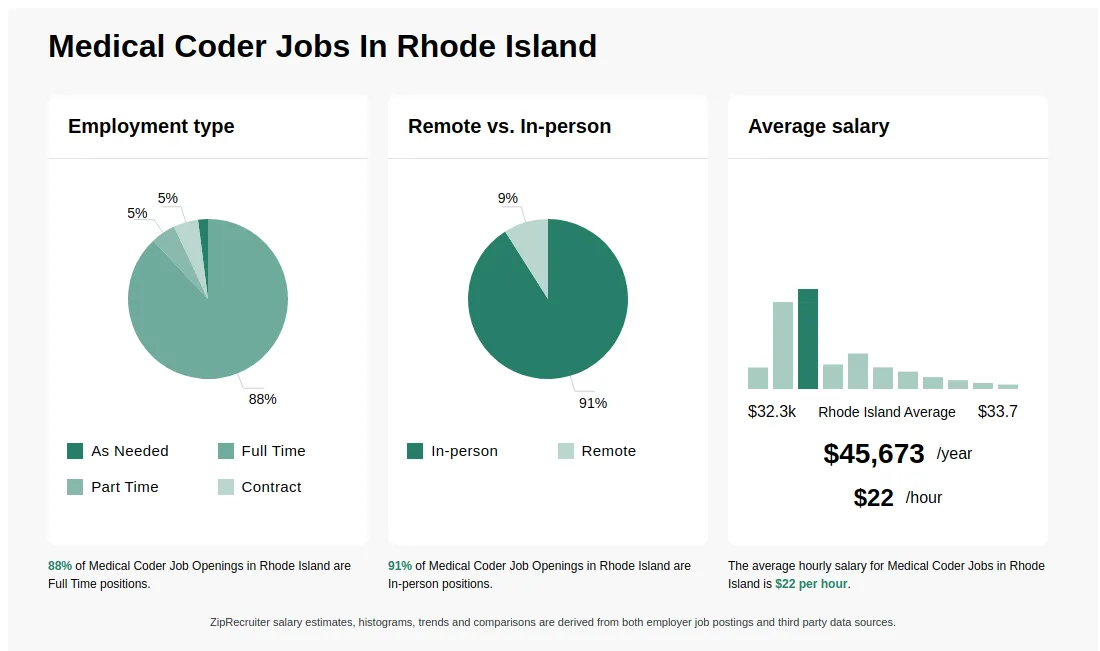
$15.54 - $17.18
6% of jobs
$18.35 is the 25th percentile. Wages below this are outliers.
$17.18 - $18.83
26% of jobs
The median wage is $19.77 / hr.
$18.83 - $20.48
31% of jobs
$20.48 - $22.13
7% of jobs
$22.83 is the 75th percentile. Wages above this are outliers.
$22.13 - $23.78
11% of jobs
$23.78 - $25.42
6% of jobs
$25.42 - $27.07
5% of jobs
$27.07 - $28.72
3% of jobs
$28.72 - $30.37
2% of jobs
$30.37 - $32.02
1% of jobs
$32.02 - $33.66
1% of jobs
$15
$21
$33
A medical coder works in the billing department of doctor's offices, hospitals, or other medical facilities. Medical coders transfer healthcare claims into universal medical codes for insurance reimbursement. To work as a medical coder, you must have great attention to detail and a solid base knowledge of medical terminology, procedure and visit authorizations, and insurance billing procedures. Having a degree is not required, but many employers prefer candidates who have an associate degree in medical coding or the Certified Professional Coder (CPC) credential. When you first start in this job, your employer may have you shadow other billing staff members and be supervised when you submit your first few claims.
| Aspect | Medical Coder | Medical Biller |
|---|---|---|
| Certifications | Certified Professional Coder (CPC), Certified Coding Specialist (CCS) | Certified Medical Reimbursement Specialist (CMRS), Certified Professional Biller (CPB) |
| Work Environment | Hospitals, clinics, physician offices, insurance companies | Medical offices, billing companies, hospitals |
| Primary Responsibilities | Assigning codes to diagnoses and procedures based on medical records | Submitting claims, following up on payments, managing billing processes |
Medical coders and medical billers work closely in healthcare revenue cycle management. While medical coders focus on translating medical records into standardized codes, medical billers handle the billing process to ensure healthcare providers are reimbursed. Both roles require understanding of healthcare documentation and often share certifications, but their core functions differ in coding versus billing tasks.
The most popular types of Medical Coder jobs in Rhode Island are:
For Medical Coder jobs in Rhode Island, the most frequently searched job titles are:
The top searched job categories for Medical Coder jobs in Rhode Island are:
Cities in Rhode Island with the most Medical Coder job openings:
For Medical Coder jobs in RI, the most frequently searched job titles are:

Providence, RI • On-site
Other
Posted 5 days ago
6.7
Based on 95 frontline employees who took The Breakroom Quiz
SUMMARY:
Reporting to the Manager of Professional Coding, the Professional Coding Specialist is responsible for the accurate review, interpretation, and assignment of ICD-10-CM, CPT, and HCPCS Level II codes for physician and other qualified healthcare provider services. This role ensures coding accuracy and compliance with federal regulations, payer guidelines, and organizational policies to support appropriate reimbursement and minimize audit risk.
The Coding Specialist collaborates with providers, revenue cycle teams, and clinical teams to ensure complete, accurate, and compliant documentation and coding practices.
Reporting to the Manager of Professional Coding, the Professional Coding Specialist is responsible for the accurate review, interpretation, and assignment of ICD-10-CM, CPT, and HCPCS Level II codes for physician and other qualified healthcare provider services. This role ensures coding accuracy and compliance with federal regulations, payer guidelines, and organizational policies to support appropriate reimbursement and minimize audit risk.
The Coding Specialist collaborates with providers, revenue cycle teams, and clinical teams to ensure complete, accurate, and compliant documentation and coding practices.
Brown University Health employees are expected to successfully role model the organization's values of Compassion, Accountability, Respect, and Excellence as these values guide our everyday actions with patients, customers and one another.
In addition to our values, all employees are expected to demonstrate the core Success Factors which tell us how we work together and how we get things done. The core Success Factors include:
Instill Trust and Value Differences
Patient and Community Focus and Collaborate
RESPONSIBILITIES:
Enters codedbstracted information into 3M 360 Finder assigning accurate APC and reviewing all coding edits appearing in 3M. Understands and follows all National Correct Code Initiative Edits (NCCI) and follows pertinent medical necessity requirements. Resolves accounts on the claims edit database. Assigns injections and infusion codes for observation patients. Meets the minimum productivity standard mintaining an average accuracy rating of 95%.
Assigns E/M, ICD-10-CM, CPT or chargemaster codes to clinic visits ensuring medical record documentation supports the code. Should physicians have entered in diagnosis, ICD or CPT codes, ensures they are accurate and supported by documentation in the medical record. Utilizes 3M to identify and resolve NCCI edits before final billing. Reports documentation insufficiencies to the responsible physician. Follows Rhode Island Hospital Facility Coding Guidelines for adult patients and 1995 Evaluation and Management Guidelines for patients less than 18 years of age.
Monitors and resolves rejected accounts on the Claims Edit Report and e Clinical Works error reports by established timeframe researching coding conflicts including chargemaster, medical necessity and various other coding and billing issues. Refers complex coding issues to the coding validator or supervisor.
Reviews pertinent outpatient uncoded reports researching and resolving old uncoded accounts and any accounts posted on report for which the charges are inappropriate. Updates patient financial accounts in the Patient Management and Patient Accounting billing system as required. Follows established procedures for rebilling accounts.
Performs related clerical duties as required.
Maintains level of knowledge and expertise pertinent to the position.
Compliance & Regulatory Adherence
Maintain compliance with CMS regulations, National Correct Coding Initiative (NCCI) edits, Medicare Administrative Contractor (MAC) guidance, payer policies and organizational policies.
Participate in compliance initiatives to reduce coding-related denials and audit findings.
Ensures compliance with HIPAA, organizational data privacy, and security policies.
Query compliance and appropriateness in accordance with ACDIS/AHIMA Guidelines for Achieving a Compliant Query Practice
Abides by the Standards of Ethical Coding as set forth by the American Health Information Management Association and the American Association of Professional Coders.
Performance Metrics
Meets or exceeds 95% coding accuracy rate
Achieves productivity benchmarks
Demonstrates consistent performance in accuracy, timeliness, and workload management
Adheres to organizational coding guidelines, payer requirements, and documentation standards to support audit readiness and reimbursement integrity
Accurately resolves coding edits, denials, and discrepancies
MINIMUM QUALIFICATIONS:
Education
High school diploma or equivalent required
Certifications
One or more of the following required:
CPC (Certified Professional Coder) – AAPC
CCS or CCS-P (Certified Coding Specialist / Physician-based) – AHIMA
Experience
1–3+ years of professional (physician-based) coding experience
Specialty experience a plus Strong knowledge of: ICD-10-CM, CPT, and HCPCS Level II coding guidelines
Medical terminology, anatomy, and healthcare documentation
Ability to interpret complex medical documentation and apply coding guidelines accurately
Strong written and verbal communication skills
Proficiency with electronic health records (EHR), Epic experience preferred
E/M coding and/or surgical/procedural coding
Work Environment
Fully Remote: Must maintain a secure, private workspace to protect PHI. Required to use organization-approved secure systems (VPN, multi-factor authentication). Maintains active communication via email, messaging platforms, and attends virtual meetings, as scheduled.
Working conditions: Requires long periods of computer use to review medical records. Ability to meet deadlines while achieving productivity and accuracy standards.
Independent action: Demonstrates ability to work independently within the department’s policies and practices. Refers specific complex problems to the supervisor when clarification of the departmental policies and procedures are required.
Supervisory responsibility: None
Disclaimer
This job description is intended to describe the general nature and level of work performed. Duties and responsibilities may be adjusted based on organizational needs and regulatory requirements.
Pay Range:
$24.29-$40.07EEO Statement:
Brown University Health is committed to providing equal employment opportunities and maintaining a work environment free from all forms of unlawful discrimination and harassment.
Location:
Remote-Rhode Island - N/A Providence, Rhode Island 02901Work Type:
8a - 5pWork Shift:
DayDaily Hours:
8 hoursDriving Required:
NoGet the full story on Breakroom

Sourced by ZipRecruiter
Hospitals