Syntricate Technologies is seeking a Microsoft Entra Identity Management expert to provide technical expertise and support in identity federation protocols and enterprise applications management. The ...
Syntricate Technologies is seeking a Microsoft Entra Identity Management expert to provide technical expertise and support in identity federation protocols and enterprise applications management. The ...
CA Identity Minder
Columbus, OH · On-site
CA Identity Minder - 2 resources Identity Management Support Resource CA Identity Minder- Operational support and issue resolutions. 5+ years of experience in Security domain especially in Identity ...
CA Identity Minder
Columbus, OH · On-site
CA Identity Minder - 2 resources Identity Management Support Resource CA Identity Minder- Operational support and issue resolutions. 5+ years of experience in Security domain especially in Identity ...
Lead Engineer, Identity Management
$112K - $147K/yr
The Lead Engineer, Identity Management is responsible for the design, engineering, and operational excellence of Sony Pictures Entertainment's (SPE) enterprise Identity and Access Management (IAM ...
Lead Engineer, Identity Management
$112K - $147K/yr
The Lead Engineer, Identity Management is responsible for the design, engineering, and operational excellence of Sony Pictures Entertainment's (SPE) enterprise Identity and Access Management (IAM ...

Oversees and coordinates Information Systems & Technology identity access management team for clinical and business system access. Experience * 7 years of experience in practitioner and management ...
Oversees and coordinates Information Systems & Technology identity access management team for clinical and business system access. Experience * 7 years of experience in practitioner and management ...

Oracle Identity Management (IDM / IAM) SME & Architect Location: Remote Duration: 6+ Months We are seeking a highly experienced Oracle Identity Management (IDM / IAM) SME & Architect to drive the end ...
Oracle Identity Management (IDM / IAM) SME & Architect Location: Remote Duration: 6+ Months We are seeking a highly experienced Oracle Identity Management (IDM / IAM) SME & Architect to drive the end ...

Manager, Digital Identity
Baltimore, MD · Hybrid
$150K - $178K/yr
The Digital Identity capability within Avanade focuses on helping clients modernize identity and access management using Microsoft Entra ID. This includes enabling secure access through MFA, SSO ...
Manager, Digital Identity
Baltimore, MD · Hybrid
$150K - $178K/yr
The Digital Identity capability within Avanade focuses on helping clients modernize identity and access management using Microsoft Entra ID. This includes enabling secure access through MFA, SSO ...
Manager, Digital Identity
Orlando, FL · Hybrid
$150K - $178K/yr
The Digital Identity capability within Avanade focuses on helping clients modernize identity and access management using Microsoft Entra ID. This includes enabling secure access through MFA, SSO ...
Manager, Digital Identity
Orlando, FL · Hybrid
$150K - $178K/yr
The Digital Identity capability within Avanade focuses on helping clients modernize identity and access management using Microsoft Entra ID. This includes enabling secure access through MFA, SSO ...
Manager, Digital Identity
Pittsburgh, PA · Hybrid
$150K - $178K/yr
The Digital Identity capability within Avanade focuses on helping clients modernize identity and access management using Microsoft Entra ID. This includes enabling secure access through MFA, SSO ...
Manager, Digital Identity
Pittsburgh, PA · Hybrid
$150K - $178K/yr
The Digital Identity capability within Avanade focuses on helping clients modernize identity and access management using Microsoft Entra ID. This includes enabling secure access through MFA, SSO ...
Manager, Digital Identity
Atlanta, GA · Hybrid
$150K - $178K/yr
The Digital Identity capability within Avanade focuses on helping clients modernize identity and access management using Microsoft Entra ID. This includes enabling secure access through MFA, SSO ...
Manager, Digital Identity
Atlanta, GA · Hybrid
$150K - $178K/yr
The Digital Identity capability within Avanade focuses on helping clients modernize identity and access management using Microsoft Entra ID. This includes enabling secure access through MFA, SSO ...
Manager, Digital Identity
Tampa, FL · Hybrid
$150K - $178K/yr
The Digital Identity capability within Avanade focuses on helping clients modernize identity and access management using Microsoft Entra ID. This includes enabling secure access through MFA, SSO ...
Manager, Digital Identity
Tampa, FL · Hybrid
$150K - $178K/yr
The Digital Identity capability within Avanade focuses on helping clients modernize identity and access management using Microsoft Entra ID. This includes enabling secure access through MFA, SSO ...
Manager, Digital Identity
San Jose, CA · Hybrid
$150K - $178K/yr
The Digital Identity capability within Avanade focuses on helping clients modernize identity and access management using Microsoft Entra ID. This includes enabling secure access through MFA, SSO ...
Manager, Digital Identity
San Jose, CA · Hybrid
$150K - $178K/yr
The Digital Identity capability within Avanade focuses on helping clients modernize identity and access management using Microsoft Entra ID. This includes enabling secure access through MFA, SSO ...
Manager, Digital Identity
Detroit, MI · Hybrid
$150K - $178K/yr
The Digital Identity capability within Avanade focuses on helping clients modernize identity and access management using Microsoft Entra ID. This includes enabling secure access through MFA, SSO ...
Manager, Digital Identity
Detroit, MI · Hybrid
$150K - $178K/yr
The Digital Identity capability within Avanade focuses on helping clients modernize identity and access management using Microsoft Entra ID. This includes enabling secure access through MFA, SSO ...
Digital Identity Non-Human Identity, Machine Identity & Agentic Identity Associate Director
Miami, FL · On-site
You'llpartner with our strategic clients to manage riskassociated with their use of technology ... Translating complex identity architecture concepts into practical business outcomes and measurable ...
Digital Identity Non-Human Identity, Machine Identity & Agentic Identity Associate Director
Miami, FL · On-site
You'llpartner with our strategic clients to manage riskassociated with their use of technology ... Translating complex identity architecture concepts into practical business outcomes and measurable ...

Description Identity and Access Management Architect Open Dealer Exchange (ODE), is seeking an Identity and Access Management (IAM) Architect to support its workforce in Southfield, MI . As an IAM ...
Description Identity and Access Management Architect Open Dealer Exchange (ODE), is seeking an Identity and Access Management (IAM) Architect to support its workforce in Southfield, MI . As an IAM ...

Digital Identity Non-Human Identity, Machine Identity & Agentic Identity Associate Director
Atlanta, GA · On-site
You'llpartner with our strategic clients to manage riskassociated with their use of technology ... Translating complex identity architecture concepts into practical business outcomes and measurable ...
Digital Identity Non-Human Identity, Machine Identity & Agentic Identity Associate Director
Atlanta, GA · On-site
You'llpartner with our strategic clients to manage riskassociated with their use of technology ... Translating complex identity architecture concepts into practical business outcomes and measurable ...
Associate Manager, Digital Identity
Tampa, FL · Hybrid
$136K - $161K/yr
The Digital Identity capability within Avanade focuses on helping clients modernize identity and access management using Microsoft Entra ID. This includes enabling secure access through MFA, SSO ...
Associate Manager, Digital Identity
Tampa, FL · Hybrid
$136K - $161K/yr
The Digital Identity capability within Avanade focuses on helping clients modernize identity and access management using Microsoft Entra ID. This includes enabling secure access through MFA, SSO ...
Identity and Access Management Architect Open Dealer Exchange (ODE), is seeking an Enterprise Identity Architect to support its workforce in Southfield, MI . As an Enterprise Identity Architect, you ...
Identity and Access Management Architect Open Dealer Exchange (ODE), is seeking an Enterprise Identity Architect to support its workforce in Southfield, MI . As an Enterprise Identity Architect, you ...
Associate Manager, Digital Identity
Florham Park, NJ · Hybrid
$136K - $161K/yr
The Digital Identity capability within Avanade focuses on helping clients modernize identity and access management using Microsoft Entra ID. This includes enabling secure access through MFA, SSO ...
Associate Manager, Digital Identity
Florham Park, NJ · Hybrid
$136K - $161K/yr
The Digital Identity capability within Avanade focuses on helping clients modernize identity and access management using Microsoft Entra ID. This includes enabling secure access through MFA, SSO ...
Associate Manager, Digital Identity
Overland Park, KS · Hybrid
$136K - $161K/yr
The Digital Identity capability within Avanade focuses on helping clients modernize identity and access management using Microsoft Entra ID. This includes enabling secure access through MFA, SSO ...
Associate Manager, Digital Identity
Overland Park, KS · Hybrid
$136K - $161K/yr
The Digital Identity capability within Avanade focuses on helping clients modernize identity and access management using Microsoft Entra ID. This includes enabling secure access through MFA, SSO ...
Associate Manager, Digital Identity
Salt Lake City, UT · Hybrid
$136K - $161K/yr
The Digital Identity capability within Avanade focuses on helping clients modernize identity and access management using Microsoft Entra ID. This includes enabling secure access through MFA, SSO ...
Associate Manager, Digital Identity
Salt Lake City, UT · Hybrid
$136K - $161K/yr
The Digital Identity capability within Avanade focuses on helping clients modernize identity and access management using Microsoft Entra ID. This includes enabling secure access through MFA, SSO ...
Identity Management information
See salary details
$29K - $32.7K
1% of jobs
$32.7K - $36.4K
4% of jobs
$36.4K - $40K
7% of jobs
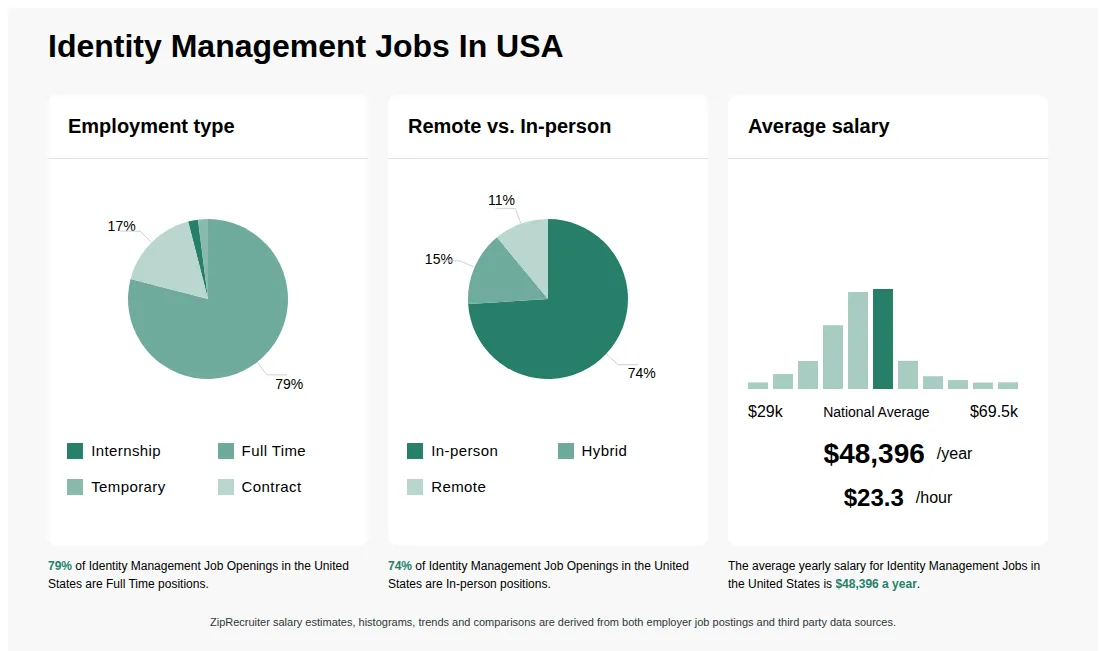
$42.5K is the 25th percentile. Wages below this are outliers.
$40K - $43.7K
18% of jobs
The median wage is $46.4K / yr.
$43.7K - $47.4K
27% of jobs
$49.7K is the 75th percentile. Wages above this are outliers.
$47.4K - $51.1K
28% of jobs
$51.1K - $54.8K
7% of jobs
$54.8K - $58.5K
3% of jobs
$58.5K - $62.1K
2% of jobs
$62.1K - $65.8K
1% of jobs
$65.8K - $69.5K
1% of jobs
$29K
$48.4K
$69.5K
How much do identity management jobs pay per year?
As of Sep 13, 2026, the average yearly pay for identity management in the United States is $48,396.00, according to ZipRecruiter salary data. Most workers in this role earn between $42,000.00 and $48,500.00 per year, depending on experience, location, and employer.
What is an identity management?
An Identity Management job involves managing user identities, access permissions, and security policies within an organization. Professionals in this role ensure that the right individuals have access to the appropriate resources while preventing unauthorized access. Responsibilities often include identity lifecycle management, authentication processes, and compliance with security regulations. They work with tools like IAM (Identity and Access Management) systems to streamline identity provisioning and enforce security protocols.
What does a typical day look like for someone working in identity management?
A typical day in Identity Management involves managing user access rights, performing audits and security reviews, responding to support tickets related to login issues, and collaborating with IT and cybersecurity teams to implement security improvements. You may also work on integrating new applications with existing IAM systems, troubleshooting complex access problems, and ensuring compliance with company policies and regulatory requirements. Regular communication with internal stakeholders is common, as you help educate users about security protocols and changes to access procedures. This dynamic environment requires both technical problem-solving and strong interpersonal skills, with opportunities to learn and grow as new technologies and security threats emerge.
What are the key skills and qualifications needed to thrive in identity management, and why are they important?
To thrive in Identity Management, you need a solid understanding of identity and access management (IAM) principles, security best practices, and experience with authentication and authorization protocols, often supported by a relevant degree or certifications such as CISSP or CompTIA Security+. Familiarity with IAM tools such as Okta, Microsoft Azure Active Directory, or SailPoint, and integration with enterprise systems, is essential. Strong analytical thinking, attention to detail, and effective communication are soft skills that set candidates apart in this field. These competencies are critical to safeguarding organizational data, ensuring regulatory compliance, and effectively coordinating with IT and security teams.
Is identity management a good career path?
Identity management is a growing field within cybersecurity that involves protecting user identities and access controls using tools like identity and access management (IAM) systems. It offers opportunities for specialization, certifications, and roles in various industries, making it a stable and in-demand career choice for those interested in security and technology. Success in this field often requires knowledge of security protocols, scripting, and compliance standards.
What does identity management do?
Identity management involves creating, maintaining, and securing digital identities for users within an organization. It ensures that the right individuals have access to appropriate resources while protecting sensitive information, often using tools like access controls and authentication systems. Professionals in this field implement policies and technologies to manage user credentials and permissions effectively.
More about Identity Management jobs
What cities are hiring for Identity Management jobs?
Cities with the most Identity Management job openings:
What are the most commonly searched types of Identity Management jobs?
The most popular types of Identity Management jobs are:
What states have the most Identity Management jobs?
States with the most job openings for Identity Management jobs include:
What job categories do people searching Identity Management jobs look for?
The top searched job categories for Identity Management jobs are:

Microsoft Entra Identity Management
Toledo, OH • On-site
Syntricate Technologies
• IT Services • 51 - 200 employees51 - 200 employees
Full-time
Re-posted 14 days ago
Job description
Job Summary:
Syntricate Technologies is seeking a Microsoft Entra Identity Management expert to provide technical expertise and support in identity federation protocols and enterprise applications management. The role involves implementing and managing integration with external service providers, ensuring secure authentication processes, and defining IAM policies within Entra ID.
Responsibilities:
• Provide technical expertise and support and Strong understanding of identity federation protocols such as SAML and OAuth, SCIM, OIDC
• Design, implement, and manage Enterprise Applications on Entra ID
• Implement and manage integration /federation with external Service providers.
• Ensure seamless and secure authentication and authorization processes with IAM best practices.
• Define and enforce IAM policies and procedures within Entra ID.
• Configure and enforce MFA policies based on organizational requirements
• Design and implement Conditional Access policies to control access based on user, device, location, and other contextual factors.
• Provide expertise in designing, implementing, and optimizing Application configurations and App registrations, including MFA, Conditional Access policies, SSPR
Qualifications:
Required:
• Strong understanding of identity federation protocols such as SAML and OAuth, SCIM, OIDC
• Design, implement, and manage Enterprise Applications on Entra ID
• Implement and manage integration/federation with external Service providers
• Ensure seamless and secure authentication and authorization processes with IAM best practices
• Define and enforce IAM policies and procedures within Entra ID
• Configure and enforce MFA policies based on organizational requirements
• Design and implement Conditional Access policies to control access based on user, device, location, and other contextual factors
• Provide expertise in designing, implementing, and optimizing Application configurations and App registrations, including MFA, Conditional Access policies, SSPR
• Okta Identity Mgmt
• MS Entra ID administration
• IAM
• IAM and SSO Integration
• Strong Communication skills
Company:
Syntricate Technologies offers quality assurance, validation, regulatory, business analysis, and project management services. Founded in 2004, the company is headquartered in Boston, USA, with a team of 51-200 employees. The company is currently Growth Stage.
Syntricate Technologies is seeking a Microsoft Entra Identity Management expert to provide technical expertise and support in identity federation protocols and enterprise applications management. The role involves implementing and managing integration with external service providers, ensuring secure authentication processes, and defining IAM policies within Entra ID.
Responsibilities:
• Provide technical expertise and support and Strong understanding of identity federation protocols such as SAML and OAuth, SCIM, OIDC
• Design, implement, and manage Enterprise Applications on Entra ID
• Implement and manage integration /federation with external Service providers.
• Ensure seamless and secure authentication and authorization processes with IAM best practices.
• Define and enforce IAM policies and procedures within Entra ID.
• Configure and enforce MFA policies based on organizational requirements
• Design and implement Conditional Access policies to control access based on user, device, location, and other contextual factors.
• Provide expertise in designing, implementing, and optimizing Application configurations and App registrations, including MFA, Conditional Access policies, SSPR
Qualifications:
Required:
• Strong understanding of identity federation protocols such as SAML and OAuth, SCIM, OIDC
• Design, implement, and manage Enterprise Applications on Entra ID
• Implement and manage integration/federation with external Service providers
• Ensure seamless and secure authentication and authorization processes with IAM best practices
• Define and enforce IAM policies and procedures within Entra ID
• Configure and enforce MFA policies based on organizational requirements
• Design and implement Conditional Access policies to control access based on user, device, location, and other contextual factors
• Provide expertise in designing, implementing, and optimizing Application configurations and App registrations, including MFA, Conditional Access policies, SSPR
• Okta Identity Mgmt
• MS Entra ID administration
• IAM
• IAM and SSO Integration
• Strong Communication skills
Company:
Syntricate Technologies offers quality assurance, validation, regulatory, business analysis, and project management services. Founded in 2004, the company is headquartered in Boston, USA, with a team of 51-200 employees. The company is currently Growth Stage.

About Syntricate Technologies
Sourced by ZipRecruiter
Industry
It services
Company size
51 - 200 Employees
Headquarters location
Boston, MA, US