1

Hospital Data Entry Jobs (NOW HIRING)

Data Entry Operator (1)

Austin, TX · On-site

$25 - $35/hr

Join our dynamic healthcare team as a Data Entry Specialist and play a vital role in ensuring accurate, timely, and confidential management of patient and medical information. This position offers an

Data Entry Operator (1)

Austin, TX · On-site

$25 - $35/hr

Join our dynamic healthcare team as a Data Entry Specialist and play a vital role in ensuring accurate, timely, and confidential management of patient and medical information. This position offers an

Data Entry Associate

Hudson, NY · On-site

$16 - $18/hr

Data Entry Associate Book here for immediate information: Job Description The Data Entry Associate visits hospital departments to collect lab boxes, accurately records all required information in the

Data Entry Associate

Hudson, NY · On-site

$16 - $18/hr

Data Entry Associate book here for immediate information: Job Description The Data Entry Associate visits hospital departments to collect lab boxes, accurately records all required information in the

Data Entry Associate

Hudson, NY · On-site

$16 - $18/hr

Data Entry Associate book here for immediate information: Job Description The Data Entry Associate visits hospital departments to collect lab boxes, accurately records all required information in the

Data Entry Clerk

Southfield, MI · On-site

$17 - $18/hr

We are seeking to add a Data Entry Clerk to our team! You will be responsible for accurate data entry, file maintenance, and record keeping. Responsibilities: * Enter variety of data using current

Be Seen First

Data Entry Coordinator

Akron, OH · On-site

$19.02 - $19.68/hr

Data Entry Coordinator Job Summary: The Data Entry Coordinator is responsible for managing and maintaining accurate records by entering, reviewing, and updating data in company databases and

Temporary Data Entry Specialist Employment Type: Temporary, Full-Time In-Office Position 82 Orland Square Drive Orland Park, Illinois 60462 Join Affiliated Oncologists as a Temporary Data Entry

Data Entry Operator (1)

Austin, TX · Remote

$20 - $32/hr

Join our dynamic Hospital & Health Care team as a Remote Data Entry Specialist, where your accuracy and attention to detail will directly contribute to delivering exceptional patient care. This role

Medical Claims Data Entry

Plano, TX · On-site

$17 - $20/hr

The Reny Company's healthcare claims data entry personnel is a professional who combines experience in data entry, health insurance and medical billing with business insight and a passion for great

Data Entry Specialist

Apopka, FL · On-site

$15 - $20/hr

Staff Performance Coordinator(Data Entry Specialist)ProLogistix - Apopka, FL This position is a 4-month contract assignment with potential of being hired on permanently! Hours: 1:30pm to 10:30pm Mon-

next page

Showing results 1-20

Hospital Data Entry information

See salary details

$11

$19

$28

How much do hospital data entry jobs pay per hour?

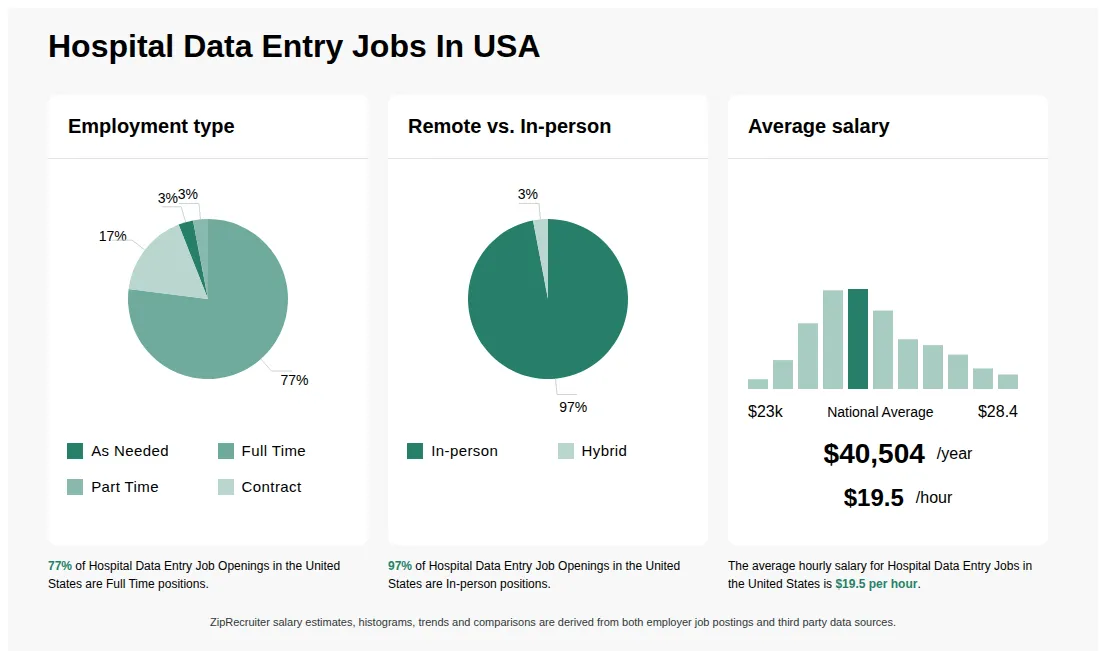
As of Sep 15, 2026, the average hourly pay for hospital data entry in the United States is $19.47, according to ZipRecruiter salary data. Most workers in this role earn between $16.35 and $21.88 per hour, depending on experience, location, and employer.

What is a hospital data entry job?

Data entry jobs at a hospital include several different positions, including roles in billing, claims, and medical records. Less obviously, data entry jobs also include administrative and HR roles that focus on evaluating employee performance and checking for compliance with all applicable regulations. Most people in this field specialize in specific types of data entry because of the amount of training required for each role. However, a few people develop a broader skillset and can do any data entry job when needed. Most hospital data entry jobs involve maintaining patient privacy and confidentiality, so the ability to memorize and follow the procedures for doing so is essential to your success. Some of these jobs are remote positions.

What is a hospital data entry job?

Hospital data entry jobs involve inputting, updating, and maintaining patient and medical information in digital databases or electronic health record (EHR) systems. Workers in these roles ensure the accuracy and confidentiality of sensitive data such as patient histories, billing information, and treatment records. Hospital data entry clerks may also help organize files, verify insurance details, and generate reports for healthcare staff. Attention to detail, computer proficiency, and knowledge of medical terminology are important for this position.

What are the key skills and qualifications needed to thrive as a hospital data entry specialist?

To thrive as a Hospital Data Entry Specialist, you need strong typing skills, attention to detail, and a high school diploma or equivalent, often with experience in medical terminology. Familiarity with hospital information systems (HIS), electronic health records (EHR) software, and basic office applications is typically required. Accuracy, time management, and the ability to maintain confidentiality are crucial soft skills in this role. These competencies help ensure that patient records are accurate, up-to-date, and secure, supporting effective clinical care and hospital operations.

What are some common challenges faced by hospital data entry professionals, and how can they be addressed?

Hospital data entry professionals often encounter challenges such as managing high volumes of sensitive patient information, maintaining accuracy under tight deadlines, and adapting to updates in electronic health record (EHR) systems. To address these challenges, it is important to develop strong attention to detail, stay current with hospital software training, and communicate effectively with medical staff to clarify any ambiguous records. Many hospitals also offer ongoing training and support to help data entry staff maintain quality and efficiency in their work.

What is the difference between Hospital Data Entry vs Medical Records Clerk?

AspectHospital Data EntryMedical Records Clerk
CredentialsBasic computer skills, data entry certificationsHigh school diploma, familiarity with medical records systems
Work EnvironmentHospitals, clinics, healthcare facilitiesHospitals, clinics, healthcare offices
Job ResponsibilitiesInputting patient data, updating records, managing databasesOrganizing, filing, retrieving patient records, ensuring accuracy
Common UsageData entry tasks in healthcareManaging and maintaining medical records

Hospital Data Entry and Medical Records Clerk roles both involve handling patient information within healthcare settings. While Hospital Data Entry focuses primarily on inputting and managing digital data, Medical Records Clerks are responsible for organizing and retrieving physical or electronic records. Both roles require attention to detail and familiarity with healthcare systems, but they differ in daily tasks and scope.

How to become a hospital data entry?

To become a hospital data entry clerk, candidates typically need a high school diploma or equivalent and proficiency in data entry software such as Microsoft Excel or hospital management systems. Attention to detail, strong typing skills, and knowledge of medical terminology are important; some positions may require certification or training in healthcare data management.

What cities are hiring for Hospital Data Entry jobs?

Cities with the most Hospital Data Entry job openings:

What are the most commonly searched types of Hospital Data Entry jobs?

The most popular types of Hospital Data Entry jobs are:

What states have the most Hospital Data Entry jobs?

States with the most job openings for Hospital Data Entry jobs include:

What are popular job titles related to Hospital Data Entry jobs?

For Hospital Data Entry jobs, the most frequently searched job titles are:

Infographic showing various Hospital Data Entry job openings in the United States as of September 2026, with employment types broken down into 1% Internship, 1% As Needed, 84% Full Time, 12% Part Time, and 2% Contract. Highlights an 85% Physical, 3% Hybrid, and 12% Remote job distribution, with an average salary of $40,504 per year, or $19.5 per hour.

Data Entry Operator (1)

Austin, TX • On-site

$25 - $35/hr

Part-time

Re-posted 19 days ago


Job description

Join our dynamic healthcare team as a Data Entry Specialist and play a vital role in ensuring accurate, timely, and confidential management of patient and medical information. This position offers an exciting opportunity to contribute to the smooth operation of our hospital's data systems, supporting quality patient care and operational excellence.

About the Role

As a Data Entry Specialist in the healthcare setting, you will be responsible for inputting, updating, and maintaining critical medical records and administrative data. Your attention to detail and commitment to accuracy will directly impact the efficiency of healthcare delivery and compliance with regulatory standards.

Key Responsibilities
  • Accurately enter patient information, medical records, and other healthcare data into electronic health record (EHR) systems.
  • Verify and review data for completeness and accuracy before submission.
  • Maintain confidentiality and security of patient information in compliance with HIPAA and other healthcare regulations.
  • Collaborate with healthcare professionals and administrative staff to resolve data discrepancies.
  • Update and manage databases to ensure current and reliable information.
  • Assist in generating reports and data summaries as needed.
  • Support audit and quality assurance processes by providing accurate data records.
Qualifications & Skills
  • High school diploma or equivalent required; associate degree or certification in healthcare administration or related field preferred.
  • Proven experience in data entry, preferably within a healthcare or hospital environment.
  • Familiarity with electronic health records (EHR) systems and medical terminology is a plus.
  • Strong computer skills, including proficiency with MS Office (Word, Excel) and data management software.
  • Exceptional attention to detail and accuracy in data handling.
  • Ability to maintain confidentiality and adhere to privacy regulations.
  • Excellent organizational and time management skills.
  • Effective communication skills and ability to work collaboratively within a multidisciplinary team.