This role partners closely with Operations, FSQA, Sanitation, and Reliability to minimize downtime, support food safety, and ensure equipment and facility systems are production-ready at all times.
Quick apply
This role partners closely with Operations, FSQA, Sanitation, and Reliability to minimize downtime, support food safety, and ensure equipment and facility systems are production-ready at all times.
Quick apply
This role partners closely with Operations, FSQA, Sanitation, and Reliability to minimize downtime, support food safety, and ensure equipment and facility systems are production-ready at all times.
Mccook, NE · On-site
This sales opportunity is within our industry leading sales division, which offers a wide variety of products and solutions to meet the needs of customers across the entire food service, retail, and ...
Mccook, NE · On-site
This sales opportunity is within our industry leading sales division, which offers a wide variety of products and solutions to meet the needs of customers across the entire food service, retail, and ...
Babylon, NY · On-site
$78K - $98K/yr
Kforce's client, a well-established Long Island based accounting firm is seeking a Senior Accountant - Restaurant/Food Industry in Babylon, NY. This firm offers a great opportunity for someone who ...
Babylon, NY · On-site
$78K - $98K/yr
Kforce's client, a well-established Long Island based accounting firm is seeking a Senior Accountant - Restaurant/Food Industry in Babylon, NY. This firm offers a great opportunity for someone who ...
Hialeah, FL · On-site
$35K - $45K/hr
Do you have a passion for ensuring the highest quality standards in the food industry? We are seeking a dedicated and detail-oriented Quality Assurance Specialist to join our team. If you are a ...
Hialeah, FL · On-site
$35K - $45K/hr
Do you have a passion for ensuring the highest quality standards in the food industry? We are seeking a dedicated and detail-oriented Quality Assurance Specialist to join our team. If you are a ...
Be Seen First
Chicago, IL · On-site
$30 - $35/hr
Experience in the food industry is preferred. * 14. Bilingual (Spanish) preferred but not required. * Key Performance Indicators: * 1. Preventive maintenance completion. * 2. Equipment uptime. * 3. ...
Quick apply
Be Seen First
Chicago, IL · On-site
$30 - $35/hr
Experience in the food industry is preferred. * 14. Bilingual (Spanish) preferred but not required. * Key Performance Indicators: * 1. Preventive maintenance completion. * 2. Equipment uptime. * 3. ...
Elgin, IL · On-site
$16 - $19/hr
The Quality Assurance Laboratory Technician assists in ensuring food safety and quality standards are met. They are responsible for performing required testing on raw materials and finished goods.
Elgin, IL · On-site
$16 - $19/hr
The Quality Assurance Laboratory Technician assists in ensuring food safety and quality standards are met. They are responsible for performing required testing on raw materials and finished goods.
Farmingdale, NY · On-site
$30 - $40/hr
This role partners closely with Operations, FSQA, Sanitation, and Reliability to minimize downtime, support food safety, and ensure equipment and facility systems are production-ready at all times.
Farmingdale, NY · On-site
$30 - $40/hr
This role partners closely with Operations, FSQA, Sanitation, and Reliability to minimize downtime, support food safety, and ensure equipment and facility systems are production-ready at all times.
Elgin, IL · On-site
$16 - $19/hr
The Quality Assurance Laboratory Technician assists in ensuring food safety and quality standards are met. They are responsible for performing required testing on raw materials and finished goods.
Elgin, IL · On-site
$16 - $19/hr
The Quality Assurance Laboratory Technician assists in ensuring food safety and quality standards are met. They are responsible for performing required testing on raw materials and finished goods.
This role partners closely with Operations, FSQA, Sanitation, and Reliability to minimize downtime, support food safety, and ensure equipment and facility systems are production-ready at all times.
Quick apply
This role partners closely with Operations, FSQA, Sanitation, and Reliability to minimize downtime, support food safety, and ensure equipment and facility systems are production-ready at all times.
Bay Shore, NY · On-site
$30 - $40/hr
This role partners closely with Operations, FSQA, Sanitation, and Reliability to minimize downtime, support food safety, and ensure equipment and facility systems are production-ready at all times.
Bay Shore, NY · On-site
$30 - $40/hr
This role partners closely with Operations, FSQA, Sanitation, and Reliability to minimize downtime, support food safety, and ensure equipment and facility systems are production-ready at all times.
This role partners closely with Operations, FSQA, Sanitation, and Reliability to minimize downtime, support food safety, and ensure equipment and facility systems are production-ready at all times.
This role partners closely with Operations, FSQA, Sanitation, and Reliability to minimize downtime, support food safety, and ensure equipment and facility systems are production-ready at all times.
This role partners closely with Operations, FSQA, Sanitation, and Reliability to minimize downtime, support food safety, and ensure equipment and facility systems are production-ready at all times.
This role partners closely with Operations, FSQA, Sanitation, and Reliability to minimize downtime, support food safety, and ensure equipment and facility systems are production-ready at all times.
A food company is seeking an Accountant for their head office to join their team in Commerce, CA. This position is responsible for supporting the accounting department and management team by ...
A food company is seeking an Accountant for their head office to join their team in Commerce, CA. This position is responsible for supporting the accounting department and management team by ...
Hialeah, FL · On-site
$45K - $50K/yr
At least 2 years of experience in quality control, food safety preferred. * Experience in manufacturing and production scheduling preferred * Strong organizational and documentation skills.
Hialeah, FL · On-site
$45K - $50K/yr
At least 2 years of experience in quality control, food safety preferred. * Experience in manufacturing and production scheduling preferred * Strong organizational and documentation skills.
Seattle, WA · On-site
$70K - $120K/yr (+ commission)
Outside Sales - Account Executive (Food Service Industry) Overview High impact outside sales role focused on aggressively developing new business and building a regional book of business from the ...
Quick apply
Seattle, WA · On-site
$70K - $120K/yr (+ commission)
Outside Sales - Account Executive (Food Service Industry) Overview High impact outside sales role focused on aggressively developing new business and building a regional book of business from the ...
We are seeking an experienced, highly skilled mechanic with a strong background in the food industry. The ideal candidate will possess advanced mechanical skills, experience with food-processing or ...
We are seeking an experienced, highly skilled mechanic with a strong background in the food industry. The ideal candidate will possess advanced mechanical skills, experience with food-processing or ...
Lecturer AY - Agribusiness & Food Industry Management/Agricultural Science Apply now Job no: 556997 Work type: Instructional Faculty - Temporary/Lecturer Location: Pomona Categories: Unit 3 - CFA ...
Lecturer AY - Agribusiness & Food Industry Management/Agricultural Science Apply now Job no: 556997 Work type: Instructional Faculty - Temporary/Lecturer Location: Pomona Categories: Unit 3 - CFA ...
Lecturer AY - Agribusiness & Food Industry Management/Agricultural Science Apply now Job no: 556997 Work type: Instructional Faculty - Temporary/Lecturer Location: Pomona Categories: Unit 3 - CFA ...
Lecturer AY - Agribusiness & Food Industry Management/Agricultural Science Apply now Job no: 556997 Work type: Instructional Faculty - Temporary/Lecturer Location: Pomona Categories: Unit 3 - CFA ...
Lecturer AY - Agribusiness & Food Industry Management/Agricultural Science Apply now Job no: 556997 Work type: Instructional Faculty - Temporary/Lecturer Location: Pomona Categories: Unit 3 - CFA ...
Lecturer AY - Agribusiness & Food Industry Management/Agricultural Science Apply now Job no: 556997 Work type: Instructional Faculty - Temporary/Lecturer Location: Pomona Categories: Unit 3 - CFA ...
Buffalo, NY · On-site
$30.65 - $32.71/hr
Previous food manufacturing experience preferred. * Mechanical experience necessary, electrical abilities necessary. * Stationary engineers/ammonia refrigeration experience preferred. * Must have a ...
Buffalo, NY · On-site
$30.65 - $32.71/hr
Previous food manufacturing experience preferred. * Mechanical experience necessary, electrical abilities necessary. * Stationary engineers/ammonia refrigeration experience preferred. * Must have a ...
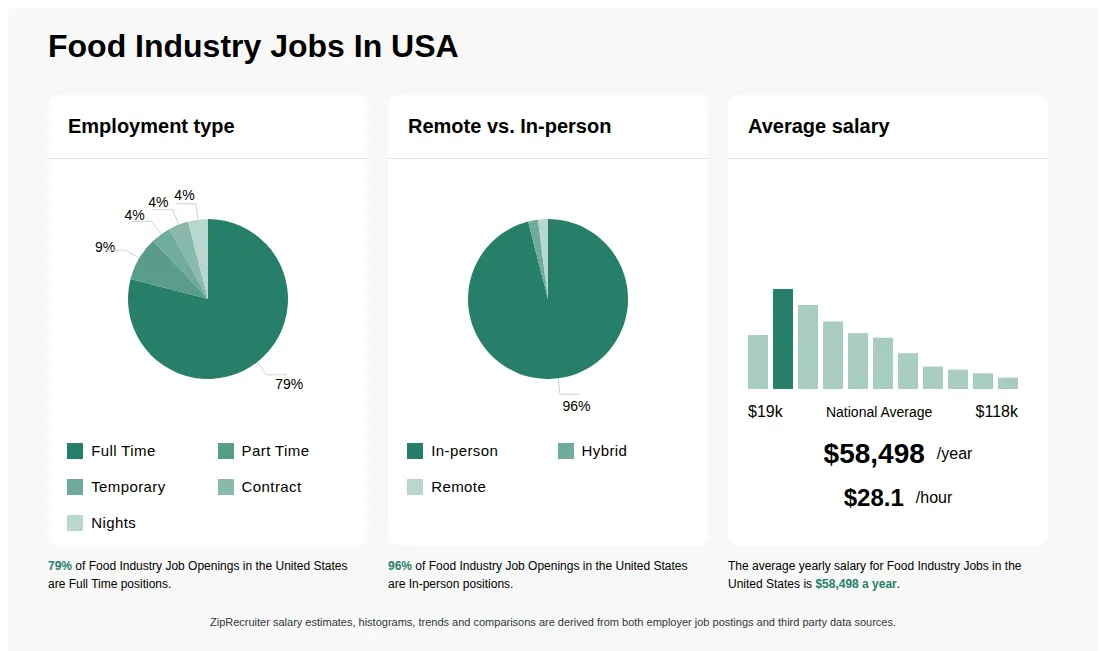
$19K - $28K
11% of jobs
$34.5K is the 25th percentile. Wages below this are outliers.
$28K - $37K
20% of jobs
$37K - $46K
17% of jobs
The median wage is $47.7K / yr.
$46K - $55K
14% of jobs
$55K - $64K
11% of jobs
$67.3K is the 75th percentile. Wages above this are outliers.
$64K - $73K
9% of jobs
$73K - $82K
6% of jobs
$82K - $91K
4% of jobs
$91K - $100K
3% of jobs
$100K - $109K
3% of jobs
$109K - $118K
2% of jobs
$19K
$58.5K
$118K
The qualifications you need to work in the food industry vary significantly by position. To be a chef, you may need to attend culinary or hospitality school, although many people who work in kitchens learn practical skills on the job and work their way up through the staff. Working in food production may require a bachelor’s degree in food science or a closely related degree. Serving and front-of-house managerial positions often require a high school diploma or a GED certificate, although many high school students get summer jobs as servers or bussers.
| Aspect | Food Industry | Food Service Worker |
|---|---|---|
| Credentials | Varies; may include food safety certifications | Typically requires food handler permits or basic training |
| Work Environment | Factories, production plants, warehouses | Restaurants, cafes, catering venues |
| Employer & Industry Usage | Manufacturers, distributors, large-scale food companies | Restaurants, fast food chains, catering services |
| Common Search & Comparison | Yes | Yes |
The Food Industry encompasses roles in food manufacturing, processing, and distribution, often involving production facilities. In contrast, Food Service Workers operate directly in customer-facing environments like restaurants and cafes. While both roles require food safety knowledge, the Food Industry focuses on production and logistics, whereas Food Service Workers focus on customer service and food preparation. Understanding these differences helps job seekers find roles aligned with their skills and career goals.
Cities with the most Food Industry job openings:
The most popular types of Food Industry jobs are:
States with the most job openings for Food Industry jobs include:
The top searched job categories for Food Industry jobs are:

Full-time
Posted 8 days ago
Position Summary
The Maintenance Technician III is a senior-level, hands-on maintenance professional responsible for diagnosing, repairing, and maintaining manufacturing equipment, utilities, and facility systems to ensure safe, reliable, and compliant operations. This role serves as a technical expert and escalation point for complex mechanical, electrical, and controls issues, while supporting preventive maintenance execution and reliability improvements across the site.
With a strong commitment to Grandma Quality, the Maintenance Technician III demonstrates pride in workmanship, accountability, and leadership by example. This role partners closely with Operations, FSQA, Sanitation, and Reliability to minimize downtime, support food safety, and ensure equipment and facility systems are production-ready at all times.
Key Responsibilities
Qualifications
Essential Physical Requirements
This job description is intended to describe the general nature and level of work being performed. It is not an exhaustive list of all responsibilities, duties, or skills required. Duties, responsibilities, expectations, and reporting structures may change at any time based on business needs, organizational priorities, or operational requirements, with or without notice.

Sourced by ZipRecruiter
Food and drink manufacturing
201 - 500 Employees
East Rutherford, NJ, US
2008