1

Food Industry Jobs (NOW HIRING)

This sales opportunity is within our industry leading sales division, which offers a wide variety of products and solutions to meet the needs of customers across the entire food service, retail, and ...

Be Seen First

The role requires a strong leader with experience in food manufacturing and good communication and problem-solving skills. Responsibilities: * Ensure compliance of quality requirements in relation to ...

This sales opportunity is within our industry leading sales division, which offers a wide variety of products and solutions to meet the needs of customers across the entire food service, retail, and ...

next page

Showing results 1-20

Food Industry information

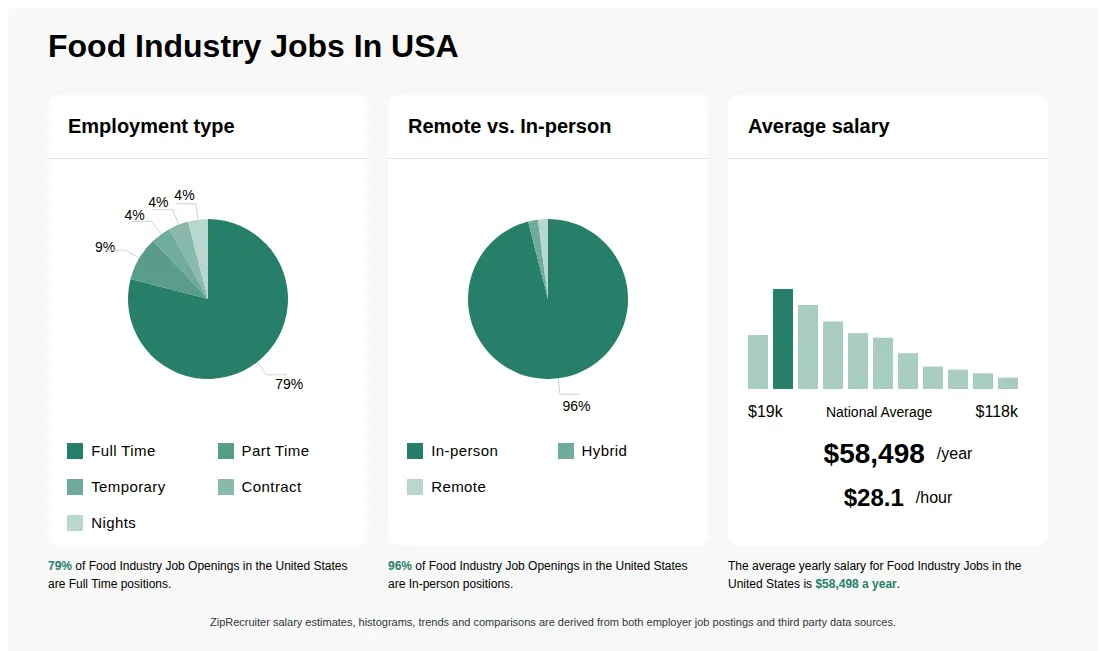
See salary details

$19K

$58.5K

$118K

How much do food industry jobs pay per year?

As of Jun 13, 2026, the average yearly pay for food industry in the United States is $58,498.00, according to ZipRecruiter salary data. Most workers in this role earn between $35,000.00 and $72,000.00 per year, depending on experience, location, and employer.

What jobs pay $2000 a day?

In the food industry, high-paying roles such as executive chefs, restaurant owners, or specialized consultants can earn around $2,000 per day, especially with extensive experience or in high-end establishments. These positions often require advanced skills, certifications, and significant responsibility, and income can vary based on location, reputation, and business success.

What's the highest paying job in the food industry?

In the food industry, executive roles such as Food Service Directors, Corporate Chefs, and Food Industry Executives tend to have the highest salaries, often exceeding six figures. These positions typically require extensive experience, leadership skills, and industry knowledge, and may involve overseeing operations, product development, or strategic planning.

What is the food industry?

The food industry encompasses all businesses and activities involved in the production, processing, packaging, distribution, and sale of food. This includes agriculture, food manufacturing, restaurants, grocery stores, and food service providers. The industry plays a vital role in ensuring the food supply chain operates smoothly from farm to table, meeting safety and quality standards. Careers in the food industry can range from food scientists and chefs to marketing professionals and supply chain managers.

What job makes 10000 a month without a degree?

In the food industry, high-level roles such as restaurant owners or franchise operators can earn $10,000 or more monthly without a degree, especially if they own multiple locations or have significant experience. Additionally, specialized roles like executive chefs or food entrepreneurs with successful businesses may reach this income level through profit sharing and business growth, often requiring strong skills, industry knowledge, and management experience.

What is the difference between Food Industry vs Food Service Worker?

AspectFood IndustryFood Service Worker
CredentialsVaries; may include food safety certificationsTypically requires food handler permits or basic training
Work EnvironmentFactories, production plants, warehousesRestaurants, cafes, catering venues
Employer & Industry UsageManufacturers, distributors, large-scale food companiesRestaurants, fast food chains, catering services
Common Search & ComparisonYesYes

The Food Industry encompasses roles in food manufacturing, processing, and distribution, often involving production facilities. In contrast, Food Service Workers operate directly in customer-facing environments like restaurants and cafes. While both roles require food safety knowledge, the Food Industry focuses on production and logistics, whereas Food Service Workers focus on customer service and food preparation. Understanding these differences helps job seekers find roles aligned with their skills and career goals.

What are the key skills and qualifications needed to thrive in the food industry, and why are they important?

To thrive in the food industry, you need a solid understanding of food safety, culinary techniques, and industry regulations, often supported by relevant training or certifications. Familiarity with commercial kitchen equipment, point-of-sale systems, and food handling certifications (like ServSafe) is commonly required. Strong teamwork, communication, and adaptability help individuals excel in dynamic and customer-focused environments. These skills ensure food quality, operational efficiency, and customer satisfaction in a highly competitive industry.

How to Get a Food Industry Job

The qualifications you need to work in the food industry vary significantly by position. To be a chef, you may need to attend culinary or hospitality school, although many people who work in kitchens learn practical skills on the job and work their way up through the staff. Working in food production may require a bachelor’s degree in food science or a closely related degree. Serving and front-of-house managerial positions often require a high school diploma or a GED certificate, although many high school students get summer jobs as servers or bussers.

What are some careers in the food industry?

Careers in the food industry include roles such as chefs, cooks, food service managers, food scientists, quality control inspectors, and production workers. These jobs often require knowledge of food safety standards, culinary skills, or food processing techniques, and may involve working in restaurants, manufacturing plants, or research laboratories.

What are some common challenges faced when working in the food industry, and how can I prepare for them?

Working in the food industry often involves fast-paced environments, strict health and safety regulations, and peak periods of high customer demand. Adapting quickly to changing priorities, maintaining excellent hygiene standards, and staying calm under pressure are essential skills. Being proactive in learning food safety protocols and developing strong communication with your team can help you succeed and grow within the industry.
What cities are hiring for Food Industry jobs? Cities with the most Food Industry job openings:
What are the most commonly searched types of Food Industry jobs? The most popular types of Food Industry jobs are:
What states have the most Food Industry jobs? States with the most job openings for Food Industry jobs include:
Infographic showing various Food Industry job openings in the United States as of June 2026, with employment types broken down into 74% Full Time, and 26% Part Time. Highlights an 100% In-person job distribution, with an average salary of $58,498 per year, or $28.1 per hour.
Food Industry Buyer

Food Industry Buyer

GreenKiss Staffing Solutions, Inc.

Chelsea, MA • On-site

$65K - $80K/yr

Full-time

Medical, Dental, Vision, PTO

Posted 10 days ago


Job description

Food Industry Buyer

Chelsea, MA

Starting salary $65,800 – $80,000 depending on the right person and experience level

*MUST HAVE experience buying perishables

Looking for a junior or mid-level Food Industry Buyer with 2–5 years of experience!

JOB SUMMARY

Responsible for the procurement of raw materials, communication with vendors, and ensuring quality standards of raw materials. This position has the authority to act as a purchasing agent for the Company.

ROLE AND RESPONSIBILITIES of the Food Industry Buyer

  • Plan and execute raw material requirements for internal customers through ERP System.
  • Reorder raw materials within lead time specifications as needed, enter purchase order with detail to quantity and cost, communicate purchase order to vendor, and confirm/update pricing as needed.
  • Adherence to inventory levels based on usage, forecast, minimum and maximum inventory ranges.
  • Monitor daily raw material orders/logistics to ensure on-time deliveries and efficient production.
  • Contact vendors when orders do not meet our standards (Ex: out of spec, not on time, incorrect quantity)
  • Maintain product reorder data including lead time, minimum order quantity, minimum and maximum inventory levels, primary and secondary vendor.
  • Maintain Vendor Database with contact and ordering info for customer service and sales representatives.
  • Negotiate with vendors for competitive pricing and review new products.
  • Qualify new suppliers as business needs change for the organization.
  • Develop and implement cost reduction programs.
  • Ability to develop new Vendor and Product setups in the future (price quotation and negation, raw material specs, data setup).
  • Invoice approval and reconciliation by researching supplier information, invoice approval software, and ERP data.
  • Maintain pricing information for the purpose of tracking and placing contracts.
  • Attend weekly KPI meetings and action initiatives to improve quality, reduce cost and reduce inventory.
  • Use internal Supplier Evaluation Program to monitor supplier performance.
  • Assist Operations Team (Receiving/Warehouse/Production/Planning/Transport) with raw material issues, delivery and pickup times, and ensure customers and supplier are aligned.
  • Work with QA to action expiring inventory, manage raw material rejections and returns, and other issues as needed.
  • Due to 24-hour delivery schedules, after hours and weekend communication may be required when issues arise.
  • Project Management - Develops Plans; Coordinates projects; Communicates changes and progress; Completes projects on time and budget.
  • May preform other duties as required.

LEVEL OF RESPONSIBILITY of the Food Industry Buyer

  • Works with little supervision and work is not reviewed. Exercises discretion within areas of responsibility.
  • Advises others within the organization on matters within area of expertise.
  • Receive customer questions and responds within prescribed areas of knowledge.
  • Position is directly responsible for generating revenue within product line or territory.

SKILL REQUIRED

  • Bachelor's degree
  • Requires two to five years of experience
  • Overall understanding of logistics, transportation and shipping and receiving
  • Looking for a creative mind, detail oriented, able to handle lots of details for tracking, ordering, scheduling, timing, etc.
  • Know demand planning, PO system, load sheets and timing.
  • Work with category managers who are the demand planners.
  • Must be proficient with MS Office programs, specifically Excel and Outlook.

Company Description

GreenKiss Staffing Solutions, Inc. brings over 30 years of industry expertise to the forefront of nationwide recruiting. Our team of dedicated talent acquisition specialists delivers customized staffing solutions, including contract, contract-to-hire, on-site managed services, and direct professional placements. We specialize in sourcing top-tier talent for manufacturing and regulatory environments, ensuring each candidate aligns seamlessly with your organizational needs. At GreenKiss, we don’t just fill roles — we build strong, lasting partnerships by delivering the right people at the right time