1

Financial Services Jobs (NOW HIRING)

next page

Showing results 1-20

Financial Services information

See salary details

$38.5K

$95.5K

$146K

How much do financial services jobs pay per year?

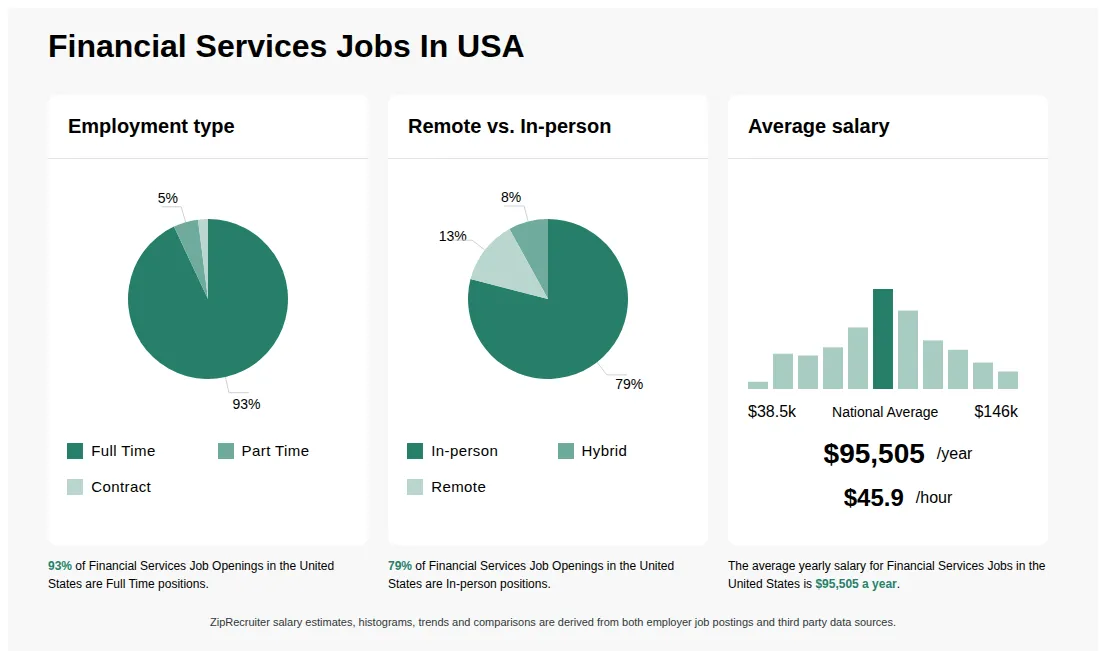
As of May 30, 2026, the average yearly pay for financial services in the United States is $95,505.00, according to ZipRecruiter salary data. Most workers in this role earn between $80,000.00 and $111,000.00 per year, depending on experience, location, and employer.

What Are the Different Financial Services Sectors Where I Can Work?

The financial services sector encompasses a wide range of employment possibilities. For example, you could work in consumer banking, which deals with basic savings and checking accounts. Your duties in this job typically involve setting up these accounts for people, but you may provide other services, like financial planning or lending. You can also work in investment banking or stock trading. In both of these industries, you help people develop investment portfolios for significant growth and profit. Outside of banking, you can work in an accountant or financial advisor position.

What are the key skills and qualifications needed to thrive in Financial Services, and why are they important?

To thrive in Financial Services, you need strong analytical skills, financial modeling proficiency, and a relevant degree such as finance, economics, or accounting. Familiarity with financial analysis tools, Excel, industry-specific software, and certifications like CFA or CPA are highly valued. Excellent communication, attention to detail, and ethical judgment set top professionals apart in this field. These skills and qualifications are critical for making informed financial decisions, maintaining regulatory compliance, and building trust with clients.

What are some typical challenges faced when starting a career in financial services, and how can new professionals overcome them?

New professionals in financial services often encounter challenges such as navigating complex regulatory environments, understanding a wide range of financial products, and building client trust. The fast-paced nature of the industry can also make it challenging to keep up with changing market trends and compliance requirements. To overcome these obstacles, it's helpful to seek mentorship, engage in continuous learning through training programs, and actively communicate with colleagues and clients to build strong relationships. Many organizations also provide structured onboarding and support to help new hires adapt successfully.

What is the difference between Financial Services vs Financial Analyst?

AspectFinancial ServicesFinancial Analyst
Required CredentialsVaries; often includes degrees in finance, economics, or related fields; certifications like CFA or CFP beneficialTypically requires a degree in finance, accounting, or economics; CFA certification often preferred
Work EnvironmentBanking institutions, investment firms, insurance companies, financial advisory firmsCorporations, investment banks, asset management firms, consulting agencies
Employer & Industry UsageFinancial services industry broadly covers banking, insurance, and investment sectorsSpecialized role within finance, focusing on analyzing financial data and investment opportunities

Financial Services is a broad industry encompassing various roles in banking, insurance, and investments, while a Financial Analyst is a specific position within that industry focused on analyzing financial data to support decision-making. Both roles often require similar credentials and work in related environments, but their scope and responsibilities differ.

What cities are hiring for Financial Services jobs? Cities with the most Financial Services job openings:
What are the most commonly searched types of Financial Services jobs? The most popular types of Financial Services jobs are:
What states have the most Financial Services jobs? States with the most job openings for Financial Services jobs include:
What job categories do people searching Financial Services jobs look for? The top searched job categories for Financial Services jobs are:
Infographic showing various Financial Services job openings in the United States as of May 2026, with employment types broken down into 1% As Needed, 91% Full Time, 7% Part Time, and 1% Contract. Highlights an 95% Physical, 2% Hybrid, and 3% Remote job distribution, with an average salary of $95,505 per year, or $45.9 per hour.

Financial Services Specialist Michigan

All Financial Freedom

Manhattan, NY โ€ข Remote

Full-time

Posted 9 days ago


Job description

We are seeking a Financial Services Specialist to support a growing financial services organization operating nationwide. This role supports a professional, structured environment focused on delivering financial education through virtual engagement. The position is well suited for individuals who value accountability, consistency, and long-term career growth.

Position Overview This role supports a growing financial services organization by delivering structured financial education and guiding individuals through a standardized engagement process. The position emphasizes professionalism, consistency, and long-term relationship building. No prior financial services experience is required.

Comprehensive training and licensing support are provided. Key Responsibilities Deliver structured financial education through virtual meetings Explain financial concepts related to protection, accumulation, and long-term planning Support individuals through a standardized, needs-based process Maintain accurate documentation and adhere to compliance standards Participate in ongoing training and professional development Required Qualifications Bachelor's degree preferred or equivalent professional experience Strong communication skills and professional presence Ability to work independently in a remote environment Willingness to obtain required state licensing (training provided) Successful completion of a background check Compensation & Benefits Performance-based compensation structure Remote work with flexible scheduling Licensing assistance and structured onboarding Clear advancement opportunities Career Path Advancement into senior specialist, leadership, or training roles based on performance. #J-18808-Ljbffr