1

Financial Literacy Jobs (NOW HIRING)

... financial literacy, art literacy, etc. Assist participants in learning or gaining a high level of skills. Prepare and present lessons on various literacy components, assessing participants ...

Financial Consultant

$75K - $100K/yr

... financial literacy and confidence. • Maintain up-to-date knowledge of financial products and services to offer the best solutions. • Build and nurture long-term relationships with clients ...

Plan and coordinate financial literacy programs. * Organize workshops on budgeting, credit, savings, banking, and entrepreneurship. * Support small business training classes and community education ...

next page

Showing results 1-20

Financial Literacy information

See salary details

$25K

$65.2K

$132K

How much do financial literacy jobs pay per year?

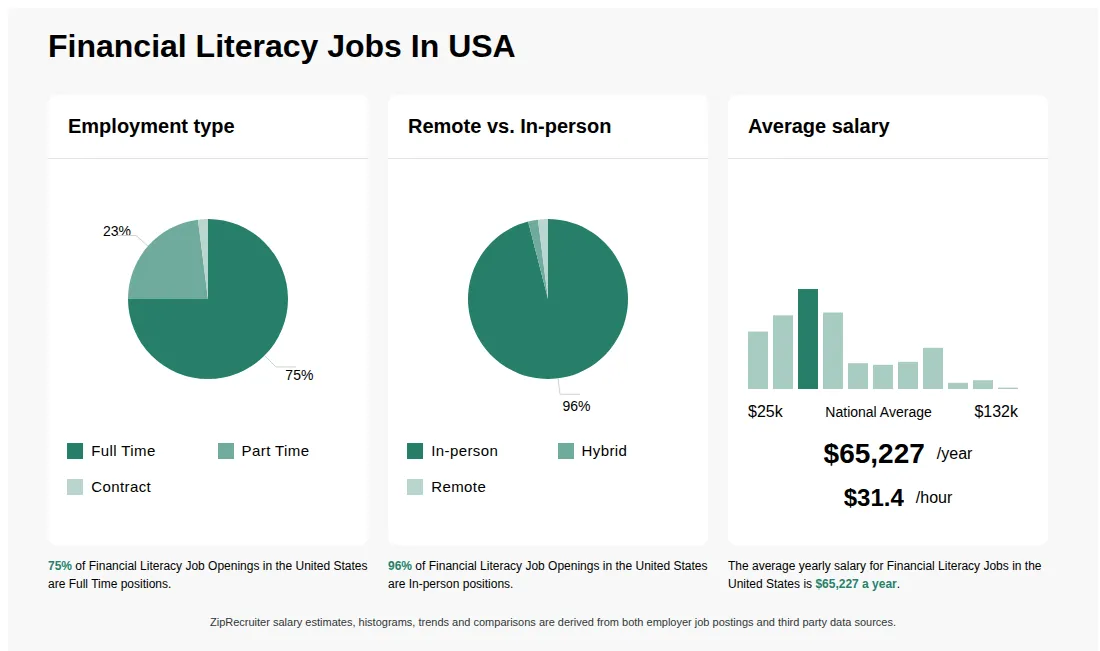
As of Jun 22, 2026, the average yearly pay for financial literacy in the United States is $65,227.00, according to ZipRecruiter salary data. Most workers in this role earn between $41,500.00 and $78,500.00 per year, depending on experience, location, and employer.

What job makes $10,000 a month without a degree?

In the field of financial literacy, roles such as financial advisor or investment consultant can potentially earn $10,000 or more per month, especially with experience, client base, and certifications like CFP or CFA. These jobs often require strong analytical skills, knowledge of financial markets, and the ability to build client relationships, but they do not always require a college degree.

What jobs require financial literacy?

Financial literacy is essential for roles such as financial analyst, accountant, financial advisor, banker, and investment manager. These jobs require understanding financial statements, budgeting, investment strategies, and often involve using tools like spreadsheets and financial software. Strong numerical skills and certifications such as CFA or CPA can enhance job prospects in these fields.

What are the key skills and qualifications needed to thrive in the Financial Literacy position, and why are they important?

To thrive as a Financial Literacy Educator, you need a solid understanding of personal finance principles, curriculum development, and instructional techniques, often supported by a degree in finance, education, or a related field. Familiarity with financial education platforms, presentation software, and relevant certifications such as Certified Financial Education Instructor (CFEI) can be valuable. Excellent communication, patience, and motivational skills help in engaging diverse audiences and fostering learning. These abilities are crucial for effectively empowering individuals to make informed financial decisions and achieve financial well-being.


What is a Financial Literacy job?

A Financial Literacy job involves educating individuals or groups on managing money, budgeting, saving, investing, and making informed financial decisions. Professionals in this field work in schools, nonprofits, financial institutions, or government agencies to improve financial awareness. They may develop educational programs, conduct workshops, or provide one-on-one coaching. The goal is to empower people with the knowledge and skills needed for financial stability and long-term success.

What are common challenges faced by Financial Literacy Educators, and how do they overcome them?

Financial Literacy Educators often encounter challenges such as engaging participants with varying levels of financial knowledge and overcoming preconceived attitudes toward money management. Adapting teaching strategies to accommodate different learning styles and cultural backgrounds is essential, requiring flexibility and creativity. Educators typically collaborate closely with schools, community organizations, or corporate partners to tailor their programs, utilize interactive tools, and share real-life examples to make concepts relatable. Continuous professional development and staying updated on financial trends also help educators address emerging topics and maintain their effectiveness.

What professions make $500,000 a year?

Professions that can earn $500,000 or more annually include investment bankers, senior corporate executives, specialized surgeons, and successful entrepreneurs. These roles often require advanced skills, extensive experience, and sometimes significant risk-taking or ownership stakes.

What jobs pay $2000 a day?

High-paying jobs that can pay around $2000 a day typically include roles such as investment bankers, senior corporate lawyers, specialized surgeons, and top-level executives. These positions often require advanced degrees, extensive experience, and sometimes certifications, and they usually involve high-stakes decision-making or specialized skills. Income can vary based on industry, location, and individual performance.
What cities are hiring for Financial Literacy jobs? Cities with the most Financial Literacy job openings:
What are the most commonly searched types of Financial Literacy jobs? The most popular types of Financial Literacy jobs are:
What states have the most Financial Literacy jobs? States with the most job openings for Financial Literacy jobs include:
Infographic showing various Financial Literacy job openings in the United States as of June 2026, with employment types broken down into 1% Locum Tenens, 19% Full Time, 70% Part Time, and 10% Contract. Highlights an 85% Physical, 1% Hybrid, and 14% Remote job distribution, with an average salary of $65,227 per year, or $31.4 per hour.
Financial Literacy & Business Instructor (After School)

Financial Literacy & Business Instructor (After School)

Concorde Education

Visalia, CA • On-site

$50/hr

Full-time

Posted 6 days ago

Be an early applicant


Job description

Location: On-site at a partner school or community site (varies by assignment)
Schedule: 1–4 hours per week, after school
Program Length: ~10 weeks
Start Date: Rolling openings based on partner schedules
Compensation: $50+ per instructional hour (flexible based on experience, program, and commute)

About the Role

Concorde Education is seeking a Business, Finance & Entrepreneurship Instructor to lead engaging, real-world after-school programs. This role introduces students to practical financial literacy and business concepts through interactive, hands-on learning.

Programs may focus on personal finance, entrepreneurship, or small business basics, depending on the site and learner group. The goal is to make these topics accessible, relevant, and immediately useful.

What You’ll Teach

  • Students will explore how money and business work in real life, including:
  • Budgeting, saving, and spending decisions
  • Banking, credit, and financial responsibility
  • Basic investing concepts (intro level)
  • Entrepreneurship and business ideas
  • Pricing, profit, and simple business models
  • Marketing, branding, and customer experience
  • Communication and presentation skills

Responsibilities

  • Lead engaging, discussion-based and project-based sessions
  • Teach practical, real-world financial and business concepts
  • Adapt lessons to different age groups and experience levels
  • Foster a positive, inclusive, and collaborative learning environment
  • Guide students through a simple business or finance-related project
  • Communicate with site staff and track attendance/session completion

Qualifications

  • Minimum of 60 college credits
  • Background in business, finance, entrepreneurship, or related field
  • Experience working with students or groups (teaching, tutoring, training, etc.)
  • Strong communication and facilitation skills
  • Ability to explain concepts in a clear, practical way
  • Reliable, professional, and comfortable in a school or group setting

Who This Role Is Great For

  • Teachers or aspiring educators
  • Business professionals or entrepreneurs
  • Finance, economics, or business students
  • Anyone who enjoys teaching real-world skills to students