
That includes an opportunity to work in our new $838M, 505,000 square foot Adams Neurosciences ... Demonstrated technical skills to meet entry level standards of routine CT imaging * ARRT RT(R ...
That includes an opportunity to work in our new $838M, 505,000 square foot Adams Neurosciences ... Demonstrated technical skills to meet entry level standards of routine CT imaging * ARRT RT(R ...
That includes an opportunity to work in our new $838M, 505,000 square foot Adams Neurosciences ... Demonstrated technical skills to meet entry level standards of routine CT imaging * ARRT RT(R ...
That includes an opportunity to work in our new $838M, 505,000 square foot Adams Neurosciences ... Demonstrated technical skills to meet entry level standards of routine CT imaging * ARRT RT(R ...
That includes an opportunity to work in our new $838M, 505,000 square foot Adams Neurosciences ... Demonstrated technical skills to meet entry level standards of routine CT imaging * ARRT RT(R ...
That includes an opportunity to work in our new $838M, 505,000 square foot Adams Neurosciences ... Demonstrated technical skills to meet entry level standards of routine CT imaging * ARRT RT(R ...
That includes an opportunity to work in our new $838M, 505,000 square foot Adams Neurosciences ... Demonstrated technical skills to meet entry level standards of routine CT imaging * ARRT RT(R ...
That includes an opportunity to work in our new $838M, 505,000 square foot Adams Neurosciences ... Demonstrated technical skills to meet entry level standards of routine CT imaging * ARRT RT(R ...
That includes an opportunity to work in our new $838M, 505,000 square foot Adams Neurosciences ... Demonstrated technical skills to meet entry level standards of routine CT imaging * ARRT RT(R ...
That includes an opportunity to work in our new $838M, 505,000 square foot Adams Neurosciences ... Demonstrated technical skills to meet entry level standards of routine CT imaging * ARRT RT(R ...
That includes an opportunity to work in our new $838M, 505,000 square foot Adams Neurosciences ... Demonstrated technical skills to meet entry level standards of routine CT imaging * ARRT RT(R ...
That includes an opportunity to work in our new $838M, 505,000 square foot Adams Neurosciences ... Demonstrated technical skills to meet entry level standards of routine CT imaging * ARRT RT(R ...
That includes an opportunity to work in our new $838M, 505,000 square foot Adams Neurosciences ... Demonstrated technical skills to meet entry level standards of routine CT imaging * ARRT RT(R ...
That includes an opportunity to work in our new $838M, 505,000 square foot Adams Neurosciences ... Demonstrated technical skills to meet entry level standards of routine CT imaging * ARRT RT(R ...
That includes an opportunity to work in our new $838M, 505,000 square foot Adams Neurosciences ... Demonstrated technical skills to meet entry level standards of routine CT imaging * ARRT RT(R ...
That includes an opportunity to work in our new $838M, 505,000 square foot Adams Neurosciences ... Demonstrated technical skills to meet entry level standards of routine CT imaging * ARRT RT(R ...
That includes an opportunity to work in our new $838M, 505,000 square foot Adams Neurosciences ... Demonstrated technical skills to meet entry level standards of routine CT imaging * ARRT RT(R ...
That includes an opportunity to work in our new $838M, 505,000 square foot Adams Neurosciences ... Demonstrated technical skills to meet entry level standards of routine CT imaging * ARRT RT(R ...
That includes an opportunity to work in our new $838M, 505,000 square foot Adams Neurosciences ... Demonstrated technical skills to meet entry level standards of routine CT imaging * ARRT RT(R ...
That includes an opportunity to work in our new $838M, 505,000 square foot Adams Neurosciences ... Demonstrated technical skills to meet entry level standards of routine CT imaging * ARRT RT(R ...
That includes an opportunity to work in our new $838M, 505,000 square foot Adams Neurosciences ... Demonstrated technical skills to meet entry level standards of routine CT imaging * ARRT RT(R ...
That includes an opportunity to work in our new $838M, 505,000 square foot Adams Neurosciences ... Demonstrated technical skills to meet entry level standards of routine CT imaging * ARRT RT(R ...
That includes an opportunity to work in our new $838M, 505,000 square foot Adams Neurosciences ... Demonstrated technical skills to meet entry level standards of routine CT imaging * ARRT RT(R ...
That includes an opportunity to work in our new $838M, 505,000 square foot Adams Neurosciences ... Demonstrated technical skills to meet entry level standards of routine CT imaging * ARRT RT(R ...
That includes an opportunity to work in our new $838M, 505,000 square foot Adams Neurosciences ... Demonstrated technical skills to meet entry level standards of routine CT imaging * ARRT RT(R ...
That includes an opportunity to work in our new $838M, 505,000 square foot Adams Neurosciences ... Demonstrated technical skills to meet entry level standards of routine CT imaging * ARRT RT(R ...
That includes an opportunity to work in our new $838M, 505,000 square foot Adams Neurosciences ... Demonstrated technical skills to meet entry level standards of routine CT imaging * ARRT RT(R ...
That includes an opportunity to work in our new $838M, 505,000 square foot Adams Neurosciences ... Demonstrated technical skills to meet entry level standards of routine CT imaging * ARRT RT(R ...
That includes an opportunity to work in our new $838M, 505,000 square foot Adams Neurosciences ... Demonstrated technical skills to meet entry level standards of routine CT imaging * ARRT RT(R ...
That includes an opportunity to work in our new $838M, 505,000 square foot Adams Neurosciences ... Demonstrated technical skills to meet entry level standards of routine CT imaging * ARRT RT(R ...
That includes an opportunity to work in our new $838M, 505,000 square foot Adams Neurosciences ... Demonstrated technical skills to meet entry level standards of routine CT imaging * ARRT RT(R ...
That includes an opportunity to work in our new $838M, 505,000 square foot Adams Neurosciences ... Demonstrated technical skills to meet entry level standards of routine CT imaging * ARRT RT(R ...
That includes an opportunity to work in our new $838M, 505,000 square foot Adams Neurosciences ... Demonstrated technical skills to meet entry level standards of routine CT imaging * ARRT RT(R ...
That includes an opportunity to work in our new $838M, 505,000 square foot Adams Neurosciences ... Demonstrated technical skills to meet entry level standards of routine CT imaging * ARRT RT(R ...
That includes an opportunity to work in our new $838M, 505,000 square foot Adams Neurosciences ... Demonstrated technical skills to meet entry level standards of routine CT imaging * ARRT RT(R ...
That includes an opportunity to work in our new $838M, 505,000 square foot Adams Neurosciences ... Demonstrated technical skills to meet entry level standards of routine CT imaging * ARRT RT(R ...
That includes an opportunity to work in our new $838M, 505,000 square foot Adams Neurosciences ... Demonstrated technical skills to meet entry level standards of routine CT imaging * ARRT RT(R ...
That includes an opportunity to work in our new $838M, 505,000 square foot Adams Neurosciences ... Demonstrated technical skills to meet entry level standards of routine CT imaging * ARRT RT(R ...
That includes an opportunity to work in our new $838M, 505,000 square foot Adams Neurosciences ... Demonstrated technical skills to meet entry level standards of routine CT imaging * ARRT RT(R ...
That includes an opportunity to work in our new $838M, 505,000 square foot Adams Neurosciences ... Demonstrated technical skills to meet entry level standards of routine CT imaging * ARRT RT(R ...
Entry Level Neuroscience information
See salary details
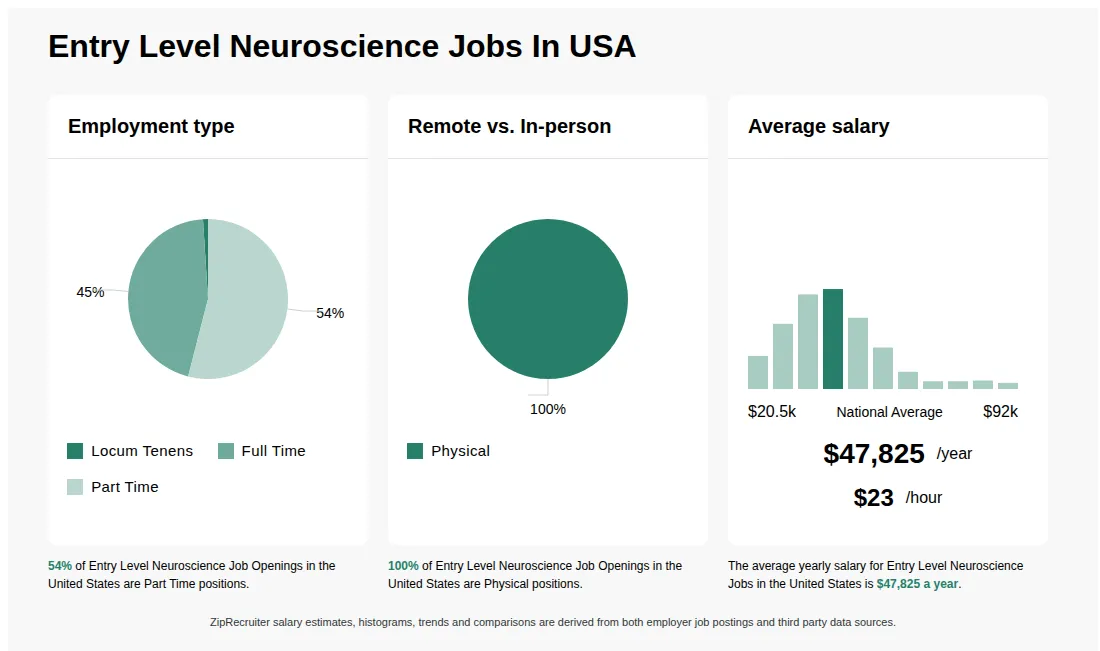
$20.5K - $27K
7% of jobs
$27K - $33.5K
15% of jobs
$34.3K is the 25th percentile. Wages below this are outliers.
$33.5K - $40K
21% of jobs
The median wage is $41.8K / yr.
$40K - $46.5K
23% of jobs
$49.8K is the 75th percentile. Wages above this are outliers.
$46.5K - $53K
16% of jobs
$53K - $59.5K
10% of jobs
$59.5K - $66K
3% of jobs
$66K - $72.5K
1% of jobs
$72.5K - $79K
1% of jobs
$79K - $85.5K
1% of jobs
$85.5K - $92K
1% of jobs
$20.5K
$47.8K
$92K
How much do entry level neuroscience jobs pay per year?
As of Jul 22, 2026, the average yearly pay for entry level neuroscience in the United States is $47,825.00, according to ZipRecruiter salary data. Most workers in this role earn between $35,000.00 and $52,000.00 per year, depending on experience, location, and employer.
What are the key skills and qualifications needed to thrive in the Entry Level Neuroscience position, and why are they important?
To thrive in an Entry Level Neuroscience role, you typically need a bachelor's degree in neuroscience, biology, or a related field, along with foundational knowledge of laboratory techniques and research methods. Familiarity with data analysis software (such as MATLAB or SPSS), lab instrumentation, and adherence to research safety protocols are also valuable. Strong attention to detail, problem-solving skills, and effective communication help you succeed in team-driven, research-focused environments. These competencies are essential for accurate data collection, collaboration on research projects, and contributing meaningfully to advancements in neuroscience.
What are some typical tasks and responsibilities in an entry level neuroscience position?
Entry level neuroscience roles often involve assisting with laboratory experiments, collecting and analyzing data, preparing research materials, and maintaining lab equipment. You may be responsible for supporting senior researchers by conducting literature reviews, documenting findings, and ensuring that experiments follow established protocols. Collaboration with multidisciplinary teams—including neuroscientists, technicians, and graduate students—is common, and you'll often attend regular team meetings to discuss project progress. This hands-on experience provides a solid foundation for growth in neuroscience research or related advanced study.
What are entry level neuroscience jobs?
Entry level neuroscience jobs include roles such as research assistant, laboratory technician, or clinical research coordinator. These positions typically require a bachelor's degree in neuroscience, biology, or a related field, and may involve tasks like data collection, lab experiments, or assisting senior researchers. Skills in laboratory techniques and familiarity with scientific tools are often beneficial.
What is an Entry Level Neuroscience job?
An Entry Level Neuroscience job typically involves assisting with research, data collection, and lab work in academic, clinical, or industry settings. Responsibilities may include running experiments, analyzing data, and supporting senior researchers. These roles are often found in universities, hospitals, pharmaceutical companies, or biotech firms. Candidates usually have a degree in neuroscience, biology, or a related field. Strong analytical, problem-solving, and technical skills are essential for success in these positions.
What jobs can I get with just a neuroscience degree?
With a neuroscience degree, entry-level jobs include research assistant, laboratory technician, or clinical research coordinator, often requiring knowledge of lab techniques and data analysis. These roles typically involve working in research settings, healthcare facilities, or pharmaceutical companies and may require additional certifications or training. They provide foundational experience for advanced positions in neuroscience or related fields.
How to start a career in neuroscience?
To start a career in neuroscience, pursue a bachelor's degree in neuroscience, biology, psychology, or a related field, and gain research experience through internships or lab work. Advanced roles often require a master's or Ph.D., along with skills in data analysis, laboratory techniques, and familiarity with neuroimaging tools. Building a strong foundation in scientific methods and networking with professionals can also facilitate entry into the field.
What jobs can you get out of neuroscience?
Entry-level neuroscience graduates can pursue roles such as research assistants, laboratory technicians, clinical research coordinators, or neuropsychology assistants. These positions often require knowledge of laboratory techniques, data analysis, and understanding of neurological concepts, and may involve working in hospitals, research institutions, or biotech companies.
More about Entry Level Neuroscience jobs
What cities are hiring for Entry Level Neuroscience jobs? Cities with the most Entry Level Neuroscience job openings:
What are the most commonly searched types of Neuroscience jobs? The most popular types of Neuroscience jobs are:
What states have the most Entry Level Neuroscience jobs? States with the most job openings for Entry Level Neuroscience jobs include:
What job categories do people searching Entry Level Neuroscience jobs look for? The top searched job categories for Entry Level Neuroscience jobs are:
Job description
Overview
When you come to Yale New Haven Health System, you'll work with leaders in medicine and be part of the cutting edge in your field. That includes an opportunity to work in our new $838M, 505,000 square foot Adams Neurosciences Center opening in 2027. The largest project of its kind in state history, the center is being designed to make it even easier for the entire clinical team to collaborate throughout each patient's continuum of care, starting with the prehospital setting, during hospitalization and through early recovery.
Full-time, Part-time, Day/Evening/Night Shifts Available!
Required qualifications:
When you come to Yale New Haven Health System, you'll work with leaders in medicine and be part of the cutting edge in your field. That includes an opportunity to work in our new $838M, 505,000 square foot Adams Neurosciences Center opening in 2027. The largest project of its kind in state history, the center is being designed to make it even easier for the entire clinical team to collaborate throughout each patient's continuum of care, starting with the prehospital setting, during hospitalization and through early recovery.
Full-time, Part-time, Day/Evening/Night Shifts Available!
Required qualifications:
- Graduation from an AMA-approved Radiologic Technology program
- 1-3 years of CT experience with routine imaging techniques
- Demonstrated technical skills to meet entry level standards of routine CT imaging
- ARRT RT(R) certification
- CT certification required or 20 years of CT experience
- Connecticut State License
- Proficiency in advanced CT imaging techniques, above average knowledge of cross section anatomy, computer/Pacs applications
- Good organizational, communication and customer service skills.
- CPR Certification
- AS or BS degree

About Yale New Haven Health
Sourced by ZipRecruiter
Industry
Health care and social assistance and hospitals
Company size
10,000+ Employees
Headquarters location
New Haven, CT, US