1

Engineering Psychologist Jobs (NOW HIRING)

... programming * Participates in hearings as assigned and assessments for potential suicide * As a ... Acts as lead worker over lower-level psychological services staff and provides clinical supervision ...

Psychologist

Grafton, OH · On-site

$115K/yr

... programming * Participates in hearings as assigned and assessments for potential suicide * As a ... Acts as lead worker over lower-level psychological services staff and provides clinical supervision ...

Psychologist

Springfield, MA · On-site

$61K - $72K/yr

... providing programming and consultation services. In addition, the position provides clinical ... Responsibilities - Provide individual, group and couples psychological counseling for Springfield ...

Overview POSITION TITLE (Oracle title) SCHOOL PSYCHOLOGIST WORKING TITLE Advanced Learning Services ... Evaluates and analyzes data to support advanced learning programming by providing professional ...

... programming and training. Provides consultative psychological services to members of the Beacon College community including faculty members, staff members, deans, administrators, and parents.

Overview POSITION TITLE (Oracle title) SCHOOL PSYCHOLOGIST WORKING TITLE Advanced Learning Services ... Evaluates and analyzes data to support advanced learning programming by providing professional ...

... programming and training. Provides consultative psychological services to members of the Beacon College community including faculty members, staff members, deans, administrators, and parents.

next page

Showing results 1-20

Engineering Psychologist information

See salary details

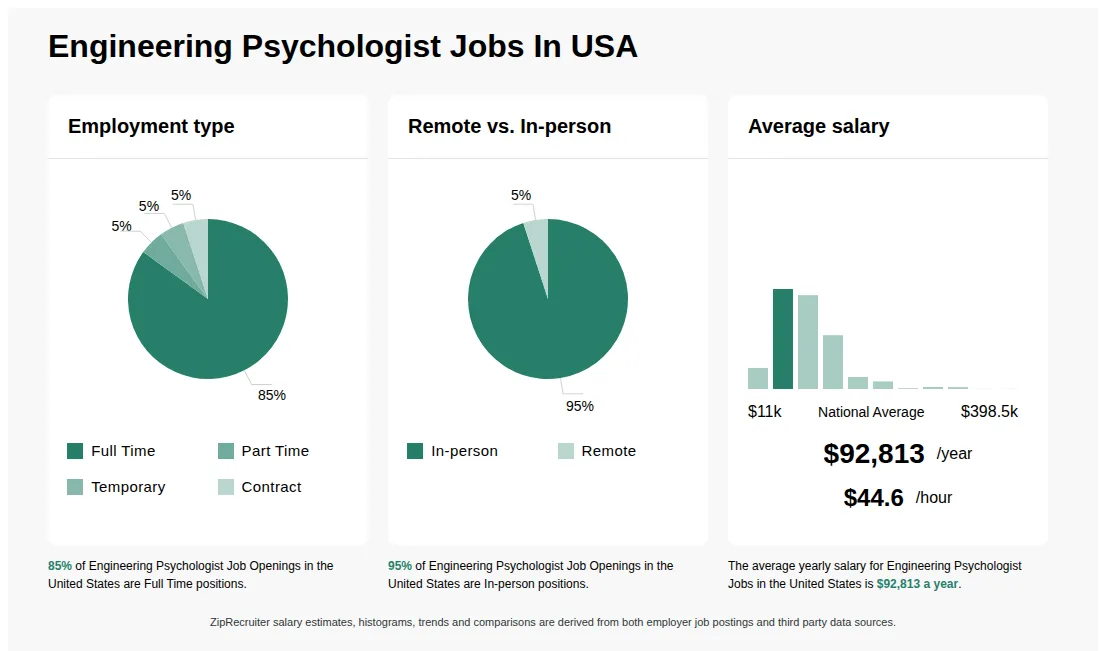
$11K

$92.8K

$398.5K

How much do engineering psychologist jobs pay per year?

As of Jul 5, 2026, the average yearly pay for engineering psychologist in the United States is $92,813.00, according to ZipRecruiter salary data. Most workers in this role earn between $66,500.00 and $117,000.00 per year, depending on experience, location, and employer.

What Does an Engineering Psychologist Do?

An engineering psychologist focuses on adapting and improving equipment, technology, and work environments to enhance human capabilities and behavior. As an engineering psychologist, your responsibilities include evaluating the human factors in a workplace, creating guidelines and making changes to guarantee the safety of employees, and explore ways in which workplaces can be made more inclusive and available to people with disabilities. Other duties include analyzing machinery, products, and employee practices to determine if changes are necessary to promote better ergonomics and safety. You typically work with other engineers, stakeholders, and executives to make changes and improvements.

What does an engineer psychologist do?

An engineering psychologist studies how humans interact with technology, systems, and equipment to improve safety, efficiency, and usability. They often analyze human performance, design user-friendly interfaces, and may use tools like ergonomic assessments and cognitive testing in their work environment.

What engineering jobs pay $500,000?

Engineering Psychologists typically do not earn $500,000 annually; such high salaries are more common in executive or specialized engineering roles like petroleum, software, or aerospace engineering at senior levels. These positions often require advanced skills, extensive experience, and sometimes leadership responsibilities. Compensation varies widely based on industry, location, and company size.

How do engineering psychologists typically collaborate with design and engineering teams during the product development process?

Engineering psychologists play a vital role in bridging the gap between human behavior and technology. They often work closely with multidisciplinary teams—including designers, engineers, and product managers—to ensure that products are user-friendly and align with human capabilities. This collaboration usually involves conducting user research, usability testing, and providing feedback on prototypes, helping teams make evidence-based decisions throughout the development cycle. Their input is crucial for identifying potential human errors and enhancing overall user experience, making their contributions highly valued across various industries.

What are the key skills and qualifications needed to thrive as an Engineering Psychologist, and why are they important?

To thrive as an Engineering Psychologist, you need a solid background in psychology, human factors, and experimental design, typically supported by at least a master's or doctoral degree in psychology or a related field. Familiarity with usability testing tools, statistical analysis software (such as SPSS or R), and human-computer interaction systems is essential. Strong analytical thinking, problem-solving abilities, and effective communication skills help you collaborate with engineers and designers to optimize user experience. These skills ensure that products, systems, and environments are designed for maximum usability, safety, and efficiency, directly impacting user satisfaction and performance.

What are engineering psychologists?

Engineering psychologists are professionals who study how people interact with machines, systems, and technology in order to improve usability, safety, and efficiency. They apply principles from psychology to the design of products, workplaces, and environments to enhance user experience and reduce human error. Their work is crucial in fields like transportation, healthcare, consumer electronics, and ergonomics, making technology more accessible and user-friendly.

Is there a job that combines engineering and psychology?

An engineering psychologist is a professional who combines principles of engineering and psychology to improve human interaction with technology and systems. They often work in areas such as human factors, ergonomics, and user experience design, utilizing skills in research, data analysis, and human-centered design. This role typically requires knowledge of engineering, psychology, and relevant tools like simulation software or usability testing methods.

How much do engineering psychologists make?

Engineering psychologists typically earn a median annual salary of around $80,000 to $110,000, depending on experience, education, and location. They often work in research, design, or human factors analysis, requiring strong analytical skills and knowledge of human-system interactions.

What is the difference between Engineering Psychologist vs Human Factors Specialist?

AspectEngineering PsychologistHuman Factors Specialist
CredentialsMaster's or Ph.D. in psychology, human factors, or related fieldMaster's or Ph.D. in human factors, psychology, or ergonomics
Work EnvironmentResearch labs, government agencies, private industryDesign firms, healthcare, transportation, government agencies
Industry UsageDesigning user interfaces, safety protocols, ergonomic systemsOptimizing product usability, safety, and performance

Engineering Psychologists and Human Factors Specialists often share similar educational backgrounds and work environments. Both focus on improving human interaction with systems and products. However, Engineering Psychologists tend to emphasize research and experimental methods, while Human Factors Specialists often focus more on applied design and usability testing. Both roles are vital in industries like technology, healthcare, and transportation, ensuring safety and efficiency for users.

What cities are hiring for Engineering Psychologist jobs? Cities with the most Engineering Psychologist job openings:
What are the most commonly searched types of Engineering Psychologist jobs? The most popular types of Engineering Psychologist jobs are:
What states have the most Engineering Psychologist jobs? States with the most job openings for Engineering Psychologist jobs include:
What job categories do people searching Engineering Psychologist jobs look for? The top searched job categories for Engineering Psychologist jobs are:
Infographic showing various Engineering Psychologist job openings in the United States as of June 2026, with employment types broken down into 100% Full Time. Highlights an 94% Physical, 3% Hybrid, and 3% Remote job distribution, with an average salary of $92,813 per year, or $44.6 per hour.
Associate Cognitive Systems Engineer

Associate Cognitive Systems Engineer

Mile Two, LLC

Dayton, OH • On-site

Full-time

Posted 25 days ago

Be an early applicant


Job description

Description:

Join Our Innovative Team at Mile 2!

Are you into solving tough problems and building cool tech? Do you thrive in a team where your ideas are heard and your creativity is encouraged? If you're nodding along, Mile 2 might be the place for you.


We're all about creating advanced solutions that really make a difference for our government partners. Our team uses the latest technologies to make a tangible impact, creating seamless integrations between human expertise and machine capabilities to tackle complex challenges.


Our core values guide everything we do: Supported Autonomy: We trust you to take initiative and make decisions, but we've always got your back. Humble Expertise: We respect everyone's knowledge and skills, creating an environment where we can all learn and get better together. Success is a Team Effort: We believe that we can only achieve great things when we work as a team. Tangible Results: We're motivated by the desire to create real, measurable impacts through our work.


When you join us, you'll work on meaningful projects that challenge you and help you grow. We offer a supportive and inclusive environment, competitive benefits, and plenty of opportunities to advance your career. If you're ready to level up your career and be part of something special, check out our current openings and apply today.


This position is contingent upon Mile Two being awarded a specific government contract.


DUTIES AND RESPONSIBILITIES:

Mile Two Cognitive Systems Engineers must analyze and optimize complex, fast-moving, and human-centric technical environments. This position is for the AFRL/IZ Digital Enablement Portfolio. Our core mission is to bridge complex technical tools with human workflows, ensuring that the organizations we work with can seamlessly adopt and leverage advanced data and software tools to make better decisions. We do this by utilizing a multidisciplinary, human-machine systems approach to eliminate operational friction and context-switching bottlenecks. Our Cognitive Systems Engineers ensure we achieve our mission by utilizing their skills to:

  • Fully Own End-to-End Adoption: Take complete operational ownership of the rollout and workforce integration of AFRL IZ/IZX digital products, driving user engagement and minimizing friction across the broader AFRL workforce.
  • Analyze Workflows & Friction: Apply core Cognitive Systems Engineering (CSE) methodologies to analyze human-workflow friction, interface directly with complex technical product teams, and design seamless human-machine adoption strategies.
  • Manage Clients & Stakeholders: Act as the dedicated, trusted operational partner to the client lead, absorbing daily logistics and execution to transition client leadership from hands-on tasks to high-level strategy.
  • Feed the Cross-Spoke Pipeline: Proactively engage with the workforce to identify tool struggles and organizational skill gaps, collaborating directly with the Digital Upskilling lead to feed the pipeline with clear targets for new course creation and marketing materials.

Drive Strategic Agile Alignment: Collaborate closely with the PM and the broader Digital Enablement team to foster a fluid, responsive resource ecosystem that easily adapts to shifting client needs.

Requirements:REQUIRED
  • Ability to obtain a Security Clearance at Secret level, USG CAC, NIPR Access
  • Experience: 1 year of professional experience as a Cognitive Systems Engineer, Human Factors Engineer, Engineering Psychologist, or in a closely related technical/operational role.
  • Core Specialty: Strong foundational background in Cognitive Systems Engineering (CSE), data collection methods, and analytical techniques. Proven ability to map complex mental models, assess cognitive workload, and analyze context-switching friction.
  • Product & Training Strategy: Experience bridging the gap between highly technical product development teams and non-technical end-users (determining where marketing, training, or workflow redesign is needed).
  • Consultative & Communication Skills: Exceptional communication skills with the ability to confidently embed with client stakeholders, manage operational expectations, and proactively drive projects without heavy supervision.
  • Defense/Federal Space Familiarity: Familiarity with the Department of Defense (DoD), specifically the Air Force Research Laboratory (AFRL) or similar scientific/research defense environments is highly preferred.

DESIRED

  • Defense Sector Experience: Prior experience working within or supporting DoD clients, specifically AFRL or similar military scientific and research environments.
  • AI & Advanced Tool Ecosystems: Familiarity with or exposure to emerging artificial intelligence toolsets, large language model interfaces, or modern defense data environments (e.g., Genai.mil Agents, Envision, or equivalent platforms).
  • Technical Skills: Advanced degree in CSE, Human Factors, Engineering Psychology or a closely related field. Experience with technical writing.
  • Cross-Functional Agile Collaboration: Experience working within an integrated digital enablement ecosystem alongside distinct project spokes like technical training/upskilling pipelines and specialized AI development teams.
  • Contract & Program Growth Support: Understanding of federal contracting environments, with the ability to identify operational alignment opportunities that support long-term contract consolidation strategies.

LEADERSHIP

  • Ability to foster growth in individuals and teams. Effectively communicate orally and in written documentation up, down, and laterally across the organization and to external stakeholders.

Defense Work

This role supports U.S. Department of Defense customers. Employees may be assigned to different projects over time, including projects involving defense operations.


Our Approach to AI in Hiring

At Mile 2, applications are reviewed by real people—not filtered out by bots. Authenticity matters more than keyword tricks.

We know you're probably using AI tools to help draft or polish your resumes, and that’s fine! We're using AI to write this blurb about AI! But we expect you to make it your own. Resumes that feel copy-pasted —repetitive, oddly phrased, “too perfect” matches to our job description— may hurt your chances. Adding personal touches and real examples of your work will make your application stronger.


We look forward to meeting the real you!