1

Energy Attorney Jobs (NOW HIRING)

This position will convert to an Associate Attorney role once the position becomes available. Specific Duties & Responsibilities: * Manage cases from inception to completion * Prepare analysis of ...

Renewable Energy Lawyer (Remote)

OR · On-site +1

$309K/yr

Join Our Team as a Renewable Energy Lawyer at Axiom We are currently seeking Renewable Energy ... The estimated total compensation for full-time Axiom attorney roles is $104,500-325,000 per year ...

Energy Regulatory Attorney

Portland, OR · On-site

$150K - $250K/yr

Energy Regulatory Attorney Location: Portland, OR Job Type: Full-Time About the Opportunity A well-established and growing law firm is seeking an Energy Regulatory Attorney to join its dynamic ...

Apply Early

next page

Showing results 1-20

Energy Attorney information

See salary details

$34K

$147.9K

$281K

How much do energy attorney jobs pay per year?

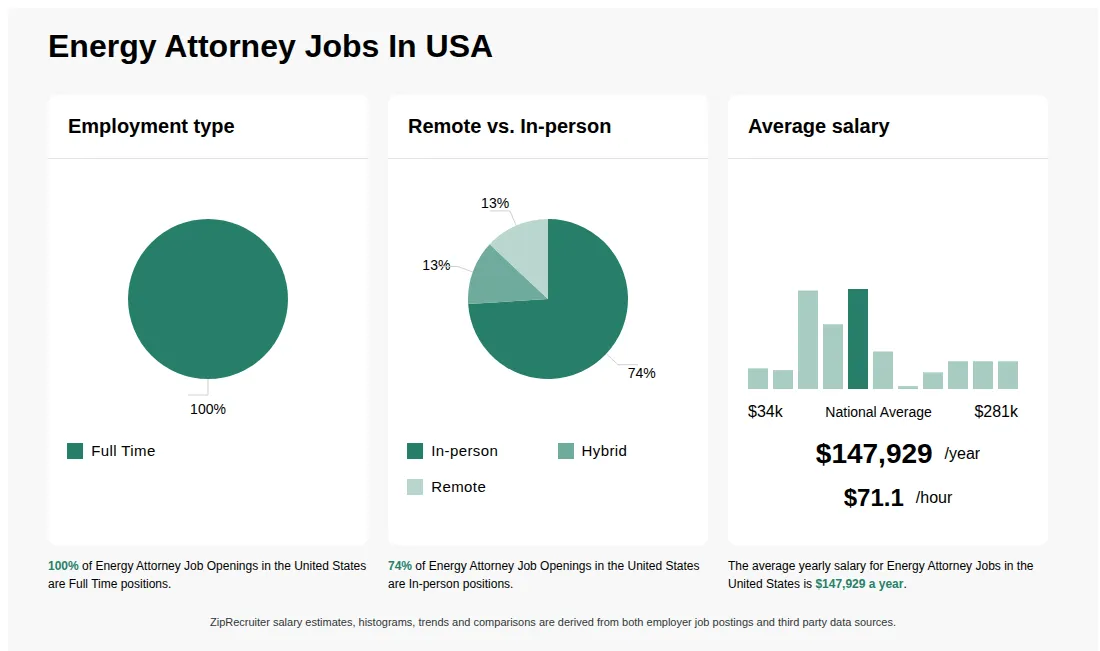
As of Jul 4, 2026, the average yearly pay for energy attorney in the United States is $147,929.00, according to ZipRecruiter salary data. Most workers in this role earn between $97,000.00 and $205,500.00 per year, depending on experience, location, and employer.

What is an Energy Attorney?

An Energy Attorney is a legal professional who specializes in laws and regulations related to the energy sector, including oil, gas, electricity, and renewable resources. They advise clients on compliance with environmental and regulatory standards, draft contracts, and represent clients in disputes or negotiations involving energy production and distribution. Energy Attorneys often work with government agencies, utility companies, or private firms to navigate the complex legal landscape of the energy industry.

What are the key skills and qualifications needed to thrive as an Energy Attorney, and why are they important?

To thrive as an Energy Attorney, you need a Juris Doctor (JD) degree, state bar admission, and expertise in energy law, regulatory compliance, and contract negotiation. Familiarity with legal research databases, energy regulatory agency platforms (such as FERC or state commissions), and document management systems is essential. Exceptional analytical thinking, negotiation skills, and the ability to communicate complex legal concepts clearly are crucial soft skills. These competencies enable effective client representation, ensure regulatory compliance, and support successful navigation of the complex and evolving energy sector.

What is the difference between Energy Attorney vs Energy Contract Specialist?

AspectEnergy AttorneyEnergy Contract Specialist
Required CredentialsJuris Doctor (JD), State Bar AdmissionBachelor's degree, often in law, business, or engineering; some roles prefer legal or contract certifications
Work EnvironmentLaw firms, corporate legal departments, government agenciesEnergy companies, utility firms, consulting agencies
Industry UsageLegal advisory, regulatory compliance, contract negotiationsDrafting, reviewing, and managing energy contracts

Energy Attorneys focus on legal matters, regulatory compliance, and advising clients on energy laws, while Energy Contract Specialists handle the drafting, review, and management of energy-related contracts. Both roles require understanding of energy regulations, but their core responsibilities differ, with attorneys providing legal counsel and specialists managing contractual processes.

What are some common challenges Energy Attorneys face when working on regulatory compliance matters?

Energy Attorneys often navigate complex and evolving regulations at federal, state, and local levels. One challenge is staying current with frequently changing policies affecting energy generation, distribution, and environmental standards. They must also coordinate with technical experts and clients to interpret regulations accurately and implement compliant business strategies. Effective communication skills and attention to detail are essential, as these attorneys often serve as liaisons between regulatory bodies, clients, and internal teams.

What Is an Energy Attorney?

An energy attorney is a lawyer who is legally authorized to work in the energy sector. Energy attorneys are experts in energy use, regulation, and law. As an energy attorney, you must understand the rules that dictate how companies create and harvest energy. Your responsibilities include handling electricity, gas, coal, and energy trading work. Other duties include representing companies that mine and sell natural resources, as well as handling pipeline agreements, power purchasing, and energy-related contracts. You may also work on contracts regarding renewable energy and biofuels.

What cities are hiring for Energy Attorney jobs? Cities with the most Energy Attorney job openings:
Who are the top companies hiring for Energy Attorney jobs? The top employers for Energy Attorney jobs are:
What states have the most Energy Attorney jobs? States with the most job openings for Energy Attorney jobs include:
What are popular job titles related to Energy Attorney jobs? For Energy Attorney jobs, the most frequently searched job titles are:
Infographic showing various Energy Attorney job openings in the United States as of June 2026, with employment types broken down into 100% Full Time. Highlights an 94% Physical, 2% Hybrid, and 4% Remote job distribution, with an average salary of $147,929 per year, or $71.1 per hour.

$143K/yr

Other

Posted 3 days ago


Job description

Attorneys at the CIA provide legal advice and policy counsel on a variety of legal issues relating to intelligence and national security law and other routine practices of an executive agency.Qualifications:Minimum Qualifications
Interested candidates should be passionate about the ideals of our American republic, committed to upholding the rule of law and the U.S. Constitution, and committed to improving the efficiency of the Federal government. Hiring decisions will not be based on race, sex, color, religion, or national origin.
  • Active membership of the bar (any US jurisdiction).
  • Ability to meet the minimum requirements for joining CIA, including U.S. citizenship and a background investigation
  • Demonstrated experience of at least three years in one or more of OGC's practice areas.
Desired Qualifications
  • All candidates are reviewed for the following competencies:
    • Legal analysis, reasoning and writing, including the ability to effectively integrate and synthesize facts and law to make legally sound decisions, including in compressed timeframes.
    • Interpersonal and communication skills.
    • The ability to work both independently and as a team member in a demanding environment.
    • The ability to exercise sound judgment in challenging situations.
    • Ability to navigate changing circumstances.
    • Ability to effectively manage multiple work assignments and competing priorities concurrently.
    • Ability to develop and maintain collaborative working relationships inside and outside the CIA.
    • Demonstrated expertise on complex legal matters, and strong client counseling skills, in one or more of the following practice areas: Constitutional Law, Government Contracts, Employment Law, Ethics, Fiscal Law, FOIA, International Law, Investigations, Litigation (Federal), Privacy Law, Operational Law, Surveillance Law, and Tech/Cyber Law.
  • Lateral (or mid-career) hires have more than three years of post-law school experience and work on the most complex legal issues in the Agency.
  • Please note other OGC job postings on CIA.gov tailored to specific practice areas (e.g., government contracts, employment law, etc.). Candidate may apply to a specialty practice area through the tailored job postings. This "Lateral Attorney" job posting is an opportunity for generalist candidates to highlight experience in multiple practice areas.

Education:
  • Juris Doctor (JD) degree from a law school accredited by the American Bar Association.
  • OGC prefers that lateral attorneys have a law school GPA of at least 3.0 for schools on a 4.0 scale, or equivalent on other scales.
Employment Type: OTHER