The Disaster Risk Management team of ILCUR provides technical, analytical and financial support to regional clients in the fields of: i) risk identification; ii) risk mitigation and preparedness ...
The Disaster Risk Management team of ILCUR provides technical, analytical and financial support to regional clients in the fields of: i) risk identification; ii) risk mitigation and preparedness ...

Disaster Risk Management Specialist (DRMS): Antigua & Barbuda and Saint Kitts & Nevis
Mexico, ME · On-site
The Disaster Risk Management Specialist (DRMS) will be responsible for the oversight, administration, and supervision of all emergency response and training and technical assistance programs ...
Disaster Risk Management Specialist (DRMS): Antigua & Barbuda and Saint Kitts & Nevis
Mexico, ME · On-site
The Disaster Risk Management Specialist (DRMS) will be responsible for the oversight, administration, and supervision of all emergency response and training and technical assistance programs ...

Community Disaster Risk Reduction Manager
Austin, TX · On-site
$90 - $130/hr
## Community Disaster Risk Reduction ManagerApplylocations: Austin, TXtime type: Full timeposted on ... Field management of Community Adaptation program, including workforce management, budget ...
New
Community Disaster Risk Reduction Manager
Austin, TX · On-site
$90 - $130/hr
## Community Disaster Risk Reduction ManagerApplylocations: Austin, TXtime type: Full timeposted on ... Field management of Community Adaptation program, including workforce management, budget ...
New
As our Community Disaster Risk Reduction Manager, you'll play a crucial role in overseeing and ... Field management of Community Adaptation program, including workforce management, budget ...
As our Community Disaster Risk Reduction Manager, you'll play a crucial role in overseeing and ... Field management of Community Adaptation program, including workforce management, budget ...

Disaster Risk Coordinator Location: Hybrid (Trenton, NJ) Job Type: Contract - 6 Months (Possibility ... Risk Management & Continuous Improvement * Identify resiliency gaps and recommend system or process ...
Quick apply
Disaster Risk Coordinator Location: Hybrid (Trenton, NJ) Job Type: Contract - 6 Months (Possibility ... Risk Management & Continuous Improvement * Identify resiliency gaps and recommend system or process ...

Risk Management Analyst
Raleigh, NC · On-site
Develop and manage Business Continuity Planning (BCP) and Disaster Recovery (DR) initiatives ... Support governance, risk, and compliance (GRC) initiatives, policy adherence reviews, audit ...
Risk Management Analyst
Raleigh, NC · On-site
Develop and manage Business Continuity Planning (BCP) and Disaster Recovery (DR) initiatives ... Support governance, risk, and compliance (GRC) initiatives, policy adherence reviews, audit ...

Risk Management Manager
Houston, TX · On-site
Direct and manage precinct-level disaster readiness, risk assessment, and recovery initiatives before, during, and after emergencies or natural disasters. Establish emergency preparedness protocols ...
Risk Management Manager
Houston, TX · On-site
Direct and manage precinct-level disaster readiness, risk assessment, and recovery initiatives before, during, and after emergencies or natural disasters. Establish emergency preparedness protocols ...

Director of Risk Management
Seattle, WA · On-site
$80K - $85K/yr
This position leads risk management efforts in abuse prevention, emergency and disaster response, facility and employee safety, health and security. * Risk Manager leads/supports the efforts in ...
Director of Risk Management
Seattle, WA · On-site
$80K - $85K/yr
This position leads risk management efforts in abuse prevention, emergency and disaster response, facility and employee safety, health and security. * Risk Manager leads/supports the efforts in ...
Participate in crisis management and disaster recovery planning. * Ensure alignment with industry best practices and established risk management frameworks, including ERM, ARM, CPCU. * Continuously ...
Quick apply
Participate in crisis management and disaster recovery planning. * Ensure alignment with industry best practices and established risk management frameworks, including ERM, ARM, CPCU. * Continuously ...

Director Risk Management
Newington, NH · On-site
Participate in crisis management and disaster recovery planning. * Ensure alignment with industry best practices and established risk management frameworks, including ERM, ARM, CPCU. * Continuously ...
Director Risk Management
Newington, NH · On-site
Participate in crisis management and disaster recovery planning. * Ensure alignment with industry best practices and established risk management frameworks, including ERM, ARM, CPCU. * Continuously ...

Director, Risk Management
Mclean, VA · On-site
At least 8 years of experience in risk management, business continuity, disaster recovery, operational resilience, or audit * At least 5 years of financialservices industry experience or regulatory ...
Director, Risk Management
Mclean, VA · On-site
At least 8 years of experience in risk management, business continuity, disaster recovery, operational resilience, or audit * At least 5 years of financialservices industry experience or regulatory ...
Director, Risk Management
Mclean, VA · On-site
At least 8 years of experience in risk management, business continuity, disaster recovery, operational resilience, or audit * At least 5 years of financial services industry experience or regulatory ...
Director, Risk Management
Mclean, VA · On-site
At least 8 years of experience in risk management, business continuity, disaster recovery, operational resilience, or audit * At least 5 years of financial services industry experience or regulatory ...
Director, Risk Management
Richmond, VA · On-site
At least 8 years of experience in risk management, business continuity, disaster recovery, operational resilience, or audit * At least 5 years of financialservices industry experience or regulatory ...
Director, Risk Management
Richmond, VA · On-site
At least 8 years of experience in risk management, business continuity, disaster recovery, operational resilience, or audit * At least 5 years of financialservices industry experience or regulatory ...
At least 8 years of experience in risk management, business continuity, disaster recovery, operational resilience, or audit * At least 5 years of financialservices industry experience or regulatory ...
New
At least 8 years of experience in risk management, business continuity, disaster recovery, operational resilience, or audit * At least 5 years of financialservices industry experience or regulatory ...
New
$71 - $77/hr
Secondary responsibilities include vendor management, disaster recovery, fraud management and mitigation. Other duties may be assigned as needed. Organizational Relationships The Enterprise Risk ...
New
$71 - $77/hr
Secondary responsibilities include vendor management, disaster recovery, fraud management and mitigation. Other duties may be assigned as needed. Organizational Relationships The Enterprise Risk ...
New
Enterprise Risk Management Specialist
Rochester, MN · On-site
$71 - $77/hr
Secondary responsibilities include vendor management, disaster recovery, fraud management and mitigation. Other duties may be assigned as needed. Organizational Relationships The Enterprise Risk ...
New
Enterprise Risk Management Specialist
Rochester, MN · On-site
$71 - $77/hr
Secondary responsibilities include vendor management, disaster recovery, fraud management and mitigation. Other duties may be assigned as needed. Organizational Relationships The Enterprise Risk ...
New
Director of Risk Management
Houston, TX · On-site
$120 - $180/hr
Coordinate disaster recovery, emergency response, FEMA-related activities, and business continuity ... Bachelor's degree in Risk Management or a related field required. * Master's degree (MBA, MPA, or ...
New
Director of Risk Management
Houston, TX · On-site
$120 - $180/hr
Coordinate disaster recovery, emergency response, FEMA-related activities, and business continuity ... Bachelor's degree in Risk Management or a related field required. * Master's degree (MBA, MPA, or ...
New
$120 - $180/hr
Coordinate disaster recovery, emergency response, FEMA-related activities, and business continuity ... Bachelor's degree in Risk Management or a related field required. * Master's degree (MBA, MPA, or ...
New
$120 - $180/hr
Coordinate disaster recovery, emergency response, FEMA-related activities, and business continuity ... Bachelor's degree in Risk Management or a related field required. * Master's degree (MBA, MPA, or ...
New

Disaster Recovery and Crisis Management Risk Mgr
Charlotte, NC · On-site
$111K - $189K/yr
DISASTER RECOVERY AND CRISIS MANAGEMENT RISK MANAGER WHAT IS THE OPPORTUNITY? The Second Line of Defense (2LOD) Disaster Recovery & Crisis Management Risk Manager provides independent oversight ...
Disaster Recovery and Crisis Management Risk Mgr
Charlotte, NC · On-site
$111K - $189K/yr
DISASTER RECOVERY AND CRISIS MANAGEMENT RISK MANAGER WHAT IS THE OPPORTUNITY? The Second Line of Defense (2LOD) Disaster Recovery & Crisis Management Risk Manager provides independent oversight ...

... disaster/emergency management, or a closely related field. Preferred: * Demonstrated research experience related to housing policy, disaster risk and recovery, displacement/gentrification, health ...
... disaster/emergency management, or a closely related field. Preferred: * Demonstrated research experience related to housing policy, disaster risk and recovery, displacement/gentrification, health ...
Disaster Risk Management information
See salary details
$51.5K - $62.3K
4% of jobs
$62.3K - $73K
6% of jobs
$73K - $83.8K
11% of jobs
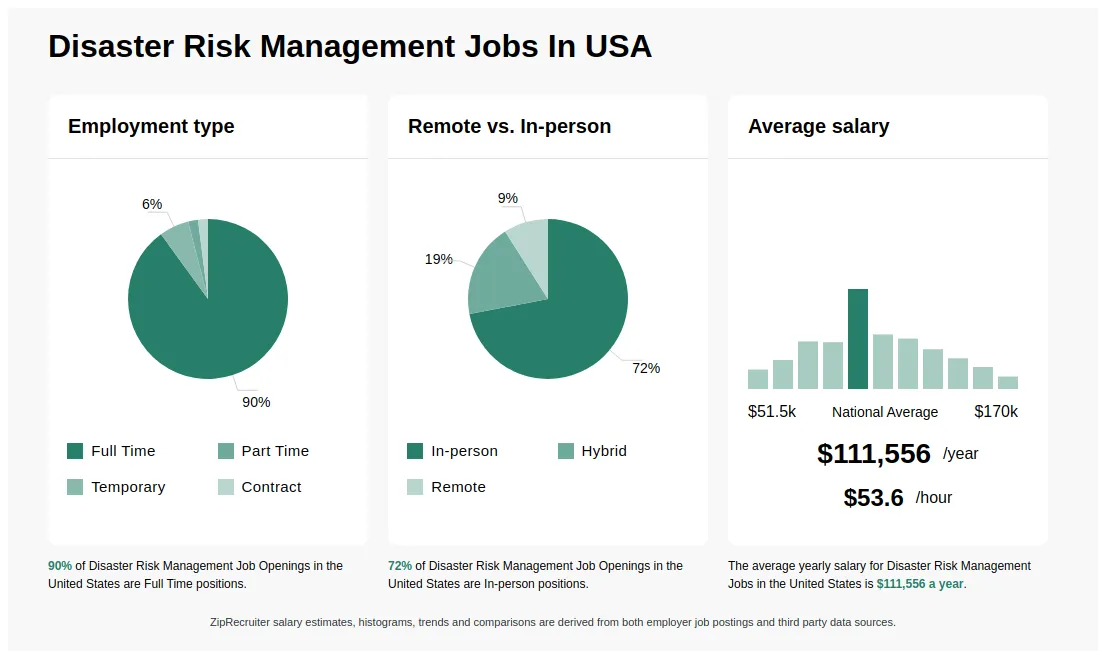
$87.9K is the 25th percentile. Wages below this are outliers.
$83.8K - $94.6K
11% of jobs
The median wage is $103.2K / yr.
$94.6K - $105.4K
23% of jobs
$105.4K - $116.1K
13% of jobs
$123.2K is the 75th percentile. Wages above this are outliers.
$116.1K - $126.9K
12% of jobs
$126.9K - $137.7K
8% of jobs
$137.7K - $148.5K
6% of jobs
$148.5K - $159.2K
4% of jobs
$159.2K - $170K
2% of jobs
$51.5K
$111.6K
$170K
How much do disaster risk management jobs pay per year?
As of Sep 3, 2026, the average yearly pay for disaster risk management in the United States is $111,556.00, according to ZipRecruiter salary data. Most workers in this role earn between $90,000.00 and $129,000.00 per year, depending on experience, location, and employer.
What is disaster risk management?
A Disaster Risk Management job involves identifying, assessing, and mitigating risks associated with natural and human-made disasters. Professionals in this field develop strategies to reduce vulnerability, implement emergency response plans, and coordinate recovery efforts. They often work with government agencies, NGOs, or private organizations to enhance community resilience. Their role includes conducting risk assessments, policy planning, and training stakeholders to handle disasters effectively.
What does a typical day look like for someone working in disaster risk management?
A typical day in Disaster Risk Management often involves conducting risk assessments, developing emergency response plans, coordinating with local authorities, and organizing training drills for staff or community members. You'll frequently gather and analyze data to identify potential hazards and recommend practical mitigation strategies. Collaboration with multidisciplinary teams—including engineers, public health officials, and government agencies—is common, requiring both teamwork and independent project management. Depending on the organization, you may also respond to emergencies or crises as they arise, ensuring quick and effective action. This dynamic role offers variety, purpose, and the opportunity to make a tangible impact on public safety.
What are the key skills and qualifications needed to thrive in disaster risk management, and why are they important?
To thrive in Disaster Risk Management, you need a solid understanding of risk assessment, emergency planning, and public safety—usually backed by a relevant degree in emergency management, environmental science, or a related field. Familiarity with GIS mapping tools, risk modeling software, and certifications such as Certified Emergency Manager (CEM) are highly valuable. Outstanding communication, analytical thinking, and leadership skills help professionals coordinate efforts and manage crises under pressure. Mastering these skills is crucial as the role requires anticipating risks, crafting effective response plans, and leading teams in safeguarding communities and organizations.
Is disaster risk management a good career?
Disaster risk management is a growing field that involves assessing and reducing risks from natural and man-made hazards. It requires skills in planning, communication, and often certifications such as the Certified Emergency Manager (CEM). The career offers opportunities in government agencies, NGOs, and private sectors, with a focus on preparedness, response, and recovery efforts.
What careers are in disaster risk management?
Careers in disaster risk management include roles such as disaster response coordinator, emergency management director, risk analyst, and resilience planner. These positions often require skills in planning, communication, and familiarity with emergency response tools, and may involve working for government agencies, NGOs, or private organizations to prepare for and respond to disasters.
What do disaster risk managers do?
Disaster risk managers assess potential hazards, develop strategies to reduce risks, and coordinate emergency preparedness and response efforts. They often analyze data, create plans, and collaborate with government agencies, communities, and organizations to minimize the impact of disasters.
More about Disaster Risk Management jobs
What cities are hiring for Disaster Risk Management jobs?
Cities with the most Disaster Risk Management job openings:
What are the most commonly searched types of Disaster Risk Management jobs?
The most popular types of Disaster Risk Management jobs are:
What states have the most Disaster Risk Management jobs?
States with the most job openings for Disaster Risk Management jobs include:
What job categories do people searching Disaster Risk Management jobs look for?
The top searched job categories for Disaster Risk Management jobs are:

Full-time
Posted 28 days ago
Job description
"This position is a part of the Japanese recruitment mission"
Do you want to build a career that is truly worthwhile? The World Bank Group is a unique global partnership of five institutions driven by a bold vision to create a world free of poverty on a livable planet. As one of the largest sources of funding and knowledge for developing countries, we help solve the world's greatest development challenges. When you join the World Bank Group, you become part of a dynamic, diverse organization with 189 member countries and more than 120 offices worldwide. We work with public and private sector partners, invest in groundbreaking projects, and use data, research, and technology to bring tangible and transformative change around the globe. For more information, visit www.worldbank.org.
The World Bank Group serves more than 20 client countries in the Latin-American and the Caribbean (LCR) region. Clients range from middle-income countries (MICs) such as Mexico, Brazil, Chile, and Argentina, with demand for cutting-edge knowledge services and technical assistance in addition to lending, to IDA countries like Haiti, Honduras, Nicaragua, and Bolivia, with an emphasis on poverty reduction and programs that support equitable and enhanced access to social and economic opportunities.
The Latin America and Caribbean Region contains 17 of the top 50 countries identified in the World Bank-sponsored Hotspot study with highest GDP exposure to natural disasters. With an increasing concentration of assets in urban or semi-urban areas, human and physical losses from floods, landslides, earthquakes, hurricanes, volcanic eruptions, and other natural events are on the rise and important development gains are being erased overnight. Population growth and the ever-increasing concentration of infrastructure in urban or semi-urban areas have been clear drivers of the growth in human and physical losses from adverse natural events. This trend is now being exacerbated by increasing climate variability, bringing disaster risk management and climate change adaptation to the forefront of the Region's development agenda.
The Disaster Risk Management team of ILCUR provides technical, analytical and financial support to regional clients in the fields of: i) risk identification; ii) risk mitigation and preparedness; iii) risk financing; and iv) post disaster reconstruction. The unit has a strong DRM portfolio with over 20 ongoing projects and a number under preparation. Examples include vulnerability reduction in OECS; CAT DDOs across the countries in the region; enhancing financial protection through expanding CCRIF to different countries and new products; urban resilience investments in Brazil, Bolivia and Haiti; post disaster reconstruction in Sint Maarten. ILCUR provides support to client countries with IBRD and IDA financing, as well as through significant partnerships with the Global Facility for Disaster Reduction and Recovery (GFDRR) and the Climate Investment Funds.
ILCUR is seeking a highly qualified and motivated individual for the position of Disaster Risk Management Specialist to support the DRM team. The DRM Specialist is expected to provide technical support and lead operational and analytical engagements in disaster risk reduction, disaster risk management, disaster risk financing, crisis toolkit, and resilience. Hydromet and flood risk management are priority areas for this position.
Duties and Accountabilities
The specific responsibilities will include:
1. Intellectual, strategic and technical expertise in DRM
Develop knowledge products and training activities to improve best practice in and outside of the Bank.
Strengthen the capacity of our clients to respond to disasters through the preparation of high priority risk mitigation strategies, programs and projects.
Establish and maintain productive relationships with external actors in the disaster risk management, disaster risk financing, and disaster recovery field (governments, international agencies, private sector, NGOs, donors and academic institutions), and work with internal and external partners to scale up the DRM and DRF agenda and lead strategic thinking.
Support the development of the ILCUR's DRM business lines.
2. Program and project management
Contribute to the preparation of priority or flagship AAA and thereby support ILCUR in delivering high visibility advisory services that may result in innovating or scaling-up the unit's investment and analytical and technical assistance program.
Contribute to priority lending projects under preparation and supervision in the sector including complex, multi-sector operations and participate in multi-sector activities led by other units.
3. Knowledge management and dissemination
Sponsor/contribute to knowledge exchanges and dissemination across the Bank and in external fora in the area of DRM and DRF.
Peer review/cross support to other units/regions in sector lending, and analytical activities.
Other activities in this field.

About World Bank
Sourced by ZipRecruiter
Industry
International trade financing
Company size
1,001 - 5,000 Employees
Headquarters location
Washington, DC, US
Year founded
1994