1

Cfo Jobs (NOW HIRING)

Chief Financial Officer (CFO)

Itasca, IL ยท On-site

$300K - $500K/yr

The CFO will partner closely with the President/CEO and Board of Directors to ensure Darley consistently makes sound, well-timed decisions around capital deployment, liquidity, and enterprise risk.

Description SCHEDULE: Full-time; Exempt The Chief Financial Officer (CFO) is a key member of the Senior Administrative Team, providing executive leadership and strategic direction for all financial ...

WI ยท On-site

The Chief Financial Officer will join a patient-first healthcare organization known for compassionate pediatric care, strong clinical collaboration, and a deep commitment to families across the ...

Showing results 21-40

Cfo information

See salary details

$52K

$261.5K

$400K

How much do cfo jobs pay per year?

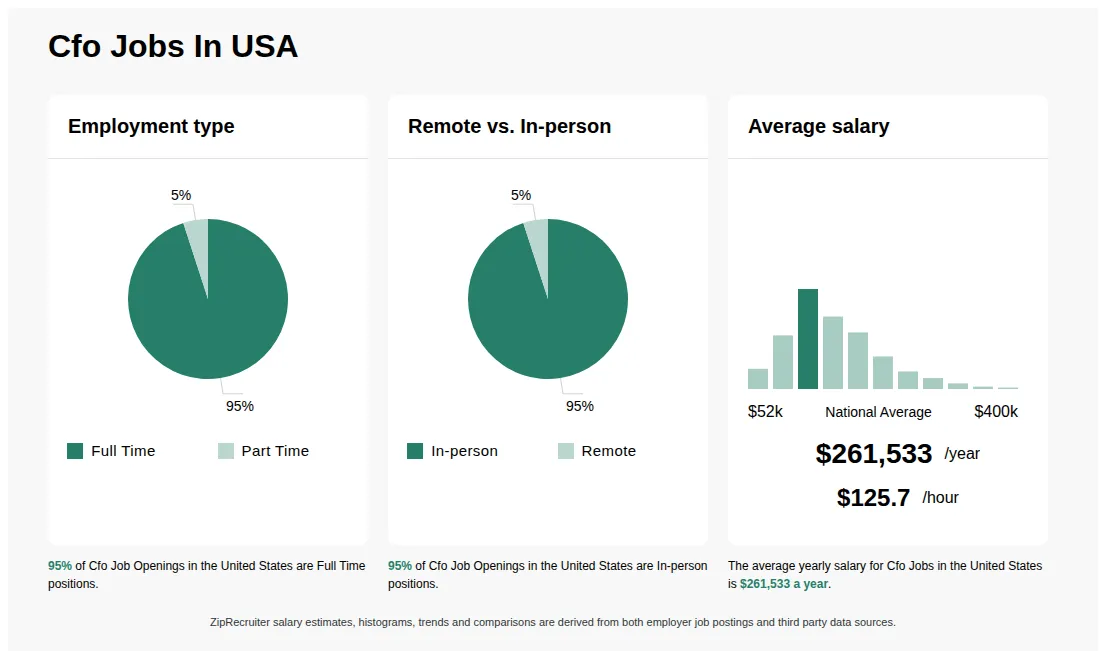
As of Sep 12, 2026, the average yearly pay for cfo in the United States is $261,533.00, according to ZipRecruiter salary data. Most workers in this role earn between $141,000.00 and $400,000.00 per year, depending on experience, location, and employer.

What are the key skills and qualifications needed to thrive as a CFO, and why are they important?

To thrive as a CFO, you need deep expertise in financial management, accounting, strategic planning, and typically a degree in finance or accounting, often supported by a CPA or MBA. Familiarity with ERP systems, financial modeling tools, and regulatory compliance frameworks is crucial. Strong leadership, communication, and decision-making skills set outstanding CFOs apart by enabling effective collaboration and guidance across departments. These skills are essential for driving organizational growth, ensuring financial health, and supporting informed executive decision-making.

How does a CFO typically collaborate with other departments to drive organizational strategy?

A CFO works closely with leaders from all departments, such as operations, sales, and HR, to align financial planning with overall business objectives. This includes participating in strategic planning meetings, providing financial insights for decision-making, and ensuring resources are allocated effectively. CFOs often lead cross-functional teams on budgeting, forecasting, and major projects, acting as a bridge between finance and other areas. Their input is crucial for evaluating investments, setting performance targets, and identifying cost-saving opportunities, making collaboration a key part of the role.

What is the difference between Cfo vs Financial Controller?

AspectChief Financial Officer (CFO)Financial Controller
Primary RoleStrategic financial planning, oversight of entire finance department, executive decision-makingManaging accounting operations, financial reporting, compliance, and internal controls
Required CredentialsTypically CPA or CFA, extensive finance experience, leadership skillsOften CPA, accounting background, strong knowledge of accounting standards
Work EnvironmentExecutive suite, collaborating with CEO and boardFinance department, accounting teams, internal reporting
Industry UsageUsed across industries for strategic leadershipCommonly found in organizations with complex accounting needs

The CFO focuses on strategic financial leadership and long-term planning, while the Financial Controller handles day-to-day accounting operations and financial reporting. Both roles require strong financial credentials, but the CFO's scope is broader, involving executive decision-making and company-wide financial strategy.

Do CFOs get paid a lot?

Chief Financial Officers (CFOs) are among the highest-paid executives in a company, with salaries often exceeding six figures and including bonuses, stock options, and other benefits. Compensation varies based on company size, industry, location, and experience, but CFOs generally earn substantial pay due to their strategic and financial responsibilities.

What does a CFO actually do?

A CFO (Chief Financial Officer) is responsible for managing a company's financial planning, risk management, record-keeping, and financial reporting. They oversee budgeting, analyze financial data, and develop strategies to support the company's growth and stability, often working closely with other executive leaders. Strong analytical skills and financial expertise are essential for this role.

What cities are hiring for Cfo jobs?

Cities with the most Cfo job openings:

What are the most commonly searched types of Cfo jobs?

The most popular types of Cfo jobs are:

What states have the most Cfo jobs?

States with the most job openings for Cfo jobs include:

What points of interest are hiring for Cfo jobs?

Points of interest with the most Cfo job openings:

Infographic showing various Cfo job openings in the United States as of September 2026, with employment types broken down into 96% Full Time, 3% Part Time, and 1% Contract. Highlights an 80% Physical, 6% Hybrid, and 14% Remote job distribution, with an average salary of $261,533 per year, or $125.7 per hour.

Chief Financial Officer (CFO)

Itasca, IL โ€ข On-site

$300K - $500K/yr

Full-time

Medical, Dental, Vision, Life, Retirement, PTO

Re-posted 20 days ago


Job description

Description

W.S. Darley & Co. is seeking a seasoned Chief Financial Officer to provide financial leadership, capital discipline, and strategic insight as the company enters its next phase of growth. The CFO will partner closely with the President/CEO and Board of Directors to ensure Darley consistently makes sound, well-timed decisions around capital deployment, liquidity, and enterprise risk.


This role is designed for a judgment-oriented CFO who excels at decision framing, governance, and leadership-not a transactional or back-office operator. The CFO will be responsible for the company's financial integrity, credibility, and performance narrative, ensuring leaders and directors receive clear, decision-ready insights rather than backward-looking explanations.

Requirements

The CFO owns liquidity management and capital allocation across the enterprise, including cash forecasting, credit facilities, covenant compliance, capital expenditures, M&A activity, and supplier prepayments. The role requires evaluating trade-offs using cash flow, return on invested capital, and risk exposure rather than relying solely on margin or accounting metrics. Anticipating risks and preserving strategic and financial flexibility are core expectations.


The CFO leads the company's planning and forecasting discipline, including rolling forecasts and scenario analysis, and sets the financial structure and narrative for Quarterly Business Reviews. Business leaders are expected to clearly own their financial commitments, risks, and opportunities, with the CFO providing pressure-testing, insight, and accountability.


The CFO prepares concise, decision-oriented materials for the Board and supports governance discussions focused on trade-offs, capital decisions, and long-term value creation. Externally, the CFO serves as the primary executive interface with banking partners, insurance carriers, auditors, tax advisors, and valuation firms, maintaining proactive relationships that protect credibility and flexibility.


As a strategic partner, the CFO provides independent, fact-based perspectives on pricing strategy, market and geographic exposure, major customer and supplier decisions, and merger and acquisition opportunities, including valuation logic, deal structure, diligence, and integration risks.


The CFO is responsible for building and leading a high-performing finance organization, setting expectations for accuracy, timeliness, and true business partnership. Success in this role requires developing strong FP&A, treasury, and controllership capabilities while reviewing and coaching work rather than personally producing analyses. The CFO also partners with IT and operations to ensure reliable financial systems, clean data, and analytics that improve decision speed and quality. The company has a strong, high-performing Controller and has made meaningful progress on business continuity; the key capability the new CFO must bring is elevated financial reporting.


The ideal candidate brings senior finance leadership experience, deep expertise in liquidity and capital allocation, and experience working directly with Boards and executive teams. Strong judgment, communication skills, and the ability to lead through influence are essential.


Success in this role is defined by the absence of financial surprises, faster and clearer capital decisions, disciplined risk management, and Board-level confidence that the company's financial direction is well understood and well governed.


Experience and qualifications

  • Bachelor's degree in Finance or Accounting required
  • Master's degree in Finance or Accounting strongly preferred
  • Registered or Licensed CPA preferred
  • 10+ years of senior finance leadership experience (CFO, Divisional CFO, or equivalent), preferably with government contracting or Defense and Aerospace experience.
  • Deep expertise in liquidity management, capital allocation, and financial reporting.
  • Experience working closely with Boards of Directors and senior executives.
  • Strong judgment, communication skills, and business acumen.
  • Proven ability to lead through influence rather than control


Benefits

  • PTO
  • Paid Holidays
  • Tuition Reimbursement
  • Health & Wellness Reimbursement
  • Medical
  • Dental
  • Vision
  • Life & Disability
  • HSA with Darley contribution
  • FSA
  • 401K/Roth with match and profit sharing
  • Darley paid life insurance


AAP/EEO Statement

Darley is an equal opportunity organization. We recruit, employ, train, compensate, and promote without regard to race, religion, color, national origin, age, gender, sexual orientation, gender identity, marital status, disability, protected veteran status, or any other basis protected by applicable federal, state, or local law