Stay up to date with industry trends and best practices in data analytics & business Intelligence ... Some requirements may exclude individuals who pose a direct threat or significant risk to the ...
Stay up to date with industry trends and best practices in data analytics & business Intelligence ... Some requirements may exclude individuals who pose a direct threat or significant risk to the ...
Director, Business Intelligence
Chicago, IL · On-site
$112K - $161K/yr
Overview Position Summary The Director Business Intelligence will leverage extensive experience in data analysis and strategic consulting to lead BI efforts for enterprise clients in the health and ...
Director, Business Intelligence
Chicago, IL · On-site
$112K - $161K/yr
Overview Position Summary The Director Business Intelligence will leverage extensive experience in data analysis and strategic consulting to lead BI efforts for enterprise clients in the health and ...
Director, Business Intelligence
Chicago, IL · On-site
$112K - $161K/yr
Overview Position Summary The Director Business Intelligence will leverage extensive experience in data analysis and strategic consulting to lead BI efforts for enterprise clients in the health and ...
Director, Business Intelligence
Chicago, IL · On-site
$112K - $161K/yr
Overview Position Summary The Director Business Intelligence will leverage extensive experience in data analysis and strategic consulting to lead BI efforts for enterprise clients in the health and ...
Director, Business Intelligence
Philadelphia, PA · On-site
$112K - $161K/yr
The Director Business Intelligence will demonstrate extensive experience in data analysis and strategic consulting to lead BI efforts for enterprise clients in the health and wellness industry. This ...
Director, Business Intelligence
Philadelphia, PA · On-site
$112K - $161K/yr
The Director Business Intelligence will demonstrate extensive experience in data analysis and strategic consulting to lead BI efforts for enterprise clients in the health and wellness industry. This ...

SUMMARY The Director of Business Intelligence is responsible for defining and executing the organization's enterprise data and analytics strategy to enable data-driven decision-making across all ...
SUMMARY The Director of Business Intelligence is responsible for defining and executing the organization's enterprise data and analytics strategy to enable data-driven decision-making across all ...
The Director, Business Intelligence will lead enterprise-wide analytics strategy and will be responsible for building and leading a high-performing team of analysts delivering actionable insights ...
The Director, Business Intelligence will lead enterprise-wide analytics strategy and will be responsible for building and leading a high-performing team of analysts delivering actionable insights ...

Overview Reporting to the Director of Data & Analytics, the Associate Director, Business Intelligence is responsible for directing and producing time-sensitive reporting and analytical needs ...
Overview Reporting to the Director of Data & Analytics, the Associate Director, Business Intelligence is responsible for directing and producing time-sensitive reporting and analytical needs ...
Associate Director, Business Intelligence Department Adv-Data & Analytics Category Information Technology Job Type Full-Time Overview Reporting to the Director of Data & Analytics, the Associate ...
Associate Director, Business Intelligence Department Adv-Data & Analytics Category Information Technology Job Type Full-Time Overview Reporting to the Director of Data & Analytics, the Associate ...

Description The Business Intelligence (BI) Director at Southeast Primary Care Partners plays a pivotal role in enhancing the decision-making capability of the organization through actionable insights ...
Description The Business Intelligence (BI) Director at Southeast Primary Care Partners plays a pivotal role in enhancing the decision-making capability of the organization through actionable insights ...
Director, Business Intelligence
Chicago, IL · On-site
$140K - $178K/yr
Oversee business rules, engagement parameters, and scoping processes, including vendor proposals ... Exhibit high emotional intelligence in stakeholder management, fostering effective collaboration.
Director, Business Intelligence
Chicago, IL · On-site
$140K - $178K/yr
Oversee business rules, engagement parameters, and scoping processes, including vendor proposals ... Exhibit high emotional intelligence in stakeholder management, fostering effective collaboration.
Overview Reporting to the Director of Data & Analytics, the Associate Director, Business Intelligence is responsible for directing and producing time-sensitive reporting and analytical needs ...
Overview Reporting to the Director of Data & Analytics, the Associate Director, Business Intelligence is responsible for directing and producing time-sensitive reporting and analytical needs ...
Associate Director, Business Intelligence
Princeton, NJ · On-site
$136K - $150K/yr
Overview Reporting to the Director of Data & Analytics, the Associate Director, Business Intelligence is responsible for directing and producing time-sensitive reporting and analytical needs ...
Associate Director, Business Intelligence
Princeton, NJ · On-site
$136K - $150K/yr
Overview Reporting to the Director of Data & Analytics, the Associate Director, Business Intelligence is responsible for directing and producing time-sensitive reporting and analytical needs ...
SUMMARY The Director of Business Intelligence is responsible for defining and executing the organization's enterprise data and analytics strategy to enable data-driven decision-making across all ...
Quick apply
SUMMARY The Director of Business Intelligence is responsible for defining and executing the organization's enterprise data and analytics strategy to enable data-driven decision-making across all ...

Assistant Director, Business Intelligence The Assistant Director, Business Intelligence leads best-in-class business intelligence program that empowers strategic decision-making and operational ...
Assistant Director, Business Intelligence The Assistant Director, Business Intelligence leads best-in-class business intelligence program that empowers strategic decision-making and operational ...

We are seeking a Director of Business Intelligence to lead that effort and establish the information infrastructure that will help ASP make better, faster, and more informed decisions. The Director ...
We are seeking a Director of Business Intelligence to lead that effort and establish the information infrastructure that will help ASP make better, faster, and more informed decisions. The Director ...
We are seeking a Director of Business Intelligence to lead that effort and establish the information infrastructure that will help ASP make better, faster, and more informed decisions. The Director ...
We are seeking a Director of Business Intelligence to lead that effort and establish the information infrastructure that will help ASP make better, faster, and more informed decisions. The Director ...
We are seeking a Director of Business Intelligence to lead that effort and establish the information infrastructure that will help ASP make better, faster, and more informed decisions. The Director ...
We are seeking a Director of Business Intelligence to lead that effort and establish the information infrastructure that will help ASP make better, faster, and more informed decisions. The Director ...
Director, Business Intelligence
$140K - $178K/yr
Oversee business rules, engagement parameters, and scoping processes, including vendor proposals ... Exhibit high emotional intelligence in stakeholder management, fostering effective collaboration.
Director, Business Intelligence
$140K - $178K/yr
Oversee business rules, engagement parameters, and scoping processes, including vendor proposals ... Exhibit high emotional intelligence in stakeholder management, fostering effective collaboration.
Director, Business Intelligence Team
Hoyt, KS · On-site
$155K/yr
Job Title Director, Business Intelligence Team Department Solution Delivery Worker Type Regular Pay Type Salary Position Salary Minimum $135,000 Position Salary Maximum $155,000 Salary will be ...
Director, Business Intelligence Team
Hoyt, KS · On-site
$155K/yr
Job Title Director, Business Intelligence Team Department Solution Delivery Worker Type Regular Pay Type Salary Position Salary Minimum $135,000 Position Salary Maximum $155,000 Salary will be ...

Director of Business Intelligence
Atlanta, GA · Hybrid
$200K/yr
Director of Business Intelligence Location: Hybrid/Sandy Springs, GA (3 days in the office/2 days remote) Overview: GreenSky is seeking a Director of Business Intelligence to lead the transformation ...
Director of Business Intelligence
Atlanta, GA · Hybrid
$200K/yr
Director of Business Intelligence Location: Hybrid/Sandy Springs, GA (3 days in the office/2 days remote) Overview: GreenSky is seeking a Director of Business Intelligence to lead the transformation ...
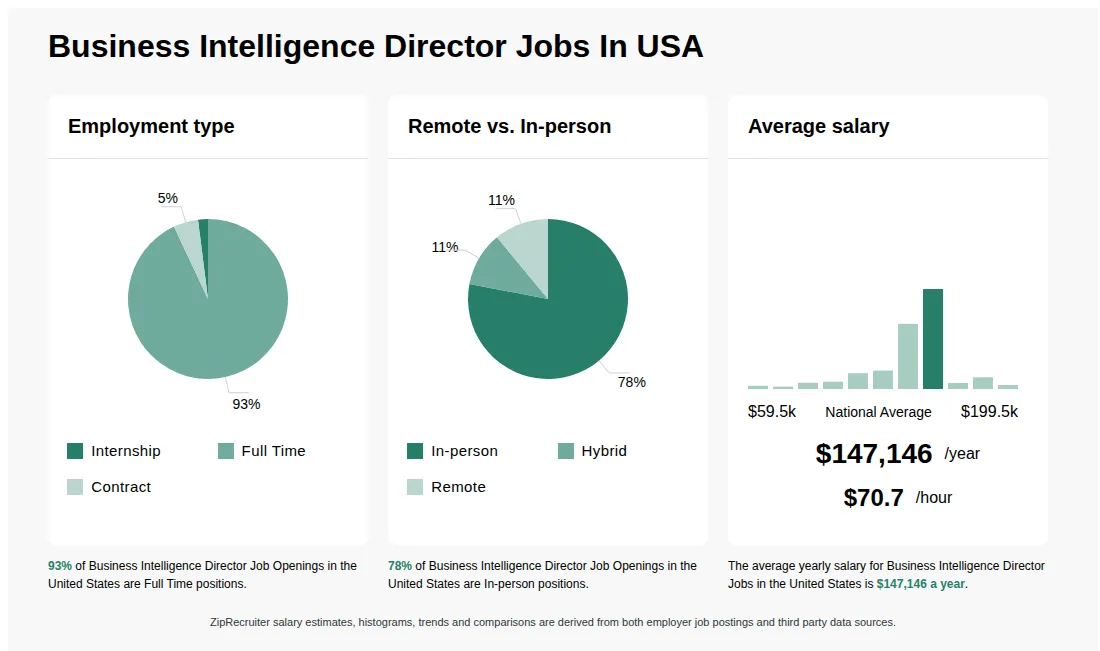
Business Intelligence Director information
See salary details
$59.5K - $72.2K
1% of jobs
$72.2K - $85K
0% of jobs
$85K - $97.7K
2% of jobs
$97.7K - $110.4K
3% of jobs
$110.4K - $123.1K
6% of jobs
$123.1K - $135.9K
7% of jobs
$138K is the 25th percentile. Wages below this are outliers.
$135.9K - $148.6K
29% of jobs
The median wage is $148.9K / yr.
$148.6K - $161.3K
44% of jobs
$161.3K - $174K
2% of jobs
$174K - $186.8K
4% of jobs
$186.8K - $199.5K
1% of jobs
$59.5K
$147.1K
$199.5K
How much do business intelligence director jobs pay per year?
As of Sep 2, 2026, the average yearly pay for business intelligence director in the United States is $147,146.00, according to ZipRecruiter salary data. Most workers in this role earn between $140,500.00 and $157,000.00 per year, depending on experience, location, and employer.
What does a Business Intelligence Director do?
A Business Intelligence (BI) Director leads the strategy and operations for collecting, analyzing, and utilizing data to support business decision-making. They oversee BI teams, manage analytics projects, and ensure that data systems provide actionable insights to drive company growth. The BI Director collaborates with other departments to identify key data needs, implement BI tools, and ensure data quality and integrity. Their role is crucial in transforming data into strategic business value.
What are the key skills and qualifications needed to thrive as a Business Intelligence Director?
To thrive as a Business Intelligence Director, you need expertise in data analytics, business strategy, and management, often supported by a degree in computer science, statistics, or business, and extensive experience in BI roles. Proficiency with BI tools like Tableau, Power BI, SQL, and data warehousing systems, as well as relevant certifications, is typically required. Strong leadership, communication, and problem-solving skills help drive cross-functional teams and translate data insights into actionable strategies. These abilities are crucial for aligning data initiatives with organizational goals and enabling data-driven decision-making across the business.
How does a Business Intelligence Director typically collaborate with other departments to drive strategic decisions?
A Business Intelligence Director works closely with cross-functional teams such as IT, marketing, finance, and operations to ensure data-driven insights are integrated into business strategy. They often lead workshops, present analytical findings, and facilitate discussions to address specific business challenges. By aligning BI initiatives with organizational goals, they help other departments identify opportunities for improvement and growth. This collaborative approach not only ensures data accuracy and relevance but also fosters a culture of informed decision-making across the company.
What is the difference between Business Intelligence Director vs Data Analytics Manager?
| Aspect | Business Intelligence Director | Data Analytics Manager |
|---|---|---|
| Required Credentials | Bachelor's or Master's in Business, IT, or related fields; often certifications in BI tools | Bachelor's or Master's in Data Science, Statistics, or related fields; certifications in analytics tools |
| Work Environment | Strategic leadership in corporate settings, overseeing BI teams | Hands-on analytics work, managing data projects and teams |
| Employer & Industry Usage | Used in large corporations across finance, retail, healthcare | Common in tech, consulting, and data-driven industries |
The Business Intelligence Director focuses on strategic oversight of BI initiatives, aligning data insights with business goals. In contrast, the Data Analytics Manager handles day-to-day data analysis and project management. Both roles require strong technical skills and leadership but differ in scope and focus.
More about Business Intelligence Director jobs
What cities are hiring for Business Intelligence Director jobs?
Cities with the most Business Intelligence Director job openings:
What are the most commonly searched types of Business Intelligence jobs?
The most popular types of Business Intelligence jobs are:
Who are the top companies hiring for Business Intelligence Director jobs?
The top employers for Business Intelligence Director jobs are:
What states have the most Business Intelligence Director jobs?
States with the most job openings for Business Intelligence Director jobs include:
What job categories do people searching Business Intelligence Director jobs look for?
The top searched job categories for Business Intelligence Director jobs are:
- Director Of Business Intelligence
- Director Of Business Analytics
- Director Microsoft Business Intelligence
- Director Business Intelligence Analytics
- Freelance Business Intelligence
- Senior Sql Business Intelligence
- Retail Business Intelligence
- Senior Business Intelligence Manager
- Data Warehousing Business Intelligence
- Vice President Rapid7

Full-time
Medical, Dental, Vision, Retirement
Re-posted 22 days ago
Publicis Groupe rating

6.1
Based on 5 frontline employees who took The Breakroom Quiz
38th of 52 rated marketing agency
Job description
Company description
Publicis Re:Sources is at the core of Publicis Groupe, the world's largest communications company. We are the only full-service, end-to-end shared service organization in the industry, enabling Groupe agencies to do what they do best: innovate and transform for their clients.
Formed in 1998 as a small team to service a few Publicis Groupe firms, Publicis Re:Sources has grown to 6,000+ employees in over 55 countries. We provide technology solutions and business services, including finance, accounting, legal, benefits, procurement, tax, real estate, treasury and risk management, information security, and global mobility - supporting 110,000+ employees across the Publicis Groupe network. Our people are at the center of everything we do, bringing curiosity, collaboration, and a commitment to excellence to their work every day.
Learn more about Publicis Re:Sources and the Publicis Groupe agencies we support at publicisresources.com.
Overview
We are on the lookout for a seasoned professional with 10-15 years of experience managing BI projects and teams.
The role is pivotal to our BI operations, encompassing stakeholder management, team leadership, and delivery of comprehensive BI solutions. We seek someone with extensive expertise in Power BI, data engineering, data pipelines, data warehousing and data lakes. An understanding of the Finance and HR domains is essential.
Our ideal candidate will be instrumental in helping define & analyse BI needs and guiding the team to design and implement effective solutions that help drive informed business decisions. This role also involves engaging with Finance, HR and other leaders to define a BI roadmap. They should also be able to lead and mentor a team of technologists to execute the roadmap.
*Visa sponsorship is not available for this role including H1B, OPT EAD etc.*
Responsibilities
Qualifications
Additional information
All your information will be kept confidential according to EEO guidelines.
This job description in no way states or implies that these are the only duties to be performed by the employee(s) currently in this position. Employee(s) will be required to follow any other job related instructions and to perform any other job-related duties requested by any person authorized to give instructions or assignments.
A review of this position has excluded the marginal functions of the position that are incidental to the performance of fundamental job duties. All duties and responsibilities are essential job functions and requirements and are subject to possible modification to reasonably accommodate individuals with disabilities. To perform this job successfully, the incumbent(s) will possess the skills, aptitudes, and abilities to perform each duty proficiently. Some requirements may exclude individuals who pose a direct threat or significant risk to the health or safety of themselves or others. The requirements listed in this document are the minimum levels of knowledge, skills, or abilities.
This document does not create an employment contract, implied or otherwise, other than an ""at-will"" relations.
Salary range : $155 - 175K/yr plus bonus and other benefits.
Publicis Groupe offers a comprehensive benefits package including medical, dental, vision, retirement(401(K)), wellness and other employee programs. For additional information regarding available benefits, please visit publicisconnections.com.
#LI-DS1
Publicis Re:Sources is at the core of Publicis Groupe, the world's largest communications company. We are the only full-service, end-to-end shared service organization in the industry, enabling Groupe agencies to do what they do best: innovate and transform for their clients.
Formed in 1998 as a small team to service a few Publicis Groupe firms, Publicis Re:Sources has grown to 6,000+ employees in over 55 countries. We provide technology solutions and business services, including finance, accounting, legal, benefits, procurement, tax, real estate, treasury and risk management, information security, and global mobility - supporting 110,000+ employees across the Publicis Groupe network. Our people are at the center of everything we do, bringing curiosity, collaboration, and a commitment to excellence to their work every day.
Learn more about Publicis Re:Sources and the Publicis Groupe agencies we support at publicisresources.com.
Overview
We are on the lookout for a seasoned professional with 10-15 years of experience managing BI projects and teams.
The role is pivotal to our BI operations, encompassing stakeholder management, team leadership, and delivery of comprehensive BI solutions. We seek someone with extensive expertise in Power BI, data engineering, data pipelines, data warehousing and data lakes. An understanding of the Finance and HR domains is essential.
Our ideal candidate will be instrumental in helping define & analyse BI needs and guiding the team to design and implement effective solutions that help drive informed business decisions. This role also involves engaging with Finance, HR and other leaders to define a BI roadmap. They should also be able to lead and mentor a team of technologists to execute the roadmap.
*Visa sponsorship is not available for this role including H1B, OPT EAD etc.*
Responsibilities
- Collaborate with stakeholders to identify the needs & opportunities - ensure proper prioritization, estimation, planning and execution delivering end to end solution.
- Report out status and to key clients, business owners & IT leadership.
- Lead the design and development of end-to-end data analytics BI solutions that meet business needs and provide actionable insights
- Work with cross-cultural teams across geographies & time-zones to ensure delivery of solutions
- Ensure compliance to IT processes throughout solution delivery & support\
- Stay up to date with industry trends and best practices in data analytics & business Intelligence, evaluate and implement new technologies to improve business value.
- Responsible for end-to-end delivery of solution and business communication
- Navigate and manage professional relationships within a complex multinational environment
Qualifications
- Bachelor's degree in IT or related field
- 15+ years of experience in business intelligence and analytics, working with data engineering, data pipeline, data warehousing, data lake, Fabric, Power BI.
- Experience with building data analytics platform/solution for SAP ERP (including S4/HANA) is highly desirable, specifically in SAP FICO, SD, PS and MM
- Experience with Power BI & Azure is essential including Azure Data Lake, Azure Blob Storage, and integrating various data formats (e.g., JSON, Parquet)
- Minimum of 5 years of technical experience working with Power BI & Azure on Financial & HR domain data
- 5+ years of experience in leadership or management role and guide teams on strategic initiative and support
- Experience in Services, Media, Creative and Production domains is highly desirable
- There should be willingness to learn and contribute to business intelligence for domains other than Financials
- Ability to effectively collaborate and work in a team environment is essential
- Excellent analytical and problem-solving skills & strong communication and interpersonal skills are also essential
Additional information
All your information will be kept confidential according to EEO guidelines.
This job description in no way states or implies that these are the only duties to be performed by the employee(s) currently in this position. Employee(s) will be required to follow any other job related instructions and to perform any other job-related duties requested by any person authorized to give instructions or assignments.
A review of this position has excluded the marginal functions of the position that are incidental to the performance of fundamental job duties. All duties and responsibilities are essential job functions and requirements and are subject to possible modification to reasonably accommodate individuals with disabilities. To perform this job successfully, the incumbent(s) will possess the skills, aptitudes, and abilities to perform each duty proficiently. Some requirements may exclude individuals who pose a direct threat or significant risk to the health or safety of themselves or others. The requirements listed in this document are the minimum levels of knowledge, skills, or abilities.
This document does not create an employment contract, implied or otherwise, other than an ""at-will"" relations.
Salary range : $155 - 175K/yr plus bonus and other benefits.
Publicis Groupe offers a comprehensive benefits package including medical, dental, vision, retirement(401(K)), wellness and other employee programs. For additional information regarding available benefits, please visit publicisconnections.com.
#LI-DS1
What Publicis Groupe employees say
Pay
Benefits
Hours and flexibility
Workplace
Get the full story on Breakroom

About Publicis Groupe
Sourced by ZipRecruiter
Industry
Advertising and public relations services and public relations agencies
Company size
10,000+ Employees
Headquarters location
Paris, IDF, FR