Workforce Development Salary in Minnesota
$28.4K - $37.2K
11% of jobs
$42.6K is the 25th percentile. Wages below this are outliers.
$37.2K - $46K
23% of jobs
The median wage is $54.3K / yr.
$46K - $54.8K
17% of jobs
$54.8K - $63.7K
11% of jobs
$63.7K - $72.5K
8% of jobs
$77.9K is the 75th percentile. Wages above this are outliers.
$72.5K - $81.3K
8% of jobs
$81.3K - $90.1K
13% of jobs
$90.1K - $98.9K
2% of jobs
$98.9K - $107.7K
4% of jobs
$107.7K - $116.6K
1% of jobs
$116.6K - $125.4K
1% of jobs
$28.4K
$56.3K
$127.3K
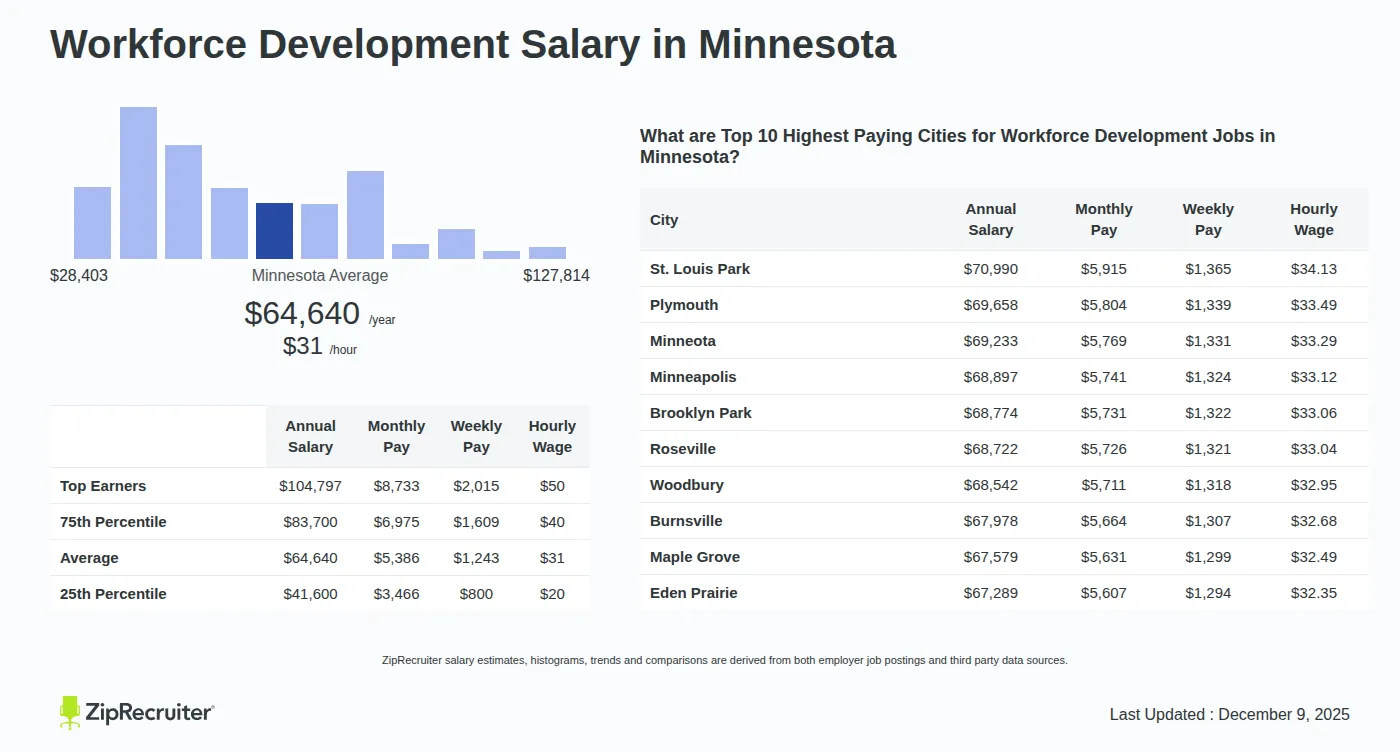
$64,640
/year
$31.08
/hour
Workforce Development Salary Comparison by Location
Nationwide
United States
$65,999
Minnesota
Minnesota
$64,640
Do you get a good deal as a Workforce Development?
Take The Breakroom Quiz to find out if your job offers fair pay and conditions. The 3-minute quiz lets you compare your pay, hours, benefits, and more.
Take The Breakroom Quiz

How much does a Workforce Development make in Minnesota?
As of Sep 1, 2026, the average annual pay for a Workforce Development in Minnesota is $64,640 a year.
Just in case you need a simple salary calculator, that works out to be approximately $31.08 an hour. This is the equivalent of $1,243/week or $5,386/month.
While ZipRecruiter is seeing salaries as high as $127,324 and as low as $28,403, the majority of Workforce Development salaries currently range between $41,600 (25th percentile) to $83,700 (75th percentile) with top earners (90th percentile) making $104,797 annually in Minnesota. The average pay range for a Workforce Development varies greatly (by as much as 42100), which suggests there may be many opportunities for advancement and increased pay based on skill level, location and years of experience.
Minnesota ranks number 50 out of 50 states nationwide for Workforce Development salaries.
To estimate the most accurate annual salary range for Workforce Development jobs, ZipRecruiter continuously scans its database of millions of active jobs published locally throughout America.
Find your next high paying job as a Workforce Development on ZipRecruiter today.
What are Top 10 Highest Paying Cities for Workforce Development Jobs in Minnesota
We've identified 10 cities where the typical salary for a Workforce Development job is above the average in Minnesota in Minnesota. Topping the list is St. Louis Park, , with Plymouth, and Minneota, close behind in the second and third positions. Minneota, beats the average in Minnesota by $4,593 (7.1%), and St. Louis Park, furthers that trend with another $6,350 (9.8%) above the $64,640 average.
With these 10 cities paying on average above the average for Minnesota, the opportunities for economic advancement by changing locations as a Workforce Development appears to be exceedingly fruitful.
Finally, another factor to consider is the average salary for these top 10 cities varies very little at 5% between St. Louis Park, and Minnetonka, , reinforcing the limited potential for much wage advancement. The possibility of a lower cost of living may be the best factor to use when considering location and salary for a Workforce Development role.
City | Annual Salary | Hourly Wage |
|---|---|---|
St. Louis Park | $70,990 | $34.13 |
Plymouth | $69,658 | $33.49 |
Minneota | $69,233 | $33.29 |
Roseville | $68,722 | $33.04 |
Woodbury | $68,542 | $32.95 |
Burnsville | $67,978 | $32.68 |
Maple Grove | $67,579 | $32.49 |
Minneapolis | $67,536 | $32.47 |
Eden Prairie | $67,289 | $32.35 |
Minnetonka | $67,278 | $32.35 |
What are Top 5 Best Paying Related Workforce Development Jobs in Minnesota
Analyzing similar jobs related to the Workforce Development job category in Minnesota, we found 5 that were relevant. However, none pay more than the $64640 state average for Workforce Development jobs.
Job Title | Annual Salary | Hourly Wage |
|---|---|---|
Content Development Associate | $109,602 | $52.69 |
Data Science Apprenticeship | $103,377 | $49.70 |
Workforce Director | $79,285 | $38.12 |
Community Development Specialist | $72,472 | $34.84 |
Business Development Support | $59,279 | $28.50 |
About Our Data
ZipRecruiter salary estimates, histograms, trends and comparisons are derived from both employer job postings and third party data sources.