1

Real Estate Development Jobs (NOW HIRING)

Analyst, Real Estate Development Job Purpose The Real Estate Strategy Analyst supports the development and maintenance of strategic market plans through research, data analysis, and reporting. This ...

Analyst, Real Estate Development Job Purpose The Real Estate Strategy Analyst supports the development and maintenance of strategic market plans through research, data analysis, and reporting. This ...

About the role As a Real Estate Development Manager (REDM), you act as the CEO of your development projects. You will own end-to-end delivery of EV infrastructure sites; from acquisitions and ...

About the role As a Real Estate Development Manager (REDM), you act as the CEO of your development projects. You will own end-to-end delivery of EV infrastructure sites; from acquisitions and ...

About the role As a Real Estate Development Manager (REDM), you act as the CEO of your development projects. You will own end-to-end delivery of EV infrastructure sites; from acquisitions and ...

Bachelor's degree preferred * 3 to 7 years' experience in General Commercial Brokerage, Development, Finance or Corporate Real Estate Management with emphasis in Commercial/Retail/Fuel/Fast Food/C ...

Showing results 41-60

real estate development information

See salary details

$54.5K

$102.3K

$162K

How much do real estate development jobs pay per year?

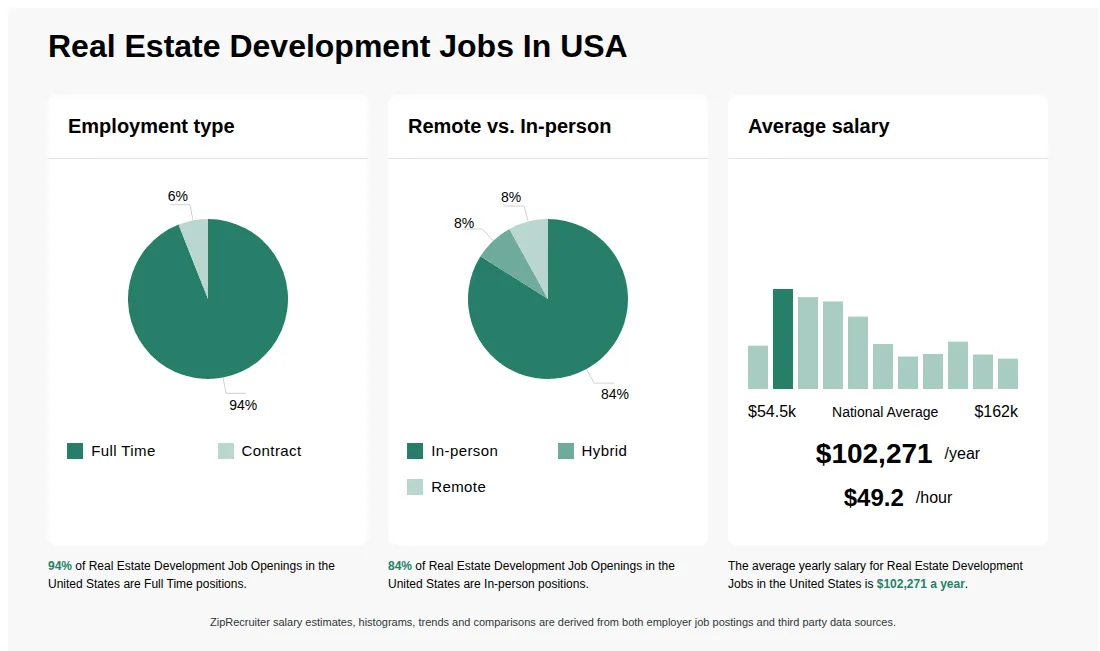
As of Sep 13, 2026, the average yearly pay for real estate development in the United States is $102,271.00, according to ZipRecruiter salary data. Most workers in this role earn between $75,000.00 and $128,000.00 per year, depending on experience, location, and employer.

What is real estate development?

Real estate development is the process of creating new buildings or renovating existing properties for residential, commercial, or mixed-use purposes. It involves tasks such as acquiring land, securing financing, obtaining permits, overseeing construction, and managing the eventual sale or lease of the property. Developers coordinate with architects, contractors, government agencies, and investors throughout each stage of a project. The goal is to transform raw land or underutilized properties into valuable assets that meet market demand.

What are the qualifications to get a job in real estate development?

The qualifications to get a job in real estate development vary depending on your responsibilities. For investment and development jobs, the most important thing is money, whether it is from personal wealth or investors. Some developers work specifically with municipal governments or community organizations. If you seek investors, you need to have strong financial skills, good negotiation and presentation tactics, and strategic vision. To become a construction or design worker in real estate development, you need to have a bachelor’s degree or credentials from an apprenticeship and several years of work as a commercial or residential contractor. Marketing professionals need a background in PR or real estate.


What are the key skills and qualifications needed to thrive as a real estate developer, and why are they important?

To thrive as a Real Estate Developer, you need strong project management, financial analysis, and market research skills, often supported by a degree in real estate, business, or a related field. Familiarity with financial modeling software, CAD tools, and zoning or permitting systems is typically required. Excellent negotiation, communication, and problem-solving abilities set top developers apart. These skills are crucial for successfully managing complex projects, securing investment, and navigating regulatory environments to deliver profitable developments.

What are some common challenges faced by professionals in real estate development, and how can they be addressed?

Professionals in real estate development often encounter challenges such as navigating complex zoning regulations, securing project financing, and coordinating with a diverse group of stakeholders including architects, contractors, and government agencies. Successfully addressing these challenges requires strong project management skills, effective communication, and a proactive approach to problem-solving. Building a network of reliable partners and staying informed about local market trends can also help mitigate risks and ensure project success.

What is the difference between Real Estate Development vs Real Estate Brokerage?

AspectReal Estate DevelopmentReal Estate Brokerage
Required CredentialsReal estate license, possibly a degree in real estate, finance, or urban planningReal estate license, sales certification
Work EnvironmentProject sites, offices, planning meetingsReal estate offices, property showings, client meetings
Industry UsageInvolved in planning, financing, and constructing new propertiesFacilitates property sales and leasing between buyers and sellers

Real estate development focuses on creating new properties from planning to construction, while real estate brokerage centers on selling and leasing existing properties. Both roles require real estate licenses but differ significantly in daily activities and project involvement.

Do real estate developers make a lot of money?

Real estate developers can earn high incomes, especially when managing large projects or successful developments, but earnings vary widely based on experience, project size, location, and market conditions. Successful developers often require strong financial skills, market knowledge, and access to capital. Income potential increases with experience and a proven track record in the industry.

Is real estate development a good career?

Real estate development is a viable career that involves managing the planning, financing, and construction of property projects. Success requires strong project management skills, knowledge of market trends, and often a background in finance, architecture, or urban planning. It can be financially rewarding but also involves significant risk and long-term commitment.

What exactly do real estate developers do?

Real estate developers plan, design, and oversee the development of new properties or the renovation of existing ones, including residential, commercial, or industrial projects. They coordinate with architects, contractors, and government agencies, secure financing, and manage project timelines to bring developments from concept to completion.

What cities are hiring for Real Estate Development jobs?

Cities with the most Real Estate Development job openings:

What are the most commonly searched types of Real Estate Development jobs?

The most popular types of Real Estate Development jobs are:

What states have the most Real Estate Development jobs?

States with the most job openings for Real Estate Development jobs include:

What are popular job titles for Real Estate Development?

Popular job titles for Real Estate Development:

Infographic showing various Real Estate Development job openings in the United States as of September 2026, with employment types broken down into 80% Full Time, and 20% Part Time. Highlights an 100% In-person job distribution, with an average salary of $102,271 per year, or $49.2 per hour.

Director of Real Estate Development

Cleveland, OH • On-site

FAMICOS FOUNDATION INC
Housing and Regional Planning Programs Administration • 11 - 50 employees

$80K - $95K/yr

Full-time

Re-posted 12 days ago


Job description

About the Role

The Director of Real Estate Development provides strategic and operational leadership for all real estate development activities at Famicos Foundation. Reporting to the Executive Director or Chief Operating Officer, this role oversees projects from concept through completion, including feasibility analysis, financing, construction, and compliance. The Director ensures that all development initiatives align with Famicos’ mission, values, and community impact goals.

Key Responsibilities
  • Lead the planning, financing, construction oversight, and delivery of real estate development projects, including new construction, rehabilitation, and substantial repair of affordable housing, mixeduse developments, and community facilities.
  • Develop and manage project budgets and timelines; create and maintain detailed financial pro formas.
  • Identify, secure, and manage diverse funding sources, including LowIncome Housing Tax Credits (LIHTC), Historic Tax Credits, New Market Tax Credits, grants, and public and private loans.
  • Identify and evaluate potential development sites; conduct feasibility analysis and oversee due diligence activities such as market studies, zoning reviews, and environmental assessments.
  • Partner with internal teams and external stakeholders; including lenders, investors, architects, contractors, government agencies, and community partners to advance development projects.
  • Ensure compliance with all applicable local, state, and federal regulations and funding requirements.
  • Prepare and present project updates, financial summaries, and compliance reports for senior leadership, the Board of Directors, and funding agencies.
  • Lead, mentor, and support development staff, fostering a collaborative, accountable, and highperforming team environment.
  • Contribute to organizational strategic planning and develop a longterm real estate development pipeline aligned with community needs and organizational priorities.
  • Complete special projects assigned by the Executive Director or COO.
  • Qualifications
  • Bachelor’s degree in Business Administration, Urban Planning, Public Administration, Real Estate, or a related field; Master’s degree preferred.
  • Five to seven years of progressively responsible experience in real estate development, with demonstrated success in affordable housing or community development.
  • Strong knowledge of real estate finance, including LIHTC and other publicsector subsidy programs.
  • Proficiency in financial modeling tools and Microsoft Office Suite.
  • Familiarity with local, state, and federal housing and development regulations; Cleveland market experience preferred.
  • Skills & Attributes
  • Strong project management and organizational skills with the ability to manage multiple projects and deadlines.
  • Excellent communication, negotiation, and stakeholder engagement skills.
  • Strategic thinker with strong problemsolving and decisionmaking abilities.
  • Leadership presence with the ability to coach, mentor, and influence teams and partners.
  • Missiondriven professional committed to community development, equity, and neighborhood revitalization.
  • Why Join Us?

    At Famicos Foundation, you’ll join a team that values integrity, diversity, and measurable results. We are committed to empowering Cleveland residents through housing, development, and social services