As the Live Captioning Project Manager, you will play a pivotal role in planning, coordinating, and ... Knowledge of RTMP, HLS, WebRTC, and other video streaming protocols. * Experience with CDN services ...
As the Live Captioning Project Manager, you will play a pivotal role in planning, coordinating, and ... Knowledge of RTMP, HLS, WebRTC, and other video streaming protocols. * Experience with CDN services ...
As the Live Captioning Project Manager, you will play a pivotal role in planning, coordinating, and ... Knowledge of RTMP, HLS, WebRTC, and other video streaming protocols. * Experience with CDN services ...
As the Live Captioning Project Manager, you will play a pivotal role in planning, coordinating, and ... Knowledge of RTMP, HLS, WebRTC, and other video streaming protocols. * Experience with CDN services ...
As the Live Captioning Project Manager, you will play a pivotal role in planning, coordinating, and ... Knowledge of RTMP, HLS, WebRTC, and other video streaming protocols. * Experience with CDN services ...
As the Live Captioning Project Manager, you will play a pivotal role in planning, coordinating, and ... Knowledge of RTMP, HLS, WebRTC, and other video streaming protocols. * Experience with CDN services ...
As the Live Captioning Project Manager, you will play a pivotal role in planning, coordinating, and ... Knowledge of RTMP, HLS, WebRTC, and other video streaming protocols. * Experience with CDN services ...
As the Live Captioning Project Manager, you will play a pivotal role in planning, coordinating, and ... Knowledge of RTMP, HLS, WebRTC, and other video streaming protocols. * Experience with CDN services ...

Captioning Technician
Stevens Point, WI · On-site
$12/hr
Captioning Technician Job Category: Student Hourly Job Profile: Student Help Job Summary ... Compensation $12 per hour Hours 10-25 per week This position ensures video captions in Kaltura are ...
Captioning Technician
Stevens Point, WI · On-site
$12/hr
Captioning Technician Job Category: Student Hourly Job Profile: Student Help Job Summary ... Compensation $12 per hour Hours 10-25 per week This position ensures video captions in Kaltura are ...
Captioning Technician Job Category: Student Hourly Job Profile: Student Help Job Summary ... Compensation $12 per hour Hours 10-25 per week This position ensures video captions in Kaltura are ...
Captioning Technician Job Category: Student Hourly Job Profile: Student Help Job Summary ... Compensation $12 per hour Hours 10-25 per week This position ensures video captions in Kaltura are ...

Tailwind Front-end Developer for B2B Platform
New York, NY · On-site +1
$113K - $132K/yr
Dotsub is building a unique video captioning and translation management tool that enables clients organize their in-house linguists, create and manage custom workflows, take advantage of the power of ...
Tailwind Front-end Developer for B2B Platform
New York, NY · On-site +1
$113K - $132K/yr
Dotsub is building a unique video captioning and translation management tool that enables clients organize their in-house linguists, create and manage custom workflows, take advantage of the power of ...
As the Live Captioning Project Manager, you will play a pivotal role in planning, coordinating, and ... Knowledge of RTMP, HLS, WebRTC, and other video streaming protocols. * Experience with CDN services ...
As the Live Captioning Project Manager, you will play a pivotal role in planning, coordinating, and ... Knowledge of RTMP, HLS, WebRTC, and other video streaming protocols. * Experience with CDN services ...

Video Editor
Fort Belvoir, VA · On-site
$90K - $120K/yr
Overview Video Editor (DTRA PAO) Bowhead is seeking a Video Editor for the upcoming DTRA PAO ... Familiarity with Section 508 captioning and accessibility requirements * Knowledge of DoD ...
Video Editor
Fort Belvoir, VA · On-site
$90K - $120K/yr
Overview Video Editor (DTRA PAO) Bowhead is seeking a Video Editor for the upcoming DTRA PAO ... Familiarity with Section 508 captioning and accessibility requirements * Knowledge of DoD ...
Video Editor
Fort Belvoir, VA · On-site
$90K - $120K/yr
Overview Video Editor (DTRA PAO) Bowhead is seeking a Video Editor for the upcoming DTRA PAO ... Familiarity with Section 508 captioning and accessibility requirements * Knowledge of DoD ...
Video Editor
Fort Belvoir, VA · On-site
$90K - $120K/yr
Overview Video Editor (DTRA PAO) Bowhead is seeking a Video Editor for the upcoming DTRA PAO ... Familiarity with Section 508 captioning and accessibility requirements * Knowledge of DoD ...
Tailwind Front-end Developer for B2B Platform
New York, NY · On-site +1
$113K - $132K/yr
Dotsub is building a unique video captioning and translation management tool that enables clients organize their in-house linguists, create and manage custom workflows, take advantage of the power of ...
Tailwind Front-end Developer for B2B Platform
New York, NY · On-site +1
$113K - $132K/yr
Dotsub is building a unique video captioning and translation management tool that enables clients organize their in-house linguists, create and manage custom workflows, take advantage of the power of ...
Video Editor
Fort Belvoir, VA · On-site
$90K - $120K/yr
Overview Video Editor (DTRA PAO) Bowhead is seeking a Video Editor for the upcoming DTRA PAO ... Familiarity with Section 508 captioning and accessibility requirements * Knowledge of DoD ...
Video Editor
Fort Belvoir, VA · On-site
$90K - $120K/yr
Overview Video Editor (DTRA PAO) Bowhead is seeking a Video Editor for the upcoming DTRA PAO ... Familiarity with Section 508 captioning and accessibility requirements * Knowledge of DoD ...

Video Producer
Minneapolis, MN · On-site
Ensure transcribing and captioning meet standards for accessible transcribing and captioning. Multimedia and Video Asset Management (20%) Handles b-roll requests and regularly updates the Universitys ...
Video Producer
Minneapolis, MN · On-site
Ensure transcribing and captioning meet standards for accessible transcribing and captioning. Multimedia and Video Asset Management (20%) Handles b-roll requests and regularly updates the Universitys ...
Perform video editing, color correction, color grading, sound mixing, motion graphics, captioning, and final file preparation. * Adapt video products for websites, presentations, social media ...
Quick apply
Perform video editing, color correction, color grading, sound mixing, motion graphics, captioning, and final file preparation. * Adapt video products for websites, presentations, social media ...

Perform video editing, color correction, color grading, sound mixing, motion graphics, captioning, and final file preparation. * Adapt video products for websites, presentations, social media ...
Perform video editing, color correction, color grading, sound mixing, motion graphics, captioning, and final file preparation. * Adapt video products for websites, presentations, social media ...

Video Editor
Los Angeles, CA · On-site
Overview LegalZoom is seeking an AI-native Video Editor to join the Brand & Creative team. This ... AI-powered audio, transcription, captioning, and localization tools * Creative workflow automation ...
Video Editor
Los Angeles, CA · On-site
Overview LegalZoom is seeking an AI-native Video Editor to join the Brand & Creative team. This ... AI-powered audio, transcription, captioning, and localization tools * Creative workflow automation ...
Overview LegalZoom is seeking an AI-native Video Editor to join the Brand & Creative team. This ... AI-powered audio, transcription, captioning, and localization tools * Creative workflow automation ...
Overview LegalZoom is seeking an AI-native Video Editor to join the Brand & Creative team. This ... AI-powered audio, transcription, captioning, and localization tools * Creative workflow automation ...
Overview LegalZoom is seeking an AI-native Video Editor to join the Brand & Creative team. This ... AI-powered audio, transcription, captioning, and localization tools * Creative workflow automation ...
Quick apply
Overview LegalZoom is seeking an AI-native Video Editor to join the Brand & Creative team. This ... AI-powered audio, transcription, captioning, and localization tools * Creative workflow automation ...
Video Editor
Los Angeles, CA · On-site
Overview LegalZoom is seeking an AI-native Video Editor to join the Brand & Creative team. This ... AI-powered audio, transcription, captioning, and localization tools * Creative workflow automation ...
Video Editor
Los Angeles, CA · On-site
Overview LegalZoom is seeking an AI-native Video Editor to join the Brand & Creative team. This ... AI-powered audio, transcription, captioning, and localization tools * Creative workflow automation ...

Perform essential color correction, audio cleanup, captioning, finishing, and quality-control work ... Stay current on video-production trends, platform capabilities, visual styles, and emerging content ...
Perform essential color correction, audio cleanup, captioning, finishing, and quality-control work ... Stay current on video-production trends, platform capabilities, visual styles, and emerging content ...
Video Captioning information
See salary details
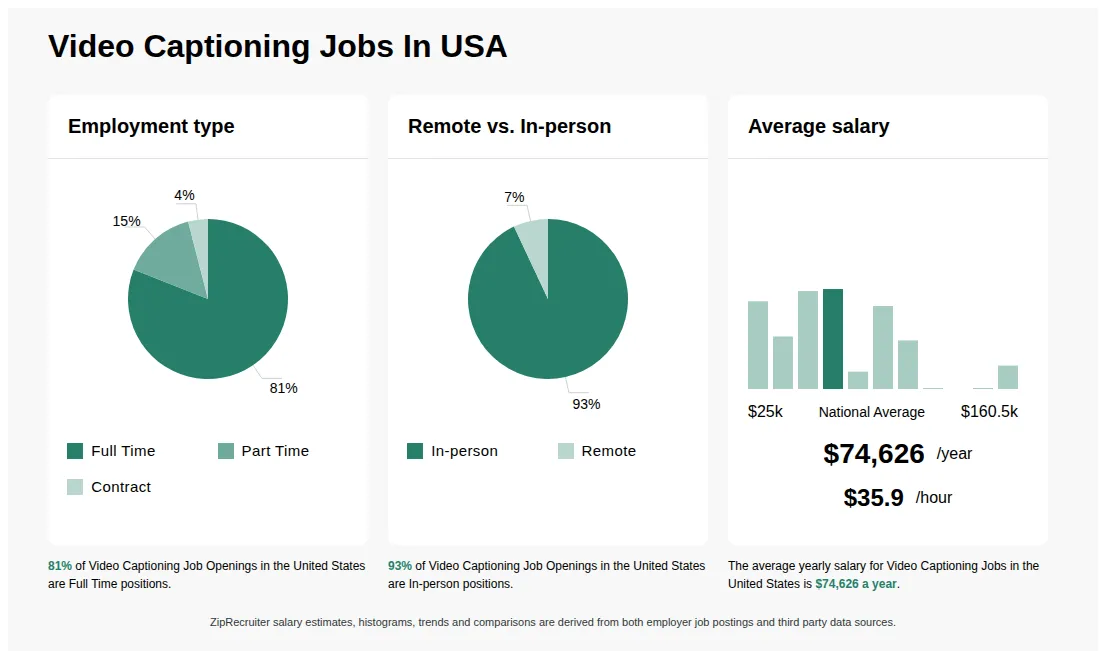
$25K - $37.3K
18% of jobs
$46.2K is the 25th percentile. Wages below this are outliers.
$37.3K - $49.6K
10% of jobs
$49.6K - $62K
20% of jobs
The median wage is $63.6K / yr.
$62K - $74.3K
20% of jobs
$74.3K - $86.6K
3% of jobs
$90.2K is the 75th percentile. Wages above this are outliers.
$86.6K - $98.9K
16% of jobs
$98.9K - $111.2K
9% of jobs
$111.2K - $123.5K
0% of jobs
$123.5K - $135.9K
0% of jobs
$135.9K - $148.2K
0% of jobs
$148.2K - $160.5K
4% of jobs
$25K
$74.6K
$160.5K
How much do video captioning jobs pay per year?
As of Sep 14, 2026, the average yearly pay for video captioning in the United States is $74,626.00, according to ZipRecruiter salary data. Most workers in this role earn between $45,000.00 and $94,500.00 per year, depending on experience, location, and employer.
What is video captioning?
Video captioning is the process of transcribing spoken dialogue and relevant audio information from a video into text, which is then displayed on the screen as captions. This helps make video content accessible to people who are deaf or hard of hearing and can also benefit viewers in noisy environments or those who prefer reading along. Captions can be created manually or generated automatically using speech recognition software, and they often include not just spoken words but also important sounds and speaker identification.
What are the key skills and qualifications needed to thrive in video captioning, and why are they important?
To thrive as a Video Captioning Specialist, you need excellent language proficiency, strong attention to detail, and a good understanding of grammar and punctuation, often supported by experience or training in transcription or captioning. Familiarity with captioning software such as Amara, Subtitle Edit, or Aegisub, as well as knowledge of captioning standards and accessibility guidelines, is typically required. Strong time management, adaptability, and communication skills help you meet deadlines and collaborate effectively with content creators. These skills ensure captions are accurate, accessible, and delivered efficiently, which is crucial for audience comprehension and legal compliance.
What are some typical challenges faced by professionals in video captioning, and how can they be overcome?
Professionals in video captioning often encounter challenges such as tight deadlines, ensuring accuracy with fast-paced dialogue, and maintaining consistency with specialized terminology or accents. Overcoming these challenges typically involves using advanced transcription tools, collaborating closely with content creators for clarifications, and maintaining a thorough style guide. Regularly reviewing and updating captioning software skills can also improve efficiency and accuracy, making the workflow smoother and more manageable.
What is the difference between Video Captioning vs Video Transcription?
| Aspect | Video Captioning | Video Transcription |
|---|---|---|
| Credentials | Typically requires basic language skills, sometimes certification in captioning tools | Requires strong language proficiency, often transcription certifications |
| Work Environment | Video editing or captioning software, often remote | Audio/video playback, transcription software, remote or office |
| Industry Usage | Media, entertainment, education, accessibility services | Media, legal, medical, general content transcription |
Video captioning involves creating timed text overlays for videos to improve accessibility, often requiring familiarity with captioning standards. Video transcription converts spoken content into written text, focusing on accuracy of dialogue or narration. While both roles involve working with audio/video content, captioning emphasizes timing and formatting for viewers, whereas transcription emphasizes verbatim text conversion. Both jobs share skills in language proficiency and often use similar tools, but serve different purposes in media production and accessibility.
More about Video Captioning jobs
What cities are hiring for Video Captioning jobs?
Cities with the most Video Captioning job openings:
What are the most commonly searched types of Video Captioning jobs?
The most popular types of Video Captioning jobs are:
What states have the most Video Captioning jobs?
States with the most job openings for Video Captioning jobs include:
What job categories do people searching Video Captioning jobs look for?
The top searched job categories for Video Captioning jobs are:
What other helpful pages are available for Video Captioning?
Other pages related to Video Captioning:

Live Captioning/Streaming Project Manager - Contractor
Burbank, CA • On-site
Keywords Studios
• Arts, Entertainment, and Recreation • 10K+ employees10,000+ employees
Other
Posted 22 days ago
Keywords Studios rating

8.7
Based on 5 frontline employees who took The Breakroom Quiz
Job description
Keywords Studios is a renowned provider of services for the global gaming and media industries. We are currently seeking a Live Captioning Project Manager to join our dynamic team. As the Live Captioning Project Manager, you will play a pivotal role in planning, coordinating, and overseeing live captioning/streaming projects across various platforms. You will ensure that all projects are delivered on-time and meet the highest standards of quality. This role requires excellent organizational skills, attention to detail, and a passion for accessibility in media.
Key Responsibilities- Manage and oversee live captioning and streaming projects from conception to completion, ensuring on-time and high-quality delivery.
- Collaborate with cross-functional teams (broadcast, engineering, IT, and accessibility) to define project requirements, timelines, and deliverables.
- Lead the configuration and deployment of streaming infrastructure, captioning tools, and platforms (e.g., OBS, Wirecast, YouTube Live, Twitch, Zoom, etc.).
- Ensure adherence to accessibility standards (e.g., ADA, WCAG) and compliance with live captioning and subtitling regulations.
- Troubleshoot and resolve technical issues in real-time during live broadcasts, ensuring minimal downtime and smooth operations.
- Develop and implement workflows for integrating live captions, transcripts, and translations with live-streamed content.
- Manage relationships with third-party vendors, freelancers, and captioning service providers.
- Experience in Live Streaming Technologies:
- Proficiency in live streaming platforms and encoders (e.g., OBS, Wirecast, vMix, Wowza, Restream).
- Knowledge of RTMP, HLS, WebRTC, and other video streaming protocols.
- Experience with CDN services (e.g., Akamai, Cloudflare) for optimized content delivery.
- Familiarity with server-side and client-side streaming architectures.
- Live Captioning Expertise:
- Strong understanding of real-time captioning technologies, including stenography, CART (Communication Access Realtime Translation), and automated speech recognition (ASR).
- Experience with captioning tools such as Ai-Media, EEG Falcon, CaptionSync, StreamText, or similar software.
- Knowledge of caption file formats (SRT, VTT, SCC) and best practices for caption positioning, timing, and quality.
- Technical Troubleshooting:
- Proven ability to troubleshoot audio/video quality issues, latency, synchronization problems, and captioning delays.
- Familiarity with video codecs, streaming resolutions, and bitrates for optimal performance.
- Compliance & Accessibility:
- Knowledge of accessibility standards such as ADA, WCAG, FCC guidelines, and country-specific live captioning regulations.
- Experience with accessibility features in live streaming platforms (closed captions, transcripts, audio descriptions).
- Project Management Skills:
- Ability to manage multiple projects simultaneously, prioritize tasks, and work under tight deadlines.
- Strong communication and leadership skills to collaborate with teams and stakeholders across different time zones.
- Preferred Qualifications:
- Bachelor's degree in IT, Broadcast Engineering, Media, or related field.
- 3+ years of experience in live streaming, captioning, or a related technical project management role.
We are excited to welcome a passionate and skilled professional to our Keywords Studios team, contributing to the enhancement of accessibility in media.
Part time position
Flexible hours.
Keywords Studios is dedicated to following a well-established Equal Opportunities Policy. We endeavor to create a workplace, which provides for equal opportunities for all employees and potential employees.
PERSONAL DATA PROTECTION POLICY
Keywords Studios is strongly committed to protecting your personal information. By sending your CV/Resume, you are agreeing to our terms and conditions and consent to your data being managed and retained in accordance with our data privacy and retention policy.
https://www.keywordsstudios.com/privacy-policy/

About Keywords Studios
Sourced by ZipRecruiter
Whatever the scale of your project, whatever the time frame, whatever your location: Keywords is here for you, bringing our network of 13,000+ people and 70+ studios together to deliver the unified solutions you need. We offer everything necessary to ensure your project achieves its full potential and that strategic opportunities are turned into long-term growth. The games industry is complex and fast-moving. Working with Keywords allows you to remain lean and agile, and to remain focused on creating the world’s most immersive playing experiences. Our network of studios brings best-in-class experience, expertise, technology and capacity across the full development, release and player-support lifecycle.
Industry
Arts, entertainment, and recreation
Company size
10,000+ Employees
Headquarters location
Burbank, CA, US