2

Remote Economics Instructor Jobs (NOW HIRING)

What the real unit economics look like. What breaks in bad weather. What approvals are actually in ... Strong Preference • Remote-market, island, or austere operating experience - particularly where ...

Approval of remote and hybrid work is not guaranteed regardless of work location.For additional ... Duties include but are not limited to assisting the lead instructor with feedback/grading ...

This is a remote role with 50% travel to work onsite at client sites throughout the United States ... Serve as an instructor in the firm, department training programs, and meetings * Take part in and ...

Tax Manager

Bethesda, MD · On-site +1

$140K - $170K/yr

Bethesda, MD (hybrid or remote available). Salary range: $140,000 - $170,000 The Tax Manager is ... Maintains knowledge of general economic and political trends including tax or other legislation ...

Remote (US) Type: Full-time Compensation: $150,000 - $175,000 Why This Role, Now CodePath's hiring ... instructor hiring and fellowship surge hiring that arrives fast and cannot miss. You will own two ...

next page

Showing results 1-20

Remote Economics Instructor information

See salary details

$33.5K

$59.6K

$119K

How much do remote economics instructor jobs pay per year?

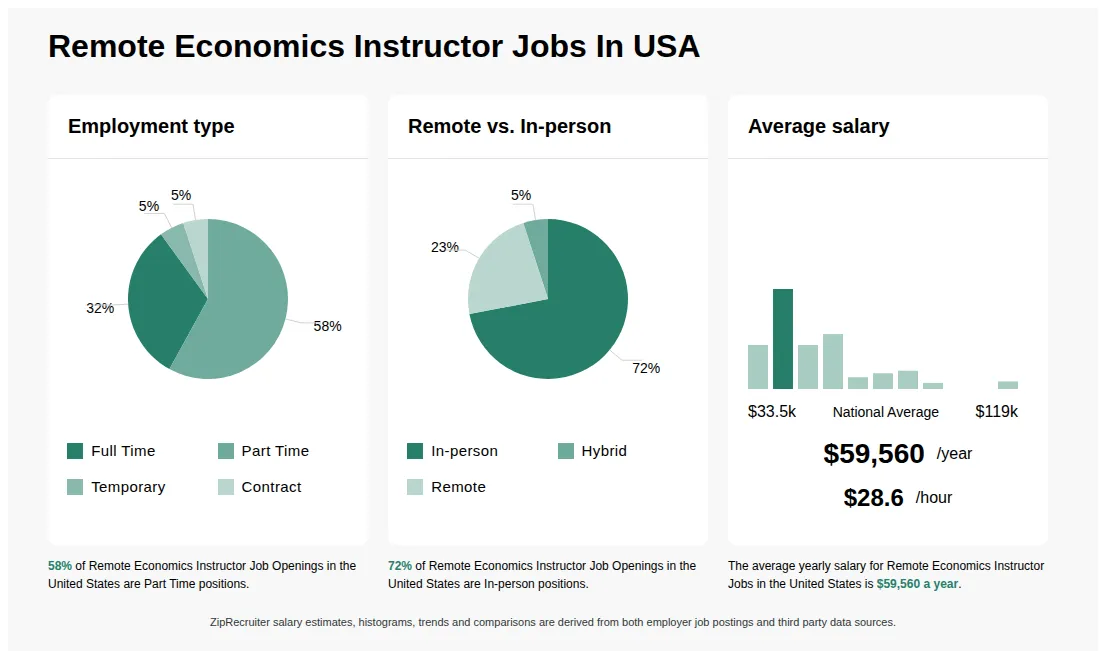
As of Jul 22, 2026, the average yearly pay for remote economics instructor in the United States is $59,560.00, according to ZipRecruiter salary data. Most workers in this role earn between $44,000.00 and $65,000.00 per year, depending on experience, location, and employer.

What are the key skills and qualifications needed to thrive in the Remote Economics Instructor position, and why are they important?

A Remote Economics Instructor should have a solid academic background in economics, teaching experience, and a relevant degree—often a master's or higher. Familiarity with online learning management systems (such as Canvas, Blackboard, or Moodle), virtual conferencing tools, and possibly online teaching certifications is common in this field. Excellent communication, time management, and adaptability are important soft skills for engaging students and delivering content remotely. These skills and qualifications ensure effective online instruction, student engagement, and the ability to manage virtual classrooms successfully.

What does the typical work environment and schedule look like for a Remote Economics Instructor?

As a Remote Economics Instructor, you'll typically conduct courses from a home office or another quiet, professional setting, using video conferencing and online platforms to interact with students. Your schedule may vary depending on the institution, with some roles offering set class times while others allow for asynchronous, self-paced instruction. Responsibilities often include preparing lesson materials, delivering live or recorded lectures, grading assignments, and providing virtual office hours or individual support to students. While you may work independently, there are often opportunities to collaborate with other instructors and participate in departmental meetings online. This flexible, tech-driven environment is well-suited for self-motivated educators who enjoy working remotely and engaging with diverse student populations.

What is a Remote Economics Instructor job?

A Remote Economics Instructor teaches economics courses online to students at various levels, typically for a university, college, or online learning platform. They develop lesson plans, deliver lectures via video conferencing or pre-recorded content, and assess student progress through assignments and exams. Responsibilities may also include hosting virtual office hours, fostering discussions, and providing individualized support. This role requires strong communication skills, expertise in economics, and proficiency with online teaching tools.

More about Remote Economics Instructor jobs
What cities are hiring for Remote Economics Instructor jobs? Cities with the most Remote Economics Instructor job openings:
What are the most commonly searched types of Economics Instructor jobs? The most popular types of Economics Instructor jobs are:
What states have the most Remote Economics Instructor jobs? States with the most job openings for Remote Economics Instructor jobs include:
Infographic showing various Remote Economics Instructor job openings in the United States as of July 2026, with employment types broken down into 100% Full Time. Highlights an 100% Remote job distribution, with an average salary of $59,560 per year, or $28.6 per hour.
Chief Operating Officer

Chief Operating Officer

TekSky

Tallahassee, FL • On-site, Remote

Full-time

Posted 10 days ago


Job description

The Role
The COO is the operator-in-chief. This person owns execution across flight operations, maintenance, compliance, engineering, commercial delivery, and government-facing work. They are responsible for turning a compelling thesis into a live, scheduled, economically defensible cargo operation - in the Caribbean first, then across the U.S. and beyond.
You will be asked what is proven and what is still pending. What the real unit economics look like. What breaks in bad weather. What approvals are actually in hand. What the path into defense and government business really looks like. The right COO answers those questions from experience and judgment - not from a memo.
Non-Negotiable Experience
• Built and led complex aviation operations in a regulated, high-consequence environment - with personal accountability for safety, operating readiness, execution discipline, and economic performance in live flight operations. Scheduled Part 135 cargo experience is highly desirable.
• Direct FAA experience tied to bringing new or nonstandard operations to market: certification pathways, operating approvals, waiver and exemption strategy, and regulator-facing problem solving across multiple stakeholders.
• Ability to build constructive, credible working relationships with the FAA and international civil aviation authorities. Experience navigating the space where regulatory, political, and institutional considerations intersect - not just the formal technical process.
• Able to build, pressure-test, and defend a fully burdened aviation operating model - including maintenance, asset life, labor, insurance, compliance overhead, weather exposure, dispatch realities, and capital efficiency.
• Demonstrated ability to lead across functions: flight operations, maintenance, compliance, engineering, commercial execution, and government-facing work simultaneously.
Strong Preference
• Remote-market, island, or austere operating experience - particularly where local regulatory relationships, political dynamics, and operational execution must be managed in parallel.
• Civilian or military pilot experience, especially where it reflects real operational judgment in challenging environments. Flight instructor experience is also valuable.
• Military logistics or defense-mission exposure relevant to tactical resupply, field reliability, mission planning, or public-sector procurement. DoD acquisition fluency - including OTA or rapid-fielding pathways - is a real advantage.
• Experience converting customer interest into contracted demand: take-or-pay structures, government retainers, or repeatable institutional partnerships.
• Cold-chain or other high-reliability specialty logistics experience.
What We Are Not Looking For
• A large-airline executive who has never built in ambiguity.
• A last-mile drone specialist whose experience does not translate to heavier aircraft, longer routes, or serious regulatory and economic constraints.
• A technology executive who treats flight operations as someone else's problem.
• Anyone who approaches regulators as a box-checking exercise or autonomy as a science project.
What You Will Own
• Phase 1 commercial launch: scheduled Caribbean cargo operations from first flight to route-level EBITDA.
• Fully burdened unit economics: documented, verified, and defensible to institutional investors and the board.
• FAA and international regulatory strategy: approvals in hand, not pending assumptions.
• Fleet acquisition, readiness, and uptime across all operating aircraft.
• Commercial execution: take-or-pay contracts, carrier partnerships (FedEx, DHL, Amazon), and government retainers.
• Defense track entry: Army tactical resupply trials, SOFWERX demonstrations, and dual-use contract structure.
• Operational scaling from the Caribbean to U.S. and international markets.
Key Numbers You Will Be Accountable For
• 400 lbs payload | 200+ mile range | <$0.01/lb-mile operating cost
• Fleet uptime target: >80% through Phase 1
• Phase 1 gate: 6 months of on-time scheduled service on at least one Caribbean route
• At least one signed take-or-pay contract before Phase 2 capital is raised
• Regulatory approval in at least two Caribbean jurisdictions
• At least one DoD demonstration completed