As our Clinical Informatics Support Specialist (CISS), you will optimize healthcare technology. Ideal for a healthcare IT professional passionate about EHR systems and user experience, you'll ensure ...
As our Clinical Informatics Support Specialist (CISS), you will optimize healthcare technology. Ideal for a healthcare IT professional passionate about EHR systems and user experience, you'll ensure ...
Apply clinical informatics knowledge to assess program operations and recommend improvements aligned with VA healthcare objectives. * Develop and maintain program performance metrics, dashboards, and ...
Quick apply
Apply clinical informatics knowledge to assess program operations and recommend improvements aligned with VA healthcare objectives. * Develop and maintain program performance metrics, dashboards, and ...
Clinical Informatics Support Specialist
West Valley City, UT · Remote
$26.70 - $44.05/hr
Job Summary and Responsibilities As our Clinical Informatics Support Specialist (CISS), you will optimize healthcare technology. Ideal for a healthcare IT professional passionate about EHR systems ...
Clinical Informatics Support Specialist
West Valley City, UT · Remote
$26.70 - $44.05/hr
Job Summary and Responsibilities As our Clinical Informatics Support Specialist (CISS), you will optimize healthcare technology. Ideal for a healthcare IT professional passionate about EHR systems ...
Required Qualifications: • Master's Degree in Clinical Informatics, Biomedical Informatics, Health Informatics, Nursing Informatics, or a related clinical or health information science field. • ...
Quick apply
Required Qualifications: • Master's Degree in Clinical Informatics, Biomedical Informatics, Health Informatics, Nursing Informatics, or a related clinical or health information science field. • ...

Experience: 15+ years in clinical informatics program management. * Clearance: Ability to obtain/maintain a VA Public Trust. Additional Information Work Arrangement * Remote Compensation: Salary ...
Experience: 15+ years in clinical informatics program management. * Clearance: Ability to obtain/maintain a VA Public Trust. Additional Information Work Arrangement * Remote Compensation: Salary ...
Clinical Informaticist II
Washington, DC · On-site +1
Required Qualifications: • Master's Degree in Clinical Informatics, Biomedical Informatics, Health Informatics, Nursing Informatics, or a related clinical or health information science field. • ...
Clinical Informaticist II
Washington, DC · On-site +1
Required Qualifications: • Master's Degree in Clinical Informatics, Biomedical Informatics, Health Informatics, Nursing Informatics, or a related clinical or health information science field. • ...
Principal Program Manager, Informatics
Washington, DC · On-site +1
Experience: 15+ years in clinical informatics program management. * Clearance: Ability to obtain/maintain a VA Public Trust. Additional Information Work Arrangement * Remote Compensation: Salary ...
Principal Program Manager, Informatics
Washington, DC · On-site +1
Experience: 15+ years in clinical informatics program management. * Clearance: Ability to obtain/maintain a VA Public Trust. Additional Information Work Arrangement * Remote Compensation: Salary ...
Health IT Informatics Analyst I
Washington, DC · On-site +1
Position Overview: The Health IT Informatics Analyst I supports the development of clinical ... The analyst bridges clinical and technical teams, translating operational needs into actionable ...
Health IT Informatics Analyst I
Washington, DC · On-site +1
Position Overview: The Health IT Informatics Analyst I supports the development of clinical ... The analyst bridges clinical and technical teams, translating operational needs into actionable ...
Position Overview: The Health IT Informatics Analyst I supports the development of clinical ... The analyst bridges clinical and technical teams, translating operational needs into actionable ...
Quick apply
Position Overview: The Health IT Informatics Analyst I supports the development of clinical ... The analyst bridges clinical and technical teams, translating operational needs into actionable ...
Depending on your expertise, you might design infrastructure in remote locations, develop renewable ... This role requires a rare blend of clinical workflow knowledge and technical system configuration ...
Depending on your expertise, you might design infrastructure in remote locations, develop renewable ... This role requires a rare blend of clinical workflow knowledge and technical system configuration ...
Health IT Informatics Analyst (Lead)
Washington, DC · On-site +1
Depending on your expertise, you might design infrastructure in remote locations, develop renewable ... This role requires a rare blend of clinical workflow knowledge and technical system configuration ...
Health IT Informatics Analyst (Lead)
Washington, DC · On-site +1
Depending on your expertise, you might design infrastructure in remote locations, develop renewable ... This role requires a rare blend of clinical workflow knowledge and technical system configuration ...

Clinical Informatics Registered Nurse
$70K - $85K/yr
Job Title Clinical Informatics Registered Nurse Location Remote/Nationwide, USA Additional Location(s) Employee Type Employee Working Hours Per Week 40 Homecare Homebase (HCHB) experience is ...
Clinical Informatics Registered Nurse
$70K - $85K/yr
Job Title Clinical Informatics Registered Nurse Location Remote/Nationwide, USA Additional Location(s) Employee Type Employee Working Hours Per Week 40 Homecare Homebase (HCHB) experience is ...

... Clinical Informatics, lead OCHS' coordinated approach in communication and decision-making related to remote workflows and functionality modifications. Ensure key stakeholder engagement. * Inform ...
New
... Clinical Informatics, lead OCHS' coordinated approach in communication and decision-making related to remote workflows and functionality modifications. Ensure key stakeholder engagement. * Inform ...
New

Clinical Informaticist
Austin, TX · On-site +1
Bachelor's or Master's degree in Nursing, Medical/Health Informatics, Bioinformatics, or a related ... remote-first culture - you've come to the right place. What Does This Mean for You? At Aledade, you ...
Clinical Informaticist
Austin, TX · On-site +1
Bachelor's or Master's degree in Nursing, Medical/Health Informatics, Bioinformatics, or a related ... remote-first culture - you've come to the right place. What Does This Mean for You? At Aledade, you ...

... against clinical ground truth, and build reusable analytical capabilities that the broader ... This can be a remote position in the US or on-site position at our Tarrytown, NY, Armonk, NY or ...
... against clinical ground truth, and build reusable analytical capabilities that the broader ... This can be a remote position in the US or on-site position at our Tarrytown, NY, Armonk, NY or ...
Clinical Informaticist
Austin, TX · Remote
Bachelor's or Master's degree in Nursing, Medical/Health Informatics, Bioinformatics, or a related ... remote-first culture - you've come to the right place. What Does This Mean for You? At Aledade, you ...
Quick apply
Clinical Informaticist
Austin, TX · Remote
Bachelor's or Master's degree in Nursing, Medical/Health Informatics, Bioinformatics, or a related ... remote-first culture - you've come to the right place. What Does This Mean for You? At Aledade, you ...

CLINICAL INFORMATICIST (CA)
$98K - $157K/yr
Provide clinical informatics consultation internally at OCHIN. * Review clinical questions via ... OCHIN is a 100% remote organization with no physical corporate office location. Employees work ...
CLINICAL INFORMATICIST (CA)
$98K - $157K/yr
Provide clinical informatics consultation internally at OCHIN. * Review clinical questions via ... OCHIN is a 100% remote organization with no physical corporate office location. Employees work ...
Epic Certified Principal Trainer - Clinical Documentation (ClinDoc) REMOTE 12+ months MUST BE A ... Collaborate with application analysts and informatics teams to understand system design and changes
Epic Certified Principal Trainer - Clinical Documentation (ClinDoc) REMOTE 12+ months MUST BE A ... Collaborate with application analysts and informatics teams to understand system design and changes

Informatics Pharmacist (Epic Willow Ambulatory)
Atlanta, GA · On-site +1
$70.60 - $83.92/hr
And more 100% remote position, but must reside in one of the following states: Alabama, Arkansas ... Cross team build and maintenance with both clinical and non-clinical applications. * Potential ...
Informatics Pharmacist (Epic Willow Ambulatory)
Atlanta, GA · On-site +1
$70.60 - $83.92/hr
And more 100% remote position, but must reside in one of the following states: Alabama, Arkansas ... Cross team build and maintenance with both clinical and non-clinical applications. * Potential ...
And more 100% remote position, but must reside in one of the following states: Alabama, Arkansas ... Cross team build and maintenance with both clinical and non-clinical applications. * Potential ...
And more 100% remote position, but must reside in one of the following states: Alabama, Arkansas ... Cross team build and maintenance with both clinical and non-clinical applications. * Potential ...
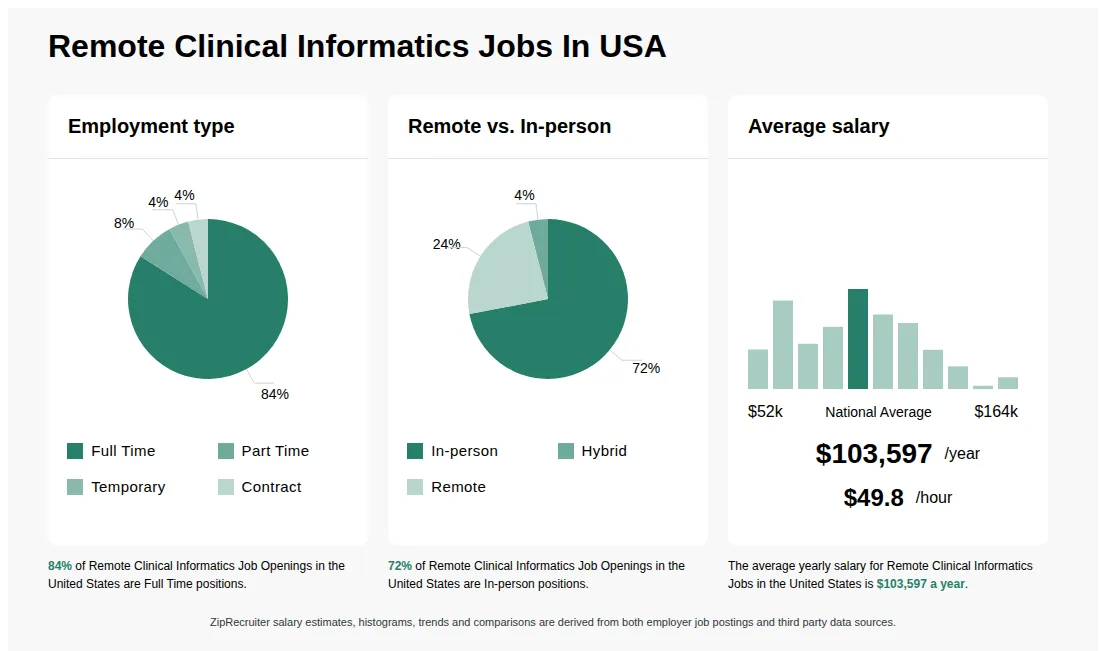
Remote Clinical Informatics information
See salary details
$52K - $62.2K
7% of jobs
$62.2K - $72.4K
16% of jobs
$74.9K is the 25th percentile. Wages below this are outliers.
$72.4K - $82.5K
8% of jobs
$82.5K - $92.7K
11% of jobs
The median wage is $96.7K / yr.
$92.7K - $102.9K
19% of jobs
$113.1K is the 75th percentile. Wages above this are outliers.
$102.9K - $113.1K
14% of jobs
$113.1K - $123.3K
11% of jobs
$123.3K - $133.5K
7% of jobs
$133.5K - $143.6K
4% of jobs
$143.6K - $153.8K
0% of jobs
$153.8K - $164K
2% of jobs
$52K
$103.6K
$164K
How much do remote clinical informatics jobs pay per year?
As of Jul 21, 2026, the average yearly pay for remote clinical informatics in the United States is $103,597.00, according to ZipRecruiter salary data. Most workers in this role earn between $75,000.00 and $115,500.00 per year, depending on experience, location, and employer.
What Are Remote Clinical Informatics Jobs?
Remote clinical informatics jobs include positions such as clinical informatics analyst, clinical informatics specialist, informatics programmer analyst, informatics scientist, and clinical informatics educator. Clinical informatics is the discipline of studying how technology can improve the flow of clinical and patient information between researchers, clinicians, patients, and health care organizations in the health care system. Your specific duties depend on your position, but most jobs require you to help design and develop data storage and sharing systems. Your responsibilities may also include helping to analyze and improve current informatics systems at an institution.
What are the key skills and qualifications needed to thrive as a Remote Clinical Informatics Specialist, and why are they important?
To thrive as a Remote Clinical Informatics Specialist, you need a background in healthcare, knowledge of clinical workflows, and often a degree in informatics, health information management, or a related field. Familiarity with electronic health records (EHR) systems, data analytics tools, and certifications such as Certified Professional in Healthcare Information and Management Systems (CPHIMS) are commonly required. Strong communication, problem-solving skills, and the ability to collaborate across clinical and technical teams are essential soft skills. These abilities are vital to ensure accurate data management, successful implementation of health IT solutions, and improved patient care outcomes in a remote environment.
What is the difference between Remote Clinical Informatics vs Remote Health Data Analyst?
| Aspect | Remote Clinical Informatics | Remote Health Data Analyst |
|---|---|---|
| Credentials | Healthcare-related degrees, certifications like CPHIMS or CAHIMS | Data analysis or statistics degrees, certifications like CPC or CAP |
| Work Environment | Healthcare settings, hospitals, clinics, telehealth | Research institutions, healthcare organizations, consulting firms |
| Employer & Industry | Hospitals, healthcare providers, EHR vendors | Healthcare analytics firms, insurance companies, research organizations |
| Search & Comparison Intent | Understanding roles in healthcare IT, telehealth, clinical systems | Analyzing healthcare data, reporting, and insights |
Remote Clinical Informatics focuses on implementing and managing healthcare technology systems within clinical settings, requiring healthcare credentials. In contrast, Remote Health Data Analysts primarily analyze healthcare data to generate insights, often with a background in data analysis. Both roles support healthcare organizations but serve different functions in the industry.
What is remote clinical informatics?
Remote clinical informatics is a field that involves managing and analyzing health information and data to improve patient care, with professionals working from locations outside traditional healthcare settings. These specialists use technology to collect, store, and interpret medical data, helping healthcare providers make better clinical decisions. Remote clinical informaticists often collaborate with IT teams, clinicians, and administrators to optimize electronic health records (EHRs), ensure data security, and support telehealth initiatives. This role is critical in the modern healthcare environment, where digital solutions and remote work are increasingly common.
How does a Remote Clinical Informatics professional typically collaborate with healthcare teams and IT departments?
Remote Clinical Informatics professionals often work closely with both clinical staff and IT teams to optimize electronic health record (EHR) systems and ensure seamless health data workflows. They facilitate communication between clinicians and technical staff, translating clinical needs into technical requirements and vice versa. Regular virtual meetings, project management tools, and secure messaging platforms are commonly used to coordinate updates, solve problems, and implement new technologies. Strong collaboration skills are essential, as much of the work involves cross-functional teamwork to improve patient care and data integrity.
More about Remote Clinical Informatics jobs
What cities are hiring for Remote Clinical Informatics jobs? Cities with the most Remote Clinical Informatics job openings:
What are the most commonly searched types of Clinical Informatics jobs? The most popular types of Clinical Informatics jobs are:
What states have the most Remote Clinical Informatics jobs? States with the most job openings for Remote Clinical Informatics jobs include:
What job categories do people searching Remote Clinical Informatics jobs look for? The top searched job categories for Remote Clinical Informatics jobs are:

Full-time
Posted 24 days ago
CommonSpirit Health rating

7.1
Based on 521 frontline employees who took The Breakroom Quiz
374th of 886 rated healthcare providers
Job description
Inspired by faith. Driven by innovation. Powered by humankindness. CommonSpirit Health is building a healthier future for all through its integrated health services. As one of the nation’s largest nonprofit Catholic healthcare organizations, CommonSpirit Health delivers more than 20 million patient encounters annually through more than 2,300 clinics, care sites and 137 hospital-based locations, in addition to its home-based services and virtual care offerings. CommonSpirit has more than 157,000 employees, 45,000 nurses and 25,000 physicians and advanced practice providers across 24 states and contributes more than $4.2 billion annually in charity care, community benefits and unreimbursed government programs. Together with our patients, physicians, partners, and communities, we are creating a more just, equitable, and innovative healthcare delivery system.
As our Clinical Informatics Support Specialist (CISS), you will optimize healthcare technology. Ideal for a healthcare IT professional passionate about EHR systems and user experience, you'll ensure our clinical information systems meet goals for patient care, efficiency, and compliance, making you a key player in innovative care delivery.
Every day you will support and optimize clinical information systems, acting as a subject matter expert and liaison. You'll engage in workflow design, project implementation, documentation, and comprehensive EHR training. Expect to lead problem-solving and collaborate with staff to develop efficient, functional workflows for all our software applications.
To be successful in this role, you will demonstrate exceptional problem-solving and robust communication skills to facilitate consensus and manage projects effectively. Proficiency in common software applications and the ability to organize priorities and train others on complex topics are critical.
- Supports and optimizes clinical information system capabilities to meet the organization's goals of quality patient care, operational efficiency, and regulatory compliance.
- Responsible for problem solving, assessing processes and issues, and collaborating with other staff and physicians to develop solutions resulting in efficient and functional workflows for end users of our software applications.
- Participates in workflow design and development; project implementation; documentation; and end user training.
- Understands and utilizes evidence-based practice in initial and ongoing EHR training and competency to end users.
- Contributes to training curricula, communication and change management for technology changes, upgrades, and downtimes to customers.
- Participates in projects, meetings, and workshops. Gathers information from end users as needed. Escalates appropriately. Prioritizes responsibilities and organizes workload to ensure that work is successfully completed within deadlines.
This position will provide on-site support to the Utah Ambulatory Market, ranging from Layton to Lehi.
Required
- Associates Degree and 2 years experience in a healthcare environment
Preferred
- Bachelors Degree
- Epic experience
What CommonSpirit Health employees say
Pay
Benefits
Hours and flexibility
Workplace
Get the full story on Breakroom

About CommonSpirit Health
Sourced by ZipRecruiter
Industry
Health care and social assistance, hospitals and non-profits
Company size
10,000+ Employees
Headquarters location
Chicago, IL, US