Previous management/supervisory experience Skills * Knowledge of health systems operations, health policy, and/or health care contracting * Knowledge of population health programs and concepts
Previous management/supervisory experience Skills * Knowledge of health systems operations, health policy, and/or health care contracting * Knowledge of population health programs and concepts
Population Health Manager
Fishersville, VA · On-site
$91K - $154K/yr
Previous management/supervisory experience. Skills: * Knowledge of health systems operations, health policy, and/or health care contracting. * Knowledge of population health programs and concepts.
Quick apply
Population Health Manager
Fishersville, VA · On-site
$91K - $154K/yr
Previous management/supervisory experience. Skills: * Knowledge of health systems operations, health policy, and/or health care contracting. * Knowledge of population health programs and concepts.

Population Health Coordinator
$30.87 - $43.94/hr
The Population Health Coordinator supports efforts to close care gaps, improve risk-adjusted ... management, and social determinants of health, while driving community engagement and fostering ...
Population Health Coordinator
$30.87 - $43.94/hr
The Population Health Coordinator supports efforts to close care gaps, improve risk-adjusted ... management, and social determinants of health, while driving community engagement and fostering ...

Product Lead - Population Health
Delray Beach, FL · Remote
$55 - $60/hr
Product Lead - Population Health Experience: 7-9 Years | Type: Contract Location: Remote (USA) Role ... management, and healthcare finance. Responsibilities include translating business needs into data ...
Quick apply
Product Lead - Population Health
Delray Beach, FL · Remote
$55 - $60/hr
Product Lead - Population Health Experience: 7-9 Years | Type: Contract Location: Remote (USA) Role ... management, and healthcare finance. Responsibilities include translating business needs into data ...
Population Health Coordinator
Coeur D Alene, ID · On-site
$30.87 - $43.94/hr
The Population Health Coordinator supports efforts to close care gaps, improve risk-adjusted ... management, and social determinants of health, while driving community engagement and fostering ...
Population Health Coordinator
Coeur D Alene, ID · On-site
$30.87 - $43.94/hr
The Population Health Coordinator supports efforts to close care gaps, improve risk-adjusted ... management, and social determinants of health, while driving community engagement and fostering ...

Population Health Manager
Fishersville, VA · On-site
$91K - $154K/hr
Previous management/supervisory experience Skills * Knowledge of health systems operations, health policy, and/or health care contracting * Knowledge of population health programs and concepts
Population Health Manager
Fishersville, VA · On-site
$91K - $154K/hr
Previous management/supervisory experience Skills * Knowledge of health systems operations, health policy, and/or health care contracting * Knowledge of population health programs and concepts
This position is responsible for supporting FLIPA in the successful deployment of Population Health Management (PHM) initiatives across the network. The Population Health Coordinator will work ...
Quick apply
This position is responsible for supporting FLIPA in the successful deployment of Population Health Management (PHM) initiatives across the network. The Population Health Coordinator will work ...

Director of Population Health
Bronx, NY · On-site
$145K - $175K/yr
We also provide nursing home support, care management, and in-home care through our Essen House Calls program. Guided by a Population Health model, our team of 500+ providers deliver care in-person ...
Director of Population Health
Bronx, NY · On-site
$145K - $175K/yr
We also provide nursing home support, care management, and in-home care through our Essen House Calls program. Guided by a Population Health model, our team of 500+ providers deliver care in-person ...
This position is responsible for supporting FLIPA in the successful deployment of Population Health Management (PHM) initiatives across the network. The Population Health Coordinator will work ...
Quick apply
This position is responsible for supporting FLIPA in the successful deployment of Population Health Management (PHM) initiatives across the network. The Population Health Coordinator will work ...
Population Health Coordinator
Syracuse, NY · On-site
$65K - $75K/yr
This position is responsible for supporting FLIPA in the successful deployment of Population Health Management (PHM) initiatives across the network. The Population Health Coordinator will work ...
Population Health Coordinator
Syracuse, NY · On-site
$65K - $75K/yr
This position is responsible for supporting FLIPA in the successful deployment of Population Health Management (PHM) initiatives across the network. The Population Health Coordinator will work ...
This position is responsible for supporting FLIPA in the successful deployment of Population Health Management (PHM) initiatives across the network. The Population Health Coordinator will work ...
This position is responsible for supporting FLIPA in the successful deployment of Population Health Management (PHM) initiatives across the network. The Population Health Coordinator will work ...

Reporting to the VP, Product Management & Analytics, this role will drive capabilities related to ... Experience in healthcare, population health, value-based care, or life sciences. * Demonstrated ...
Reporting to the VP, Product Management & Analytics, this role will drive capabilities related to ... Experience in healthcare, population health, value-based care, or life sciences. * Demonstrated ...
Director of Population Health
Bronx, NY · On-site
$145K - $175K/yr
We also provide nursing home support, care management, and in-home care through our Essen House Calls program. Guided by a Population Health model, our team of 500+ providers deliver care in-person ...
Director of Population Health
Bronx, NY · On-site
$145K - $175K/yr
We also provide nursing home support, care management, and in-home care through our Essen House Calls program. Guided by a Population Health model, our team of 500+ providers deliver care in-person ...

Population Health Manager, Field
Kansas City, MO · On-site
$60K - $132K/yr
Lead the analytics, insights, and project management that drive population health execution in the region. * Be accountable for medical scribe cohort recruitment, retention, performance and ...
Population Health Manager, Field
Kansas City, MO · On-site
$60K - $132K/yr
Lead the analytics, insights, and project management that drive population health execution in the region. * Be accountable for medical scribe cohort recruitment, retention, performance and ...
We also provide nursing home support, care management, and in-home care through our Essen House Calls program. Guided by a Population Health model, our team of 500+ providers deliver care in-person ...
We also provide nursing home support, care management, and in-home care through our Essen House Calls program. Guided by a Population Health model, our team of 500+ providers deliver care in-person ...

Director-Population Health
Chicago, IL · On-site
$74.37/hr
Enhance EMR tools for population health management * Align programs with system targets Program Oversight * Ensures compliance with established clinical protocols and connectivity to the NM System ...
New
Director-Population Health
Chicago, IL · On-site
$74.37/hr
Enhance EMR tools for population health management * Align programs with system targets Program Oversight * Ensures compliance with established clinical protocols and connectivity to the NM System ...
New

Overview Under the leadership of the Director of Population Health, manages and provides direction to the Population Health team managers and supervisors to ensure Basic Population Health Management ...
Overview Under the leadership of the Director of Population Health, manages and provides direction to the Population Health team managers and supervisors to ensure Basic Population Health Management ...

The department offers undergraduate degrees in Applied Psychology and Population Health Management, Graduate degrees in Applied Behavior Analysis and Marriage and Family Therapy, minors in Arts ...
The department offers undergraduate degrees in Applied Psychology and Population Health Management, Graduate degrees in Applied Behavior Analysis and Marriage and Family Therapy, minors in Arts ...
Under the leadership of the Director of Population Health, manages and provides direction to the Population Health team managers and supervisors to ensure Basic Population Health Management ...
Under the leadership of the Director of Population Health, manages and provides direction to the Population Health team managers and supervisors to ensure Basic Population Health Management ...
Overview Under the leadership of the Director of Population Health, manages and provides direction to the Population Health team managers and supervisors to ensure Basic Population Health Management ...
Overview Under the leadership of the Director of Population Health, manages and provides direction to the Population Health team managers and supervisors to ensure Basic Population Health Management ...
Population Health Management information
See salary details
$25K - $38.5K
17% of jobs
$50.1K is the 25th percentile. Wages below this are outliers.
$38.5K - $52K
9% of jobs
$52K - $65.5K
11% of jobs
The median wage is $74.4K / yr.
$65.5K - $79K
20% of jobs
$79K - $92.5K
12% of jobs
$103K is the 75th percentile. Wages above this are outliers.
$92.5K - $106K
8% of jobs
$106K - $119.5K
7% of jobs
$119.5K - $133K
6% of jobs
$133K - $146.5K
2% of jobs
$146.5K - $160K
1% of jobs
$160K - $173.5K
6% of jobs
$25K
$87.8K
$173.5K
How much do population health management jobs pay per year?
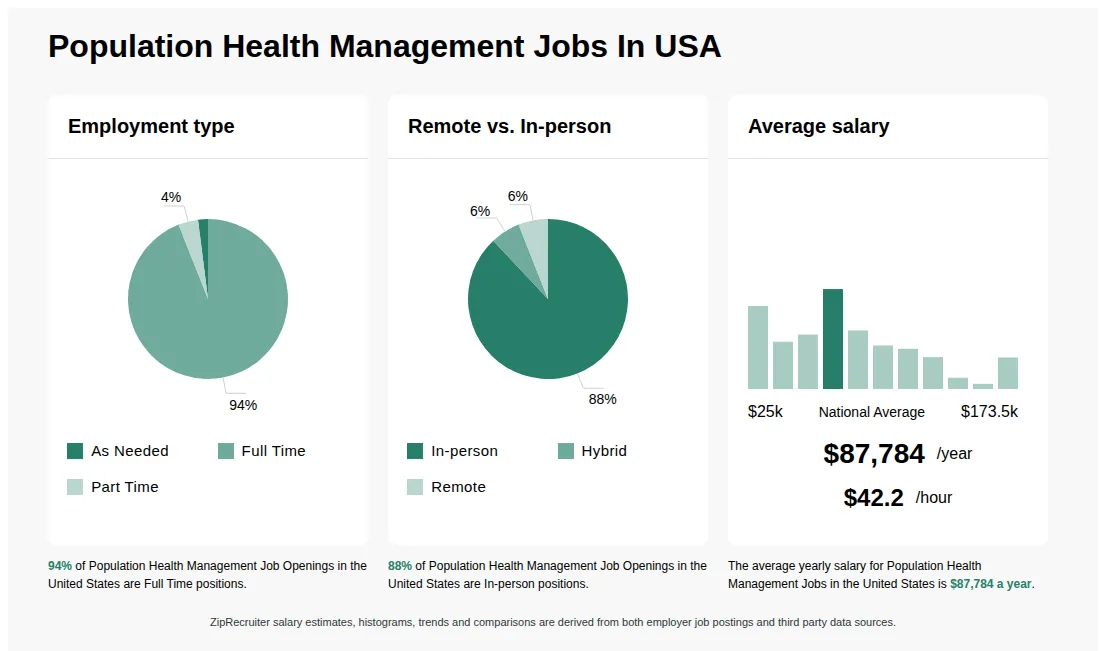
As of Jul 15, 2026, the average yearly pay for population health management in the United States is $87,784.00, according to ZipRecruiter salary data. Most workers in this role earn between $53,000.00 and $111,000.00 per year, depending on experience, location, and employer.
What are the key skills and qualifications needed to thrive in Population Health Management, and why are they important?
To thrive in Population Health Management, you need expertise in public health principles, data analysis, care coordination, and a relevant degree in public health, healthcare administration, or a related field. Familiarity with population health analytics platforms, electronic health records (EHRs), and certifications such as Certified Population Health Management Professional (CPHMP) are often required. Strong communication, problem-solving, and leadership skills are essential for collaborating across healthcare teams and engaging diverse patient populations. These skills ensure effective program implementation, improved patient outcomes, and efficient management of community health initiatives.
Is population health a good career?
Population health management is a growing field focused on improving health outcomes for communities through data analysis, care coordination, and policy development. It offers opportunities in healthcare organizations, public health agencies, and consulting firms, often requiring skills in data management and understanding of healthcare systems. The career can be stable and impactful, with increasing demand for professionals who can address social determinants of health and implement preventive strategies.
What are some common challenges faced in a Population Health Management role, and how are they typically addressed?
Professionals in Population Health Management often encounter challenges such as integrating data from multiple sources, ensuring patient engagement, and addressing health disparities across diverse populations. These challenges are typically addressed by leveraging advanced health IT systems, collaborating closely with interdisciplinary teams including clinicians, data analysts, and community partners, and implementing targeted outreach and education programs. Continuous learning and adaptation are key, as the field evolves rapidly with new technologies and regulatory requirements.
How to Get a Job in Population Health Management
Your qualifications to get a job in population health management depend on the position. Population health management analysts and managers typically have a minimum of a bachelor’s degree in health care administration, public health, or a related field, but managers may additionally need a formal education in business management or equivalent professional experience. Both positions require exceptional data analysis skills and the ability to problem-solve, communicate effectively with writing and speaking, and understand health care issues, trends, and programs that affect the populations with which you work. You can find population health management jobs with medical groups, hospitals, and government health departments.
What are the highest paying mph jobs?
In population health management, senior roles such as Director of Population Health or Chief Population Health Officer tend to have the highest salaries, often exceeding six figures. These positions typically require extensive experience, leadership skills, and knowledge of healthcare systems, data analytics, and policy. Advanced degrees, certifications, and strategic oversight responsibilities contribute to higher compensation levels.
What do population health managers do?
Population health managers oversee strategies to improve the health outcomes of specific populations by analyzing data, coordinating care, and implementing health programs. They work with healthcare providers, policymakers, and community organizations to address social determinants of health and reduce disparities, often using health information systems and requiring knowledge of public health principles. Strong communication, data analysis skills, and relevant certifications are typically important for this role.
What is the difference between Population Health Management vs Care Coordinator?
| Aspect | Population Health Management | Care Coordinator |
|---|---|---|
| Credentials | Often requires a degree in public health, nursing, or related fields; certifications like CHES or CPH | Typically requires nursing, social work, or health education background; certifications vary |
| Work Environment | Healthcare organizations, public health agencies, insurance companies | Hospitals, clinics, community health settings |
| Employer & Industry Usage | Used in population-based health strategies, policy planning | Focuses on individual patient care coordination |
Population Health Management involves analyzing and improving health outcomes across populations, often at a systemic level. Care Coordinators focus on managing individual patient care plans. While both roles aim to improve health, Population Health Management emphasizes data-driven strategies for groups, whereas Care Coordinators work directly with patients to ensure they receive appropriate care.
What can you do with a degree in population health?
A degree in population health prepares individuals for roles in healthcare organizations, public health agencies, and research institutions focused on improving community health outcomes. Graduates can work as population health managers, data analysts, health educators, or policy advisors, often utilizing skills in data analysis, health promotion, and program development. Certification and familiarity with health information systems can enhance job prospects in this field.
What is population health management?
Population health management is a strategy used in healthcare to improve the health outcomes of a specific group or population by analyzing data and implementing targeted interventions. It involves coordinating care, identifying health trends, and addressing social determinants of health to prevent disease and reduce healthcare costs. Healthcare providers, insurers, and organizations use population health management to deliver personalized care, improve quality, and ensure better patient engagement.
More about Population Health Management jobs
What cities are hiring for Population Health Management jobs? Cities with the most Population Health Management job openings:
What are the most commonly searched types of Population Health Management jobs? The most popular types of Population Health Management jobs are:
What states have the most Population Health Management jobs? States with the most job openings for Population Health Management jobs include:
What job categories do people searching Population Health Management jobs look for? The top searched job categories for Population Health Management jobs are:

Full-time
Medical, Retirement
Re-posted 20 days ago
Augusta Health rating

6.9
Based on 46 frontline employees who took The Breakroom Quiz
533rd of 1,020 rated hospitals
Job description
Under the direction of the Population Health Leadership team, the Population Health Manager will lead initiatives that result in organizational success in value-based care. This includes improving and growing our patient complexity capture, increasing usage of category two codes to close care gaps, oversight of reporting for value-based care, analytics for contracts, and other performance improvement activities as they arise. With the pop health leadership team this individual will be responsible for achieving annual financial performance goals in value-based care. This individual will collaborate with many teams across the organization to develop, integrate and monitor our performance in value-based care. Along with the AD of Population Health, this individual will oversee the Wellness team, working with the team to increase participation and awareness of organizations' wellness goals.
Minimum Qualifications
Preferred Qualifications:
Skills
Some benefits of working at Augusta Health include:
Company Information
Augusta Health is a mission-driven, independent, nonprofit, community health system located in Fishersville Virginia in Virginia's scenic Shenandoah Valley. Augusta Health offers a full continuum of inpatient and outpatient which includes Augusta Medical Center a 255 bed inpatient facility and Augusta Medical Group which is comprised of 40 practice locations and four urgent care locations.
Equal Opportunity
Augusta Health recruits, hires and promotes qualified candidates for employment without regard to age, color, disability, gender identity or expression, marital status, national or ethnic origin, political affiliation, race, religion, sex (including pregnancy), sexual orientation, veteran or military discharge status, and family medical or genetic information.
Equal Opportunity Employer
This employer is required to notify all applicants of their rights pursuant to federal employment laws. For further information, please review the Know Your Rights notice from the Department of Labor.
Minimum Qualifications
- Bachelor's degree in nursing or Health Administration or related field
- Two (2) years of relevant experience in the management of population health-related programs such as health system management, health plans, or public health
Preferred Qualifications:
- MS in Health Administration or comparable job-related experience
- Registered Nurse
- Experience with Medicare, Medicaid, and/or commercial value-based payment models
- Experience implementing or supporting CMS alternative payment models
- Regulatory and contractual requirement management experience
- Previous management/supervisory experience
Skills
- Knowledge of health systems operations, health policy, and/or health care contracting
- Knowledge of population health programs and concepts
- Expert team management and facilitation skills
- Advanced written and verbal communication skills
- A high degree of professionalism and competency in dealing with a variety of individuals
- Demonstrated ability to lead diverse teams to achieve outcomes as well as form and maintain collaborative relationships
- Ability to independently organize and prioritize work
- Skilled at conflict management
- Ability to identify data needed for both assessment and decision-making purposes
- Ability to deploy appropriate data sources, analysis methods, and effective communication of analytical results
- Demonstrate ability to develop, implement, and evaluate population health programs
- Demonstrated project and portfolio management skills
- Articulates and presents data, information, and ideas in a clear and concise manner
- Creates an environment that encourages diverse opinions, recognizes differences and incorporates into process and services.
Some benefits of working at Augusta Health include:
- Retirement savings helping you to plan for your future
- Free onsite parking
- 24/7 armed security to ensure your safety
- Tuition reimbursement
- Onsite child care
- Augusta Health Fitness Reimbursement Program
- Individualized orientation with dedicated preceptor
- Onsite credit union
- Employee discounts including the cafeteria, gift shop, pharmacy, and movie tickets
Company Information
Augusta Health is a mission-driven, independent, nonprofit, community health system located in Fishersville Virginia in Virginia's scenic Shenandoah Valley. Augusta Health offers a full continuum of inpatient and outpatient which includes Augusta Medical Center a 255 bed inpatient facility and Augusta Medical Group which is comprised of 40 practice locations and four urgent care locations.
Equal Opportunity
Augusta Health recruits, hires and promotes qualified candidates for employment without regard to age, color, disability, gender identity or expression, marital status, national or ethnic origin, political affiliation, race, religion, sex (including pregnancy), sexual orientation, veteran or military discharge status, and family medical or genetic information.
Equal Opportunity Employer
This employer is required to notify all applicants of their rights pursuant to federal employment laws. For further information, please review the Know Your Rights notice from the Department of Labor.
What Augusta Health employees say
Pay
Benefits
Hours and flexibility
Workplace
Get the full story on Breakroom

About Augusta Health
Sourced by ZipRecruiter
Company size
1,001 - 5,000 Employees
Headquarters location
Fishersville, VA, US
Year founded
1994