Seeking a board-certified/eligible physician specializing in critical care to join our Intensive Care Unit (ICU) team at Medical Center in Palm Beach County, FL. The successful candidate will be ...
Seeking a board-certified/eligible physician specializing in critical care to join our Intensive Care Unit (ICU) team at Medical Center in Palm Beach County, FL. The successful candidate will be ...
A Geriatrics Physician practice is seeking a qualified physician for Duluth, MN. This and other physician jobs brought to you by ExactMD. PRACTICE SPECIFICS - J1 CONSIDERED Join a growing, well ...
A Geriatrics Physician practice is seeking a qualified physician for Duluth, MN. This and other physician jobs brought to you by ExactMD. PRACTICE SPECIFICS - J1 CONSIDERED Join a growing, well ...

A Emergency Medicine Physician practice is seeking a qualified physician for Albuquerque, NM. This and other physician jobs brought to you by ExactMD. American Physician Partners has physician ...
A Emergency Medicine Physician practice is seeking a qualified physician for Albuquerque, NM. This and other physician jobs brought to you by ExactMD. American Physician Partners has physician ...
A Hospitalist Physician Internal Medicine practice is seeking a qualified physician for Cincinnati, OH. This and other physician jobs brought to you by ExactMD. Board Certified/Eligible in Internal ...
A Hospitalist Physician Internal Medicine practice is seeking a qualified physician for Cincinnati, OH. This and other physician jobs brought to you by ExactMD. Board Certified/Eligible in Internal ...

Physician - Primary Care
Denver, CO · On-site
Primary Care Physician Opportunity Colorado Physician Partners, PLLC is looking for a Primary Care Physician to join our Littleton, Colorado clinic location, one of 8 clinics in an independent ...
Physician - Primary Care
Denver, CO · On-site
Primary Care Physician Opportunity Colorado Physician Partners, PLLC is looking for a Primary Care Physician to join our Littleton, Colorado clinic location, one of 8 clinics in an independent ...

Family Physician
Fort Walton Beach, FL · On-site
Family Physician Location: Fort Walton Beach, FL Job Type: Full-time Seeking a board-certified (or eligible) Family Physician to join busy and well-respected practice. This multi-specialty group is ...
Family Physician
Fort Walton Beach, FL · On-site
Family Physician Location: Fort Walton Beach, FL Job Type: Full-time Seeking a board-certified (or eligible) Family Physician to join busy and well-respected practice. This multi-specialty group is ...

Hospitalist Physician opening in TN Located in Jackson, TN Full-Time, PermanentPractice Overview: * Full-time Hospitalist Physician opportunity in Jackson, Tennessee * Family Medicine-trained ...
Hospitalist Physician opening in TN Located in Jackson, TN Full-Time, PermanentPractice Overview: * Full-time Hospitalist Physician opportunity in Jackson, Tennessee * Family Medicine-trained ...
OBGYN Physician
Safety Harbor, FL · On-site
Description Position: OBGYN Physician Location: Safety Harbor, FL Job Type: Full-time An established women's health practice in the Tampa Bay area is seeking a Board-Certified or Board-Eligible OBGYN ...
OBGYN Physician
Safety Harbor, FL · On-site
Description Position: OBGYN Physician Location: Safety Harbor, FL Job Type: Full-time An established women's health practice in the Tampa Bay area is seeking a Board-Certified or Board-Eligible OBGYN ...
This opportunity offers a 7-on/7-off schedule, strong physician support, and an excellent work-life balance within an independent community hospital.-Hospital-employed position-7 on/7 off schedule-7 ...
This opportunity offers a 7-on/7-off schedule, strong physician support, and an excellent work-life balance within an independent community hospital.-Hospital-employed position-7 on/7 off schedule-7 ...
A Hospitalist Physician Family Medicine practice is seeking a qualified physician for Knoxville, TN. This and other physician jobs brought to you by ExactMD. Board certified or eligible internist or ...
A Hospitalist Physician Family Medicine practice is seeking a qualified physician for Knoxville, TN. This and other physician jobs brought to you by ExactMD. Board certified or eligible internist or ...
A Hospitalist Physician Internal Medicine practice is seeking a qualified physician for Denver, CO. This and other physician jobs brought to you by ExactMD. Board certified or eligible internist or ...
A Hospitalist Physician Internal Medicine practice is seeking a qualified physician for Denver, CO. This and other physician jobs brought to you by ExactMD. Board certified or eligible internist or ...
OBGYN Physician
Bradenton, FL · On-site
Description Position: OBGYN Physician Location: Manatee County, FL Job Type: Full-time A growing, physician-led women's health practice in Manatee County is seeking a Board-Certified or Board ...
OBGYN Physician
Bradenton, FL · On-site
Description Position: OBGYN Physician Location: Manatee County, FL Job Type: Full-time A growing, physician-led women's health practice in Manatee County is seeking a Board-Certified or Board ...
A Emergency Medicine Physician practice is seeking a qualified physician for Chattanooga, TN. This and other physician jobs brought to you by ExactMD. Emergency Medicine Opportunity at Lincoln ...
A Emergency Medicine Physician practice is seeking a qualified physician for Chattanooga, TN. This and other physician jobs brought to you by ExactMD. Emergency Medicine Opportunity at Lincoln ...

At Millennium Physician Group, we've built a model designed specifically to give you back what matters most: autonomy, support, and time with your patients. -Practice independently - no hospital ...
At Millennium Physician Group, we've built a model designed specifically to give you back what matters most: autonomy, support, and time with your patients. -Practice independently - no hospital ...
A Geriatrics Physician practice is seeking a qualified physician for Mooresville, NC. This and other physician jobs brought to you by ExactMD. Lake Norman Regional Medical Center, located in ...
A Geriatrics Physician practice is seeking a qualified physician for Mooresville, NC. This and other physician jobs brought to you by ExactMD. Lake Norman Regional Medical Center, located in ...
OBGYN Physician
Sarasota, FL · On-site
Description Position: OBGYN Physician Location: Lakewood Ranch, FL Job Type: Full-time An established women's health group in the Lakewood Ranch area is seeking an OBGYN Physician to join its growing ...
OBGYN Physician
Sarasota, FL · On-site
Description Position: OBGYN Physician Location: Lakewood Ranch, FL Job Type: Full-time An established women's health group in the Lakewood Ranch area is seeking an OBGYN Physician to join its growing ...
A Hospitalist Physician Family Medicine practice is seeking a qualified physician for Denver, CO. This and other physician jobs brought to you by ExactMD. Board certified or eligible internist or ...
A Hospitalist Physician Family Medicine practice is seeking a qualified physician for Denver, CO. This and other physician jobs brought to you by ExactMD. Board certified or eligible internist or ...
A Hospitalist Physician Family Medicine practice is seeking a qualified physician for Philadelphia, PA. This and other physician jobs brought to you by ExactMD. Board certified or eligible internist ...
A Hospitalist Physician Family Medicine practice is seeking a qualified physician for Philadelphia, PA. This and other physician jobs brought to you by ExactMD. Board certified or eligible internist ...
A Hospitalist Physician Internal Medicine practice is seeking a qualified physician for Kansas City, KS. This and other physician jobs brought to you by ExactMD. Board certified or eligible internist ...
A Hospitalist Physician Internal Medicine practice is seeking a qualified physician for Kansas City, KS. This and other physician jobs brought to you by ExactMD. Board certified or eligible internist ...
A Hospitalist Physician Internal Medicine practice is seeking a qualified physician for Albuquerque, NM. This and other physician jobs brought to you by ExactMD. Board certified or eligible internist ...
A Hospitalist Physician Internal Medicine practice is seeking a qualified physician for Albuquerque, NM. This and other physician jobs brought to you by ExactMD. Board certified or eligible internist ...
Physician information
See salary details
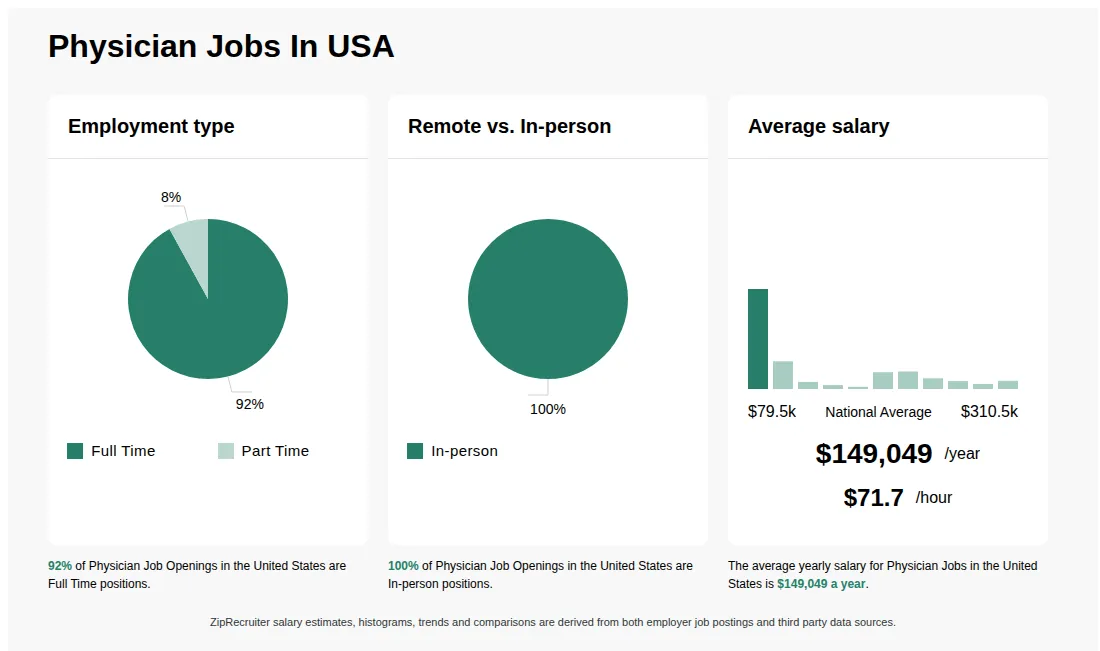
$89.9K is the 25th percentile. Wages below this are outliers.
$79.5K - $100.5K
51% of jobs
$100.5K - $121.5K
14% of jobs
$121.5K - $142.5K
3% of jobs
$142.5K - $163.5K
1% of jobs
$163.5K - $184.5K
1% of jobs
$198.3K is the 75th percentile. Wages above this are outliers.
$184.5K - $205.5K
8% of jobs
$205.5K - $226.5K
8% of jobs
$226.5K - $247.5K
5% of jobs
$247.5K - $268.5K
3% of jobs
$268.5K - $289.5K
2% of jobs
$289.5K - $310.5K
3% of jobs
$79.5K
$149K
$310.5K
How much do physician jobs pay per year?
As of Sep 7, 2026, the average yearly pay for physician in the United States is $149,049.00, according to ZipRecruiter salary data. Most workers in this role earn between $81,000.00 and $216,500.00 per year, depending on experience, location, and employer.
What is a physician?
Physicians are licensed medical professionals who diagnose, treat, and help prevent diseases and injuries in patients. They provide medical care by examining patients, ordering and interpreting diagnostic tests, prescribing medications, and recommending treatment plans. Physicians can specialize in various areas, such as family medicine, internal medicine, pediatrics, or surgery. Their role is essential in maintaining and improving individual and community health. Becoming a physician typically requires extensive education and training, including medical school and residency.
What do physicians do?
Physicians examine, diagnose, and treat patients, often with injuries and illnesses. They meet with patients, record medical histories, conduct routine physical exams, prescribe medications, and run diagnostic tests to determine a patient’s health status. Physicians also provide guidance to their patients on aspects of a healthy lifestyle, like diet, exercise, and hygiene. Physicians may direct other medical staff and train new physicians, educating them in the field.
What are the key skills and qualifications needed to thrive as a physician, and why are they important?
To thrive as a Physician, you need a comprehensive medical education (MD or DO), completion of residency training, and a valid medical license. Familiarity with electronic health record (EHR) systems, diagnostic tools, and continuing medical education certifications is crucial. Excellent communication, empathy, problem-solving, and the ability to work under pressure are standout soft skills in this field. These skills and qualifications are vital to delivering effective patient care, maintaining safety, and adapting to evolving medical environments.
What are some common challenges physicians face when managing work-life balance in a clinical setting?
Physicians often encounter challenges in maintaining work-life balance due to demanding schedules, unpredictable hours, and the emotional intensity of patient care. Many physicians are required to be on-call, work nights or weekends, and respond to emergencies, which can impact personal time. However, healthcare organizations are increasingly aware of these issues and are implementing support measures such as flexible scheduling, job sharing, and wellness programs to help physicians manage stress and avoid burnout. Proactively communicating your needs and taking advantage of available resources can make a significant difference.
What is the difference between Physician vs Nurse Practitioner?
| Aspect | Physician | Nurse Practitioner |
|---|---|---|
| Credentials | Medical degree (MD or DO), residency | Master's or Doctorate in Nursing, certification |
| Work Environment | Hospitals, clinics, private practices | Hospitals, clinics, outpatient settings |
| Scope of Practice | Diagnose, treat, perform surgeries, prescribe medications | Diagnose, treat, prescribe medications, some procedures |
| Industry Usage | Primary care and specialized medicine | Primary care, some specialties, patient management |
Physicians and Nurse Practitioners both provide essential healthcare services, but physicians typically have more extensive training and a broader scope of practice, including performing surgeries. Nurse Practitioners often focus on primary care, offering diagnosis and treatment within their scope, and work collaboratively with physicians in various healthcare settings.
More about Physician jobs
What cities are hiring for Physician jobs?
Cities with the most Physician job openings:
What are the most commonly searched types of Physician jobs?
The most popular types of Physician jobs are:
Who are the top companies hiring for Physician jobs?
The top employers for Physician jobs are:
What states have the most Physician jobs?
States with the most job openings for Physician jobs include:
What job categories do people searching Physician jobs look for?
The top searched job categories for Physician jobs are:
What points of interest are hiring for Physician jobs?
Points of interest with the most Physician job openings:
What are popular job titles related to Physician jobs?
For Physician jobs, the most frequently searched job titles are:

Other
Re-posted 5 days ago
Key responsibilities
Evaluate and manage critically ill patients in the ICU during night shifts, performing necessary procedures as required.
Provide expert medical consultation and collaborate with a multidisciplinary team to develop and implement patient care plans.
Ensure accurate medical documentation, respond to emergencies, and participate in quality improvement initiatives.
Job description
Seeking a board-certified/eligible physician specializing in critical care to join our Intensive Care Unit (ICU) team at Medical Center in Palm Beach County, FL. The successful candidate will be responsible for overseeing the care of critically ill patients during night shifts, working in conjunction with a multidisciplinary team of healthcare professionals. This role requires an unwavering commitment to excellence in patient care and the ability to handle high-stress situations effectively.
Responsibilities:
- Direct Patient Care: Evaluate and manage critically ill patients in the ICU, providing immediate and ongoing care. Perform necessary procedures such as intubation, central line placement, arterial line placement, lumbar punctures, etc., as required by the patient's condition.
- Medical Consultation: Provide expert advice to other physicians, nurses, and healthcare staff regarding the diagnosis, management, and treatment of critically ill patients. Offer consultations to other departments as necessary.
- Interdisciplinary Teamwork: Collaborate closely with a multidisciplinary team, including but not limited to, intensivists, hospitalists, pulmonologists, surgeons, radiologists, pharmacists, dietitians, social workers, and case managers, to formulate and implement comprehensive patient care plans.
- Diagnostic Review: Interpret and integrate data from a variety of sources, such as lab results, radiology studies, and other diagnostic tests to inform the diagnosis and management of patients.
- Education and Guidance: Educate patients and their families about their conditions and the associated treatments, complications, and prognoses. This may include discussing end-of-life care and advanced directives with patients and their families.
- Medical Documentation: Ensure accurate and timely documentation of all patient interactions, treatment plans, medical decisions, and outcomes in the Electronic Health Records (EHR). Complete necessary paperwork for patient admissions, discharges, and transfers.
- Clinical Leadership: Act as a leader within the ICU, promoting a culture of clinical excellence, open communication, and patient-centered care. Mentor and guide junior doctors, nurses, and other health care professionals, promoting continuous learning and development.
- Quality Improvement and Research: Participate in quality improvement initiatives, contributing to the development and implementation of policies, protocols, and procedures to enhance patient care in the ICU. Engage in clinical research as relevant to improve the understanding and management of critical illnesses.
- Emergency Management: Respond promptly and effectively to sudden changes in patient condition or acute emergencies. Coordinate with the rapid response team as necessary.
- Compliance and Ethics: Comply with all legal and ethical standards, as well as hospital policies and procedures. Respect patient confidentiality and autonomy at all times.
Qualifications:
- Doctor of Medicine (MD) or Doctor of Osteopathy (DO) from an accredited institution
- Board certification/eligibility in Critical Care Medicine
- Valid and active medical license in the state of Florida
- Minimum of [2-3] years of experience as an ICU physician, preferred
- Excellent communication, problem-solving, and leadership skills
- Ability to work during night shifts, including some weekends and holidays
Contact us today for more information and include your updated CV and phone #
Debbie Aber
Physician Services
847-541=9347
physervices@comcast.net

About Physician Services
Sourced by ZipRecruiter