1

Pattern Making Jobs (NOW HIRING)

Stay current with industry trends, emerging technologies, and best practices in tooling and pattern making. Administrative Responsibilities * Maintain accurate records, documentation, and reports ...

Pattern Maker Reports to: Sand Superintendent Location: Cleveland, Ohio Position Type: Full-time ... Decision-making -- Assess situations to determine the importance, urgency, and risks, and make ...

This critical role is responsible for pattern making, cutting, and fabrication in one of the finest regional shops. Key Responsibilities include but are not limited to the following: * Works directly ...

Be Seen First

Apparel Pattern Maker

Brooklyn, NY · On-site

$85K - $110K/yr

We're seeking a highly skilled apparel Pattern Maker, already experienced in 3D design or ready and ... Production marker making experience * Experience working in PLM systems * Working fluency in ...

Apparel Pattern Maker

New York, NY · On-site

$85K - $110K/yr

We're seeking a highly skilled apparel Pattern Maker, already experienced in 3D design or ready and ... Production marker making experience * Experience working in PLM systems * Working fluency in ...

Urgent

next page

Showing results 1-20

Pattern Making information

See salary details

$33.5K

$77.4K

$126K

How much do pattern making jobs pay per year?

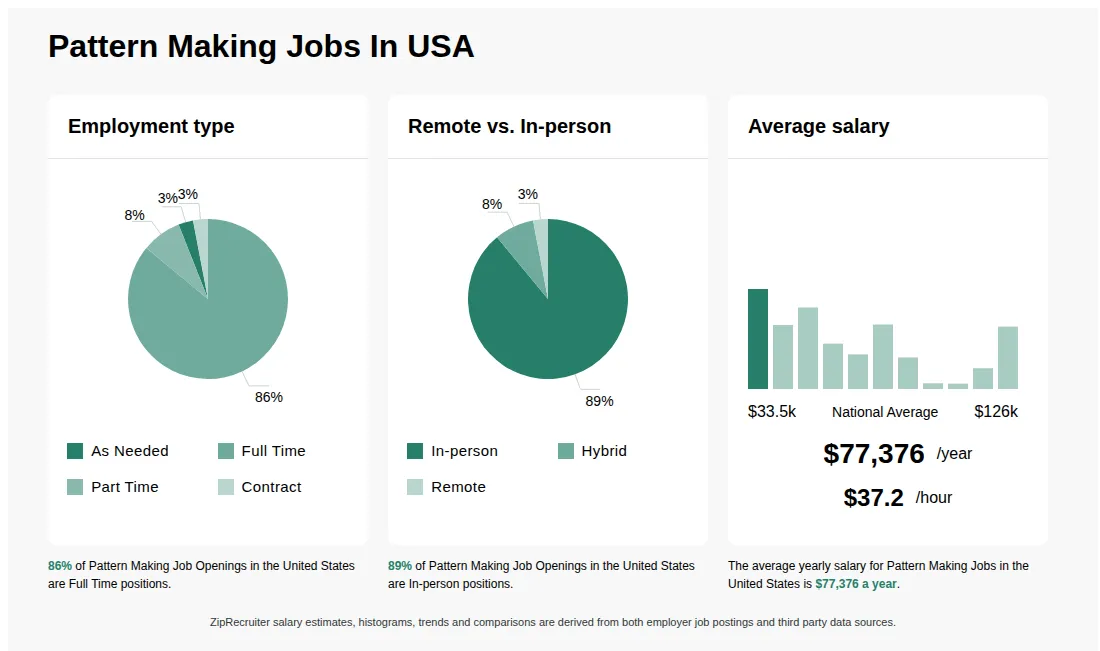
As of May 30, 2026, the average yearly pay for pattern making in the United States is $77,376.00, according to ZipRecruiter salary data. Most workers in this role earn between $48,000.00 and $86,000.00 per year, depending on experience, location, and employer.

What is a Pattern Making job?

A Pattern Making job involves creating templates or blueprints for garments, accessories, or other textile-based products. Pattern makers translate design sketches into accurate patterns that guide the cutting and sewing process in production. They use specialized software or manual techniques to ensure proper fit, proportions, and construction details. Precision and attention to detail are essential, as patterns dictate the final look and functionality of a product.

What are the key skills and qualifications needed to thrive in the Pattern Making position, and why are they important?

To thrive in Pattern Making, a strong understanding of garment construction, dimensional accuracy, and textile properties is essential, often supported by coursework or experience in fashion design or apparel technology. Familiarity with pattern drafting software like Gerber, Optitex, or CAD systems is typically required, and formal certifications can be an advantage. Attention to detail, creative problem-solving, and effective teamwork are important soft skills for success in this role. These skills ensure the creation of functional, well-fitting garments and facilitate smooth collaboration within the production team.

What are some common challenges faced by Pattern Makers in the apparel industry?

Pattern Makers often encounter challenges such as accommodating unique design specifications while ensuring garments maintain proper fit and functionality. Balancing creative vision with technical limitations, especially when working with new fabrics or manufacturing processes, can require innovative problem-solving. Additionally, managing tight deadlines and frequent iterations with design and production teams demands strong organizational skills. Collaborating closely with designers, sample makers, and production staff is key to overcoming these challenges and achieving high-quality, finished products.

What career can you have with pattern making?

Pattern making is a key skill in the fashion and apparel industry, enabling careers such as fashion designer, technical designer, sample maker, or pattern maker technician. Professionals in this field often work in clothing manufacturing, costume design, or product development, utilizing tools like CAD software and sewing techniques. Advanced skills and certifications can lead to roles in design management or pattern development for large brands.
What cities are hiring for Pattern Making jobs? Cities with the most Pattern Making job openings:
What are the most commonly searched types of Pattern Making jobs? The most popular types of Pattern Making jobs are:
What states have the most Pattern Making jobs? States with the most job openings for Pattern Making jobs include:
Infographic showing various Pattern Making job openings in the United States as of May 2026, with employment types broken down into 1% As Needed, 72% Full Time, 24% Part Time, 1% Temporary, and 2% Contract. Highlights an 13% Physical, and 87% Remote job distribution, with an average salary of $77,376 per year, or $37.2 per hour.
Clothing Designer (Patterns)

$55.60K/yr

Other

Posted 3 days ago


U.S. Department Of Defense rating

7.7

Company rating: 7.7 out of 10

Based on 517 frontline employees who took The Breakroom Quiz

26th of 46 rated military and defense


Job description

See below for important information regarding this job.Qualifications:To qualify for a Clothing Designer (Patterns) your resume and supporting documentation must support:
A. Specialized Experience: One year of specialized experience that equipped you with the particular competencies to successfully perform the duties of the position, and that is typically in or related to the position to be filled. To qualify at the GS-11 level, applicants must possess one year of specialized experience equivalent to the GS-09 level or equivalent under other pay systems in the Federal service, military or private sector. To qualify at the GS-09 level, applicants must possess one year of specialized experience equivalent to the GS-07 level or equivalent under other pay systems in the Federal service, military or private sector To qualify at the GS-07 level, applicants must possess one year of specialized experience equivalent to the GS-05 level or equivalent under other pay systems in the Federal service, military or private sector. .Applicants must meet eligibility requirements including minimum qualifications, and any other regulatory requirements by the cut-off/closing date of the announcement. Creditable specialized experience includes:
GS-11:
  • - Display comprehensive knowledge of the principles and techniques of uniform and clothing design, flat patterns, drawings, grading/sizing, commercial practices, characteristics of materials and finishes and various fabrication and manufacturing techniques.
  • - Experience with and in-depth knowledge of the principles and techniques of tailoring, pattern making and size grading, and the ability to translate designs into flat patterns using traditional and modern methods.
  • - Knowledge of multiple CAD software systems and equipment in order to accomplish assigned work including storing master patterns, assist others in equipment operation and maintenance, etc.
  • - Experienced judgment in modifying, adapting, or making compromises with standard guidelines and in developing approaches and solutions to complex features.
GS-09:
  • - Knowledge of the principles and techniques of uniform and clothing design, flat patterns, drawings, grading/sizing, commercial practices, characteristics of materials and finishes and various fabrication and manufacturing techniques.;
  • - Experience with pattern making or grading.
GS-07:
  • - Experience in the design and development of highly tailored outer garments or specialized occupational clothing such as clothing for a particular functional or occupational purpose.
  • - Experience with demonstrated knowledge of layout and fabrication methods.

B. Education Substitution: Such education must demonstrate the knowledge, skills, and abilities necessary to do the work. Education must be from a college or university accredited by an organization approved by the U.S. Department of Education. See http://ope.ed.gov/accreditation/Search.aspx. If using education to meet basic qualifications, YOU MUST SUBMIT A TRANSCRIPT as supplemental documentation. To qualify based on education in lieu of specialized experience, you must possess:
  • GS-11: A Ph.D. or equivalent doctoral degree 3 years of progressively higher-level graduate education leading to such a degree, or LL.M., if related. If qualifying on strictly education, Undergraduate and Graduate Education; Major study must be in one the following: textile technology, tailoring, clothing design, clothing production, anthropometry, anatomy, or physiology.
  • GS-09: A Master's or equivalent graduate degree, or 2 full years of progressively higher-level graduate education leading to such a degree, or LL.B. or J.D; with a major in one the following: textile technology, tailoring, clothing design, clothing production, anthropometry, anatomy, or physiology.
  • GS-07: One full year of graduate level education or have superior academic achievement with a major in one of the following: textile technology, tailoring, clothing design, clothing production, anthropometry, anatomy, or physiology.
C. Combination: Combinations of successfully completed post-high school education and experience may be used to meet total qualification requirements for grade levels GS-11, GS-09 and GS-07, and may be computed by first determining the applicant's total qualifying experience as a percentage of the experience required for the grade level; then determining the applicant's education as a percentage of the education required for the grade level; and then adding the two percentages. The total percentages must equal at least 100 percent to qualify an applicant for that grade level. Only graduate education in excess of the amount required for the next lower grade level may be used to qualify applicants for positions at grade GS-11, GS-09, and GS-07.

Experience refers to paid and unpaid experience, including volunteer work done through National Service programs (e.g., Peace Corps, AmeriCorps) and other organizations (e.g., professional, philanthropic, religious, spiritual, community, student, social). Volunteer work helps build critical competencies, knowledge, and skills and can provide valuable training and experience that translates directly to paid employment. You will receive credit for all qualifying experience, including volunteer experience.
To be found well-qualified as an ICTAP applicant, individuals need to demonstrate experience including: Skilled as a Clothing Designer (Patterns) and technical consultant. Evaluating, maintaining, drafting, and developing master patterns for prototype and standard garments, work from sketches and sample models. Determining complete pattern requirements, including sizing patterns based on the thickness of components, number of layers involved, construction type desired. Hands-on experience with maintaining inventory of Computer Aided Draft (CAD) and paper patterns. Developing and drafting special measurement patterns through the utilization of a computer aided design (CAD) system and through the manual modification of existing hard paper patterns and recommending major modifications to the patterns for a wide variety of garments. Reviewing and organizing technical information and analyzing problem areas and proposing technical solutions. Developing item files and data packages for technical history on each item.
Expertise in knowledge of the principles and techniques of uniform and clothing design, patterns, drawings, grading/sizing, commercial practices, characteristics of materials and finishes, and skilled in various fabrication and manufacturing techniques to devise new or improved methods of clothing design and/or manufacture. Applying techniques of tailoring, pattern making and size grading, and the ability to translate designs into patterns using traditional and modern methods. Providing technical advice and guidance on assigned projects to review technical data, conduct preliminary negotiations, and make recommendations.Education:Are you using your education to qualify? You MUST provide transcripts or other documentation to support your educational claims. Unless otherwise stated: Unofficial transcripts are acceptable at time of application.
GRADUATE EDUCATION: One academic year of graduate education is considered to be the number of credits hours that your graduate school has determined to represent one academic year of full-time study. Such study may have been performed on a full-time or part-time basis. If you cannot obtain your graduate school's definition of one year of graduate study, 18 semester hours (or 27 quarter hours) should be considered as satisfying the requirement for one year of full-time graduate study.
FOREIGN EDUCATION: If you are using education completed in foreign colleges or universities to meet the qualification requirements, you must show that the education credentials have been evaluated by a private organization that specializes in interpretation of foreign education programs and such education has been deemed equivalent to that gained in an accredited U.S. education program; or full credit has been given for the courses at a U.S. accredited college or university.Employment Type: OTHER

What U.S. Department Of Defense employees say

Pay

Benefits

Hours and flexibility

Workplace

Get the full story on Breakroom