1

Master Data Analyst Jobs (NOW HIRING)

Data Analysis: Conduct thorough data analysis to identify data quality issues, inconsistencies, and ... Train and mentor team members on master data best practices and tools. * Tool Expertise:

Managing master data, including creation, updates, and deletion. Managing users and user roles. Provide quality assurance of imported data, working with quality assurance analysts if necessary.

Managing master data, including creation, updates, and deletion. Managing users and user roles. Provide quality assurance of imported data, working with quality assurance analysts if necessary.

Managing master data, including creation, updates, and deletion. Managing users and user roles. Provide quality assurance of imported data, working with quality assurance analysts if necessary.

Managing master data, including creation, updates, and deletion. Managing users and user roles. Provide quality assurance of imported data, working with quality assurance analysts if necessary.

next page

Showing results 1-20

Master Data Analyst information

See salary details

$19

$44

$76

How much do master data analyst jobs pay per hour?

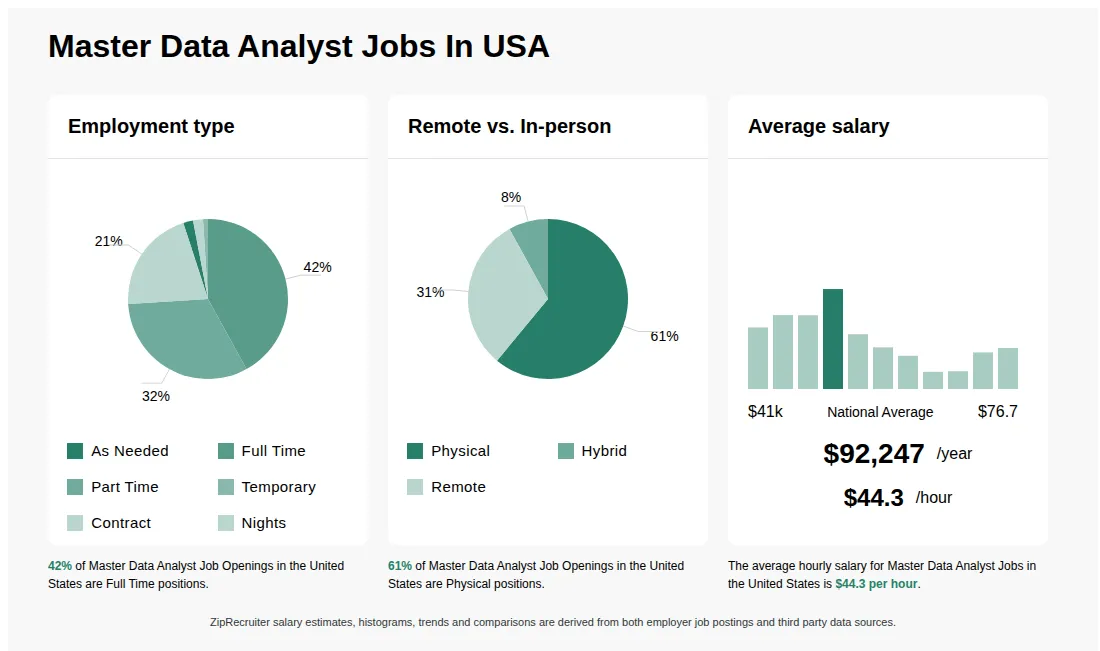
As of Jul 12, 2026, the average hourly pay for master data analyst in the United States is $44.35, according to ZipRecruiter salary data. Most workers in this role earn between $30.53 and $55.29 per hour, depending on experience, location, and employer.

What are Master Data Analysts?

Master Data Analysts are professionals responsible for managing and maintaining an organization's critical business data, often referred to as 'master data.' This includes key information about customers, products, suppliers, and other core business entities. Their work ensures that data is accurate, consistent, and accessible across different departments and systems. Master Data Analysts also help establish data governance standards, support data integration projects, and troubleshoot data quality issues to support business operations and decision-making.

How does a Master Data Analyst typically collaborate with other departments to maintain data quality?

A Master Data Analyst regularly works with teams such as IT, finance, supply chain, and operations to ensure data consistency and integrity across systems. This collaboration often involves participating in cross-functional meetings, clarifying data requirements, and resolving discrepancies in master data. Effective communication and problem-solving skills are essential, as the analyst serves as a bridge between technical and business stakeholders to implement data governance policies and improve data processes.

What Does a Master Data Analyst Do?

A master data analyst monitors and examines master and key data within a company or organization. As a master data analyst, your job duties include developing databases to support business goals, implementing standards for collecting and storing data, and using data to gain key business insights. The career typically requires a bachelor’s degree in IT, data science, or a related field and work experience in data analysis or software programming. Additional qualifications include strong analytical and computer skills, as well as an understanding of database architecture.

Is a master's in data analysis worth it?

For a Master Data Analyst, obtaining a master's degree in data analysis can enhance technical skills, such as proficiency in SQL, Python, and data visualization tools, and may improve job prospects and salary potential. However, practical experience and certifications like Certified Analytics Professional (CAP) can also be valuable in this field. The decision depends on career goals and the specific requirements of employers in data analysis roles.

Is 40 too late for data science?

For a Master Data Analyst, age is not a barrier to entering data science. Many professionals successfully transition into data science roles later in their careers by acquiring relevant skills such as programming, statistics, and tools like Python or SQL, often through online courses or certifications. Experience and continuous learning are valued more than age in the data industry.

Will AI replace a data analyst?

AI can automate routine data processing and basic analysis tasks, but a Master Data Analyst's role involves interpreting complex data, making strategic decisions, and communicating insights, which require human judgment and domain expertise. AI tools are valuable for enhancing efficiency but are unlikely to fully replace skilled analysts who provide critical context and nuanced analysis.

What are the key skills and qualifications needed to thrive as a Master Data Analyst, and why are they important?

To thrive as a Master Data Analyst, you need a strong background in data management, analytics, and a relevant degree such as computer science, information systems, or business. Familiarity with data management tools like SAP, Oracle, SQL, and experience with data governance frameworks or related certifications are typically required. Excellent attention to detail, problem-solving abilities, and effective communication skills help distinguish top performers in this role. These competencies are critical for ensuring data accuracy, supporting business decisions, and maintaining consistent data standards across the organization.

What can I do with a master's in data analysis?

A master's in data analysis prepares individuals for roles such as Master Data Analyst, Data Scientist, or Business Intelligence Analyst, involving tasks like data cleaning, statistical analysis, and reporting. It often requires proficiency in tools like SQL, Python, or R and understanding of data management systems. Graduates can work in various industries including finance, healthcare, and technology, often in environments that emphasize data-driven decision making.

What is the difference between Master Data Analyst vs Data Analyst?

AspectMaster Data AnalystData Analyst
CredentialsBachelor's degree in data-related field; certifications like CDMP or DAMA often preferredBachelor's degree in statistics, mathematics, or related field; certifications are optional
Work EnvironmentFocus on managing and maintaining master data across departmentsAnalyze data sets to generate reports and insights for decision-making
Industry UsageCommon in organizations with complex data management needsWidespread across various industries for data analysis tasks

The main difference is that a Master Data Analyst specializes in managing and maintaining core organizational data, ensuring data quality and consistency. In contrast, a Data Analyst primarily focuses on analyzing data to support business decisions. Both roles require strong analytical skills, but the Master Data Analyst emphasizes data governance and integrity, often working closely with IT and data management teams.

What cities are hiring for Master Data Analyst jobs? Cities with the most Master Data Analyst job openings:
Who are the top companies hiring for Master Data Analyst jobs? The top employers for Master Data Analyst jobs are:
What states have the most Master Data Analyst jobs? States with the most job openings for Master Data Analyst jobs include:
What are popular job titles related to Master Data Analyst jobs? For Master Data Analyst jobs, the most frequently searched job titles are:
Infographic showing various Master Data Analyst job openings in the United States as of July 2026, with employment types broken down into 43% Full Time, 7% Part Time, and 50% Contract. Highlights an 86% In-person, and 14% Remote job distribution, with an average salary of $92,247 per year, or $44.3 per hour.

Project Manager & Data Analyst, Master Data Management (MDM)

Futran Tech Solutions Pvt. Ltd.

Austin, TX • On-site

Full-time

Re-posted 21 days ago


Job description

Job Title: Project Manager & Data Analyst, Master Data Management (MDM)
Location: Austin, TX (Preferred)

Project Manager and Data Analyst with practical hands-on experience to lead and execute Master Data Management (MDM)( is must to have)
About the Role:
We are seeking a highly skilled hybrid Project Manager and Data Analyst with practical hands-on experience to lead and execute Master Data Management (MDM) initiatives with our Core Data team on a contract basis. This team is responsible for delivering high-quality data solutions and services that support business strategy and operations.
This dual-hat role is critical in helping us assess the gap between our current data infrastructure and our defined future state, while simultaneously driving the project to completion. The successful candidate will not only manage project timelines, resources, and risks, but also roll up their sleeves to perform detailed analysis of existing data. You will identify where changes are needed to support future business capabilities, evaluate potential business impacts, determine the scale and severity of those impacts, and recommend practical approaches to mitigate them. The role will be based out of our Austin offices.
Key Responsibilities
End-to-End Project Management: Lead the planning, execution, and delivery of MDM initiatives. Develop project plans, manage sprint schedules, track milestones, and proactively identify and mitigate project risks.
Impact Assessment & Gap Analysis: Analyze current-state data against future-state MDM needs, identifying deltas, assessing business impact severity, and proposing mitigation strategies to keep the project on track.
Stakeholder Engagement & Communication: Facilitate harmonization discussions with global business teams and support governance forums to align on key MDM attributes. Provide regular status updates, executive summaries, and risk assessments to leadership and steering committees.
Data Profiling & Availability Analysis: Partner with SMEs and business stakeholders to understand current data structures, availability, and gaps, translating these findings into actionable project requirements.
Integration & Transformation Design: Define, document, and manage the requirements for data integration, migration, transformation, and current-to-future state mapping
Data Quality Evaluation: Assess and document the quality of key MDM attributes, define data quality rules, and collaborate with data quality analysts and business partners to drive improvements.
Testing, Validation & UAT: Manage and actively participate in the validation of new or transformed data sets. Oversee User Acceptance Testing (UAT) to ensure data integrity and alignment with business requirements before deployment.
Key Qualifications
Project Management Expertise: Proven track record of managing complex data, MDM, or governance projects. Strong proficiency in Agile/Scrum methodologies and project management tools (e.g., Jira, Confluence, Smartsheet, MS Project).
Master Data & Governance: Deep understanding of master data management principles, data governance frameworks, and large-scale data quality improvement initiatives.
Impact & Business Analysis Skills: Proven ability to capture/document requirements, assess business impacts and tradeoffs, and align stakeholders through interviews, workshops, and requirements harmonization.
Technical Data Skills:
* Hands-on experience with data profiling, source system analysis, and KPI definition.
* Strong SQL & Python expertise and experience querying large, complex data sets.
* Familiarity with at least one analytics platform (e.g., Hadoop, Spark, Snowflake).
* Experience with BI tools such as Tableau, ThoughtSpot, or Business Objects.
Data Architecture & Quality: Understanding of data architecture principles, data lineage, and experience maintaining data dictionaries/definitions.
Tools & Platforms: Exposure to tools such as Collibra, Data Hub (or equivalent for governance and data quality) alongside standard PM software.
Collaboration & Communication: Ability to navigate a matrixed organization, work across time zones, drive consensus among competing priorities, and build strong stakeholder relationships.
Execution & Accountability: Strong problem-solving skills with a track record of delivering results on time and within budget in large, complex programs.
Education & Experience
5+ years of combined experience in project management and data analysis, specifically focused on data-related initiatives, MDM, or data governance.
Project Management certifications (e.g., PMP, CSM, PMI-ACP) are highly preferred.
Industry-standard certifications in data management or analytics preferred.
Deep familiarity with D&B data architecture, hierarchies, and enrichment preferred.