1

Industrial Engineering Jobs (NOW HIRING)

Industrial Engineering Lead

Huntsville, AL · On-site

$69K - $93K/yr

Guidehouse is seeking an Industrial Engineering Lead who will lead the delivery of modeling and simulation solutions, recommendations for continuous improvement and operational excellence, and an ...

Industrial Engineering Supervisor Location: Cresco, IA Job Summary: Industrial engineering technicians help engineers solve problems affecting manufacturing layout or production. They prepare ...

Industrial Engineering Lead

Huntsville, AL · On-site

$69K - $93K/yr

Guidehouse is seeking an Industrial Engineering Lead who will lead the delivery of modeling and simulation solutions, recommendations for continuous improvement and operational excellence, and an ...

We are seeking a strategic engineering leader to lead our Industrial Engineering function at our Anoka, MN manufacturing campus. In this role, you will shape the direction of facility-wide industrial ...

Role Purpose The Industrial Engineering Manager leads hands-on operational improvement initiatives across the A.M.P.S. manufacturing site. This role is responsible for improving PM green-to-green ...

next page

Showing results 1-20

Industrial Engineering information

See salary details

$36K

$83.5K

$116K

How much do industrial engineering jobs pay per year?

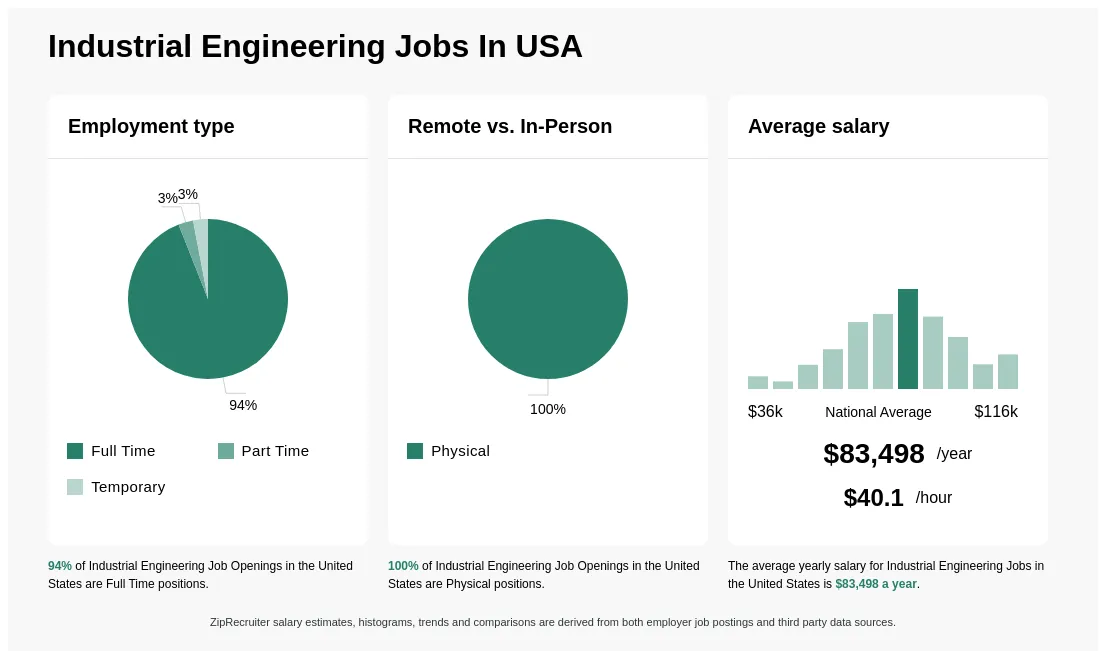
As of Jul 23, 2026, the average yearly pay for industrial engineering in the United States is $83,498.00, according to ZipRecruiter salary data. Most workers in this role earn between $70,000.00 and $94,500.00 per year, depending on experience, location, and employer.

What engineers make $500,000?

Senior engineers in specialized fields such as petroleum, aerospace, or software engineering can earn $500,000 or more annually, often through a combination of base salary, bonuses, and stock options. These roles typically require extensive experience, advanced skills, and sometimes leadership responsibilities or working in high-cost-of-living areas.

What are the key skills and qualifications needed to thrive as an Industrial Engineer, and why are they important?

To thrive as an Industrial Engineer, you need strong analytical skills, a solid grasp of process optimization, and a bachelor's degree in industrial engineering or a related field. Familiarity with tools like AutoCAD, Six Sigma methodologies, and ERP systems, as well as relevant certifications such as Lean Six Sigma Green Belt, are typically required. Excellent problem-solving abilities, teamwork, and effective communication distinguish top performers in this role. These competencies are crucial for designing efficient systems, reducing costs, and improving productivity in various industries.

What is the job of an industrial engineer?

An industrial engineer designs, develops, and improves manufacturing and service processes to increase efficiency, reduce waste, and optimize productivity. They analyze workflows, use tools like time studies and data analysis, and often work in environments such as factories or offices to implement process improvements.

What is industrial engineering?

Industrial engineering is a branch of engineering focused on optimizing complex processes, systems, or organizations by improving efficiency, productivity, quality, and safety. Industrial engineers analyze workflows, design efficient systems, and integrate people, materials, information, and technology to streamline operations. Their work is applicable in various industries, including manufacturing, healthcare, logistics, and service sectors. By reducing waste and improving processes, industrial engineers help organizations save time and resources.

What is the difference between Industrial Engineering vs Mechanical Engineering?

AspectIndustrial EngineeringMechanical Engineering
Required CredentialsBachelor's in Industrial Engineering or related field; often professional certificationsBachelor's in Mechanical Engineering; licensure may be required for certain roles
Work EnvironmentManufacturing, healthcare, logistics, consultingDesign, manufacturing, automotive, aerospace
Industry UsageOptimizing processes, systems, and operationsDesigning mechanical systems, product development

Industrial Engineering focuses on improving processes and systems across various industries, while Mechanical Engineering emphasizes designing and developing mechanical devices and systems. Both fields share some credentials and work environments but serve different core functions in the industry.

What Is Industrial Engineering?

Industrial engineering is an engineering specialty that combines physical and social sciences with engineering principles. This field of engineering focuses on analyzing and optimizing manufacturing production processes to create more productive and profitable systems. Industrial engineers research a system’s current state, design improvement plans, and eliminate any waste of manpower, energy, money, and materials.

What engineers make $200,000 a year?

Senior industrial engineers with extensive experience, advanced skills in process optimization, and often certifications such as Six Sigma can earn salaries around or above $200,000 annually, especially in high-demand industries or managerial roles. Salary levels depend on factors like location, company size, and individual expertise.

How does an industrial engineer typically collaborate with other departments to improve operational efficiency?

Industrial engineers often work closely with teams in production, quality assurance, logistics, and IT to identify bottlenecks and streamline processes. They may lead cross-functional meetings to analyze workflow data, gather input from various stakeholders, and implement process improvements that benefit multiple departments. Strong communication skills and a collaborative mindset are essential, as industrial engineers must translate technical findings into actionable recommendations and ensure alignment with broader organizational goals.

What type of jobs do industrial engineers get?

Industrial engineers work in roles such as process improvement specialists, manufacturing engineers, quality assurance managers, supply chain analysts, and operations managers. They optimize production processes, improve efficiency, and reduce costs using skills in systems analysis, data analysis, and tools like CAD and Lean methodologies.
What cities are hiring for Industrial Engineering jobs? Cities with the most Industrial Engineering job openings:
What are the most commonly searched types of Industrial Engineering jobs? The most popular types of Industrial Engineering jobs are:
Who are the top companies hiring for Industrial Engineering jobs? The top employers for Industrial Engineering jobs are:
What states have the most Industrial Engineering jobs? States with the most job openings for Industrial Engineering jobs include:
Infographic showing various Industrial Engineering job openings in the United States as of July 2026, with employment types broken down into 93% Full Time, 4% Part Time, and 3% Contract. Highlights an 87% Physical, 4% Hybrid, and 9% Remote job distribution, with an average salary of $83,498 per year, or $40.1 per hour.

Industrial Engineering Technician

Unither Pharmaceuticals

Rochester, NY

Other

Posted 26 days ago


Job description

JOB SUMMARY:
The Lead Operations Industrial Engineer will serve as a key liaison between the Engineering, Operations and Production Maintenance teams driving continuous improvements in manufacturing processes. Responsibilities include managing the Industrial Engineering team, analyzing operations data, designing workflows and production processes, reducing inefficiencies, and ensuring that final products meet the established quality standards. The position also involves applying Lean, Six Sigma, and other methodologies to enhance cost efficiency while maintaining high-quality product standards.   Additionally, this position will document processes, develop troubleshooting methods, and provide training to team members to ensure  standardization and operational excellence. Collaboration with cross-functional teams, managing KPIs, and implementing new technologies or processes will also be key components of this role.
ESSENTIAL FUNCTIONS / RESPONSIBILITIES:
Operations Support
Participate in the writing of procedures for Operations activities linked to new equipment/processes.
Work with Manager and HR Department to implement training plans adapted to specific user profiles.
Determine and help ensure necessary documentation is in place, maintained and organized (e.g., troubleshooting guides, Process Flows, SOPs, etc.)
Develop and implement process improvements and technological upgrades.
Develop and implement Visual and Production documentation standards in cooperation with management and user personnel (5S floor zoning, furniture, line flow
Familiarize self with different key equipment (participation in the set-up and testing) and determine good practices of use (parameters, methods)
Train staff for new processes and provide instructions and manuals.
Represent Operations on Site Projects/Continuous Improvement Activities
Actively participate in the definition of needs in URS for both functional and technical specifications.
Represent plant operations during industrialization of new equipment/Line.
Review and approve Qualification and Validation documents.
Define and Lead action plan as necessary to get the equipment to match the expectations of the URS once installed/qualified.
Identify users and assess levels required based on department and specific needs.
Assist in the design and implementation of LEAN practices (VSM, Continuous flow, Workplace organization 5S, Cycle time, takt time studies, Ergonomic, Define Waste, TPM program)
Identify areas for improvement by collecting Data or with input from the Operations Department (Operations and Maintenance of Industrial Engineering Team
Supervise, mentor and develop the Industrial Engineering team, ensuring they have the necessary skills and resources to succeed.
Assign continuous improvement projects and tasks to Industrial Engineering Technicians and monitor workload and outcome.
Organize the department to be able to address continuous improvement initiatives as they are identified.
Team That Consistently Delivers
Ensure regulatory compliance.
Assist supervisors and directions to staff and coordinates workflow within the work unit based on new equipment/process improvements.
Provide technical assistance, positively answer users' questions and request for support in resolving problems/external analysis.
Keep abreast of all new technical knowledge and developments that impact performance and relay information to the Operations team.
Assist/lead the resolution of deviations by obtaining root cause and corrective actions in a timely manner with no disruption to operations activities.
Implement both short- and long-term corrective actions and process improvements to ensure continued compliance.
Assist with developing quantitative techniques to monitor process performance (KPI).
Analyze management information and continuous quality improvement data to identify ways to streamline, improve process quality and/or compliance while maintaining process effectiveness.
Ensure that all change control documentation is implemented, in a timely manner.
Ensure stakeholders are appropriately trained on the process and any process changes.