Risk Program Manager
Phoenix, AZ · Hybrid
The Clinical Risk Management Department is a dynamic, passionate, and engaged group of experienced Risk Managers, the majority being health care certified through the American Society for Healthcare ...
Phoenix, AZ · Hybrid
The Clinical Risk Management Department is a dynamic, passionate, and engaged group of experienced Risk Managers, the majority being health care certified through the American Society for Healthcare ...
Phoenix, AZ · Hybrid
The Clinical Risk Management Department is a dynamic, passionate, and engaged group of experienced Risk Managers, the majority being health care certified through the American Society for Healthcare ...
Newport News, VA · On-site
$60 - $80/hr
Certified Professional in Health Care Risk Management (CPHRM) - American Hospital Association Certification Center within 1 Year (Required) About us At Riverside Health System we care for others as ...
Newport News, VA · On-site
$60 - $80/hr
Certified Professional in Health Care Risk Management (CPHRM) - American Hospital Association Certification Center within 1 Year (Required) About us At Riverside Health System we care for others as ...
Portland, OR · On-site
$49.89 - $74.34/hr
Three to five years of experience in healthcare including behavioral health risk management or related field required. Three to five years of experience in a clinical role or clinical management ...
Portland, OR · On-site
$49.89 - $74.34/hr
Three to five years of experience in healthcare including behavioral health risk management or related field required. Three to five years of experience in a clinical role or clinical management ...
Portland, OR · On-site
$49.89/hr
Three to five years of experience in healthcare including behavioral health risk management or related field required. Three to five years of experience in a clinical role or clinical management ...
Portland, OR · On-site
$49.89/hr
Three to five years of experience in healthcare including behavioral health risk management or related field required. Three to five years of experience in a clinical role or clinical management ...
Moosic, PA · On-site
Bachelor's degree in a clinical healthcare, risk management, business, finance, or a related field required. Master's degree in health information management, nursing, or related field preferred.
Moosic, PA · On-site
Bachelor's degree in a clinical healthcare, risk management, business, finance, or a related field required. Master's degree in health information management, nursing, or related field preferred.
Certified Professional in Healthcare Risk Management (CPHRM) certification preferred. * Strong ... knowledge of healthcare regulatory and accreditation standards, including TJC, CMS, and Department ...
Certified Professional in Healthcare Risk Management (CPHRM) certification preferred. * Strong ... knowledge of healthcare regulatory and accreditation standards, including TJC, CMS, and Department ...
Certified Professional in Healthcare Risk Management (CPHRM) certification preferred. * Strong ... knowledge of healthcare regulatory and accreditation standards, including TJC, CMS, and Department ...
Certified Professional in Healthcare Risk Management (CPHRM) certification preferred. * Strong ... knowledge of healthcare regulatory and accreditation standards, including TJC, CMS, and Department ...
Houston, TX · On-site
Certified in Healthcare Risk Management (CPHRM) or able to obtain within two (2) years of employment Experience / Knowledge / Skills: * Minimum of five (5) years of progressive experience in a ...
Houston, TX · On-site
Certified in Healthcare Risk Management (CPHRM) or able to obtain within two (2) years of employment Experience / Knowledge / Skills: * Minimum of five (5) years of progressive experience in a ...
Certified Professional in healthcare Risk Management (CPHRM) preferred. Technical Skills: Computer proficiency to include at a minimum Microsoft Word, Excel, and Outlook, and hospital software ...
Certified Professional in healthcare Risk Management (CPHRM) preferred. Technical Skills: Computer proficiency to include at a minimum Microsoft Word, Excel, and Outlook, and hospital software ...
Certified Professional in healthcare Risk Management (CPHRM) preferred. Technical Skills: Computer proficiency to include at a minimum Microsoft Word, Excel, and Outlook, and hospital software ...
Certified Professional in healthcare Risk Management (CPHRM) preferred. Technical Skills: Computer proficiency to include at a minimum Microsoft Word, Excel, and Outlook, and hospital software ...
Overview Acadia Healthcare and Henry Ford Health System have partnered in a joint venture to ... The Risk Director will lead incident investigations, manage compliance with regulations, and ...
Overview Acadia Healthcare and Henry Ford Health System have partnered in a joint venture to ... The Risk Director will lead incident investigations, manage compliance with regulations, and ...
Certified Professional in Healthcare Quality (CPHQ) and/or Certified Professional in Healthcare Risk Management (CPHRM) required, or attainment within 1 year of hire. PREFERRED QUALIFICATIONS:
Certified Professional in Healthcare Quality (CPHQ) and/or Certified Professional in Healthcare Risk Management (CPHRM) required, or attainment within 1 year of hire. PREFERRED QUALIFICATIONS:
Houston, TX · On-site
$80 - $100/hr
Certified in Healthcare Risk Management (CPHRM) or able to obtain within two (2) years of employment * Experience / Knowledge / Skills: * Minimum of five (5) years of progressive experience in a ...
Houston, TX · On-site
$80 - $100/hr
Certified in Healthcare Risk Management (CPHRM) or able to obtain within two (2) years of employment * Experience / Knowledge / Skills: * Minimum of five (5) years of progressive experience in a ...
$14.25 - $19.25/hr
Certified Professional Healthcare Risk Management from the American Society for Healthcare Risk Management or Certified Professional in Patient Safety from the Institute for Healthcare Improvement ...
$14.25 - $19.25/hr
Certified Professional Healthcare Risk Management from the American Society for Healthcare Risk Management or Certified Professional in Patient Safety from the Institute for Healthcare Improvement ...
Charlotte, NC · On-site
$51.05 - $76.60/hr
Pay Range: $51.05 - $76.60 Identifies and evaluates risk in all areas of healthcare operations and champions the enterprise Advocate Risk Management Program at the assigned site(s) with the overall ...
Charlotte, NC · On-site
$51.05 - $76.60/hr
Pay Range: $51.05 - $76.60 Identifies and evaluates risk in all areas of healthcare operations and champions the enterprise Advocate Risk Management Program at the assigned site(s) with the overall ...
Peridot, AZ · On-site
$2.5K - $2.5K/wk
Certified Professional in Healthcare Risk Management (CPHRM) or Certified in Healthcare Compliance (CHC) (or willingness to obtain within 1 year of hire) * Strong analytical, communication, and ...
Quick apply
Peridot, AZ · On-site
$2.5K - $2.5K/wk
Certified Professional in Healthcare Risk Management (CPHRM) or Certified in Healthcare Compliance (CHC) (or willingness to obtain within 1 year of hire) * Strong analytical, communication, and ...
Demonstrates knowledge of principles/practices of healthcare risk management. * Understands insurance coverage, risk reduction/control, claims administration, investigations, etc. * Serves as ...
Demonstrates knowledge of principles/practices of healthcare risk management. * Understands insurance coverage, risk reduction/control, claims administration, investigations, etc. * Serves as ...
Education: * 4 year/Bachelor's Degree - Healthcare Administration, Public Health, Nursing, Business, Legal Studies, Risk Management, or related field. In lieu of a bachelor's degree, candidates may ...
Education: * 4 year/Bachelor's Degree - Healthcare Administration, Public Health, Nursing, Business, Legal Studies, Risk Management, or related field. In lieu of a bachelor's degree, candidates may ...
Tucson, AZ · On-site
Bachelor's degree in a clinical healthcare, risk management, business, finance, or a related field required. Master's degree in health information management, nursing, or related field preferred.
Tucson, AZ · On-site
Bachelor's degree in a clinical healthcare, risk management, business, finance, or a related field required. Master's degree in health information management, nursing, or related field preferred.
Certified Professional Healthcare Risk Management from the American Society for Healthcare Risk Management or Certified Professional in Patient Safety from the Institute for Healthcare Improvement ...
Certified Professional Healthcare Risk Management from the American Society for Healthcare Risk Management or Certified Professional in Patient Safety from the Institute for Healthcare Improvement ...
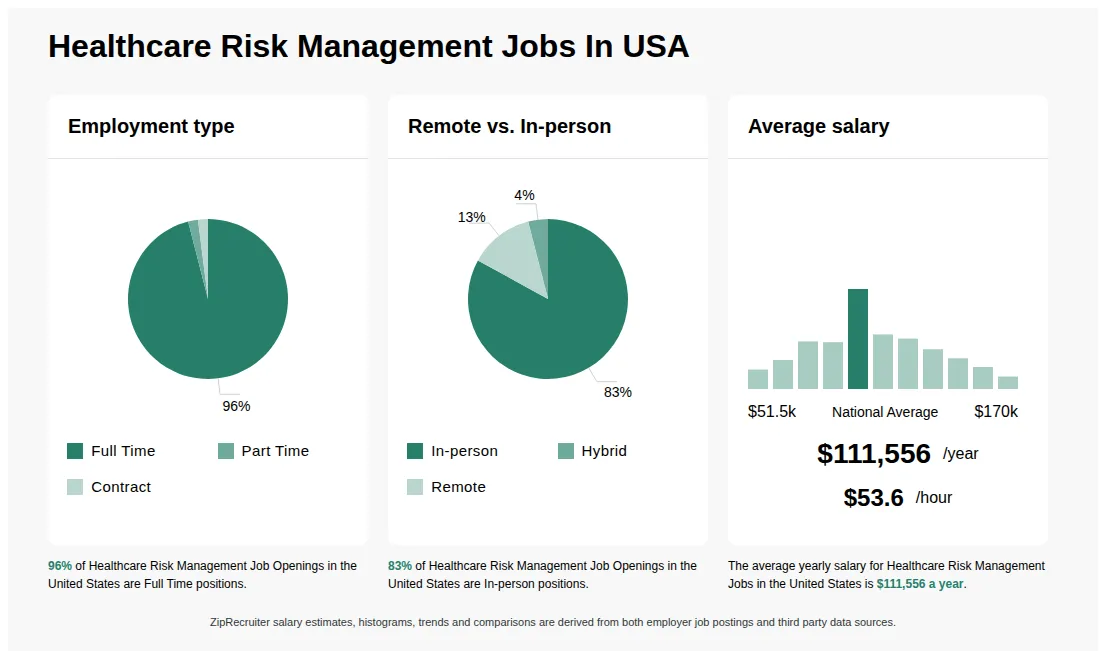
$51.5K - $62.3K
4% of jobs
$62.3K - $73K
6% of jobs
$73K - $83.8K
11% of jobs
$87.9K is the 25th percentile. Wages below this are outliers.
$83.8K - $94.6K
11% of jobs
The median wage is $103.2K / yr.
$94.6K - $105.4K
23% of jobs
$105.4K - $116.1K
13% of jobs
$123.2K is the 75th percentile. Wages above this are outliers.
$116.1K - $126.9K
12% of jobs
$126.9K - $137.7K
8% of jobs
$137.7K - $148.5K
6% of jobs
$148.5K - $159.2K
4% of jobs
$159.2K - $170K
2% of jobs
$51.5K
$111.6K
$170K
Healthcare risk management jobs include working as a risk management analyst, specialist, or manager. Each job has specific duties, but your overall goal is to identify risk in potential clients or pools of clients, assess whether healthcare staff and programs are in compliance with all government regulations, and provide analysis of business decisions or changes in public health and insurance policy. As a healthcare risk manager, you have increased supervisory responsibilities and take a leadership role in coordinating and implementing risk management strategies.
| Aspect | Healthcare Risk Management | Healthcare Compliance Officer |
|---|---|---|
| Primary Focus | Identifying, assessing, and mitigating risks to improve patient safety and reduce liability | Ensuring adherence to laws, regulations, and policies to maintain legal and ethical standards |
| Certifications | CPHRM, ARM, or similar risk management credentials | CHC, CHPC, or compliance-specific certifications |
| Work Environment | Hospitals, clinics, insurance companies, healthcare organizations | Hospitals, healthcare systems, regulatory agencies |
| Key Responsibilities | Risk assessments, incident investigations, safety protocols | Policy development, audits, regulatory reporting |
While both roles aim to improve healthcare quality and safety, Healthcare Risk Management focuses on proactively reducing risks and liabilities, whereas Healthcare Compliance Officers ensure adherence to legal and regulatory standards. Both roles often collaborate to promote a safe, compliant healthcare environment.
Cities with the most Healthcare Risk Management job openings:
The most popular types of Healthcare Risk Management jobs are:
States with the most job openings for Healthcare Risk Management jobs include:
The top searched job categories for Healthcare Risk Management jobs are:

Phoenix, AZ • Hybrid
Full-time
Re-posted 20 days ago
7.5
Based on 774 frontline employees who took The Breakroom Quiz
231st of 898 rated healthcare providers
Primary City/State:
Phoenix, ArizonaDepartment Name:
Risk ManagementWork Shift:
DayJob Category:
Risk, Quality and SafetyWe are honored to have earned Great Place To Work Certification for a third year in a row. This recognition reflects the dedication, expertise and compassion of our team members, who make Banner Health a great place to work.
Bring your passion for exceptional customer service, positive energy and creative thinking to a cohesive team that leverages knowledge and experience for customer enrichment and strong team performance. The Clinical Risk Management team prides itself on the ability to value diverse input and effectively adapt priorities to ensure customer and team needs are at the center of decision making in service to all Banner Health entities, customers, and communities.
As the Risk Program Manager supporting Banner Medical Center-South and the Ambulatory entities (clinics, home health, Imaging), you will have the opportunity to develop close partnerships with the healthcare team and Administration to improve patient safety, support our staff and physicians, and provide key risk management consultation. This team works together in an academic environment to provide quality care to underserved populations.
The Clinical Risk Management Department is a dynamic, passionate, and engaged group of experienced Risk Managers, the majority being health care certified through the American Society for Healthcare Risk Management . If you want to become part of a strong team of dedicated professionals, this is the team for you. The department has been successful with the planning, implementation, and ongoing support of the CANDOR program across the entire organization, which includes a care for the care giver peer support program for those staff and providers who are involved in events. This work at Banner Health has been recognized by poster presentations at several annual ASHRM annual conferences.
The CRM department supports Risk Managers who have not yet obtained certification through provision of study materials and an ongoing study group and covers the cost of passing the exam as well as recertification every three years. Opportunities for ongoing education through both ASHRM and the Arizona Society of Healthcare Risk Management , are provided.
The scheduled shift will be Monday - Friday 8am - 5pm, with periodic call. Hands-on patient care experience and background is preferred for this position.
Position can by hybrid - onsite as needed for meetings and rounding in Phoenix & Tucson.
POSITION SUMMARY
This position is responsible for the assigned entity's risk management activities, which includes, but may not be limited to a general knowledge of corporate insurance programs, administering the risk management program on a day-to-day basis, managing and analyzing risk management data, and conducting risk management educational programs, complying with risk management related standards by The Joint Commission (TJC )and other accrediting and regulatory agencies with the objective of enhancing and promoting patient safety, quality of care, and minimizing losses to protect the assets of the facility. This individual participates in formulating policy and/or organizational changes, but must seek advice and approval from higher authority. While the Risk Manager may be responsible for the functions in the Risk Specialist job description, this position most often provides guidance, oversight and offers overall program direction to staff performing these tasks in the Risk Specialist position. Provides information and data for the development of the budget for the assigned entities and obtains management approval.
CORE FUNCTIONS
1. Develops, coordinates, and administers systems for risk identification, investigation and reduction. Performs risk assessments in various clinical settings and inspects patient care areas. Maintains awareness of legislative activities that may affect risk management programs in assigned entities.
2. Develops, implements and monitors entity-specific risk management plan. Develops and monitors progress on annual entity-specific risk management goals. Collaborates with quality and patient safety representatives in developing performance improvement plans, indicators and goals.
3. Assumes an active role in planning and decision making efforts through membership in various entity committees: hospital, clinic, and ambulatory. Provides consultative advice to senior management, administrators, physicians, relevant internal department, nurses, and other personnel regarding patient safety and risk management issues.
4. Works in conjunction with the patient safety officer, service excellence, and management in the investigation of potential or actual events/concerns. Participates in root cause analysis investigation and reporting of adverse drug events and sentinel events to the appropriate parties.
5. Collects, evaluates and presents relevant data on risk management claims data to CEOs, administrators, physician committees, leadership groups, department heads and Human Resources; this includes aggregate data summaries, trend analyses, and claims and litigation information. Provides analysis of risk data for all levels of management. Shares risk management information and issues through participation in patient safety initiatives and various hospitals, medical staff and/or other similar entity-specific committees.
6. Responds to professional liability and facility liability questions posed by physicians, administrators, nurses, and other personnel regarding emergent patient care issues to minimize risk and control loss. Assists in resolving treatment issues, including patient decisions made against medical advice (AMA), refusals of treatment, and consent issues; initiates court orders as appropriate via in-house and outside legal counsel. Participates in the process of disclosure of medical errors. Provides assistance to departments in complying with TJC or other accrediting agencies, regarding risk management related standards. Responsible for being on call as scheduled.
7. The risk manager is responsible for development of loss prevention programs that may include but not limited to patient safety issues. Periodic inservices and routine orientation may be conducted for facility employees/medical staff regarding health care risk management and related subjects. Recommends appropriate revisions to new or existing policies and procedures to reduce the frequency of future occurrences; recommends ways to minimize risks through system changes; reviews and revises facility policies as appropriate to maintain adherence to current standards.
8. In litigated claims, assists Business Health Claims team and legal counsel in accessing facility records and personnel. May assume an active role in release of records and information in response to subpoenas, court orders, attorney requests, state and federal agency investigations, and other inquiries from outside sources.
9. Internal customers include senior management at assigned organization, patients and their families, administrators, physicians, relevant department heads, all types of employees, Business Health regional claims managers, region leaders, and the organization as a whole. External customers include federal agencies, the legal system such as the judiciary, outside legal counsel; state agencies, various professional boards; state and local law enforcement agencies; physicians and other health care providers.
MINIMUM QUALIFICATIONS
Must possess a knowledge of risk management as normally obtained through a bachelor's degree in nursing or related field.
CPHRM is required within two years of hire.
Four to five years in Risk Management or equivalent experience required. Must possess strong written and oral communications skills, presentation skills, team player, ability to influence change without direct authority, and negotiation skills. Must demonstrate and apply knowledge of federal and state statutes specific to health care, medical terminology and hospital or department policies, procedures and practices. Requires ability to manage and negotiate in emotional and confrontational situations, with sensitivity to operations and culture of facilities and organization as a whole.
PREFERRED QUALIFICATIONS
RN preferred. QA, Patient Safety, CPHQ, and/or ARM preferred; patient safety certification preferred.
Additional related education and/or experience preferred.
EEO Statement:
EEO/Disabled/Veterans
Our organization supports a drug-free work environment.
Privacy Policy:
Privacy Policy
Get the full story on Breakroom


