Nursing preferred. - Master's Degree is preferred. • Licensure & Certifications: - Certification in healthcare risk management (CPHRM) required within 4 years of hire. • Experience & Skills: - 7 ...
Nursing preferred. - Master's Degree is preferred. • Licensure & Certifications: - Certification in healthcare risk management (CPHRM) required within 4 years of hire. • Experience & Skills: - 7 ...

Patient Safety/Grievance Program Manager - TH Urgent Care (Breeze), Full-time, Days
Arlington, TX · On-site
Other Clinical Healthcare Related Field Upon Hire required * CRM - Certified Risk Manager within 12 Months required Or * CPPS - Certified Professional in Patient Safety within 12 Months required Or
Patient Safety/Grievance Program Manager - TH Urgent Care (Breeze), Full-time, Days
Arlington, TX · On-site
Other Clinical Healthcare Related Field Upon Hire required * CRM - Certified Risk Manager within 12 Months required Or * CPPS - Certified Professional in Patient Safety within 12 Months required Or
Compliance - Healthcare Risk Management Program Manager (O-5 Billet) Non-Supervisory
Washington, DC · On-site
The Compliance - Healthcare Risk Management Program Manager oversees risk management within ICE/IHSC, focusing on preventing, reducing, and controlling organizational loss while improving healthcare ...
Compliance - Healthcare Risk Management Program Manager (O-5 Billet) Non-Supervisory
Washington, DC · On-site
The Compliance - Healthcare Risk Management Program Manager oversees risk management within ICE/IHSC, focusing on preventing, reducing, and controlling organizational loss while improving healthcare ...

Travel Risk & Compliance Manager
Peridot, AZ · On-site
$2.5K - $2.5K/wk
Certified Professional in Healthcare Risk Management (CPHRM) or Certified in Healthcare Compliance (CHC) (or willingness to obtain within 1 year of hire) * Strong analytical, communication, and ...
Quick apply
Travel Risk & Compliance Manager
Peridot, AZ · On-site
$2.5K - $2.5K/wk
Certified Professional in Healthcare Risk Management (CPHRM) or Certified in Healthcare Compliance (CHC) (or willingness to obtain within 1 year of hire) * Strong analytical, communication, and ...

Education: * 4 year/Bachelor's Degree - Healthcare Administration, Public Health, Nursing, Business, Legal Studies, Risk Management, or related field. In lieu of a bachelor's degree, candidates may ...
Education: * 4 year/Bachelor's Degree - Healthcare Administration, Public Health, Nursing, Business, Legal Studies, Risk Management, or related field. In lieu of a bachelor's degree, candidates may ...

CPHRM - Certified Professional in Healthcare Risk Management (or within 1 year of hire) Preferred Certifications, Credentials and Licenses: Required Experience: 10+ years in healthcare. 1-3 years in ...
CPHRM - Certified Professional in Healthcare Risk Management (or within 1 year of hire) Preferred Certifications, Credentials and Licenses: Required Experience: 10+ years in healthcare. 1-3 years in ...

Risk Manager II
Orlando, FL · On-site
... to healthcare risk management, communicating relevant updates to stakeholders and adopting practices as needed. • Aggregates and analyzes data on patient injuries, incident trends, and sentinel ...
Risk Manager II
Orlando, FL · On-site
... to healthcare risk management, communicating relevant updates to stakeholders and adopting practices as needed. • Aggregates and analyzes data on patient injuries, incident trends, and sentinel ...
Risk Manager II
Orlando, FL · On-site
... to healthcare risk management, communicating relevant updates to stakeholders and adopting practices as needed. • Aggregates and analyzes data on patient injuries, incident trends, and sentinel ...
Risk Manager II
Orlando, FL · On-site
... to healthcare risk management, communicating relevant updates to stakeholders and adopting practices as needed. • Aggregates and analyzes data on patient injuries, incident trends, and sentinel ...
Director of Risk Management - RN
Las Cruces, NM · On-site
$120K - $150K/yr
Maintain awareness of emerging healthcare risk management trends, regulatory requirements, and industry best practices. Collaboration & Performance Improvement * Partner with the Chief Nursing ...
Quick apply
Director of Risk Management - RN
Las Cruces, NM · On-site
$120K - $150K/yr
Maintain awareness of emerging healthcare risk management trends, regulatory requirements, and industry best practices. Collaboration & Performance Improvement * Partner with the Chief Nursing ...

Quality Assurance Coordinator (On-Site) - Risk Management
Redding, CA · On-site
$24.30 - $34.58/hr
Shasta Regional Medical Center, a member of Prime Healthcare, offers incredible opportunities to ... Evaluates risk management program(s) through the use of data capture, follow up and trend analysis ...
Quality Assurance Coordinator (On-Site) - Risk Management
Redding, CA · On-site
$24.30 - $34.58/hr
Shasta Regional Medical Center, a member of Prime Healthcare, offers incredible opportunities to ... Evaluates risk management program(s) through the use of data capture, follow up and trend analysis ...

EDUCATION, CERTIFICATION, AND/OR LICENSURE: 1. Master's degree in nursing or medical-related field. 2. Certified Professional in Health Care Risk Management(CPHRM). EXPERIENCE: 1. Five (5) years of ...
EDUCATION, CERTIFICATION, AND/OR LICENSURE: 1. Master's degree in nursing or medical-related field. 2. Certified Professional in Health Care Risk Management(CPHRM). EXPERIENCE: 1. Five (5) years of ...
Quality Assurance Coordinator (On-Site) - Risk Management
Redding, CA · On-site
$24.30 - $34.58/hr
Shasta Regional Medical Center, a member of Prime Healthcare, offers incredible opportunities to ... Evaluates risk management program(s) through the use of data capture, follow up and trend analysis ...
Quality Assurance Coordinator (On-Site) - Risk Management
Redding, CA · On-site
$24.30 - $34.58/hr
Shasta Regional Medical Center, a member of Prime Healthcare, offers incredible opportunities to ... Evaluates risk management program(s) through the use of data capture, follow up and trend analysis ...

Sr. Manager, Risk Management
Miami, FL · On-site
Certified Professional in Health Care Risk Management (CPHRM), Certified Professional in Patient Safety (CPPS) is highly desired. Knowledge, Skills and Attitudes: * Ability to maintain effective ...
Sr. Manager, Risk Management
Miami, FL · On-site
Certified Professional in Health Care Risk Management (CPHRM), Certified Professional in Patient Safety (CPPS) is highly desired. Knowledge, Skills and Attitudes: * Ability to maintain effective ...
Sr. Manager, Risk Management
Miami, FL · On-site
Certified Professional in Health Care Risk Management (CPHRM), Certified Professional in Patient Safety (CPPS) is highly desired. Knowledge, Skills and Attitudes: * Ability to maintain effective ...
Sr. Manager, Risk Management
Miami, FL · On-site
Certified Professional in Health Care Risk Management (CPHRM), Certified Professional in Patient Safety (CPPS) is highly desired. Knowledge, Skills and Attitudes: * Ability to maintain effective ...

Manager - Healthcare Risk Consulting (Internal Audit)
Dallas, TX · On-site
$97K - $128K/yr
RSM's Healthcare Risk Consulting Group performs process improvement projects, internal audits and ... Own management level relationships, and interact with C-suite group. Drive collaboration with ...
Manager - Healthcare Risk Consulting (Internal Audit)
Dallas, TX · On-site
$97K - $128K/yr
RSM's Healthcare Risk Consulting Group performs process improvement projects, internal audits and ... Own management level relationships, and interact with C-suite group. Drive collaboration with ...

Program Manager - Corporate Insurance and Risk - AS Treasury
Concord, CA · On-site
$124K - $186K/yr
CPHRM - Certified Professional in Healthcare Risk Management - Preferred Related Certification - Preferred Essential Job Functions:Operational Risk and Insurance Management * Manages the operational ...
Program Manager - Corporate Insurance and Risk - AS Treasury
Concord, CA · On-site
$124K - $186K/yr
CPHRM - Certified Professional in Healthcare Risk Management - Preferred Related Certification - Preferred Essential Job Functions:Operational Risk and Insurance Management * Manages the operational ...
Risk and Compliance Manager-RN
Peridot, AZ · On-site
$2.5K/wk
Certified Professional Healthcare Risk Management (CPHRM) or Healthcare Compliance (CHC), or will obtain certification in Healthcare Compliance and/or Risk Management within one year of hire * BLS ...
Quick apply
Risk and Compliance Manager-RN
Peridot, AZ · On-site
$2.5K/wk
Certified Professional Healthcare Risk Management (CPHRM) or Healthcare Compliance (CHC), or will obtain certification in Healthcare Compliance and/or Risk Management within one year of hire * BLS ...

Responsibilities Old Vineyard Behavioral Health is seeking a talented and dynamic Director of Risk Management to join our team of dedicated healthcare professionals! At Old Vineyard Behavioral Health ...
Responsibilities Old Vineyard Behavioral Health is seeking a talented and dynamic Director of Risk Management to join our team of dedicated healthcare professionals! At Old Vineyard Behavioral Health ...
Bachelors Degree in Health Care Administration OR * Paralegal * 3 or more years of experience in risk management, paralegal services, claims settlement work or clinical bedside/acute care. Required ...
Bachelors Degree in Health Care Administration OR * Paralegal * 3 or more years of experience in risk management, paralegal services, claims settlement work or clinical bedside/acute care. Required ...

Sr. Director, Risk Management & Patient Safety
Cambridge, MA · On-site
$75.60 - $114.04/hr
Certified Professional in Healthcare Risk Management (CPHRM) or Certified Professional in Patient Safety (CPPS) preferred. * Experience 5+ years of relevant and progressive experience in risk ...
Sr. Director, Risk Management & Patient Safety
Cambridge, MA · On-site
$75.60 - $114.04/hr
Certified Professional in Healthcare Risk Management (CPHRM) or Certified Professional in Patient Safety (CPPS) preferred. * Experience 5+ years of relevant and progressive experience in risk ...
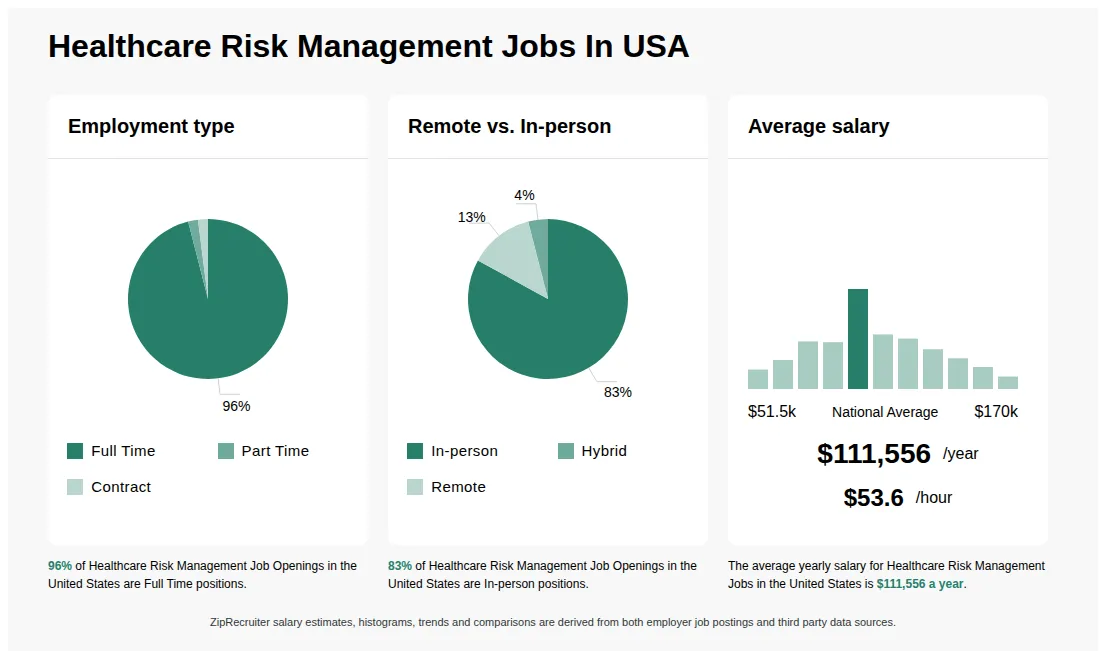
Healthcare Risk Management information
See salary details
$51.5K - $62.3K
4% of jobs
$62.3K - $73K
6% of jobs
$73K - $83.8K
11% of jobs
$87.9K is the 25th percentile. Wages below this are outliers.
$83.8K - $94.6K
11% of jobs
The median wage is $103.2K / yr.
$94.6K - $105.4K
23% of jobs
$105.4K - $116.1K
13% of jobs
$123.2K is the 75th percentile. Wages above this are outliers.
$116.1K - $126.9K
12% of jobs
$126.9K - $137.7K
8% of jobs
$137.7K - $148.5K
6% of jobs
$148.5K - $159.2K
4% of jobs
$159.2K - $170K
2% of jobs
$51.5K
$111.6K
$170K
How much do healthcare risk management jobs pay per year?
As of Sep 10, 2026, the average yearly pay for healthcare risk management in the United States is $111,556.00, according to ZipRecruiter salary data. Most workers in this role earn between $90,000.00 and $129,000.00 per year, depending on experience, location, and employer.
What is healthcare risk management?
Healthcare risk management refers to the process of identifying, assessing, and minimizing risks to patients, staff, and organizations within the healthcare sector. It involves implementing policies and procedures to prevent harm, ensure patient safety, and reduce legal liability. Risk managers work closely with clinical staff, administrators, and legal teams to address issues like patient safety, compliance, and incident reporting. Their goal is to create a safer healthcare environment while protecting the organization's assets and reputation.
What are healthcare risk management jobs?
Healthcare risk management jobs include working as a risk management analyst, specialist, or manager. Each job has specific duties, but your overall goal is to identify risk in potential clients or pools of clients, assess whether healthcare staff and programs are in compliance with all government regulations, and provide analysis of business decisions or changes in public health and insurance policy. As a healthcare risk manager, you have increased supervisory responsibilities and take a leadership role in coordinating and implementing risk management strategies.
What are the key skills and qualifications needed to thrive in healthcare risk management, and why are they important?
To excel in Healthcare Risk Management, you need a solid background in healthcare regulations, risk assessment, and patient safety, often supported by a degree in healthcare administration or a related field. Familiarity with risk management information systems (RMIS), incident reporting tools, and certifications such as Certified Professional in Healthcare Risk Management (CPHRM) are highly valuable. Strong analytical thinking, attention to detail, and effective communication skills are critical for identifying risks and collaborating with cross-functional teams. These competencies are essential to proactively minimize liability, enhance patient safety, and ensure regulatory compliance in healthcare organizations.
What are the biggest challenges faced by professionals in healthcare risk management roles?
Healthcare risk management professionals often navigate complex regulatory requirements while proactively identifying and mitigating potential risks to patient safety and organizational assets. One common challenge is keeping up with ever-evolving healthcare laws and accreditation standards, which requires continuous learning and adaptability. Additionally, these roles frequently involve collaborating with clinical staff, administrators, and legal teams to develop effective risk prevention strategies, making strong communication and teamwork skills essential. Balancing immediate crisis response with long-term risk reduction initiatives is also a key aspect of the job.
What is the difference between Healthcare Risk Management vs Healthcare Compliance Officer?
| Aspect | Healthcare Risk Management | Healthcare Compliance Officer |
|---|---|---|
| Primary Focus | Identifying, assessing, and mitigating risks to improve patient safety and reduce liability | Ensuring adherence to laws, regulations, and policies to maintain legal and ethical standards |
| Certifications | CPHRM, ARM, or similar risk management credentials | CHC, CHPC, or compliance-specific certifications |
| Work Environment | Hospitals, clinics, insurance companies, healthcare organizations | Hospitals, healthcare systems, regulatory agencies |
| Key Responsibilities | Risk assessments, incident investigations, safety protocols | Policy development, audits, regulatory reporting |
While both roles aim to improve healthcare quality and safety, Healthcare Risk Management focuses on proactively reducing risks and liabilities, whereas Healthcare Compliance Officers ensure adherence to legal and regulatory standards. Both roles often collaborate to promote a safe, compliant healthcare environment.
How to become a healthcare risk management professional?
To become a healthcare risk management professional, typically a bachelor's degree in healthcare administration, nursing, or a related field is required, along with experience in healthcare settings. Certification such as the Certified Professional in Healthcare Risk Management (CPHRM) can enhance job prospects and credibility in the field.
Is healthcare risk management a good career?
Healthcare risk management is a growing field focused on identifying and reducing risks in healthcare settings, often requiring knowledge of healthcare regulations, safety protocols, and risk assessment tools. It offers opportunities for advancement, a stable job outlook, and the chance to improve patient safety, making it a viable career choice for those interested in healthcare and risk analysis.
What does a healthcare risk management typically do?
A healthcare risk management professional identifies and assesses potential risks to patient safety, staff, and the organization, developing strategies to prevent or minimize incidents. They analyze data, implement safety protocols, and ensure compliance with regulations to reduce liability and improve healthcare quality.
More about Healthcare Risk Management jobs
What cities are hiring for Healthcare Risk Management jobs?
Cities with the most Healthcare Risk Management job openings:
What are the most commonly searched types of Healthcare Risk Management jobs?
The most popular types of Healthcare Risk Management jobs are:
What states have the most Healthcare Risk Management jobs?
States with the most job openings for Healthcare Risk Management jobs include:
What job categories do people searching Healthcare Risk Management jobs look for?
The top searched job categories for Healthcare Risk Management jobs are:

Clinical Risk Manager - Consultant
Indianapolis, IN • On-site
Indiana University Health •
Hospitals • 10K+ employees10,000+ employees
Full-time
Medical, Dental, Vision, Retirement
Re-posted 22 days ago
Indiana University Health rating

7.2
Based on 466 frontline employees who took The Breakroom Quiz
344th of 898 rated healthcare providers
Job description
Location:Methodist Hospital
Position: Clinical Risk Manager - Consultant
Shift:Monday - Friday, day shift with the expectation of on-call rotation approx. 3 times per year
IU Health is Indiana's largest and most comprehensive healthcare system, and the #1 ranked healthcare provider in the state. We are seeking a dedicated professional to provide clinical risk leadership, expertise, and service to facilitate the management of the overall operation, tactics, and strategy of clinical risk management and patient safety processes.
Position Overview:
The Clinical Risk Manager - Consultant provides clinical risk leadership, expertise, and service to support the organization's risk management and patient safety initiatives. They oversee and coordinate the review of reported risk events, patient adverse events, and sentinel events. The role involves managing ongoing analysis, development, and implementation of methods and systems to improve safety, efficiency, and effectiveness of clinical risk management functions. The Risk Manager analyzes incident report data, identifies organizational process improvement needs, and facilitates interdisciplinary efforts to enhance patient safety. They participate in insurance-related risk activities, including claims mitigation, and assume leadership in response to serious patient events.
Key Responsibilities:
• Oversee and coordinate the review of risk events, adverse events, and sentinel events.
• Analyze incident report data to identify trends and areas for improvement.
• Develop and implement strategies, methods, and systems to improve safety and risk mitigation.
• Facilitate interdisciplinary efforts to identify and implement patient safety improvements.
• Participate in insurance-related risk management activities, including claims mitigation.
• Provide leadership and guidance in responding to serious patient safety events.
• Ensure compliance with Joint Commission standards, State Board of Health requirements, and relevant federal and state laws.
• Support ongoing education and training initiatives related to patient safety and risk management.
Qualifications & Requirements:
• Education & Certification:
- Bachelor's Degree in a health-related field required; Nursing preferred.
- Master's Degree is preferred.
• Licensure & Certifications:
- Certification in healthcare risk management (CPHRM) required within 4 years of hire.
• Experience & Skills:
- 7-10 years of relevant clinical experience.
- Minimum of 5 years of clinical experience; quality or safety experience is a plus; leadership experience preferred.
- Knowledge of state and federal laws related to healthcare.
- Demonstrated mastery of Joint Commission standards and State Board of Health requirements related to patient safety and sentinel events.
Why Join IU Health?
• Competitive benefits package including health, dental, and vision insurance
• Retirement savings plan with employer match
• Tuition reimbursement and professional development opportunities
• Employee assistance programs and wellness initiatives
• Supportive work environment committed to safety and excellence
To learn more about our benefits, visit: [careers.iuhealth.org/pages/benefits-designed-for-you](https://careers.iuhealth.org/pages/benefits-designed-for-you)
About Us
- Indiana University Health has nearly 40,000 team members, including more than 3,600 physicians and 1,200 advanced practice providers, and we're home to the largest nursing network in Indiana with more than 9,000 nursing team members at over 800 sites of care.
- IU Health is ranked No. 1 in Indiana by U.S. News & World Report, Riley Children's Health is ranked among the top children's hospitals in the country by U.S. News & World Report.
- A unique partnership with the Indiana University School of Medicine - one of the nation's largest medical schools - gives patients access to groundbreaking research and innovative treatments, and it offers team members access to the latest science and the very best training - advancing healthcare for all.
- With 15 hospitals, including seven with Magnet designation and eight with Pathways to Excellence designation, our team members are leading the way through excellence.
- At Indiana University Health, your personal and professional growth is a top priority. You will have access to many diverse opportunities to learn and develop in meaningful ways that matter most to you, such as advanced clinical training, leadership development, promotion opportunities and cross training development.
- Indiana University Health is invested in the lives of Hoosiers, leading the transformation of healthcare to make Indiana one of the nation's healthiest states.
About the Team
Indiana University Health is Indiana's most comprehensive health system, with 15 hospitals and nearly 40,000 team members serving Hoosiers across the state. We're looking for team members who are inspired by challenging and meaningful work for the good of every patient. People who are compassionate and serve with a purpose. People who aspire to excellence every day.
What Indiana University Health employees say
Pay
Benefits
Hours and flexibility
Workplace
Get the full story on Breakroom

About Indiana Univeristy Health
Sourced by ZipRecruiter
Industry
Hospitals
Company size
10,000+ Employees
Headquarters location
Indianapolis, IN, US
Year founded
1997