Ensure healthcare risk management information is tracked, evaluated, and acted upon according to policy and regulations. Adverse Event & Risk Management * Support management of: * Adverse event ...
Ensure healthcare risk management information is tracked, evaluated, and acted upon according to policy and regulations. Adverse Event & Risk Management * Support management of: * Adverse event ...

A healthcare facility in Las Cruces, New Mexico is seeking an experienced Director of Risk Management to lead risk management strategy and operations across the organization. This is a senior-level ...
Quick apply
A healthcare facility in Las Cruces, New Mexico is seeking an experienced Director of Risk Management to lead risk management strategy and operations across the organization. This is a senior-level ...

Risk Manager
San Antonio, TX · On-site
EDUCATION/EXPERIENCE A Bachelor's degree in a healthcare, risk management, or related field and five (5) years' recent experience in a healthcare or healthcare risk management setting is required. A ...
Quick apply
Risk Manager
San Antonio, TX · On-site
EDUCATION/EXPERIENCE A Bachelor's degree in a healthcare, risk management, or related field and five (5) years' recent experience in a healthcare or healthcare risk management setting is required. A ...

Risk Management Director (RN)
TX · Remote
This is an exceptional opportunity for an experienced healthcare risk management leader with a clinical foundation to contribute at the highest level within a globally recognized institution. **The ...
Risk Management Director (RN)
TX · Remote
This is an exceptional opportunity for an experienced healthcare risk management leader with a clinical foundation to contribute at the highest level within a globally recognized institution. **The ...
Risk Management Manager
Chicago, IL · On-site
$70K - $102K/yr
EDUCATION, EXPERIENCE, TRAINING 1. Bachelor of Science in Nursing or healthcare related field preferred. 2. Fellow or Diplomat of American Society of Healthcare Risk Managers Associate in Risk ...
Risk Management Manager
Chicago, IL · On-site
$70K - $102K/yr
EDUCATION, EXPERIENCE, TRAINING 1. Bachelor of Science in Nursing or healthcare related field preferred. 2. Fellow or Diplomat of American Society of Healthcare Risk Managers Associate in Risk ...
$80 - $100/hr
Qualifications EDUCATION, EXPERIENCE, TRAINING 1. Bachelor of Science in Nursing or healthcare related field preferred. 2. Fellow or Diplomat of American Society of Healthcare Risk Managers Associate ...
$80 - $100/hr
Qualifications EDUCATION, EXPERIENCE, TRAINING 1. Bachelor of Science in Nursing or healthcare related field preferred. 2. Fellow or Diplomat of American Society of Healthcare Risk Managers Associate ...
As a member of Prime Healthcare, Landmark Medical Center is actively seeking new members to join ... Evaluates risk management program(s) through the use of data capture, follow up and trend analysis ...
As a member of Prime Healthcare, Landmark Medical Center is actively seeking new members to join ... Evaluates risk management program(s) through the use of data capture, follow up and trend analysis ...

Risk Manager
Reading, PA · On-site
Experience in Healthcare Risk Management, Insurance, MCARE Fund Insurance, Claims Management, and Contract Review * Paralegal background helpful but not required Certification and Licensure
Risk Manager
Reading, PA · On-site
Experience in Healthcare Risk Management, Insurance, MCARE Fund Insurance, Claims Management, and Contract Review * Paralegal background helpful but not required Certification and Licensure

Qualifications QUALIFICATIONS: 1. 10+ years of experience in Healthcare Risk Management required. 2. CPRHM (Certified Professional in Healthcare Risk Management preferred. 3. 5-8 years of management ...
Qualifications QUALIFICATIONS: 1. 10+ years of experience in Healthcare Risk Management required. 2. CPRHM (Certified Professional in Healthcare Risk Management preferred. 3. 5-8 years of management ...

Senior Risk Manager
Manhattan, NY · On-site
$103K - $140K/yr
Master's degree in nursing, nursing informatics, healthcare law (Juris Prudence), public health policy and administration, or an MBA with a focus in finance, risk management, or business required.
Senior Risk Manager
Manhattan, NY · On-site
$103K - $140K/yr
Master's degree in nursing, nursing informatics, healthcare law (Juris Prudence), public health policy and administration, or an MBA with a focus in finance, risk management, or business required.
Risk Manager
Pensacola, FL · On-site
$100 - $125/hr
Educates workforce members in high reliability, patient safety and healthcare risk management concepts. * Responds effectively to AHCA, CMS and DOH investigations and surveys. Identifies and submits ...
Risk Manager
Pensacola, FL · On-site
$100 - $125/hr
Educates workforce members in high reliability, patient safety and healthcare risk management concepts. * Responds effectively to AHCA, CMS and DOH investigations and surveys. Identifies and submits ...

Fellow or Diplomat of American Society of Healthcare Risk Managers Associate in Risk Management (ARM) or Certified Professional in Healthcare Risk Management (CPHRM), preferred. * Five years clinical ...
Fellow or Diplomat of American Society of Healthcare Risk Managers Associate in Risk Management (ARM) or Certified Professional in Healthcare Risk Management (CPHRM), preferred. * Five years clinical ...
Director Risk Management, Quality and Medical Staff
Las Cruces, NM · On-site
$125 - $150/hr
About the Opportunity Our client, an established acute‑care hospital and healthcare system, is seeking an experienced Director of Risk Management to lead its risk management program across the ...
New
Director Risk Management, Quality and Medical Staff
Las Cruces, NM · On-site
$125 - $150/hr
About the Opportunity Our client, an established acute‑care hospital and healthcare system, is seeking an experienced Director of Risk Management to lead its risk management program across the ...
New
The System Director of Patient Safety and Risk Management reports to the System Vice President ... Day Experience: - Minimum 5 years' experience in a leadership/management role in a healthcare ...
The System Director of Patient Safety and Risk Management reports to the System Vice President ... Day Experience: - Minimum 5 years' experience in a leadership/management role in a healthcare ...

Director of Risk Management
Norcross, GA · On-site
Bachelor's degree in a clinical healthcare, risk management, business, finance, or a related field required. * Master's degree in health information management, nursing, or related field preferred.
Director of Risk Management
Norcross, GA · On-site
Bachelor's degree in a clinical healthcare, risk management, business, finance, or a related field required. * Master's degree in health information management, nursing, or related field preferred.

A Master's Degree or other graduate degree in a healthcare or other pertinent related field desired ... Three (3) years' experience in risk management, quality, or patient safety desired. * Demonstrated ...
A Master's Degree or other graduate degree in a healthcare or other pertinent related field desired ... Three (3) years' experience in risk management, quality, or patient safety desired. * Demonstrated ...

Local/ Travel RN Risk and Compliance Management
Peridot, AZ · On-site
$2.0K - $2.1K/wk
Now Hiring: Healthcare Compliance & Risk Manager (RN) Location: Peridot, AZ Schedule: Travel or local Contract , dayshift 13 weeks Start Date: 2 weeks within offer Company : Talented Medical ...
Quick apply
Local/ Travel RN Risk and Compliance Management
Peridot, AZ · On-site
$2.0K - $2.1K/wk
Now Hiring: Healthcare Compliance & Risk Manager (RN) Location: Peridot, AZ Schedule: Travel or local Contract , dayshift 13 weeks Start Date: 2 weeks within offer Company : Talented Medical ...
Bachelor's degree in a clinical healthcare field, risk management, business, finance, or a related field required. * Master's degree in health information management, nursing, or related field ...
Bachelor's degree in a clinical healthcare field, risk management, business, finance, or a related field required. * Master's degree in health information management, nursing, or related field ...

Director Risk Management, Quality and Medical Staff
Las Cruces, NM · On-site
$120K - $150K/yr
About the Opportunity Our client, an established acute-care hospital and healthcare system, is seeking an experienced Director of Risk Management to lead its risk management program across the ...
Director Risk Management, Quality and Medical Staff
Las Cruces, NM · On-site
$120K - $150K/yr
About the Opportunity Our client, an established acute-care hospital and healthcare system, is seeking an experienced Director of Risk Management to lead its risk management program across the ...

Master's degree in Nursing, Healthcare Risk Management, Patient Safety, Human Factors Engineering, Jurisprudence, Juris Doctor, or a related field of study from an accredited institution. Experience ...
Master's degree in Nursing, Healthcare Risk Management, Patient Safety, Human Factors Engineering, Jurisprudence, Juris Doctor, or a related field of study from an accredited institution. Experience ...
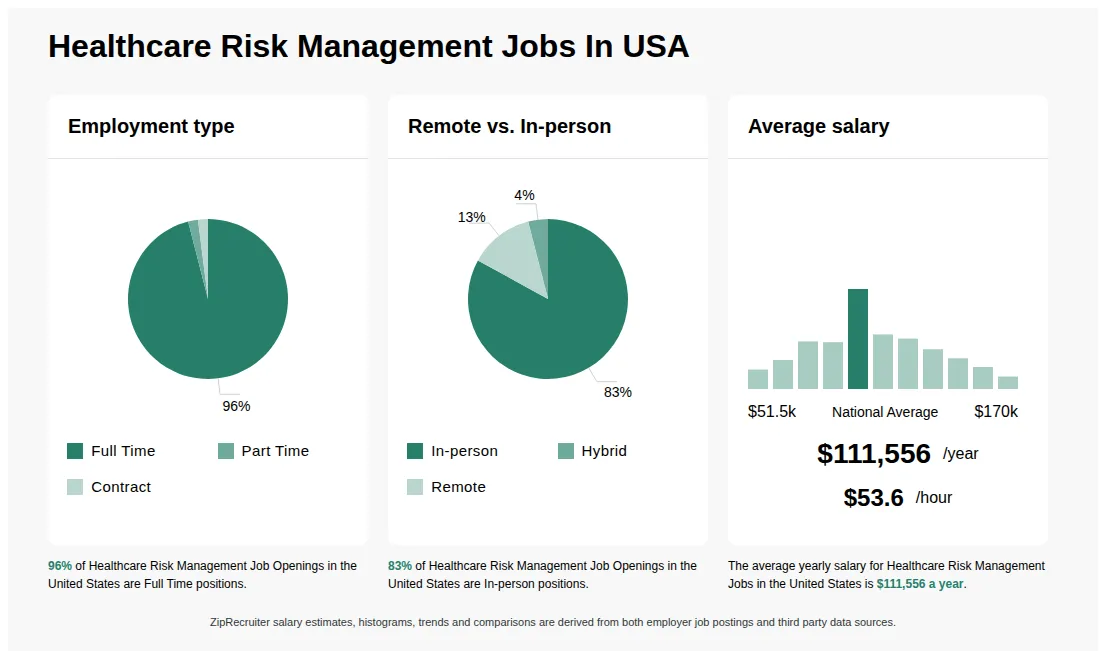
Healthcare Risk Management information
See salary details
$51.5K - $62.3K
4% of jobs
$62.3K - $73K
6% of jobs
$73K - $83.8K
11% of jobs
$87.9K is the 25th percentile. Wages below this are outliers.
$83.8K - $94.6K
11% of jobs
The median wage is $103.2K / yr.
$94.6K - $105.4K
23% of jobs
$105.4K - $116.1K
13% of jobs
$123.2K is the 75th percentile. Wages above this are outliers.
$116.1K - $126.9K
12% of jobs
$126.9K - $137.7K
8% of jobs
$137.7K - $148.5K
6% of jobs
$148.5K - $159.2K
4% of jobs
$159.2K - $170K
2% of jobs
$51.5K
$111.6K
$170K
How much do healthcare risk management jobs pay per year?
As of Sep 8, 2026, the average yearly pay for healthcare risk management in the United States is $111,556.00, according to ZipRecruiter salary data. Most workers in this role earn between $90,000.00 and $129,000.00 per year, depending on experience, location, and employer.
What is healthcare risk management?
Healthcare risk management refers to the process of identifying, assessing, and minimizing risks to patients, staff, and organizations within the healthcare sector. It involves implementing policies and procedures to prevent harm, ensure patient safety, and reduce legal liability. Risk managers work closely with clinical staff, administrators, and legal teams to address issues like patient safety, compliance, and incident reporting. Their goal is to create a safer healthcare environment while protecting the organization's assets and reputation.
What are healthcare risk management jobs?
Healthcare risk management jobs include working as a risk management analyst, specialist, or manager. Each job has specific duties, but your overall goal is to identify risk in potential clients or pools of clients, assess whether healthcare staff and programs are in compliance with all government regulations, and provide analysis of business decisions or changes in public health and insurance policy. As a healthcare risk manager, you have increased supervisory responsibilities and take a leadership role in coordinating and implementing risk management strategies.
What are the key skills and qualifications needed to thrive in healthcare risk management, and why are they important?
To excel in Healthcare Risk Management, you need a solid background in healthcare regulations, risk assessment, and patient safety, often supported by a degree in healthcare administration or a related field. Familiarity with risk management information systems (RMIS), incident reporting tools, and certifications such as Certified Professional in Healthcare Risk Management (CPHRM) are highly valuable. Strong analytical thinking, attention to detail, and effective communication skills are critical for identifying risks and collaborating with cross-functional teams. These competencies are essential to proactively minimize liability, enhance patient safety, and ensure regulatory compliance in healthcare organizations.
What are the biggest challenges faced by professionals in healthcare risk management roles?
Healthcare risk management professionals often navigate complex regulatory requirements while proactively identifying and mitigating potential risks to patient safety and organizational assets. One common challenge is keeping up with ever-evolving healthcare laws and accreditation standards, which requires continuous learning and adaptability. Additionally, these roles frequently involve collaborating with clinical staff, administrators, and legal teams to develop effective risk prevention strategies, making strong communication and teamwork skills essential. Balancing immediate crisis response with long-term risk reduction initiatives is also a key aspect of the job.
What is the difference between Healthcare Risk Management vs Healthcare Compliance Officer?
| Aspect | Healthcare Risk Management | Healthcare Compliance Officer |
|---|---|---|
| Primary Focus | Identifying, assessing, and mitigating risks to improve patient safety and reduce liability | Ensuring adherence to laws, regulations, and policies to maintain legal and ethical standards |
| Certifications | CPHRM, ARM, or similar risk management credentials | CHC, CHPC, or compliance-specific certifications |
| Work Environment | Hospitals, clinics, insurance companies, healthcare organizations | Hospitals, healthcare systems, regulatory agencies |
| Key Responsibilities | Risk assessments, incident investigations, safety protocols | Policy development, audits, regulatory reporting |
While both roles aim to improve healthcare quality and safety, Healthcare Risk Management focuses on proactively reducing risks and liabilities, whereas Healthcare Compliance Officers ensure adherence to legal and regulatory standards. Both roles often collaborate to promote a safe, compliant healthcare environment.
How to become a healthcare risk management professional?
To become a healthcare risk management professional, typically a bachelor's degree in healthcare administration, nursing, or a related field is required, along with experience in healthcare settings. Certification such as the Certified Professional in Healthcare Risk Management (CPHRM) can enhance job prospects and credibility in the field.
Is healthcare risk management a good career?
Healthcare risk management is a growing field focused on identifying and reducing risks in healthcare settings, often requiring knowledge of healthcare regulations, safety protocols, and risk assessment tools. It offers opportunities for advancement, a stable job outlook, and the chance to improve patient safety, making it a viable career choice for those interested in healthcare and risk analysis.
What does a healthcare risk management typically do?
A healthcare risk management professional identifies and assesses potential risks to patient safety, staff, and the organization, developing strategies to prevent or minimize incidents. They analyze data, implement safety protocols, and ensure compliance with regulations to reduce liability and improve healthcare quality.
More about Healthcare Risk Management jobs
What cities are hiring for Healthcare Risk Management jobs?
Cities with the most Healthcare Risk Management job openings:
What are the most commonly searched types of Healthcare Risk Management jobs?
The most popular types of Healthcare Risk Management jobs are:
What states have the most Healthcare Risk Management jobs?
States with the most job openings for Healthcare Risk Management jobs include:
What job categories do people searching Healthcare Risk Management jobs look for?
The top searched job categories for Healthcare Risk Management jobs are:
Health Risk Management Support
Falls Church, VA • On-site
Akahi Associates/Kako'o Services, LLC
Full-time
Medical, Dental, Vision, Life, Retirement, PTO
Re-posted 2 hours ago
Job description
Schedule: Monday-Friday between the hours of 0800- 1700 EST
Location: Contracted personnel performing in support of this contract will be assigned to the Defense Health Headquarters (DHHQ) in Falls Church, Virginia but will work at the Contractor’s facility or remotely
Benefits: PTO, holiday leave, Life, Accidental Death and Dismemberment, Short Term Disability
Optional Benefits: Medical, Dental, Vision, 401(K) matching with employee participation in 401(K) plan
***Position is contingent upon contract award.
Healthcare Risk Management Program Support
- Support headquarters and network-level risk management processes.
- Ensure healthcare risk management information is tracked, evaluated, and acted upon according to policy and regulations.
Adverse Event & Risk Management
- Support management of:
- Adverse event reporting and monitoring
- Tort claim processing
- Death and disability case reviews
- Administrative and clinical adverse actions
Policy & Documentation
- Draft headquarters-level documents such as:
- Procedural manuals
- Instructions
- Decision memorandums
- Documentation related to adverse event and action cases.
Program Analysis
- Provide technical and analytical support in healthcare management and program analysis.
- Support enterprise-level healthcare risk management and credentialing and privileging programs.
Data Management & Reporting
- Provide guidance on database management and data analysis.
- Prepare reports and briefings for stakeholders.
Subject Matter Expertise
- Utilize advanced clinical practice knowledge and healthcare risk management expertise.
- Apply quality management principles to healthcare risk programs.
Training & Professional Development
- Provide coaching, mentoring, and education to:
- DHA HRM staff
- Network personnel
- Military Treatment Facility staff.
Status Reporting
- Prepare and submit weekly HRM status reports for inclusion in the CQM Weekly Performance Report.
- Certification in HRM
- Maintain current unencumbered Registered Nurse licensure
- 10 years of experience specializing in healthcare risk management
- 5 years of experience leading and managing healthcare risk managers
- 5 years of experience in supporting healthcare management activities through data and database analysis
- Corporate, HQ or large medical system experienced MHS/DHA experience preferred
- Effectively communicate at various levels within the organization (i.e., HQ, Network, facility) Proficient in Microsoft Office tools
- Familiar with Centralized Credentials Quality Assurance System (CCQAS) or a similar Credentialing and Privileging database
AKAHI ASSOCIATES LLC
Akahi Associates is a premier provider of healthcare workers to various military treatment facilities across the United States. With a corporate office in Honolulu, Hawaii and recruiting office in San Antonio, Texas we specialize in providing skilled, trained and highly successful healthcare workers, including RNs, CRNAs, Physicians, LPN/LVN, Licensed Social Workers, and many more.
We have a strong focus on providing our government customers with quality and superior service.
Akahi Associates is an equal opportunity employer. For further information, please click the link to view the “Know Your Rights: Workplace Discrimination is Illegal” poster.
Know Your Rights: Workplace Discrimination is Illegal
Qualified applicants will receive consideration for employment without regard to race, color, religion, sex, national origin, sexual orientation, gender identity, disability, protected veteran status, or other characteristics protected by law.
Only qualified individuals who are being considered will be contacted for an interview.