1

Freelance Workday Integration Developer Jobs (NOW HIRING)

$50.75 - $67.50/hr

Workday Developer: Responsibilities * Designs, builds, tests, and deploys integration solutions for Workday. * Troubleshoots integration issues requiring in depth expertise in the Workday solution.

$50.75 - $67.50/hr

Workday Developer: Responsibilities * Designs, builds, tests, and deploys integration solutions for Workday. * Troubleshoots integration issues requiring in depth expertise in the Workday solution.

Be Seen First

Workday Integration Developer Location: Milwaukee Wisconsin or Fond Du Lac WI Duration: 6 month contract to hire Project Overview Current State The organization is implementing Workday and moving ...

New

Workday Integration Developer Lead

Taylor, TX · On-site

$59.50 - $78/hr

Workday Integration Developer Lead Location: Taylor TX 76574 Duration: 24 Months (Full Time) Job Type: Full Time Work Type: Onsite * Designs, codes, tests, documents, and maintains integrations and ...

The Workday Integration Developer is a member of the Integration/Automation team at ServiceTitan. In this role, you will support the cross-functional teams by serving as a technical resource for the ...

The Sr. Integration Developer will be responsible for designing, developing, testing, and maintaining integrations using Workday Studio, Core Connectors, EIBs, and APIs. This role also requires ...

Showing results 21-40

Freelance Workday Integration Developer information

See salary details

$30

$57

$81

How much do freelance workday integration developer jobs pay per hour?

As of Aug 23, 2026, the average hourly pay for freelance workday integration developer in the United States is $57.57, according to ZipRecruiter salary data. Most workers in this role earn between $48.32 and $64.18 per hour, depending on experience, location, and employer.

What is a freelance Workday integration developer?

Freelance Workday Integration Developers are independent professionals who specialize in connecting the Workday platform with other software systems used by a business. They design, build, and maintain integrations to ensure smooth data flow between Workday and external applications such as payroll, benefits, or HR systems. Working on a contract or project basis, they bring expertise in Workday tools like Workday Studio, EIB, and Core Connectors, and often collaborate remotely with clients. Their role is critical in helping organizations automate processes, improve efficiency, and maintain data accuracy across multiple platforms.

What are the key skills and qualifications needed to thrive as a freelance Workday integration developer?

To thrive as a Freelance Workday Integration Developer, you need strong expertise in Workday Studio, Workday Core Connectors, and integration technologies, along with a background in computer science or a related field. Familiarity with XML, XSLT, web services (SOAP/REST), and relevant Workday certifications is highly valued. Effective problem-solving, project management, and client communication skills help distinguish top performers in this freelance role. These skills and qualities are crucial for delivering seamless, efficient integrations that meet client requirements and support business operations.

What are some common challenges freelance Workday integration developers face when working with multiple clients?

Freelance Workday Integration Developers often manage projects for several clients simultaneously, which can present challenges such as balancing competing deadlines, adapting to different client requirements, and learning unique business processes quickly. Additionally, each client may have distinct security policies, system customizations, and communication styles, requiring developers to be flexible and proactive in their approach. Effective time management, clear communication, and staying updated on Workday's latest features are essential for navigating these challenges and delivering successful integrations.

What is the difference between Freelance Workday Integration Developer vs Workday Integration Consultant?

AspectFreelance Workday Integration DeveloperWorkday Integration Consultant
CredentialsWorkday certifications, technical skillsWorkday certifications, consulting experience
Work EnvironmentIndependent, project-basedConsulting firms, client sites
Industry UsageFreelance platforms, independent contractsConsulting companies, enterprise clients

Both roles require Workday certifications and technical expertise. The Freelance Workday Integration Developer typically works independently on specific integration projects, while the Workday Integration Consultant often works within consulting firms or client teams, providing broader advisory services. The choice depends on whether you prefer independent project work or a consulting environment.

More about Freelance Workday Integration Developer jobs

What cities are hiring for Freelance Workday Integration Developer jobs?

Cities with the most Freelance Workday Integration Developer job openings:

What are the most commonly searched types of Workday Integration Developer jobs?

The most popular types of Workday Integration Developer jobs are:

What states have the most Freelance Workday Integration Developer jobs?

States with the most job openings for Freelance Workday Integration Developer jobs include:

What job categories do people searching Freelance Workday Integration Developer jobs look for?

The top searched job categories for Freelance Workday Integration Developer jobs are:

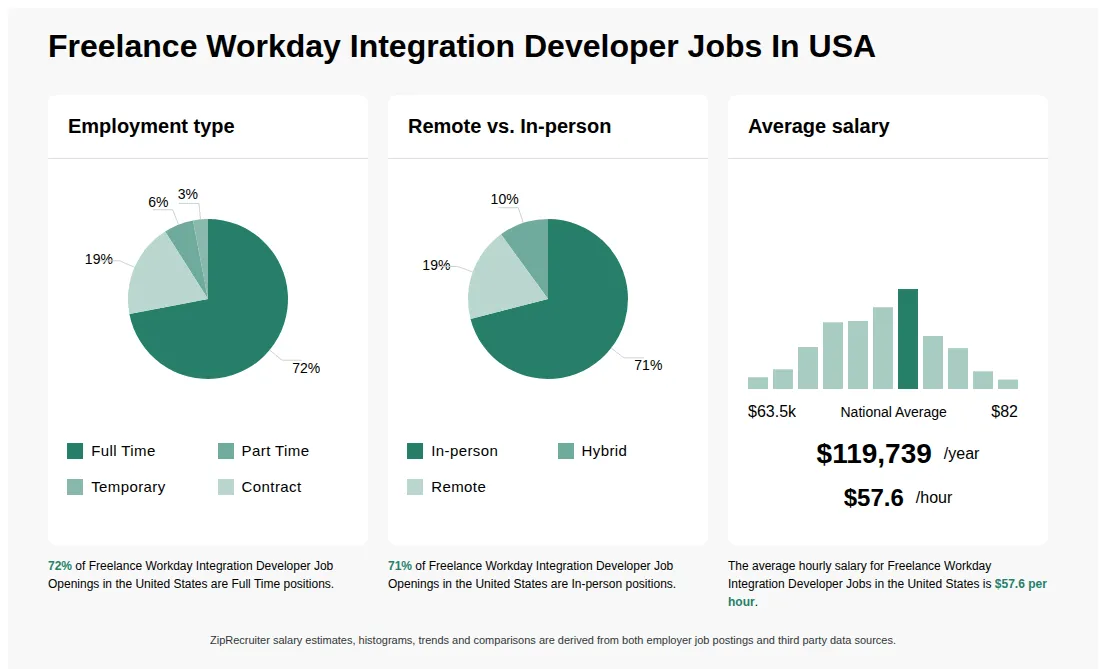
Infographic showing various Freelance Workday Integration Developer job openings in the United States as of August 2026, with employment types broken down into 91% Full Time, 5% Part Time, and 4% Contract. Highlights an 85% Physical, 5% Hybrid, and 10% Remote job distribution, with an average salary of $119,739 per year, or $57.6 per hour.

Sr Workday Integration Developer

Soltex systens

On-site

$50.75 - $67.50/hr

Contractor

Re-posted 10 days ago


Job description

Workday Developer:

Responsibilities

  • Designs, builds, tests, and deploys integration solutions for Workday.
  • Troubleshoots integration issues requiring in depth expertise in the Workday solution.
  • Conduct unit and end-to-end testing of interfaces to ensure they function as designed based on functional and technical requirements
  • Coordinates assigned deliverable schedules to ensure timelines are met.
  • Provides guidance to business, IT or service partners on integration strategies.
  • Contributes to the end users’ experience with Workday’s integration products, tools, and services in a way that results in high customer satisfaction.
  • Work with project teams through integration discovery and scoping phases of their implementation projects.
  • Mentors development team on best practices regarding Workday integrations and solutions
  • Performs other job-related duties as assigned or apparent.
  • Analyze and translate functional specifications and change requests into technical specifications
  • Consult with business, vendor, and technical teams about interface design and maintenance

Qualifications

  • Minimum of 3 years of experience as a Workday Integrations Consultant/Developer
  • Minimum of 2 full life cycle Workday implementation experience as an Implementer performing Integrations
  • Minimum of 2 full life cycle Workday implementation experience in the capacity of managing a team of developers
  • Minimum of 20 integrations design and development using each of Workday integration types EIB, Core Connectors, Cloud Connect, Document Transforms, and Workday Studio
  • General knowledge and design of at least 3 Workday functional areas
  • Good understanding of Workday security
  • Use of at least 1 third party integration framework is preferred
  • Flexible with creative problem-solving skills
  • Experience with Workday EIB, RaaS, and Web Services.
  • Experience with JavaScript, XSLT and xPath programming strongly preferred.
  • Experience with Java, Informatica, or Relational Database development desired.
  • Some non-Workday programming experience required.
  • Integration design and testing concepts.
  • Integration frameworks (e.g., middleware, transformation logic).
  • Data conversion concepts and impacts on business processes (such as Workday iLoads or bulk data loading).
  • Issues documentation and analysis for payroll and related financial activities used to identify systemic issues or problems with integrations.
  • Understanding of application technology and associated solutions and strategies related to the client’s business to help them achieve their business goals and objectives.
  • System design and testing concepts.
  • Knowledge of all phases of system development lifecycle, including production support.
  • Strong customer service focus and responsiveness.
  • Strong analytical skills, interpretive and evaluative skills.
  • Strong organizational skills across multiple threads of work streams.