1

Executive Director Jobs (NOW HIRING)

The Executive Director is entrusted with helping create the conditions in which individuals with developmental disabilities, families, employees, service providers, community partners, and future ...

Hospice Executive Director

Milwaukee, WI · On-site

$140K - $160K/yr

  • Medical

  • Life

Hospice Executive Director Location: Milwaukee, WI Great hospice organizations are built by leaders who understand that when you invest in your team, they can provide exceptional care to patients and ...

The Executive Director of the Texas Tech Equestrian Center and Equine Programs provides strategic leadership, operational oversight, financial management, and external engagement for one of the ...

Executive Director

Brunswick, ME · On-site

$120 - $180/hr

The next Executive Director will lead a highly respected, community-centered organization at an exciting moment in its evolution. Guided by the 2024-2029 Strategic Plan, the Executive Director will ...

Executive Director

Montgomery, AL · On-site

$125K - $150K/yr

Legal Services Alabama seeks an Executive Director Legal Services Alabama's Executive Director, Guy Lescault, has announced his retirement at the end of 2026. LSA now seeks an experienced and ...

The Executive Director is entrusted with helping create the conditions in which individuals with developmental disabilities, families, employees, service providers, community partners, and future ...

Executive Director

Midvale, UT · On-site

$70K - $85K/yr

  • Medical

  • Dental

  • Vision

  • PTO

Executive DirectorSummary of the Role The Executive Director (ED) is responsible for leading, understanding, and overseeing OPPO's growing Utah operations. The Executive Director ensures the ...

Executive Director

San Diego, CA · On-site

$145 - $165/hr

Executive Director Friends of the Children - San Diego San Diego, California The Moran Company is pleased to partner with Friends of the Children-San Diego to recruit the organization's first ...

Executive Director

Santa Barbara, CA · On-site

$265 - $330/hr

Under the policy direction of the TCADD Board of Directors, the Executive Director (ED): * Provides strategic, planning, organizational, fiscal, development, culture, and community leadership: * in ...

Executive Director

El Paso, TX · On-site

$150 - $230/hr

Reporting to the Board of Trustees, the Executive Director serves as the chief executive, Board Secretary, and senior fiduciary for administration of the Trust. The leader will ensure excellent ...

Executive Director

Landover, MD · On-site

$120 - $150/hr

  • Medical

  • Dental

  • Vision

  • Life

  • Retirement

  • PTO

Executive Director Regular Full-Time Full-time Landover, MD, US 1 Attachments Salary Range: $120,000.00 To $150,000.00 Annually EXECUTIVE DIRECTOR About SHABACH! Ministries, Inc. SHABACH! Ministries ...

The Executive Director will collaborate closely with the facility leadership team to drive key performance indicators and financial measures, focusing on optimizing facility performance through ...

Executive Director Midland Institute for Entrepreneurship Effingham, Illinois (hybrid) The Moran Company is pleased to partner with the Midland Institute for Entrepreneurship to recruit the ...

Showing results 21-40

Executive Director information

See salary details

$36.5K

$89.8K

$165.5K

How much do executive director jobs pay per year?

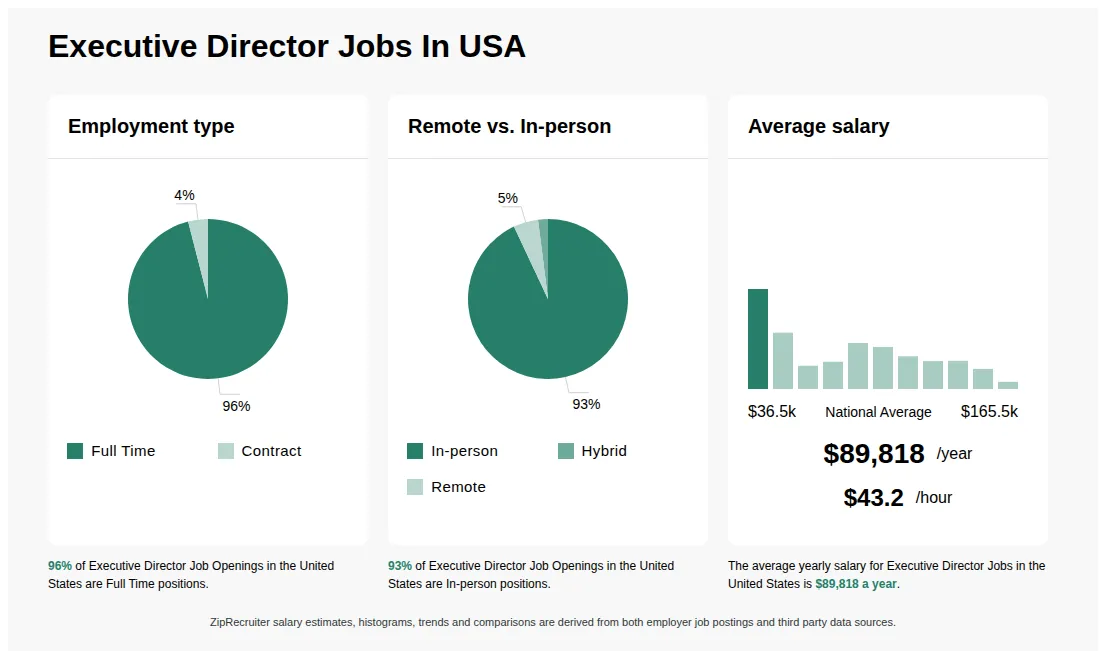
As of Aug 17, 2026, the average yearly pay for executive director in the United States is $89,818.00, according to ZipRecruiter salary data. Most workers in this role earn between $50,000.00 and $117,000.00 per year, depending on experience, location, and employer.

What does an executive director do?

An Executive Director is the senior leader responsible for overseeing the operations and strategic direction of an organization, often in the nonprofit or public sector. Their duties include managing staff, developing policies, ensuring financial sustainability, and working with the board of directors to fulfill the organization's mission. Executive Directors also represent the organization to stakeholders, secure funding, and ensure compliance with laws and regulations. Their leadership is crucial for driving organizational growth and achieving long-term goals.

What are the key skills and qualifications needed to thrive as an executive director, and why are they important?

To thrive as an Executive Director, you need strong leadership, strategic planning, financial management, and organizational development skills, typically supported by a relevant bachelor's or master's degree and significant managerial experience. Familiarity with budgeting software, CRM systems, and nonprofit or corporate governance frameworks is often required. Excellent communication, decision-making, and relationship-building abilities are crucial soft skills for inspiring teams and engaging stakeholders. These competencies are essential for driving organizational growth, ensuring operational efficiency, and achieving long-term mission success.

What are some common challenges faced by an executive director when balancing strategic leadership with day-to-day operations?

Executive Directors often face the challenge of balancing high-level strategic planning with the demands of overseeing daily operations. While setting long-term goals and ensuring organizational sustainability, they must also address immediate issues such as team management, resource allocation, and stakeholder communication. Effective delegation, time management, and maintaining open communication with both staff and the board are key to navigating these challenges successfully. Building a strong leadership team can also help distribute responsibilities and ensure smooth organizational functioning.

What is the difference between Executive Director vs Nonprofit Program Manager?

AspectExecutive DirectorNonprofit Program Manager
CredentialsBachelor's degree often required; advanced degrees preferredBachelor's degree typically required; relevant experience valued
Work EnvironmentOversees entire organization, strategic planningManages specific programs or projects within the organization
Employer & Industry UsageCommon in nonprofits, associations, foundationsCommon in nonprofit organizations, community services
Search & Comparison IntentUnderstanding leadership roles, organizational oversightFocus on program management, project execution

The Executive Director holds a top leadership position, responsible for overall organizational strategy and governance. In contrast, a Nonprofit Program Manager focuses on managing specific programs or projects within the organization. While both roles require relevant experience and similar educational backgrounds, the Executive Director has broader responsibilities, including fundraising and stakeholder relations, whereas the Program Manager concentrates on program delivery and operational details.

What cities are hiring for Executive Director jobs?

Cities with the most Executive Director job openings:

What are the most commonly searched types of Executive jobs?

The most popular types of Executive jobs are:

What states have the most Executive Director jobs?

States with the most job openings for Executive Director jobs include:

Infographic showing various Executive Director job openings in the United States as of August 2026, with employment types broken down into 1% As Needed, 85% Full Time, 12% Part Time, 1% Temporary, and 1% Contract. Highlights an 92% Physical, 3% Hybrid, and 5% Remote job distribution, with an average salary of $89,818 per year, or $43.2 per hour.

Full-time

Posted 11 days ago


Job description

Job Type
Full-time
Description
Application Procedures, Recruitment Timeline: If you are interested in this dynamic and rewarding opportunity, please submit a letter of interest, no more than two pages, addressing the responsibilities and qualifications detailed in this job description, and a current resume of professional experience, by 5:00pm SEPTEMBER 13, 2026 Email your letter of interest and resume as .doc, .docx, or .pdf attachments to NBRCED@KineticFlowCorp.org
Paper applications will not be accepted.
Resumes will be screened according to the qualifications outlined above. The most qualified candidates will be invited to a first interview. Top candidates will be invited to further interviews.
For confidential inquiries, feel free to contact our search consultant Ami Sullivan at (916) 258-5218 or email ami.sullivan@kineticflowcorp.com.
We are an equal opportunity employer.
About North Bay Regional Center
North Bay Regional Center (NBRC), one of 21 regional centers located throughout California, is a private non-profit (501(c)3), started as a grass roots movement to assist persons with intellectual disabilities - and their families - in identifying and developing services and programs within their communities that help them lead more independent lives. The regional centers were established by the Lanterman Act (California Welfare & Institutions Code §4500 et seq. ) and are regulated by Title 17 of California's Government Code. Regional centers serve as the point of entry into the State's developmental services delivery system, providing life-long services and supports to individuals with developmental disabilities and their families.
North Bay Regional Center was incorporated in 1972 and proudly serves the needs 13,000 children and adults with developmental disabilities in the linguistically and culturally diverse communities of Napa, Solano and Sonoma counties. NBRC is guided by a dedicated Board of Directors and supported by approximately 400 staff and 1,500+ service providers. Our mission is to empower, respect and serve each child and adult with or with the potential for a developmental disability, while promoting the health and well-being of each individual, their families, and our community.
We value: ~ Belonging ~ Compassion ~ Dignity and Respect ~ Honesty and Integrity ~ Humility ~
Servant Leadership is Ultimately an Act of Stewardship.
At North Bay Regional Center, the Executive Director is entrusted with far more than the leadership of a complex organization. The Executive Director is entrusted with helping create the conditions in which individuals with developmental disabilities, families, employees, service providers, community partners, and future leaders can flourish together.
This opportunity calls for a leader who understands that operational excellence and human dignity are inseparable-that responsible stewardship of public resources, thoughtful leadership of people, and meaningful relationships all contribute to the same purpose: supporting individuals to live lives of their own choosing as valued members of their communities.
As North Bay Regional Center looks toward its next chapter, we seek a leader who is inspired by that responsibility and who believes, as we do, that leadership is ultimately measured not by authority, but by the opportunities it creates for others.
Executive Director Position Description
Position Title: Executive Director
Reports To: Board of Directors
Supervises: Executive Team (which currently includes: Chief Financial Officer, Director of Case Management, Director of Clinical and Intake, Director of Community Services, Director of Equity and Engagement, Director of Administrative Services, Executive Assistants)
FLSA Status: Exempt
Position Summary (Definition and Nature of Work)
The Executive Director serves as the Chief Executive Officer of North Bay Regional Center and is accountable to the Board of Directors for the overall leadership, performance, and stewardship of the organization.
Working at the Board's direction, the Executive Director advances the organization's mission by providing strategic leadership, ensuring operational excellence, safeguarding the responsible stewardship of public funding, and fostering an organizational culture that reflects integrity, accountability, collaboration, and person-centered practices.
The Executive Director leads a complex organization operating within California's developmental services system and is responsible for ensuring that North Bay Regional Center fulfills its statutory responsibilities under the Lanterman Developmental Disabilities Services Act and is responsive to the individuals, families, employees, service providers, and the communities it serves.
The Executive Director recognizes that organizational excellence is achieved when strong systems support strong relationships, and when those relationships strengthen organizational performance. Through thoughtful leadership, sound judgment, and responsible stewardship, the Executive Director ensures that North Bay Regional Center remains a trusted partner and a high-performing organization committed to improving the lives of people with developmental disabilities.
For additional context and NBRC's vision of leadership, please see the companion document, "Our Philosophy of Leadership".
Responsibilities of this Position
Executive Accountabilities
The Executive Director is entrusted with the overall stewardship of North Bay Regional Center and is accountable for ensuring that the organization fulfills its mission, operates with integrity, and remains responsive to the communities it serves.
The Executive Director provides leadership that:
  • Advances the mission, vision, values, and strategic direction established by the Board of Directors (developed in partnership with community members).
  • Ensures the delivery of high-quality, person-centered services in compliance with applicable laws, regulations, contractual requirements, and ethical standards.
  • Aligns strategy, operations, people, and resources to achieve organizational priorities and continuously improve organizational effectiveness and efficiency.
  • Strengthens organizational capacity through sound leadership, workforce development, succession planning, operational improvement, and responsible stewardship of financial and public resources.
  • Cultivates an organizational culture characterized by trust, accountability, responsiveness, collaboration, learning, and respect.
  • Builds enduring partnerships with individuals receiving services, families, employees, service providers, community organizations, governmental agencies, advocacy organizations, and other stakeholders.
  • Represents North Bay Regional Center with credibility, professionalism, and integrity while strengthening public confidence in the organization and its mission.
  • Furthers strong relationships with state leaders, including the Department of Developmental Services (DDS), the Association of Regional Center Agencies (ARCA), and state Legislatures.

Strategic Leadership
The Executive Director provides strategic leadership that positions North Bay Regional Center to fulfill its mission today while preparing thoughtfully for the future.
Working under the guidance of the Board of Directors and executive leadership team, the Executive Director establishes organizational priorities that respond to emerging opportunities, evolving community needs, changing regulatory requirements, and the long-term sustainability of the organization. Strategic leadership requires balancing innovation with stability, ensuring that change strengthens-rather than distracts from-the organization's mission and person-centered values.
The Executive Director is responsible for:
  • Leading the implementation and ongoing evaluation of the organization's strategic plan and long-range priorities.
  • Anticipating emerging trends, legislative developments, service delivery challenges, and opportunities that may affect the organization's future.
  • Aligning organizational resources, operational priorities, and leadership initiatives with strategic objectives established by the Board of Directors.
  • Promoting thoughtful innovation while ensuring organizational readiness, fiscal responsibility, and continuity of high-quality services.
  • Establishing measurable organizational goals and performance indicators that support continuous improvement and organizational accountability.
  • Working to further organizational fluidity and adaptability to meet the changing dynamics and state directives that drive the operational work of the regional center.
  • Fostering a culture of strategic thinking, organizational learning, and continuous improvement throughout the organization.

Operational Leadership
The Executive Director provides executive oversight for all organizational operations, ensuring that North Bay Regional Center consistently delivers high-quality, person-centered services in an effective, efficient, and legally compliant manner.
The Executive Director is responsible for integrating operational excellence with the organization's mission by strengthening systems, improving organizational responsiveness, supporting informed decision-making, and creating an environment where employees have the tools, resources, and leadership necessary to succeed.
The Executive Director ensures that operational systems support meaningful relationships and that organizational processes improve-not hinder-the experience of individuals receiving services, families, employees, service providers, and community partners.
Primary responsibilities include:
  • Ensuring compliance with all applicable federal and state laws, regulations, contractual requirements, Board policies, and Department of Developmental Services directives.
  • Providing executive oversight for all organizational programs, services, administrative functions, and support operations.
  • Promoting operational effectiveness through process improvement, organizational responsiveness, timely decision-making, and continuous evaluation of organizational performance.
  • Establishing and modeling organizational systems that support accountability, quality assurance, risk management, and continuous quality improvement.
  • Monitoring organizational performance through data evaluation including quality indicators, performance measures, and stakeholder experience to guide executive decision-making.
  • Ensuring organizational readiness to respond effectively to emerging issues, organizational risks, public health emergencies, and changing service delivery needs.
  • Promoting collaboration across departments to improve communication, coordination, and consistency throughout the organization.
  • Strengthening organizational effectiveness through the thoughtful integration of technology, innovation, and operational best practices.

Financial Stewardship
The Executive Director serves as the chief steward of North Bay Regional Center's financial resources and is accountable for ensuring the organization's long-term fiscal health, integrity, and sustainability.
Recognizing that public resources are entrusted to the organization in support of individuals with developmental disabilities and their families, the Executive Director ensures that financial decisions reflect sound stewardship, transparency, accountability, and alignment with the organization's mission and strategic priorities.
The Executive Director is responsible for:
  • Developing and administering the organization's annual operating budget in partnership with the Board of Directors and executive leadership.
  • Ensuring responsible stewardship and effective management of all financial resources, assets, contracts, and public funds entrusted to the organization.
  • Maintaining financial systems and internal controls that support accountability, transparency, regulatory compliance, and sound fiscal management. Including:
  1. Monitoring financial performance.
  2. Implementing strategies that promote long-term financial sustainability.
  3. Managing resource allocation in accordance with applicable laws, regulations, and organizational policies.
  4. Ensuring completion and compliance with independent audits, fiscal reviews, and timely implementation of recommendations and corrective actions when needed.
  5. Maintaining accurate financial reporting and timely communication with the Board.

Organizational Leadership & Culture
The Executive Director provides leadership that strengthens organizational performance while cultivating an environment in which people, relationships, and systems work together to advance North Bay Regional Center's mission.
Recognizing that organizational culture is intentionally shaped through leadership, the Executive Director establishes clear expectations, promotes shared accountability, develops leadership throughout the organization, and ensures that organizational practices consistently reflect the values of integrity, inclusion, responsiveness, collaboration, learning, and respect.
The Executive Director creates an environment in which employees understand how their work contributes to the organization's mission, are empowered to solve problems, encouraged to innovate, supported in their professional growth, and held accountable for achieving high standards of performance.
Primary responsibilities include:
  • Providing visible, accessible, and values-based leadership throughout the organization.
  • Aligning organizational priorities, structures, and operational practices with the strategic direction established by the Board.
  • Strengthening organizational responsiveness by promoting timely communication, thoughtful decision-making, and consistent follow-through.
  • Building organizational capacity through leadership development, succession planning, employee enga