2

Entry Level Hardware Engineer Jobs (NOW HIRING)

Hardware Engineer

Carlsbad, CA · On-site

$75K - $90K/yr

The Arlo Smart Home Device team is seeking an entry-level Hardware Engineer. We are looking for a new or recent EE graduate who is interested in a very hands-on position working within a team ...

The Arlo Smart Home Device team is seeking an entry-level Hardware Engineer. We are looking for a new or recent EE graduate who is interested in a very hands-on position working within a team ...

Hardware Engineer

Carlsbad, CA · On-site

$75K - $90K/yr

The Arlo Smart Home Device team is seeking an entry-level Hardware Engineer. We are looking for a new or recent EE graduate who is interested in a very hands-on position working within a team ...

Position Summary We are seeking an entry-level Hardware Design Engineer to contribute to the design, development, validation, and support of advanced electronic hardware for test and measurement ...

Position Summary We are seeking an entry-level Hardware Design Engineer to contribute to the design, development, validation, and support of advanced electronic hardware for test and measurement ...

Hardware Verification Engineer (Solon)

Solon, OH · On-site

$114K - $151K/yr

Solon, OH Purpose of Position Tektronix is seeking an entry-level Hardware Verification Engineer to join our team and support the testing of our Precision DC test and measurement equipment. This role ...

next page

Showing results 1-20

Entry Level Hardware Engineer information

See salary details

$51K

$146.2K

$196.5K

How much do entry level hardware engineer jobs pay per year?

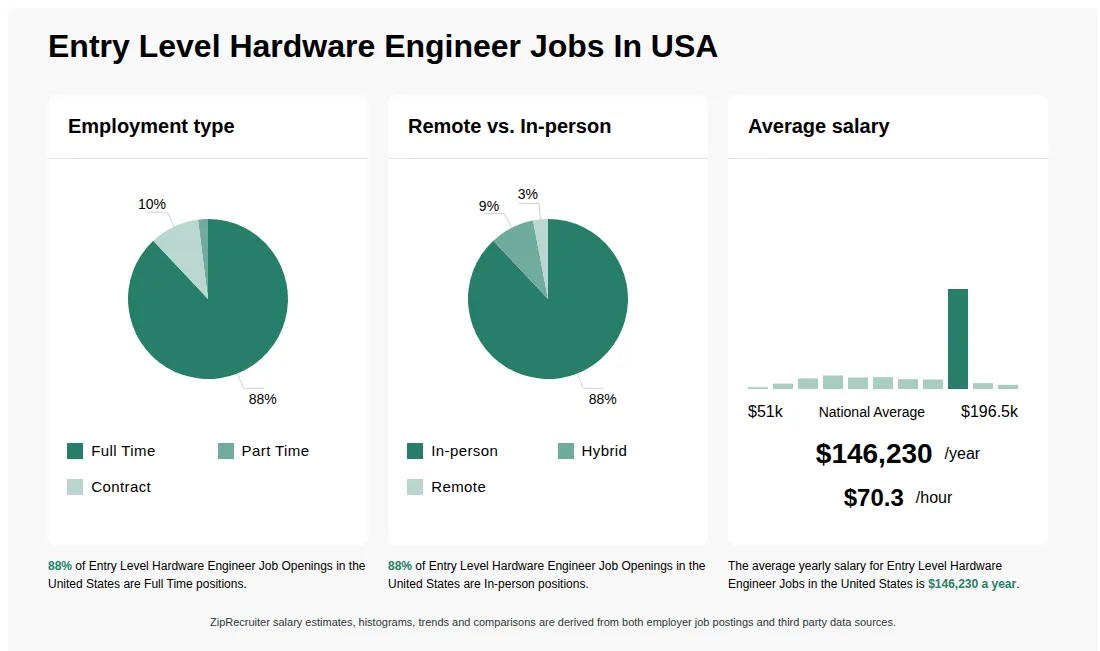
As of Aug 19, 2026, the average yearly pay for entry level hardware engineer in the United States is $146,230.00, according to ZipRecruiter salary data. Most workers in this role earn between $123,500.00 and $163,000.00 per year, depending on experience, location, and employer.

What is an entry level hardware engineer?

An Entry Level Hardware Engineer is responsible for assisting in the design, development, testing, and troubleshooting of computer hardware components and electronic systems. They work under the guidance of senior engineers to create circuit boards, processors, and other hardware elements used in various devices. Their role often includes schematic design, prototyping, debugging, and performance analysis to ensure optimal hardware functionality. Additionally, they collaborate with software engineers and manufacturers to bring products to market efficiently.

What does an entry level hardware engineer do?

A typical day for an Entry Level Hardware Engineer involves working closely with senior engineers to design, test, and debug hardware components and systems. You might spend time developing schematics, using simulation tools, assembling prototypes in the lab, and participating in team meetings to review project progress. Collaboration with software engineers, quality assurance teams, and manufacturing staff is common, ensuring seamless integration of hardware and software elements. The role offers a mix of hands-on technical tasks and problem-solving challenges, making every day varied and engaging as you build your experience and skills.

What are the key skills and qualifications needed to thrive as an entry level hardware engineer?

To thrive as an Entry Level Hardware Engineer, you typically need a bachelor's degree in electrical or computer engineering and a solid understanding of circuit design, microprocessors, and embedded systems. Familiarity with hardware description languages (such as VHDL or Verilog), PCB design tools (like Altium Designer or Eagle), and basic lab equipment is often required. Strong analytical thinking, attention to detail, and collaborative communication skills help distinguish successful candidates. These skills are critical for effectively designing, testing, and supporting hardware solutions as part of a team in a fast-evolving technology landscape.

More about Entry Level Hardware Engineer jobs

What cities are hiring for Entry Level Hardware Engineer jobs?

Cities with the most Entry Level Hardware Engineer job openings:

What are the most commonly searched types of Hardware Engineer jobs?

The most popular types of Hardware Engineer jobs are:

What states have the most Entry Level Hardware Engineer jobs?

States with the most job openings for Entry Level Hardware Engineer jobs include:

Infographic showing various Entry Level Hardware Engineer job openings in the United States as of August 2026, with employment types broken down into 67% Full Time, 22% Part Time, and 11% Contract. Highlights an 100% In-person job distribution, with an average salary of $146,230 per year, or $70.3 per hour.

Entry Level Hardware Engineer

Cornerstone Defense

Herndon, VA • On-site

$80K - $140K/yr

Contractor

Medical, Dental, Vision, Life, Retirement, PTO

Posted 8 days ago


Job description

  • Location: Herndon, Virginia
  • Type: Contract
  • Job #4038

Hardware Engineer/Help Desk Support
Herndon, VA
Active TS/SCI
Salary Range: $80,000 - $140,000

Company Overview:
Cornerstone Defense is the Employer of Choice within the Intelligence, Defense, and Space communities of the U.S. Government. Realizing early on that our most prized assets are our employees, we continually focus our attention on improving the overall work/life experience they have supporting the mission. Our Team is pushed every day to use their industry leading knowledge to provide end-to-end solutions to combat our nation's toughest and most secure problems. If you are looking for a place to not only be professionally challenged, but encouraged and supported by a company that cares, don't look any further than Cornerstone Defense.
Job Responsibilities:
We are seeking an entry-level Hardware Engineer to join our IT/Hardware Support team. This role will focus on triaging help desk tickets, performing hardware installations and removals, and providing first- and second-line technical support for desktop/laptop/workstation systems. The ideal candidate has basic experience with Windows or Linux, strong troubleshooting skills, and a customer-service mindset.
  • Respond to and resolve help desk tickets in a timely manner (hardware-related issues, peripheral and connectivity problems, basic OS troubleshooting).
  • Install, configure, image, upgrade, and decommission desktops, laptops, monitors, docking stations, printers, and other peripherals.
  • Perform hardware diagnostics and basic repairs; escalate complex hardware or firmware issues to senior engineering or vendor support.
  • Maintain accurate inventory records and asset tagging for hardware lifecycle tracking.
  • Apply operating system updates, drivers, and firmware as required.
  • Assist with cable management, workstation setup, and office moves or reconfigurations.
  • Create and maintain standard operating procedures (SOPs) and documentation for common tasks.
  • Provide courteous and professional support to end users; communicate ticket status and resolution steps clearly.
  • Follow IT security and compliance policies when handling equipment and data.
  • Strong problem-solving skills and an attention to detail.
  • Good verbal and written communication skills; customer-service oriented.
  • Ability to lift and move hardware (typically up to 50 lbs.) and work in office or data-center environments.
  • Willingness to work occasional extended hours for deployments or hardware refreshes.
  • Ability to lift and carry hardware; climb ladders and work in confined spaces if needed.
  • Must adhere to safety procedures for handling hardware and batteries.

Required Skills:
  • 0-2 years of professional experience in IT support, desktop support, or hardware technician roles.
  • Basic familiarity with Windows or Linux operating systems (installation, configuration, troubleshooting).
  • Comfortable working with PC hardware components (SATA/SSD/HDD, RAM, power supplies, motherboards) and common peripherals.

Desired Skills:
  • Security+ certification required.
  • Experience with Jira ticketing systems desired.

Company Benefits:
Cornerstone Defense offers a comprehensive list of benefits, designed to give employees and their families several options to choose from when selecting benefits that best fit their needs. These offerings include not only a full suite of the traditional Medical/Dental/Vision insurances, but also a number of other benefits and perks to include, but not limited to: A 401(K) plan with a company match, tuition and training assistances, paid vacation/leave, a fitness reimbursement program, college savings plan, commuter benefits, financial advisory services, flex spending accounts, health savings accounts, STD/LTD coverage, life and AD&D insurance, employee assistance programs, life financial planning assistance, and legal resources.