1

Empathetic Listener Jobs (NOW HIRING)

Regional Senior Product Manager

Atlanta, GA ยท Remote

$121K - $160K/yr

To be successful in this role you will be an empathetic listener, a self-starter, and a strong team player with excellent written and verbal communication skills. In addition, the successful ...

Being a positive and empathetic listener for all guest queries * Maximize all potential opportunities to create one of kind moments for special occasions (ranging from birthdays to anniversaries to ...

Clinic Receptionist

Pleasanton, CA ยท On-site

$17.75 - $21.50/hr

Exemplifies superb interpersonal skills - a "people person" - empathetic listener, sensitive, upbeat, optimistic, articulate, gracious, and tactful. * Builds relationships and accomplishes conflict ...

next page

Showing results 1-20

Empathetic Listener information

See salary details

$10

$31

$87

How much do empathetic listener jobs pay per hour?

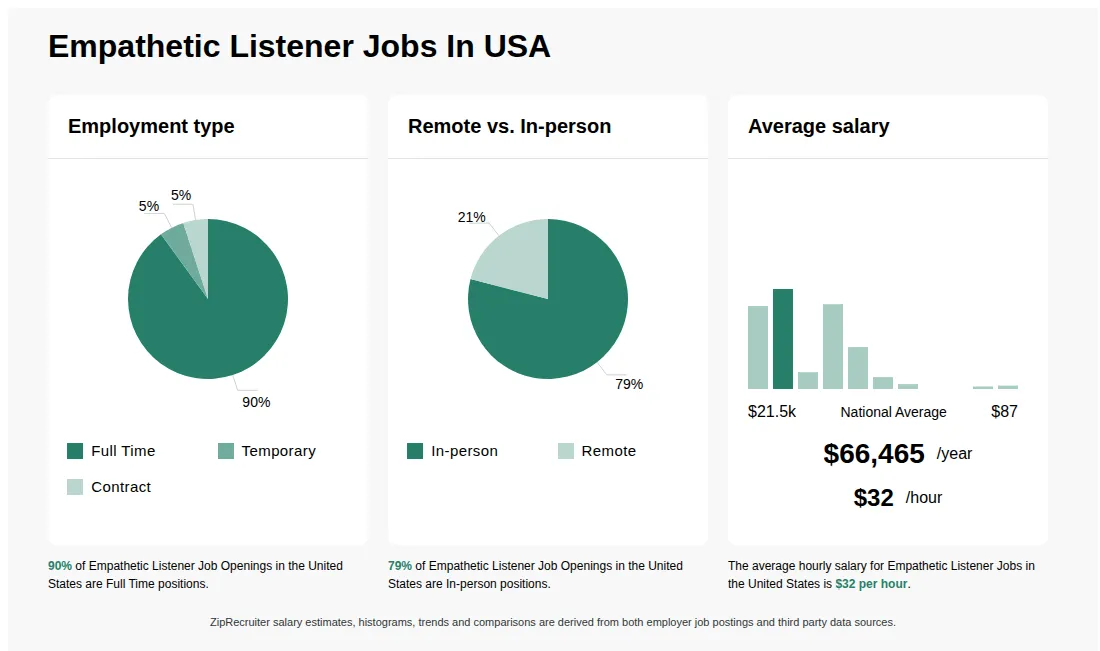
As of Jul 7, 2026, the average hourly pay for empathetic listener in the United States is $31.95, according to ZipRecruiter salary data. Most workers in this role earn between $18.03 and $37.74 per hour, depending on experience, location, and employer.

What is an Empathetic Listener job?

An Empathetic Listener is someone who provides a supportive and nonjudgmental space for individuals to express their thoughts and emotions. Their role involves actively listening, showing understanding, and offering encouragement without giving direct advice or judgment. This job is valuable in counseling, customer service, coaching, and peer support roles, where emotional intelligence and patience are essential. Empathetic listeners help people feel heard and validated, fostering trust and connection.

What are some typical challenges faced by an Empathetic Listener, and how are they addressed?

Empathetic Listeners often encounter emotionally charged conversations that require careful handling and strong boundaries to avoid compassion fatigue. Balancing active listening with providing appropriate resources or referrals, while maintaining confidentiality and neutrality, can also be demanding. Many organizations offer regular supervision, peer support, and training to help listeners manage stress and process challenging interactions. Building self-care routines and utilizing available support mechanisms are important for long-term effectiveness and well-being in this role.

How to become a paid empathetic listener?

To become a paid empathetic listener, develop strong communication and active listening skills, often through training or certification programs such as counseling or coaching courses. Gaining experience in roles like customer service, mental health support, or peer counseling can also help, and building a reputation for empathy can lead to paid opportunities in coaching, therapy, or support services.

What are the key skills and qualifications needed to thrive in the Empathetic Listener position, and why are they important?

To excel as an Empathetic Listener, you need strong active listening skills, emotional intelligence, and a background in counseling, psychology, or social work is often advantageous. Familiarity with client management systems and adherence to ethical guidelines or certifications, such as Mental Health First Aid, may be required. Exceptional interpersonal communication, patience, and cultural sensitivity are vital soft skills for this position. These attributes are critical for building trust, supporting individuals effectively, and facilitating meaningful conversations in various support environments.

Can you really get paid to be an empathetic listener?

Empathetic listening is a key skill for roles such as counselors, therapists, social workers, and customer service representatives, and these positions often offer compensation. While the job involves active listening and emotional support, earning depends on the specific role, experience, and employer, with some positions requiring certifications or training.

Is empathetic listener legit?

An empathetic listener is a real role that involves actively understanding and sharing the feelings of others, often in counseling, customer service, or support environments. The position typically requires strong communication skills and emotional intelligence, and it is recognized as a legitimate job in various industries. Certification or training in active listening or counseling can enhance credibility and effectiveness in this role.

Can I get paid to be a listener?

Empathetic listeners can be paid in roles such as counselors, therapists, or customer service representatives, where active listening is essential. These jobs often require relevant training, certifications, or experience, and may involve working in mental health, healthcare, or support environments.
More about Empathetic Listener jobs
What cities are hiring for Empathetic Listener jobs? Cities with the most Empathetic Listener job openings:
What are the most commonly searched types of Empathetic Listener jobs? The most popular types of Empathetic Listener jobs are:
What states have the most Empathetic Listener jobs? States with the most job openings for Empathetic Listener jobs include:
What job categories do people searching Empathetic Listener jobs look for? The top searched job categories for Empathetic Listener jobs are:
Infographic showing various Empathetic Listener job openings in the United States as of July 2026, with employment types broken down into 70% Full Time, 24% Part Time, 3% Temporary, and 3% Contract. Highlights an 91% In-person, 6% Hybrid, and 3% Remote job distribution, with an average salary of $66,465 per year, or $32 per hour.

Adept Patient Experience Specialist

MLee Medical Employment

Salemburg, NC โ€ข On-site

$15.50 - $19.75/hr

Other

Posted 10 days ago


Job description

This Patient Experience Specialist plays a vital role in crafting and leading educational initiatives aimed at enhancing patient experience metrics within Ancillary and Support Services Departments. The specialist offers coaching and support across all service lines to foster effective patient interactions, boosting satisfaction and outcomes.
Acting as a trusted consultant, this role involves conducting gap assessments and collaborating with nursing leadership to uphold best practices that elevate patient experience and overall perception. The specialist serves as a neutral, empathetic listener in sensitive care situations, building trust and professionalism among patients, providers, and staff.
Partnering closely with patients, leaders, and healthcare teams, this position drives the achievement of organizational patient experience goals.
Education and Formal Training
A minimum of a Bachelor's degree in a healthcare-related field is required. Candidates with a Master's degree or a strong clinical background are preferred.
Work Experience
At least two years of experience in training or educating on patient experience principles is necessary.
Knowledge, Skills, and Abilities

  • Understanding of adult learning theories, curriculum design, and program development.
  • Proficiency in Microsoft Word, Excel, Outlook, and PowerPoint.
  • Familiarity with EPIC applications is advantageous.
  • Ability to work independently in a fast-paced, confidential environment.
  • Strong organizational skills and meticulous attention to detail.
  • Skilled in monitoring, observing, and coaching ancillary staff to improve patient experience processes.

Physical Requirements
Frequent moderate lifting, pulling, pushing, and carrying; regular walking, standing, stooping, and reaching. Must be able to travel across multiple hospital campuses and offsite locations as needed.