We are seeking Embedded Systems Engineers to help design, develop, and support the embedded hardware systems for Nomad Total Command™ (NTC) and other systems integrated into Nomad products.
We are seeking Embedded Systems Engineers to help design, develop, and support the embedded hardware systems for Nomad Total Command™ (NTC) and other systems integrated into Nomad products.
We are seeking Embedded Systems Engineers to help design, develop, and support the embedded hardware systems for Nomad Total Command™ (NTC) and other systems integrated into Nomad products.
We are seeking Embedded Systems Engineers to help design, develop, and support the embedded hardware systems for Nomad Total Command™ (NTC) and other systems integrated into Nomad products.

Embedded Systems Engineer
Clyde Hill, WA · On-site
Embedded Systems Engineer 4 months Bellevue, WA, 10550 NE 10th St, 98004 Embedded Systems Engineer This engagement will support standing up a dedicated edge-compute environment for a new LiDAR ground ...
Quick apply
Embedded Systems Engineer
Clyde Hill, WA · On-site
Embedded Systems Engineer 4 months Bellevue, WA, 10550 NE 10th St, 98004 Embedded Systems Engineer This engagement will support standing up a dedicated edge-compute environment for a new LiDAR ground ...
We are seeking Embedded Systems Engineers to help design, develop, and support the embedded hardware systems for Nomad Total Command™ (NTC) and other systems integrated into Nomad products.
We are seeking Embedded Systems Engineers to help design, develop, and support the embedded hardware systems for Nomad Total Command™ (NTC) and other systems integrated into Nomad products.

Embedded Systems Engineer
California, MO · On-site
About the Job Umbra is seeking an Embedded Systems Engineer with a strong firmware background to support development of mission‑critical satellite systems. This role focuses on bare‑metal ...
Embedded Systems Engineer
California, MO · On-site
About the Job Umbra is seeking an Embedded Systems Engineer with a strong firmware background to support development of mission‑critical satellite systems. This role focuses on bare‑metal ...
Embedded Systems Engineers at Nomad GCS are responsible for the design, development, integration, testing, and lifecycle support of embedded hardware and firmware used within Nomad Total Command (NTC ...
Embedded Systems Engineers at Nomad GCS are responsible for the design, development, integration, testing, and lifecycle support of embedded hardware and firmware used within Nomad Total Command (NTC ...
We are seeking Embedded Systems Engineers to help design, develop, and support the embedded hardware systems for Nomad Total Command™ (NTC) and other systems integrated into Nomad products.
We are seeking Embedded Systems Engineers to help design, develop, and support the embedded hardware systems for Nomad Total Command™ (NTC) and other systems integrated into Nomad products.
We are seeking an Embedded Systems Engineer with strong experience in embedded hardware and software development, automotive interfaces, Linux-based systems, and hardware-in-the-loop (HiL) testing.
We are seeking an Embedded Systems Engineer with strong experience in embedded hardware and software development, automotive interfaces, Linux-based systems, and hardware-in-the-loop (HiL) testing.
We are seeking an Embedded Systems Engineer with strong experience in embedded hardware and software development, automotive interfaces, Linux-based systems, and hardware-in-the-loop (HiL) testing.
We are seeking an Embedded Systems Engineer with strong experience in embedded hardware and software development, automotive interfaces, Linux-based systems, and hardware-in-the-loop (HiL) testing.
Embedded Systems Engineer
Dearborn, MI · On-site
We are seeking an Embedded Systems Engineer with strong experience in embedded hardware and software development, automotive interfaces, Linux-based systems, and hardware-in-the-loop (HiL) testing.
Embedded Systems Engineer
Dearborn, MI · On-site
We are seeking an Embedded Systems Engineer with strong experience in embedded hardware and software development, automotive interfaces, Linux-based systems, and hardware-in-the-loop (HiL) testing.
We are seeking an Embedded Systems Engineer with strong experience in embedded hardware and software development, automotive interfaces, Linux-based systems, and hardware-in-the-loop (HiL) testing.
We are seeking an Embedded Systems Engineer with strong experience in embedded hardware and software development, automotive interfaces, Linux-based systems, and hardware-in-the-loop (HiL) testing.
Embedded Systems Engineer
Hazel Park, MI · On-site
We are seeking an Embedded Systems Engineer with strong experience in embedded hardware and software development, automotive interfaces, Linux-based systems, and hardware-in-the-loop (HiL) testing.
Embedded Systems Engineer
Hazel Park, MI · On-site
We are seeking an Embedded Systems Engineer with strong experience in embedded hardware and software development, automotive interfaces, Linux-based systems, and hardware-in-the-loop (HiL) testing.
We are seeking Embedded Systems Engineers to help design, develop, and support the embedded hardware systems for Nomad Total Command™ (NTC) and other systems integrated into Nomad products.
We are seeking Embedded Systems Engineers to help design, develop, and support the embedded hardware systems for Nomad Total Command™ (NTC) and other systems integrated into Nomad products.
Embedded Systems Engineer
Center Line, MI · On-site
We are seeking an Embedded Systems Engineer with strong experience in embedded hardware and software development, automotive interfaces, Linux-based systems, and hardware-in-the-loop (HiL) testing.
Embedded Systems Engineer
Center Line, MI · On-site
We are seeking an Embedded Systems Engineer with strong experience in embedded hardware and software development, automotive interfaces, Linux-based systems, and hardware-in-the-loop (HiL) testing.
Embedded Systems Engineer
Taylor, MI · On-site
We are seeking an Embedded Systems Engineer with strong experience in embedded hardware and software development, automotive interfaces, Linux-based systems, and hardware-in-the-loop (HiL) testing.
Embedded Systems Engineer
Taylor, MI · On-site
We are seeking an Embedded Systems Engineer with strong experience in embedded hardware and software development, automotive interfaces, Linux-based systems, and hardware-in-the-loop (HiL) testing.
We are seeking an Embedded Systems Engineer with strong experience in embedded hardware and software development, automotive interfaces, Linux-based systems, and hardware-in-the-loop (HiL) testing.
We are seeking an Embedded Systems Engineer with strong experience in embedded hardware and software development, automotive interfaces, Linux-based systems, and hardware-in-the-loop (HiL) testing.
Embedded Systems Engineer
Clawson, MI · On-site
We are seeking an Embedded Systems Engineer with strong experience in embedded hardware and software development, automotive interfaces, Linux-based systems, and hardware-in-the-loop (HiL) testing.
Embedded Systems Engineer
Clawson, MI · On-site
We are seeking an Embedded Systems Engineer with strong experience in embedded hardware and software development, automotive interfaces, Linux-based systems, and hardware-in-the-loop (HiL) testing.
Embedded Systems Engineer
Fraser, MI · On-site
We are seeking an Embedded Systems Engineer with strong experience in embedded hardware and software development, automotive interfaces, Linux-based systems, and hardware-in-the-loop (HiL) testing.
Embedded Systems Engineer
Fraser, MI · On-site
We are seeking an Embedded Systems Engineer with strong experience in embedded hardware and software development, automotive interfaces, Linux-based systems, and hardware-in-the-loop (HiL) testing.
Embedded Systems Engineer
Berkley, MI · On-site
We are seeking an Embedded Systems Engineer with strong experience in embedded hardware and software development, automotive interfaces, Linux-based systems, and hardware-in-the-loop (HiL) testing.
Embedded Systems Engineer
Berkley, MI · On-site
We are seeking an Embedded Systems Engineer with strong experience in embedded hardware and software development, automotive interfaces, Linux-based systems, and hardware-in-the-loop (HiL) testing.
Embedded Systems Engineer
Trenton, MI · On-site
We are seeking an Embedded Systems Engineer with strong experience in embedded hardware and software development, automotive interfaces, Linux-based systems, and hardware-in-the-loop (HiL) testing.
Embedded Systems Engineer
Trenton, MI · On-site
We are seeking an Embedded Systems Engineer with strong experience in embedded hardware and software development, automotive interfaces, Linux-based systems, and hardware-in-the-loop (HiL) testing.
Embedded Systems Engineer information
See salary details
$62.5K - $74.3K
1% of jobs
$74.3K - $86K
2% of jobs
$86K - $97.8K
6% of jobs
$97.8K - $109.6K
13% of jobs
$112.1K is the 25th percentile. Wages below this are outliers.
$109.6K - $121.4K
14% of jobs
$121.4K - $133.1K
12% of jobs
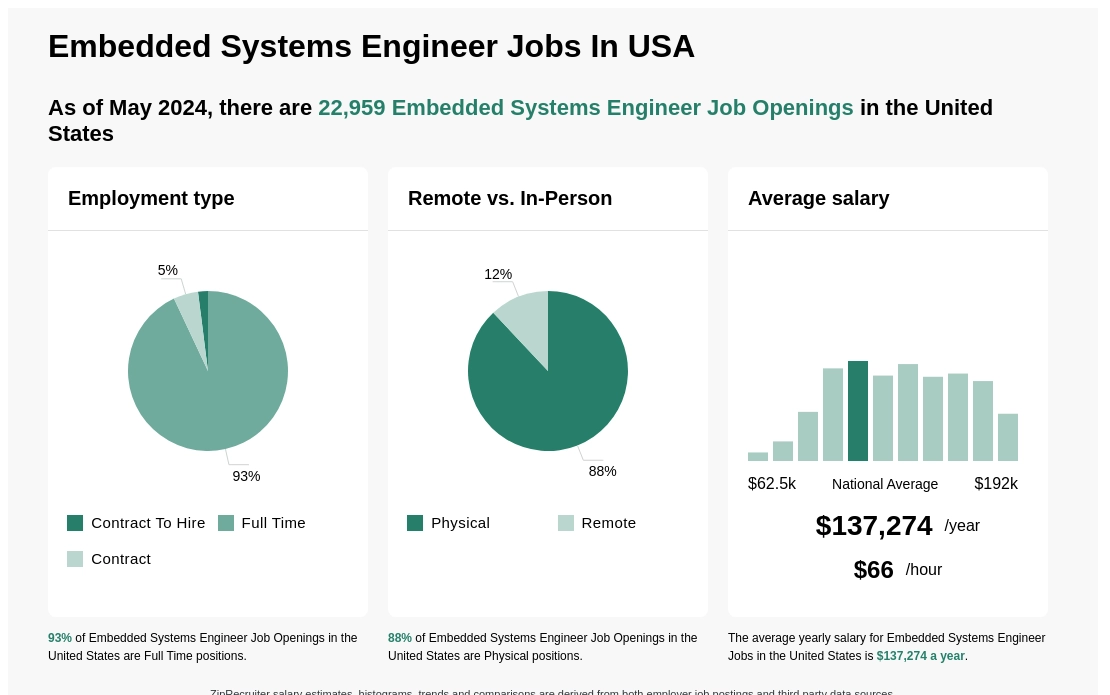
The median wage is $135.6K / yr.
$133.1K - $144.9K
13% of jobs
$144.9K - $156.7K
12% of jobs
$160.2K is the 75th percentile. Wages above this are outliers.
$156.7K - $168.5K
12% of jobs
$168.5K - $180.2K
11% of jobs
$180.2K - $192K
6% of jobs
$62.5K
$137.3K
$192K
How much do embedded systems engineer jobs pay per year?
As of Sep 15, 2026, the average yearly pay for embedded systems engineer in the United States is $137,274.00, according to ZipRecruiter salary data. Most workers in this role earn between $111,500.00 and $163,500.00 per year, depending on experience, location, and employer.
What is an embedded systems engineer?
Embedded Systems Engineers are professionals who design, develop, and maintain embedded systems—specialized computing systems that perform dedicated functions within larger mechanical or electrical systems. These engineers work with both hardware and software, often programming microcontrollers or microprocessors to control devices like automobiles, medical equipment, consumer electronics, and industrial machines. Their expertise ensures devices are efficient, reliable, and optimized for specific tasks, making embedded systems a crucial part of modern technology.
What does an embedded systems engineer do?
An embedded systems engineer creates the software to control electronics or machines that are different from regular computers. This software needs to run on the specific hardware it controls. Their duties also include troubleshooting and testing. Essential skills include problem-solving, critical thinking, and communication. Work is typically in an office environment with full-time business hours. Educational qualifications include a bachelor’s or master’s degree in embedded systems engineering or a related field.
What are the key skills and qualifications needed to thrive as an embedded systems engineer, and why are they important?
To thrive as an Embedded Systems Engineer, you need strong proficiency in C/C++ programming, embedded hardware knowledge, and a degree in electrical engineering, computer engineering, or a related field. Familiarity with real-time operating systems (RTOS), microcontroller development platforms, and debugging tools like oscilloscopes and logic analyzers is typically required. Problem-solving, attention to detail, and effective teamwork are critical soft skills for success in this role. These skills and qualities are essential to design reliable embedded solutions that meet strict performance, safety, and efficiency requirements.
What are some common challenges an embedded systems engineer faces when integrating hardware and software components?
Embedded Systems Engineers often encounter challenges when ensuring that hardware and software components work seamlessly together. These can include dealing with limited memory and processing power, timing constraints, and real-time performance requirements. Troubleshooting issues that arise from hardware-software interactions—such as driver compatibility, signal integrity, or power management—requires strong problem-solving skills and close collaboration with hardware designers and software developers. Engineers must frequently debug at both the hardware and code level, making attention to detail and cross-disciplinary communication essential in this role.
What is the difference between Embedded Systems Engineer vs Firmware Engineer?
| Aspect | Embedded Systems Engineer | Firmware Engineer |
|---|---|---|
| Credentials | Bachelor's in Electrical Engineering, Computer Engineering, or related fields; certifications like Certified Embedded Systems Engineer | Bachelor's in Computer Engineering, Electrical Engineering; certifications like Certified Firmware Engineer |
| Work Environment | Designing and developing embedded hardware/software for devices like automotive, medical, consumer electronics | Writing low-level code to optimize firmware for microcontrollers and embedded devices |
| Industry Usage | Used across automotive, aerospace, consumer electronics, industrial automation | Primarily in consumer electronics, IoT devices, and embedded hardware products |
Both roles focus on embedded development but differ in scope. Embedded Systems Engineers work on both hardware and software integration, while Firmware Engineers specialize in writing low-level code for device firmware. Understanding these distinctions helps in choosing the right career path or job search focus.
Are embedded systems engineers in demand?
Embedded systems engineers are in high demand due to the growth of IoT, automotive, healthcare, and consumer electronics industries. They typically require skills in programming languages like C and C++, and knowledge of hardware design, with job opportunities available across various sectors worldwide.
More about Embedded Systems Engineer jobs
What cities are hiring for Embedded Systems Engineer jobs?
Cities with the most Embedded Systems Engineer job openings:
What are the most commonly searched types of Embedded Systems Engineer jobs?
The most popular types of Embedded Systems Engineer jobs are:
Who are the top companies hiring for Embedded Systems Engineer jobs?
The top employers for Embedded Systems Engineer jobs are:
What states have the most Embedded Systems Engineer jobs?
States with the most job openings for Embedded Systems Engineer jobs include:
What are popular job titles related to Embedded Systems Engineer jobs?
For Embedded Systems Engineer jobs, the most frequently searched job titles are:

Embedded Systems Engineer ll
Huntsville, AL • On-site
Kratos Defense
• National Security and International Affairs • 1 - 5K employees1,001 - 5,000 employees
Full-time
Re-posted 10 days ago
Kratos Defense & Security Solutions rating

7.8
Based on 10 frontline employees who took The Breakroom Quiz
Job description
Overview: Nomad Global Communication Solutions (Nomad GCS) is a leading provider of communication and response products serving a wide range of customers. Our purpose is to be the solution when every minute matters. We are seeking Embedded Systems Engineers to help design, develop, and support the embedded hardware systems for Nomad Total Command™ (NTC) and other systems integrated into Nomad products.
Embedded Systems Engineers at Nomad GCS are responsible for the design, development, integration, testing, and lifecycle support of embedded hardware and firmware used within Nomad Total Command™ (NTC), as well as support of embedded systems across all Nomad products and platforms. This includes microcontrollers, embedded processors, sensors, control modules, communication interfaces, and operator control systems that enable deterministic control, automation, monitoring, and safe operation of capabilities across Nomad platforms.
Depending on level (I-V), Engineers progress from learning foundational engineering practices and supporting designs to independently leading complex system architectures, mentoring others, and driving technical strategy across the organization.
This position requires strong hands-on engineering capability combined with system-level thinking, enabling the engineer to diagnose complex system interactions, guide technical decisions, and improve the robustness and performance of embedded systems deployed in demanding environments.
Career Growth: Embedded Systems Engineers at Nomad GCS progress through five levels based on demonstrated technical mastery, independence, leadership, and impact. Advancement is supported through mentorship, ownership of embedded subsystems, and alignment with Nomad's Core Values.
Organizational Structure: Engineering is organized into Teams and Disciplines within the Innovative Solutions Division.
Teams:
o Team 1 - Standards and Modularity: Builds and maintains engineering standards, modules, templates, and rules enabling repeatability and scale.
o Team 2 - Design: Executes project-level engineering using established standards and less complex custom configurations.
o Team 3 - Advanced: Develops novel systems and resolves first-of-kind engineering challenges.
o Team 4 - Manufacturing & Industrial Engineering: Ensures manufacturability, safety, engineering intent, efficiency, and continuous improvement throughout Production.
Disciplines:
o Mechanical Engineering
o Electrical Engineering
o IT Engineering
o Human Factors Engineering
o Embedded Systems Engineering (where this role is located)
o Software Engineering
An Embedded Systems Engineer may be temporarily assigned to one or more of the four Teams and support Standards and Modularity, Design Engineering, Advanced Engineering, and/or Manufacturing & Industrial Engineering.
Core Responsibilities - All Levels:
- Design, develop, and support embedded hardware and firmware used within Nomad Total Command (NTC) and other Nomad platforms.
- Develop firmware and control logic using C/C++ for microcontrollers and embedded processors supporting modules and control interfaces.
- Write logic that bridges embedded hardware with NTC software using C/C++ and other languages.
- Specify/test new embedded computers, network switches, and other hardware for NTC or other Nomad platforms.
- Integrate sensors, actuators, networking interfaces, and operator control systems used by the NTC platform.
- Design and troubleshoot embedded systems using CAN, SPI, I²C, UART, Ethernet, and related protocols used within various communication networks.
- Ensure systems exhibit deterministic and predictable behavior, particularly in real-time or near real-time environments.
- Review, edit, or write JSON based configuration files.
- Implement error logging, as well as frequent “health checks” and hardware status updates.
- Drive improvements in reliability through testing, diagnostics, and design iteration.
- Diagnose complex interactions between hardware, firmware, networking, and electrical systems.
- Work within Linux-based environments, including containerized environments (Docker).
- Flash embedded firmware for micro-controlled hardware and sensors.
- Write control logic & software for Programmable Logic Controllers (PLC's).
- Participate in efforts to automate and continuously improve NTC hardware configuration.
- Attend meetings regarding upcoming builds, take meaningful notes, and actively participate:
- Proposal Reviews;
- Sales/Project Management Kickoffs;
- SPN reviews, Initial Design Reviews (IDR), and Executive Design Reviews (EDR); and
- Actively participate in Executive Reviews and document any findings.
- Configure, or aid in configuring NTC hardware for production projects, ensuring configuration is accurate and aligns with customer requirements and intended system operation.
- Assist production team(s) with troubleshooting NTC issues.
- Design or assist in designing printed circuit boards (PCB's)
- Participate in design reviews, testing, validation, and root cause analysis of embedded hardware and control behavior.
- Work closely with Software Engineering to define hardware abstraction layers (HAL's) and other methods to translate software commands into hardware actions.
- Assist software in defining how hardware data/control should be presented in the NTC frontend.
- Develop and improve embedded systems with the goal that hardware control logic is independent of NTC software functionality.
- Design systems with strong emphasis on fault tolerance, redundancy, and predictable failure behavior.
- Assist field and production teams in resolving challenging system-level issues.
- Prototype and test next-generation capabilities including, but not limited to:
- Automation systems
- Advanced sensor integration
- AI-assisted monitoring
- Autonomous subsystems
- Vehicle information system integration (CAN)
- Self-deployment capabilities (SLAM, Sensor-Fusion, Computer Vision etc.)
- Edge machine learning
- Predictive maintenance capabilities
- Subsystem data acquisition for local inference.
- Identify opportunities to improve operational awareness, system automation, and reliability.
- Collaborate cross-functionally with Mechanical Engineering, Electrical Engineering, IT Integration, Human Factors Engineering, Software Engineering, Production, Quality, and Program Management teams to ensure embedded systems integrate cleanly with platform subsystems.
- Apply continuous improvement principles to improve reliability, determinism, manufacturability, and maintainability of embedded hardware.
- Produce clear technical documentation including:
- Engineering notes
- Troubleshooting guides
- Test procedures
- Technical design documentation
- System changes, firmware updates, and hardware improvements.
- Translate operational feedback into engineering improvements.
- Uphold and model Nomad Core Values in all work.
- Perform additional duties as assigned.
Level Expectations:
Embedded Systems Engineer ll - Independent Contributor
- Independently develop firmware for embedded subsystems and control modules.
- Implement control logic, state machines, and communication interfaces supporting NTC functionality.
- Create production-ready embedded code and configuration for NTC hardware.
- Participate in NTC hardware bring-up, integration, and troubleshooting.
- Support manufacturing troubleshooting and resolve moderate NTC system issues.
- Participate actively in design reviews and cross-functional collaboration with supporting disciplines.
- Participate in advanced engineering projects requiring new features or complex logic.
- 2-5 years embedded systems engineering experience.
Progression signal: Can be trusted to deliver correct and quality embedded solutions under minimal supervision. Takes full ownership of projects and remains composed under pressure. Trusted to lead tasks assigned to them including leading design reviews, mentoring others, and taking initiative to continuously improve quality of work.
Basic Knowledge Progression:
- Level l: Foundational understanding of microcontrollers, firmware development, and debugging tools used within NTC embedded systems.
- Level ll: Strong working knowledge of embedded protocols and subsystem integration supporting NTC modules.
- Level lll: System-level expertise and troubleshooting mastery of NTC embedded hardware and communications.
- Level lV: Platform-level architecture and technical leadership for the NTC embedded system.
- Level V: Enterprise-level strategy, innovation, and mentorship guiding the evolution of the NTC embedded platform.
Qualifications & Preferred Skills:
- Proficiency in C/C++ for embedded systems required.
- Experience working in Linux environments required.
- Basic networking knowledge required, advanced preferred.
- Bachelor's Degree in Computer Engineering or related preferred.
- 2-5 years embedded systems engineering experience.
- Working knowledge of relational database systems preferred.
- Experience with FreeRTOS or other RTOS platforms preferred.
- Exposure to closed-loop control in robotics, automotive, aerospace or similar preferred.
- Working knowledge of JavaScript, React, and/or similar object-oriented programming preferred.
Physical Demands:
- Ability to stand and sit for extended periods.
- Manual dexterity to operate office equipment.
- Occasionally lift and/or move up to 20 pounds.
- Occasional climbing or hands-on testing activities.
- Ability to work in office, shop, and vehicle environments as needed.
- Ability to work safely around energized systems when required.
- Must be able to travel as needed on occasion.
Working Environment:
- Combination of office, production floor, and vehicle-based environments.
- Exposure to manufacturing noise, electrical equipment, and testing environments.
- PPE required when entering production or testing areas.
What Kratos Defense & Security Solutions employees say
Pay
Benefits
Hours and flexibility
Workplace
Get the full story on Breakroom

About Kratos Defense
Sourced by ZipRecruiter
Industry
National security and international affairs
Company size
1,001 - 5,000 Employees
Headquarters location
San Diego, CA, US
Year founded
1994