PassiveLogic is looking for an Embedded Systems Engineer who is excited to help build the hardware platform powering the world's first autonomous buildings. About PassiveLogic ® PassiveLogic is the ...
PassiveLogic is looking for an Embedded Systems Engineer who is excited to help build the hardware platform powering the world's first autonomous buildings. About PassiveLogic ® PassiveLogic is the ...
Embedded Systems Engineer
Salt Lake City, UT · On-site
$120/hr
We're looking for an Embedded Systems Engineer to help build and evolve the device-side (edge) software and firmware stack - controlling cameras and sensors, synchronizing capture, and building new ...
Embedded Systems Engineer
Salt Lake City, UT · On-site
$120/hr
We're looking for an Embedded Systems Engineer to help build and evolve the device-side (edge) software and firmware stack - controlling cameras and sensors, synchronizing capture, and building new ...

Embedded Systems Engineer II
Midvale, UT · On-site
$115K - $130K/yr
Embedded Systems Engineer II Hours: Full-time Location: Midvale, UT (On-site with occasional remote flexibility) #LI-Onsite You report to: Engineering Manager Compensation: A base salary range of ...
Embedded Systems Engineer II
Midvale, UT · On-site
$115K - $130K/yr
Embedded Systems Engineer II Hours: Full-time Location: Midvale, UT (On-site with occasional remote flexibility) #LI-Onsite You report to: Engineering Manager Compensation: A base salary range of ...
Embedded Systems Engineer II
Midvale, UT · On-site
$115K - $130K/yr
Embedded Systems Engineer II Hours: Full-time Location: Midvale, UT (On-site with occasional remote flexibility) #LI-Onsite You report to: Engineering Manager Compensation: A base salary range of ...
Embedded Systems Engineer II
Midvale, UT · On-site
$115K - $130K/yr
Embedded Systems Engineer II Hours: Full-time Location: Midvale, UT (On-site with occasional remote flexibility) #LI-Onsite You report to: Engineering Manager Compensation: A base salary range of ...
Embedded Systems Engineer II
Midvale, UT · On-site
$115K - $130K/yr
Embedded Systems Engineer II Hours: Full-time Location: Midvale, UT (On-site with occasional remote flexibility) #LI-Onsite You report to: Engineering Manager Compensation: A base salary range of ...
Quick apply
Embedded Systems Engineer II
Midvale, UT · On-site
$115K - $130K/yr
Embedded Systems Engineer II Hours: Full-time Location: Midvale, UT (On-site with occasional remote flexibility) #LI-Onsite You report to: Engineering Manager Compensation: A base salary range of ...

Senior Embedded Systems Engineer
$130K - $170K/yr
As a Senior Embedded Systems Engineer, you'll help build the embedded platform that everything else depends on. About the Role We're looking for an experienced embedded software engineer with strong ...
Quick apply
Senior Embedded Systems Engineer
$130K - $170K/yr
As a Senior Embedded Systems Engineer, you'll help build the embedded platform that everything else depends on. About the Role We're looking for an experienced embedded software engineer with strong ...
Senior Embedded Systems Engineer
Salt Lake City, UT · On-site
$150/hr
We're looking for a Senior Embedded Systems Engineer to own and evolve the device-side (edge) software and firmware stack - controlling cameras and sensors, synchronizing capture, and building new ...
Senior Embedded Systems Engineer
Salt Lake City, UT · On-site
$150/hr
We're looking for a Senior Embedded Systems Engineer to own and evolve the device-side (edge) software and firmware stack - controlling cameras and sensors, synchronizing capture, and building new ...

Senior Embedded Systems Engineer - Draper, UT
Draper, UT · On-site
$115K/yr
The Senior Embedded Systems Engineer is an individual contributor responsible for technical design, development, and validation of embedded hardware and firmware projects within PDK. You will create ...
Senior Embedded Systems Engineer - Draper, UT
Draper, UT · On-site
$115K/yr
The Senior Embedded Systems Engineer is an individual contributor responsible for technical design, development, and validation of embedded hardware and firmware projects within PDK. You will create ...
Senior Embedded Systems Engineer (Wireless Product Development) About the Role As an Embedded Systems Engineer at PassiveLogic, you'll co-lead the development of our suite of wireless products, from ...
Senior Embedded Systems Engineer (Wireless Product Development) About the Role As an Embedded Systems Engineer at PassiveLogic, you'll co-lead the development of our suite of wireless products, from ...

Embedded System Manager
American Fork, UT · On-site
Position Summary Lion Energy is seeking an Embedded Systems Manager to lead our embedded engineering team in the development of next-generation energy storage and portable power solutions. This role ...
Embedded System Manager
American Fork, UT · On-site
Position Summary Lion Energy is seeking an Embedded Systems Manager to lead our embedded engineering team in the development of next-generation energy storage and portable power solutions. This role ...
Embedded System Manager
American Fork, UT · On-site
Position Summary Lion Energy is seeking an Embedded Systems Manager to lead our embedded engineering team in the development of next-generation energy storage and portable power solutions. This role ...
Embedded System Manager
American Fork, UT · On-site
Position Summary Lion Energy is seeking an Embedded Systems Manager to lead our embedded engineering team in the development of next-generation energy storage and portable power solutions. This role ...

... an embedded software/firmware engineer to support development of a range of high-performance actuation systems, such as aerodynamic steering, thrust vectoring, attitude and divert maneuvering ...
... an embedded software/firmware engineer to support development of a range of high-performance actuation systems, such as aerodynamic steering, thrust vectoring, attitude and divert maneuvering ...

Embedded Software Engineering- UT with Security Clearance
Salt Lake City, UT · On-site
$126K - $166K/yr
S. Secret Required Job Overview The Resilient Communications software engineering organization is seeking Software Engineers focused on system software development for embedded devices and ...
Embedded Software Engineering- UT with Security Clearance
Salt Lake City, UT · On-site
$126K - $166K/yr
S. Secret Required Job Overview The Resilient Communications software engineering organization is seeking Software Engineers focused on system software development for embedded devices and ...

Embedded systems engineering * Mechanical engineering Future Scope (Long-Term Impact): * Contribute to system design and architecture * Define requirements and system interfaces * Influence ...
Embedded systems engineering * Mechanical engineering Future Scope (Long-Term Impact): * Contribute to system design and architecture * Define requirements and system interfaces * Influence ...

Embedded Software Engineer with Security Clearance
Salt Lake City, UT · On-site
$127K - $167K/yr
... Level 4 Software Engineer focused on system software development for embedded devices and ... The ideal candidate brings strong system software experience, sound technical judgment, and the ...
Embedded Software Engineer with Security Clearance
Salt Lake City, UT · On-site
$127K - $167K/yr
... Level 4 Software Engineer focused on system software development for embedded devices and ... The ideal candidate brings strong system software experience, sound technical judgment, and the ...

Embedded Software Engineer - II - Contract
Mendon, UT · On-site
$89K - $113K/yr
As an Embedded Software Engineer II, you will participate in the full software development ... Participate in systems engineering to ensure smooth software integration across hardware and ...
Quick apply
Embedded Software Engineer - II - Contract
Mendon, UT · On-site
$89K - $113K/yr
As an Embedded Software Engineer II, you will participate in the full software development ... Participate in systems engineering to ensure smooth software integration across hardware and ...
Embedded Software Engineer - III - Contract
Mendon, UT · On-site
$109K - $137K/yr
As an Embedded Software Engineer III , you will participate in the full software development ... Participate in systems engineering to ensure smooth software integration across hardware and ...
Embedded Software Engineer - III - Contract
Mendon, UT · On-site
$109K - $137K/yr
As an Embedded Software Engineer III , you will participate in the full software development ... Participate in systems engineering to ensure smooth software integration across hardware and ...
Embedded Software Engineer - II - Contract
Mendon, UT · On-site
$89K - $113K/yr
As an Embedded Software Engineer II , you will participate in the full software development ... Participate in systems engineering to ensure smooth software integration across hardware and ...
Embedded Software Engineer - II - Contract
Mendon, UT · On-site
$89K - $113K/yr
As an Embedded Software Engineer II , you will participate in the full software development ... Participate in systems engineering to ensure smooth software integration across hardware and ...
Embedded Software Engineer - III - Contract
Mendon, UT · On-site
$109K - $137K/yr
As an Embedded Software Engineer III, you will participate in the full software development ... Participate in systems engineering to ensure smooth software integration across hardware and ...
Quick apply
Embedded Software Engineer - III - Contract
Mendon, UT · On-site
$109K - $137K/yr
As an Embedded Software Engineer III, you will participate in the full software development ... Participate in systems engineering to ensure smooth software integration across hardware and ...
Embedded Software Engineer - III - Contract
Mendon, UT · On-site
$114K - $150K/yr
As an Embedded Software Engineer III , you will participate in the full software development ... Participate in systems engineering to ensure smooth software integration across hardware and ...
Embedded Software Engineer - III - Contract
Mendon, UT · On-site
$114K - $150K/yr
As an Embedded Software Engineer III , you will participate in the full software development ... Participate in systems engineering to ensure smooth software integration across hardware and ...
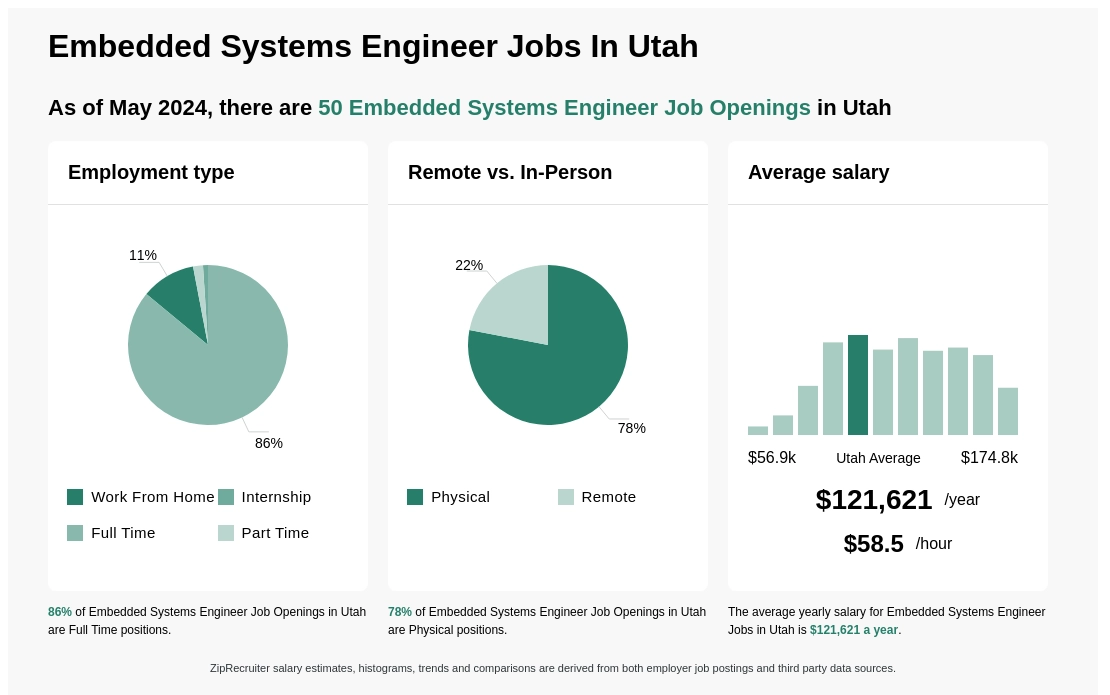
Embedded Systems Engineer information
See Utah salary details
$56.9K - $67.6K
1% of jobs
$67.6K - $78.3K
2% of jobs
$78.3K - $89.1K
6% of jobs
$89.1K - $99.8K
13% of jobs
$102K is the 25th percentile. Wages below this are outliers.
$99.8K - $110.5K
14% of jobs
$110.5K - $121.2K
12% of jobs
The median wage is $123.4K / yr.
$121.2K - $131.9K
13% of jobs
$131.9K - $142.6K
12% of jobs
$145.8K is the 75th percentile. Wages above this are outliers.
$142.6K - $153.4K
12% of jobs
$153.4K - $164.1K
11% of jobs
$164.1K - $174.8K
6% of jobs
$56.9K
$125K
$174.8K
How much do embedded systems engineer jobs pay per year?
As of Sep 3, 2026, the average yearly pay for embedded systems engineer in Utah is $124,970.00, according to ZipRecruiter salary data. Most workers in this role earn between $101,500.00 and $148,800.00 per year, depending on experience, location, and employer.
What is an embedded systems engineer?
Embedded Systems Engineers are professionals who design, develop, and maintain embedded systems—specialized computing systems that perform dedicated functions within larger mechanical or electrical systems. These engineers work with both hardware and software, often programming microcontrollers or microprocessors to control devices like automobiles, medical equipment, consumer electronics, and industrial machines. Their expertise ensures devices are efficient, reliable, and optimized for specific tasks, making embedded systems a crucial part of modern technology.
What does an embedded systems engineer do?
An embedded systems engineer creates the software to control electronics or machines that are different from regular computers. This software needs to run on the specific hardware it controls. Their duties also include troubleshooting and testing. Essential skills include problem-solving, critical thinking, and communication. Work is typically in an office environment with full-time business hours. Educational qualifications include a bachelor’s or master’s degree in embedded systems engineering or a related field.
What are the key skills and qualifications needed to thrive as an embedded systems engineer, and why are they important?
To thrive as an Embedded Systems Engineer, you need strong proficiency in C/C++ programming, embedded hardware knowledge, and a degree in electrical engineering, computer engineering, or a related field. Familiarity with real-time operating systems (RTOS), microcontroller development platforms, and debugging tools like oscilloscopes and logic analyzers is typically required. Problem-solving, attention to detail, and effective teamwork are critical soft skills for success in this role. These skills and qualities are essential to design reliable embedded solutions that meet strict performance, safety, and efficiency requirements.
What are some common challenges an embedded systems engineer faces when integrating hardware and software components?
Embedded Systems Engineers often encounter challenges when ensuring that hardware and software components work seamlessly together. These can include dealing with limited memory and processing power, timing constraints, and real-time performance requirements. Troubleshooting issues that arise from hardware-software interactions—such as driver compatibility, signal integrity, or power management—requires strong problem-solving skills and close collaboration with hardware designers and software developers. Engineers must frequently debug at both the hardware and code level, making attention to detail and cross-disciplinary communication essential in this role.
What is the difference between Embedded Systems Engineer vs Firmware Engineer?
| Aspect | Embedded Systems Engineer | Firmware Engineer |
|---|---|---|
| Credentials | Bachelor's in Electrical Engineering, Computer Engineering, or related fields; certifications like Certified Embedded Systems Engineer | Bachelor's in Computer Engineering, Electrical Engineering; certifications like Certified Firmware Engineer |
| Work Environment | Designing and developing embedded hardware/software for devices like automotive, medical, consumer electronics | Writing low-level code to optimize firmware for microcontrollers and embedded devices |
| Industry Usage | Used across automotive, aerospace, consumer electronics, industrial automation | Primarily in consumer electronics, IoT devices, and embedded hardware products |
Both roles focus on embedded development but differ in scope. Embedded Systems Engineers work on both hardware and software integration, while Firmware Engineers specialize in writing low-level code for device firmware. Understanding these distinctions helps in choosing the right career path or job search focus.
Are embedded systems engineers in demand?
Embedded systems engineers are in high demand due to the growth of IoT, automotive, healthcare, and consumer electronics industries. They typically require skills in programming languages like C and C++, and knowledge of hardware design, with job opportunities available across various sectors worldwide.
More about Embedded Systems Engineer jobs
What are the most commonly searched types of Embedded Systems Engineer jobs in Utah?
The most popular types of Embedded Systems Engineer jobs in Utah are:
What are popular job titles related to Embedded Systems Engineer jobs in Utah?
For Embedded Systems Engineer jobs in Utah, the most frequently searched job titles are:
What job categories do people searching Embedded Systems Engineer jobs in Utah look for?
The top searched job categories for Embedded Systems Engineer jobs in Utah are:
What cities in Utah are hiring for Embedded Systems Engineer jobs?
Cities in Utah with the most Embedded Systems Engineer job openings:
What are popular job titles related to Embedded Systems Engineer jobs in UT?
For Embedded Systems Engineer jobs in UT, the most frequently searched job titles are:

Full-time
Medical, Dental, Vision, Life, PTO
Re-posted 9 days ago
Job description
Are you passionate about building embedded systems that bridge the physical and digital worlds? Do you thrive on solving complex engineering challenges and seeing your work come to life in real-world products? PassiveLogic is looking for an Embedded Systems Engineer who is excited to help build the hardware platform powering the world's first autonomous buildings.
About PassiveLogic®
PassiveLogic is the first fully autonomous platform for buildings. We've reinvented the fundamental principles of automation to democratize technology, optimize buildings, and reduce the world's carbon footprint. We are a team of technologists, engineers, and creatives dedicated to making a sustainable impact through real-world solutions.
We are looking for team members who have a passion for technology and want to work on cutting-edge problems with real-world solutions. Our culture is built on bringing together the most talented engineers, thinkers, and creatives-backed by the world's leading investors-working together to make the future a reality.
About the Role
This is a career-defining opportunity to play a crucial role in a hyper-scale AI company that is transforming the future of autonomous systems, energy, and the built environment.
As an Embedded Systems Engineer at PassiveLogic, you will co-lead development of our suite of building controller hardware products, from zero to manufacture. You'll collaborate closely with the electrical, mechanical, industrial design, and verification/validation (V&V) teams to deliver robust, innovative solutions. This role demands a disciplined, independent leader with stellar embedded software skills, a systems-level mindset and the ability to self-teach and solve tough problems. You will contribute to shaping the product vision, drive its execution, and ensure it meets our standards for quality and efficiency.
What you'll do
Develop embedded systems: End to end development, from architecture design to high-volume production, of firmware and software for our embedded platforms, that is robust, functional, power-efficient, and feature-rich.
Test and validate embedded systems: Design and implement HIL/SIL testing frameworks to validate robust, fail-safe code before V&V handoff. Collaborate with electrical, mechanical and industrial design teams to maintain product vision alignment.
Collaborate on Feature Development: Work with platform architects, product management, and product design teams to architect and implement new features from initial concept to productization.
Ensure Hardware-Firmware Platform Robustness: Use a structured and efficient approach to bug management. Perform hands-on system debugging to integrate hardware and software seamlessly.
Prepare and maintain technical documentation: Maintain meticulous engineering and code documentation and communicate progress/design intent.
What you'll bring
If your experience does not meet all our posted requirements below, we'd still love to hear from you. We are looking for practitioners who are passionate about understanding people, committed to lifelong learning, and driven by the love of what they do. If that's you, please apply!
You must have
You should have
It's helpful to have
We know there are candidates who might not fit everything we've described above, or who might have experience and skills we haven't considered. PassiveLogic can sometimes be flexible enough to shift responsibilities to the right person, or otherwise identify open or upcoming roles that may better fit your professional background. Even if you don't meet all the requirements above, we still want to hear from you.
Compensation, Benefits & Perks:
A Note on Working Onsite:
This role is based in our Salt Lake City headquarters. We believe that creativity and cohesion flows best when we are all together. When you're constantly innovating, transforming whole industries, inventing new products and processes, and creating a more sustainable future through technology-and we are doing all these things-we believe we're better as a team in-person. That's why all of our teams work from one of our office locations, five days a week.
When applying, include:
Diversity and inclusion
Diversity, inclusion, and belonging is woven into our values and everything we do. We welcome all-come as you are and bring your whole self. We are proud to be an Equal Opportunity Employer. We celebrate diversity every day by maintaining a safe and inclusive environment for our employees at every stage of their careers.
Department Hardware Engineering Role Embedded Locations Salt Lake City
About PassiveLogic®
PassiveLogic is the first fully autonomous platform for buildings. We've reinvented the fundamental principles of automation to democratize technology, optimize buildings, and reduce the world's carbon footprint. We are a team of technologists, engineers, and creatives dedicated to making a sustainable impact through real-world solutions.
We are looking for team members who have a passion for technology and want to work on cutting-edge problems with real-world solutions. Our culture is built on bringing together the most talented engineers, thinkers, and creatives-backed by the world's leading investors-working together to make the future a reality.
About the Role
This is a career-defining opportunity to play a crucial role in a hyper-scale AI company that is transforming the future of autonomous systems, energy, and the built environment.
As an Embedded Systems Engineer at PassiveLogic, you will co-lead development of our suite of building controller hardware products, from zero to manufacture. You'll collaborate closely with the electrical, mechanical, industrial design, and verification/validation (V&V) teams to deliver robust, innovative solutions. This role demands a disciplined, independent leader with stellar embedded software skills, a systems-level mindset and the ability to self-teach and solve tough problems. You will contribute to shaping the product vision, drive its execution, and ensure it meets our standards for quality and efficiency.
What you'll do
Develop embedded systems: End to end development, from architecture design to high-volume production, of firmware and software for our embedded platforms, that is robust, functional, power-efficient, and feature-rich.
Test and validate embedded systems: Design and implement HIL/SIL testing frameworks to validate robust, fail-safe code before V&V handoff. Collaborate with electrical, mechanical and industrial design teams to maintain product vision alignment.
Collaborate on Feature Development: Work with platform architects, product management, and product design teams to architect and implement new features from initial concept to productization.
Ensure Hardware-Firmware Platform Robustness: Use a structured and efficient approach to bug management. Perform hands-on system debugging to integrate hardware and software seamlessly.
Prepare and maintain technical documentation: Maintain meticulous engineering and code documentation and communicate progress/design intent.
What you'll bring
If your experience does not meet all our posted requirements below, we'd still love to hear from you. We are looking for practitioners who are passionate about understanding people, committed to lifelong learning, and driven by the love of what they do. If that's you, please apply!
You must have
- Proven experience:
- Degree in Electrical Engineering, Computer Engineering, Computer Science, or related field-or proven exceptional ability through experience.
- 6+ years working with embedded systems and embedded software development
- Very strong embedded programming skills (C, C++, Python, etc)
- Embedded Linux and/or RTOS system development experience
- Strong electronic laboratory and debugging skills
- Familiarity with schematics and electronic systems
- Proficiency in Git for version control, collaboration, and maintaining high-quality codebases.
- Exceptional Communication Skills: An ability to document/communicate clearly to effectively lead, mentor, and align teams.
- Organized and Strategic: An organized, structured approach to complex project leadership and an enthusiasm for owning work within the context of the big picture.
- Collaborative Mindset: You thrive in cross-disciplinary teams, knowing the best hardware is built when everyone's brainpower is in the mix.
- Adaptability: Comfortable in a fast-paced startup environment, eager to learn, iterate, and innovate.
- Problem solving: You own this role. When issues arise, be the empowered force that solves them, rolling-up to product management and leadership.
- A self-driven curious mindset: Able to independently research, learn, and solve complex challenges. Experience with (or a desire to explore) setting up and deploying AI-assisted testing systems is a bonus.
You should have
- ARM SoC development experience
- Experience with wireless protocols (BLE, Mesh, Zigbee)
- Experience with schematic capture and board layout using Altium.
- Experience with safety and radio compliance testing.
It's helpful to have
- Familiarity with the startup environment.
- Experience interfacing with overseas vendors and supporting the manufacturing process.
- Background in mentoring junior engineers or leading cross-functional teams.
- Familiarity with RF design
- Swift language experience
- Experience with autonomous systems, Machine Learning, or energy systems
- Personal projects showcasing initiative and technical depth (include these with your application!).
We know there are candidates who might not fit everything we've described above, or who might have experience and skills we haven't considered. PassiveLogic can sometimes be flexible enough to shift responsibilities to the right person, or otherwise identify open or upcoming roles that may better fit your professional background. Even if you don't meet all the requirements above, we still want to hear from you.
Compensation, Benefits & Perks:
- Competitive compensation
- Generous equity share package
- Medical, dental and vision coverage
- Disability and life Insurance options
- Flex PTO
- Team-building events
- Free catered lunch in the office Monday - Friday
- Free ski pass (We are at the base of Big Cottonwood Canyon)
- Free National Park pass
- Onsite Gym
A Note on Working Onsite:
This role is based in our Salt Lake City headquarters. We believe that creativity and cohesion flows best when we are all together. When you're constantly innovating, transforming whole industries, inventing new products and processes, and creating a more sustainable future through technology-and we are doing all these things-we believe we're better as a team in-person. That's why all of our teams work from one of our office locations, five days a week.
When applying, include:
- A cover letter telling us why you're the perfect candidate for PassiveLogic
- A resume
- Extra mile - include a description of a project (of any type) you personally created, devised, built, managed, organized, or designed that was of your own self-initiative
Diversity and inclusion
Diversity, inclusion, and belonging is woven into our values and everything we do. We welcome all-come as you are and bring your whole self. We are proud to be an Equal Opportunity Employer. We celebrate diversity every day by maintaining a safe and inclusive environment for our employees at every stage of their careers.
Department Hardware Engineering Role Embedded Locations Salt Lake City

About PassiveLogic
Sourced by ZipRecruiter
Industry
Software development
Company size
51 - 200 Employees
Headquarters location
Salt Lake City, UT, US
Year founded
2016