1

Code Enforcement Jobs in Georgia (NOW HIRING)

Code Enforcement Officer

Lawrenceville, GA ยท On-site

$50K - $57K/yr

Code Enforcement Officer REPOSTED 6/25/2026 Base Hiring Salary Ranges: Code Enforcement Officer I: $50,270 - $57,812 Code Enforcement Officer II: $59,452 - $68,3780 Code Enforcement Officer III: $64 ...

Code Enforcement Officer

Lawrenceville, GA ยท On-site

$62K - $72K/yr

Code Enforcement Officer I: $50,270 - $57,812 Code Enforcement Officer II: $59,452 - $68,3780 Code Enforcement Officer III: $64,655 - $75,162 This position serves as a lead to staff in the Commercial ...

Code Enforcement Officer Code enforcement officers perform a variety of field and office work to ensure compliance with property maintenance, minimum housing standards, ordinances, and land use ...

next page

Showing results 1-20

Code Enforcement information

See Georgia salary details

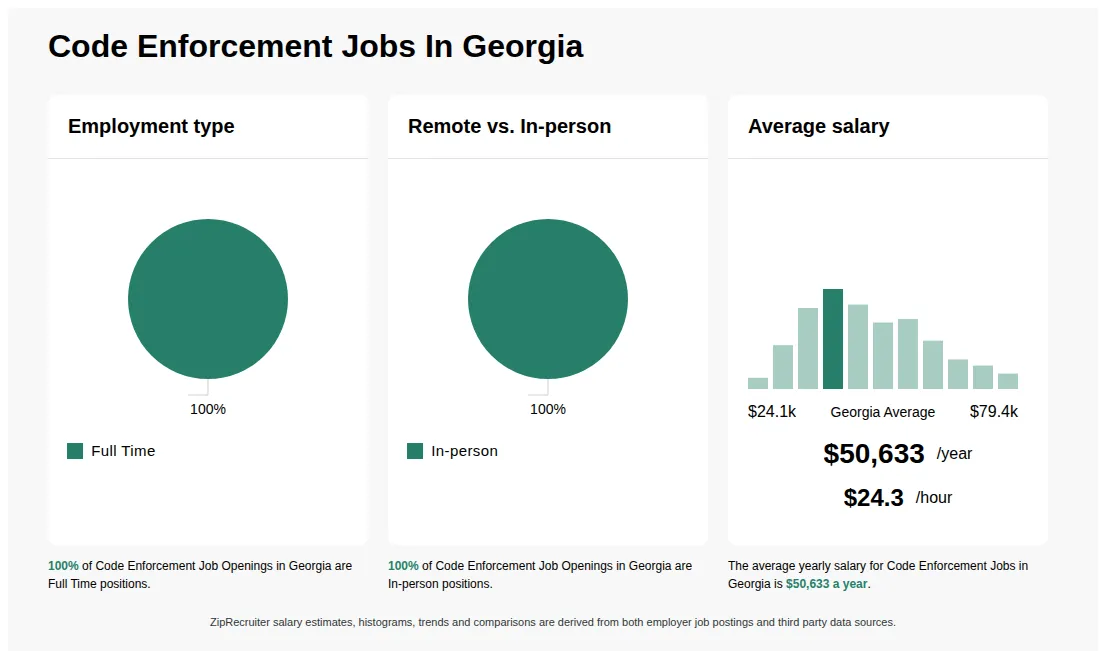
$24.1K

$50.6K

$79.4K

How much do code enforcement jobs pay per year?

As of Jul 15, 2026, the average yearly pay for code enforcement in Georgia is $50,633.00, according to ZipRecruiter salary data. Most workers in this role earn between $39,700.00 and $58,300.00 per year, depending on experience, location, and employer.

What are code enforcement officers and what do they do?

Code enforcement officers are professionals responsible for ensuring that local laws, ordinances, and regulations related to building codes, zoning, property maintenance, and public safety are followed. They inspect properties, investigate complaints, and work with property owners to resolve violations. Their goal is to maintain community standards, protect public health and safety, and improve neighborhood quality. Code enforcement officers may issue warnings, citations, or even initiate legal proceedings if violations are not corrected.

What does a code enforcement officer do?

A code enforcement officer ensures compliance with local building, zoning, and safety codes by inspecting properties, investigating violations, and issuing citations or notices for non-compliance. They often work with property owners, contractors, and city officials to resolve issues and may require knowledge of relevant regulations and documentation skills.

What are some common challenges faced by code enforcement officers in their daily work?

Code enforcement officers frequently encounter challenges such as handling confrontational situations with property owners, staying updated with evolving local codes and ordinances, and managing a high volume of cases efficiently. They often need to balance regulatory compliance with diplomacy, as building positive relationships with the community is crucial. Additionally, officers must document violations thoroughly and collaborate with other municipal departments, such as zoning, fire, or public health, to resolve complex issues.

What are career paths in code enforcement?

Career paths in code enforcement typically start with entry-level inspector or officer roles, focusing on enforcing building codes, zoning laws, and property standards. Advancement can lead to supervisory positions, specialized roles such as environmental or fire code inspectors, or management positions like code enforcement supervisor or director, often requiring additional certifications and experience. Skills in communication, knowledge of local regulations, and familiarity with inspection tools are important for career progression.

What is the difference between Code Enforcement vs Building Inspector?

AspectCode EnforcementBuilding Inspector
Required credentialsTypically requires a high school diploma or equivalent; some roles may need certifications in code enforcement or related fieldsRequires a high school diploma; certifications in building inspection or related areas are common
Work environmentFieldwork and office work; inspecting properties for code violationsPrimarily fieldwork; inspecting new and existing structures for compliance
Employer and industry usageMunicipalities, counties, government agenciesMunicipalities, counties, government agencies
Common search and comparison intentUnderstanding roles related to code compliance and enforcementUnderstanding building inspection processes and requirements

Both roles are essential in ensuring safety and compliance within communities. While Code Enforcement focuses on violations of codes and ordinances, Building Inspectors primarily verify that construction and renovations meet building codes. They often work together but have distinct responsibilities within the regulatory framework.

What degree do you need to be a code enforcement officer?

A code enforcement officer typically needs at least a high school diploma or equivalent; however, some positions prefer or require postsecondary education such as an associate's or bachelor's degree in fields like urban planning, public administration, or a related area. Relevant skills include knowledge of local codes and regulations, and some agencies may require certification or training in code enforcement procedures.

What's the difference between police and code enforcement?

Code enforcement officers focus on ensuring compliance with local ordinances related to property maintenance, zoning, and safety, while police officers enforce laws related to public safety, crime, and order. Code enforcement typically involves inspections and issuing citations for violations, whereas police handle criminal investigations and law enforcement actions.

What are the key skills and qualifications needed to thrive as a Code Enforcement Officer, and why are they important?

To thrive as a Code Enforcement Officer, you need a solid understanding of local codes and ordinances, investigative techniques, and often a background in public administration or criminal justice. Familiarity with inspection software, record management systems, and sometimes certification such as the ICC (International Code Council) certification is typical. Strong communication, conflict resolution, and attention to detail are vital soft skills for interacting with the public and resolving disputes. These abilities are crucial for ensuring community safety, upholding local standards, and maintaining positive relationships with residents.
What are the most commonly searched types of Code Enforcement jobs in Georgia? The most popular types of Code Enforcement jobs in Georgia are:
What job categories do people searching Code Enforcement jobs in Georgia look for? The top searched job categories for Code Enforcement jobs in Georgia are:
What cities in Georgia are hiring for Code Enforcement jobs? Cities in Georgia with the most Code Enforcement job openings:
Code Enforcement Officer

Code Enforcement Officer

GovernmentJobs.com

Lawrenceville, GA โ€ข On-site

$50K - $57K/yr

Other

This job post hasย expired today.ย Applications are no longer accepted.


Job description

Code Enforcement Officer

REPOSTED 6/25/2026 Base Hiring Salary Ranges: Code Enforcement Officer I: $50,270 - $57,812 Code Enforcement Officer II: $59,452 - $68,3780 Code Enforcement Officer III: $64,655 - $75,162 Job Description This position serves as a lead to staff in the Commercial Enforcement Unit and responds to citizen questions and complaints and is responsible for performing field investigations to determine compliance with codes, ordinances, rules, and regulations for quality-of-life issues. Essential Duties Researching property information by reviewing plans Accessing databases Performing data entry of zoning and other property information Understanding current laws relating to codes and compliance Performing independent field investigations (Level II only) Issuing notices and citations Completing reports detailing findings Assisting supervisor in completing administrative reports and trains new employees (Level II only) Other duties of a similar nature Public Speaking Duties Preparing and presenting cases to the Environmental Division of Recorders Court Other Job Requirements/Information This job is a safety sensitive position that will require a pre-employment drug test and subsequent random drug and alcohol testing. This job may require on-call rotation and emergency after hours, weekends, and/or holidays. Effective 4/11/2023, this position is eligible for the Employee Referral Program. Minimum Qualifications Code Enforcement Officer I - Grade B23(2) Associate degree AND One year of code enforcement, inspections, or customer service experience Valid driver's license Security and Awareness Certification within six months of employment Code Enforcement Officer II - Grade B25(2) Associate degree AND Two years of code enforcement experience Valid driver's license Security and Awareness Certification within six months of employment Code Enforcement Officer III - Grade C41(2) Associate degree AND Three years of code enforcement, inspections, or customer service experience Valid driver's license ICC Property Maintenance and Housing Inspector certification within one year of employment Security and Awareness Certification within six months of employment An equivalent combination of education and experience sufficient to successfully perform the essential duties of the job will also be considered. Minimum Requirements Positions in this class typically require climbing, stooping, crouching, reaching, standing, walking, pulling, lifting, fingering, grasping, feeling, talking, hearing, and seeing. Medium Work: Exerting up to 50 pounds of force occasionally, and/or up to 20 pounds of force frequently, and/or up to 10 pounds of force constantly to move objects. The incumbent works in a dynamic environment that requires sensitivity to change and responsiveness to changing goals, priorities, and needs. Work is performed in an office (10%) and driving (90%). This exposes the employee to much noise, dirt, dust, machinery, and its moving parts, as well as inclement weather. Work requires the use of personal protective equipment and devices when needed.